
Section 1: From Paris to Isfahan: The Genesis of Tavernier’s Travels – the Eastern Trajectory
authored by @jamesdumar.com | Identity: did:plc:7vknci6jk2jqfwsq6gkzu
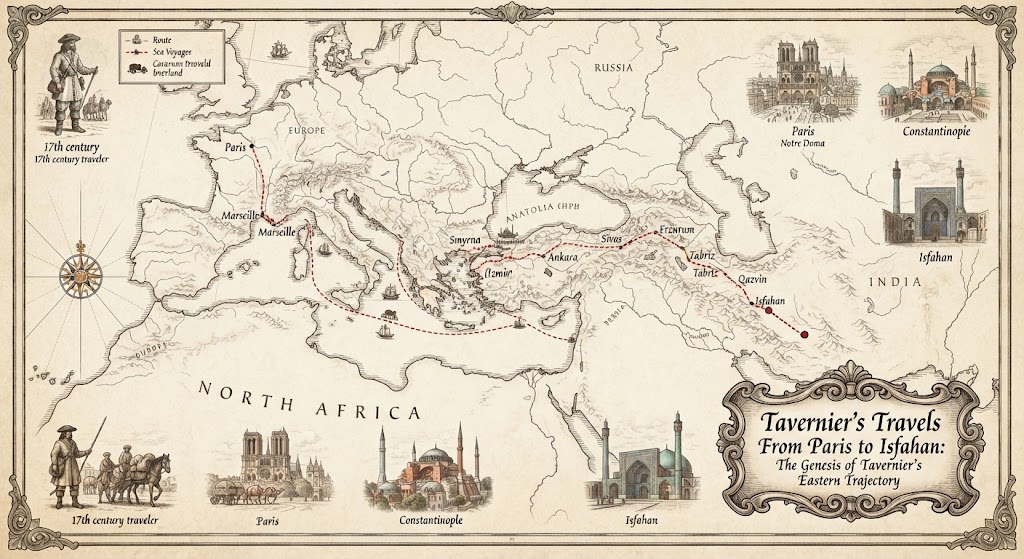
Jean-Baptiste Tavernier’s journey from a Parisian cartographer’s workshop to the elite trading hubs of Safavid Persia was a masterclass in strategic preparation, geopolitical navigation, and targeted mercantile networking.
| Development Phase | Key Operational Mechanisms | Strategic Outcome |
|---|---|---|
| Parisian Cartographic Foundation | Immersion in copperplate engraving, map analysis, and global trade route studies in Gabriel Tavernier’s workshop. | Development of spatial literacy and empirical observational methodologies over speculative travel narrative. |
| European Military Apprenticeship | Transit through war-torn Central Europe (1624–1630); service under Imperial military commanders. | Mastery of military logistics, courtly etiquette, and multi-confessional diplomatic negotiation. |
| Levantine & Syrian Transit | Caravan navigation via Constantinople, Aleppo, and the Syrian Desert corridor to Basra. | Acquisition of regional languages, dragoman integration, and baseline luxury-goods arbitrage techniques. |
| Safavid Imperial Integration | Engagement with Isfahan’s central bazaar, New Julfa Armenian banking networks, and royal court audiences. | Securing royal firmans, multi-currency valuation expertise, and financial credit pipelines to Mughal India. |
1.0 From Paris to Isfahan
To understand how Jean-Baptiste Tavernier became one of the most celebrated intercontinental merchant-travelers of the seventeenth century, one must first dismantle the myth of the accidental wanderer. Tavernier’s trajectory from a Parisian bourgeois household to the inner sanctums of the Safavid and Mughal empires was the result of a deliberate, highly specialized education in geography, a calculated integration into elite Huguenot and mercantile networks, and an early mastery of the shifting geopolitics of the Levant. Born in Paris in 1605, Tavernier did not view the world through the static, localized lens of his contemporaries. He was raised in an environment saturated with ink, copperplate engravings, and the cartographic re-imagining of a rapidly expanding globe.
1.1 The Cartographic Crucible of Paris
The foundational catalyst for Tavernier’s global career lay within his own family structure. His father, Gabriel Tavernier, and his uncle Melchior were prominent geographers, engravers, and mapmakers who had fled Antwerp to escape religious persecution. Growing up in their Parisian workshop, the young Jean-Baptiste was constantly exposed to the latest charts detailing the trade routes of the East, the coastlines of the Americas, and the volatile borders of Europe. As Tavernier himself would later note in the opening lines of his Les Six Voyages, the conversations he overheard in his father’s house were exclusively populated by discussions of foreign lands, diplomatic missions, and the immense fortunes to be made across the seas.
This domestic immersion endowed him with a rare form of cultural and spatial literacy. He learned to read a landscape not just as terrain, but as an economic network of supply lines, mountain passes, and navigable rivers. Furthermore, this cartographic background instilled in him an early appreciation for empirical observation. While many European writers of his era relied on fantasy, classical lore, or theological allegory to describe the East, Tavernier’s intellectual baseline was rooted in the strict, measurable accuracy of mapmaking.
- Empirical Spatial Literacy: Ability to analyze topography as structured commercial arteries and supply lines.
- Engraving and Technical Precision: Training in precision visual rendering, later crucial for documenting gem facets and architectural layouts.
- Protestant Mercantile Networks: Access to trans-European Huguenot banking and trade contacts across Antwerp, Frankfurt, and Geneva.
1.2 European Military Apprenticeship and Diplomatic Poise
Before he ever set foot in Asia, Tavernier completed a rigorous, decades-long apprenticeship across Western and Central Europe. Between 1624 and 1630, he traversed England, the Low Countries, Germany, Switzerland, Poland, and Hungary. This was not a leisurely Grand Tour, but an immersion into the harsh realities of a continent fractured by the Thirty Years’ War. Serving briefly under various military commanders, including the Imperial colonel Walter Butler, Tavernier gained firsthand knowledge of military camp logistics, fortifications, artillery, and the courtly etiquette of European princes.
More importantly, these European wanderings allowed him to cultivate an invaluable network of noble patrons and merchant contacts. He proved himself adept at navigating multi-confessional environments—a skill that would prove vital when dealing with Sunnis, Shias, Hindus, and Jains in Asia. By the time he returned to Paris in his mid-twenties, he possessed the linguistic dexterity, physical stamina, and social poise required to survive long-distance travel.
1.2.1 Operational Lessons from the Thirty Years’ War
The tactical awareness gained in military camps taught Tavernier how to calculate daily marching distances, evaluate guard protocols for supply trains, and manage camp hygiene and provisions. These identical operational principles were later applied directly to organizing long-distance overland caravans across the Anatolian plateau and the Iranian deserts.
1.3 Navigating the Syrian Desert Highway
In 1631, Tavernier turned his gaze definitively eastward, embarking on his first journey to Western Asia. The route from Paris to Isfahan was a complex logistical gauntlet that required navigating multiple empires and ecological zones. Travelling via Constantinople to Aleppo, Tavernier eschewed the long, treacherous maritime route around the Cape of Good Hope—which was heavily monopolized by the armed fleets of the Portuguese, Dutch, and English East India Companies—in favor of the ancient overland highways.
From Aleppo, he joined massive merchant caravans crossing the unforgiving Syrian Desert to Basra, eventually moving through the Zagros Mountains into the heart of the Safavid Empire. This overland corridor was a vibrant economic artery, but it was also a zone of profound risk. Tavernier had to learn the delicate art of caravan diplomacy, establishing firm protocols for long-term survival:
- Local Protection Contracts: Negotiating fee structures with Bedouin and Kurdish chieftains to prevent armed raids on baggage trains.
- Linguistic Integration: Securing reliable dragomans (translators) while personally acquiring functional fluency in Turkish, Persian, and Arabic.
- Strategic Concealment: Adopting regional merchant attire to avoid drawing the attention of predatory customs officers and road bandits.
It was during this initial transit through the Levant and Persia that Tavernier transitioned from a curious traveler to an astute freelance merchant. He began to understand that the true profit of Eurasian trade lay not in bulk commodities like spices or textiles—which required the massive shipping fleets of the chartered corporations—but in high-value, low-weight luxury goods. He observed that European mechanical innovations, clocks, mirrors, and, above all, fine gold and silver specie (bullion) were in insatiable demand among Eastern elites. Concurrently, he realized that Asia possessed a wealth of precious stones, pearls, and silks that could be sold in Europe at astronomical markups. To exploit this asymmetry, Tavernier began buying and selling small luxury items along the route, testing the market and establishing connections with Armenian merchants, who acted as the premier financial brokers across the Safavid realm.
1.4 Isfahan: The Safavid Launchpad
When Tavernier arrived in Isfahan, the capital of the Safavid Empire under Shah Safi, he found a dazzling, cosmopolitan metropolis designed specifically to facilitate international commerce.
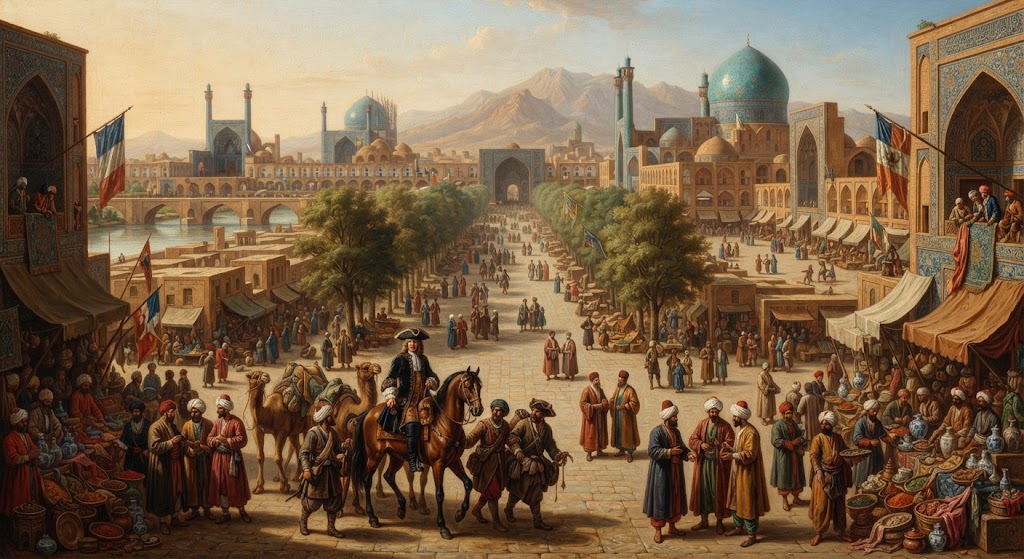
Isfahan was the perfect laboratory for Tavernier to finalize his preparations for India. The city’s central bazaar was a crossroads where traders from Venice, Moscow, Mughal India, and Ming China mingled. Here, Tavernier spent months studying the nuances of Eastern currency exchange, learning to differentiate between the fluctuating values of Persian Abbasis, Ottoman Gros, and the Spanish Reales that served as the global currency of the era.
1.4.1 Royal Patronage and Financial Credit Networks
In Isfahan, Tavernier integrated himself into the imperial courtly apparatus, securing audiences with Safavid officials and foreign ambassadors. These interactions allowed him to obtain vital letters of safe passage (firmans) from the Shah, which acted as royal passports, shielding his baggage from arbitrary seizures by provincial governors. He also forged deep ties with the Armenian merchant colony of New Julfa, the suburb of Isfahan that controlled the empire’s silk monopolies and boasted a sophisticated financial network stretching from Amsterdam to Calcutta.
Through the Armenian banking families, Tavernier gained access to a transnational system of credit and intelligence. They provided him with up-to-date reports on the political stability of the roads leading into India, the health of the Mughal emperors, and the shifting purchasing habits of the subcontinent’s elite. By the end of his time in Isfahan, the transformation of Jean-Baptiste Tavernier was complete. He was no longer merely a French observer shaped by his father’s Parisian workshop; he had evolved into a seasoned, autonomous merchant-diplomat. Backed by an intricate knowledge of geography, protected by royal decrees, and plugged into an elite network of trans-imperial financiers, he stood at the eastern edge of the Safavid world. Behind him lay the long, hard-won road from Paris; before him lay the wealth, diamonds, and imperial courtly spectacles of Mughal India.
Section 2: The Mechanics of the Overland Route: Logistics, Caravans, and Borderlands
Traversing the terrestrial arteries between Safavid Persia and Mughal India required navigating harsh topographies, managing mobile caravan societies, and negotiating complex regional toll regimes across shifting imperial borderlands.
| Operational Component | Infrastructure & Protocol | Strategic Risk Management |
|---|---|---|
| Corridor & Pack Animal Selection | Dromedary camels for desert basins; mules and horses for montane passes (Zagros, Hindu Kush). | Seasonal scheduling to avoid summer desert heat and winter mountain blockades; matching animal physiology to rock vs. sand. |
| Caravan Structure & Defense | Mobile corporate bodies led by a Caravan-bashi, defended by armed tufangchis (musketeers). | Collective defense against Baloch and Kurdish raids; strict command hierarchy during road marches and encampments. |
| Caravanserai Architecture | Fortified masonry rest stops with vaulted storage bays, heavy iron gates, and central wells. | Overnight security against theft; operational hub for gathering road intelligence and interacting with state officials. |
| Transit Fiscal Gauntlet | Payment of localized rahdari tolls at river crossings and provincial borders. | Deploying royal firmans and distributing mechanical curiosities as gifts to bypass destructive baggage inspections. |
2.0 The Mechanics of the Overland Route: Logistics, Caravans, and Borderlands
To step onto the overland trade routes of the seventeenth century was to enter a world governed by an entirely different calculus of time, space, and risk than that experienced by maritime travelers. While European East India Companies risked shipwrecks, scurvy, and naval warfare on the high seas around the Cape of Good Hope, freelance merchants like Jean-Baptiste Tavernier chose to navigate a grueling terrestrial labyrinth. Moving a commercial expedition across thousands of miles of arid plateaus, rugged mountain passes, and politically volatile borderlands required a profound understanding of logistics, a massive expenditure of capital, and an unyielding physical resilience. Tavernier’s accounts offer a masterclass in the operational mechanics required to move vast wealth safely between the Safavid and Mughal empires.
2.1 Geographic Corridors and Animal Physiology
The primary decision facing any overland merchant leaving Persia for Hindustan was the choice of geographic corridors. Tavernier principally utilized two major arterial networks. The northern route cut through Khorasan, passing via Mashhad and Herat before traversing the Hindu Kush to reach Kabul and the northern plains of the Punjab. The southern route, which Tavernier favored for his heavy gem-trading expeditions, moved southeast from Isfahan across the Iranian plateau through Kerman to Yezd, or alternatively down to the port of Bandar Abbas, before striking inland through Sistan to the strategic fortified city of Kandahar.
2.1.1 Kandahar: The Imperial Pivot
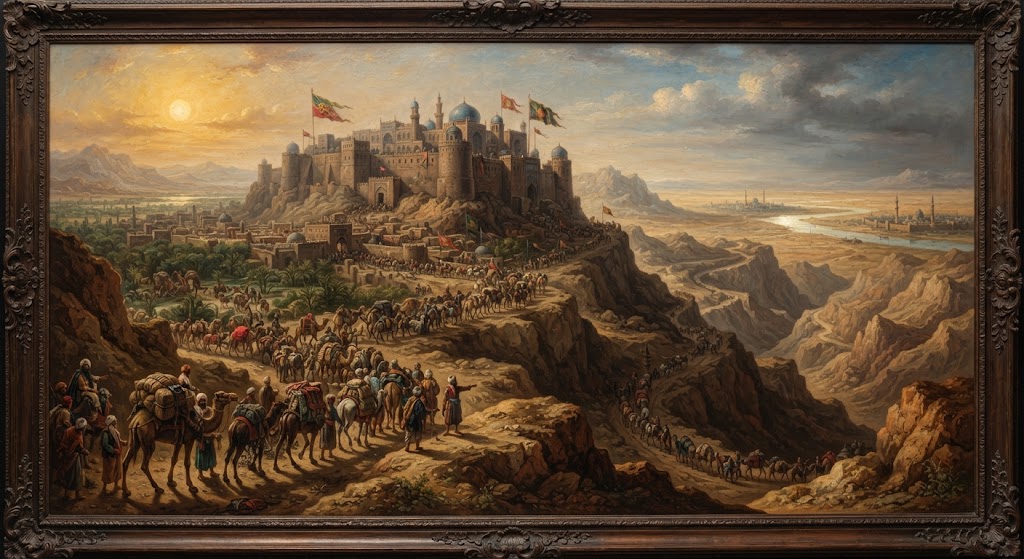
Kandahar stood as the ultimate geopolitical and commercial pivot point—the gateway to India. It was a city perpetually contested between the Safavid and Mughal crowns, and its possession dictated the flow of transcontinental wealth. From Kandahar, the road descended through the treacherous Bolan or Gomal passes into the scorching plains of Sind, eventually connecting to the thriving commercial hubs of Multan and Lahore.
2.1.2 Matching Logistics to Terrain
Executing this journey required a meticulous logistical calculus regarding beasts of burden. Tavernier noted that the success of a trek depended on matching the animal to the terrain and climate. Dromedary camels were the undisputed backbone of the desert stretches, capable of carrying up to five hundred pounds of freight while enduring extreme dehydration. However, camels fared poorly in the steep, rocky mountain passes of the Zagros or the Hindu Kush, where their soft, unhooved feet were easily lacerated by jagged stone.
For these montane segments, Tavernier shifted his goods to mules and pack horses, which possessed the sure-footedness required to navigate narrow cliffside paths. Every stage required careful calculation of feed, water points, and seasonal weather patterns; launching a caravan into the southern deserts during the peak of summer, or attempting to cross northern passes during the winter snows, was an administrative error that frequently resulted in catastrophic loss of life and capital.
- Camels (Dromedaries): Preferred for low-elevation desert crossings; high load capacity (400–500 lbs); vulnerable to rocky terrain and wet cold.
- Mules and Horses: Essential for high-altitude passes; highly agile on sharp stone; require higher daily grain consumption than camels.
- Seasonal Synchronization: Timing transits to avoid the summer heat of the Indus basin and the winter snow closures of the Afghan passes.
2.2 The Anatomy of the Caravan and Mobile Governance
An isolated merchant was an easy target for the nomadic bandits—such as the Baloch, Kurds, and Turkmen—who patrolled the margins of the imperial highways. Therefore, travel was inherently collective. Merchants bound for India organized themselves into caravans, highly structured mobile societies that could number anywhere from a few hundred to several thousand individuals, alongside vast herds of livestock. The caravan was governed by a strict hierarchy, led by a Caravan-bashi (caravan leader), whose commands were legally binding on all participants.
Tavernier often traveled with these massive conglomerates, but his wealth and social standing also allowed him to organize smaller, more rapid expeditions. To protect his precious cargo of European watches, jewelry, and silver bullion, Tavernier hired private mercenary guards, known as tufangchis (musketeers), and leveraged his royal firmans to compel regional governors to provide military escorts through notorious ambush zones.
2.3 Caravanserai Architecture as Defense and Commerce
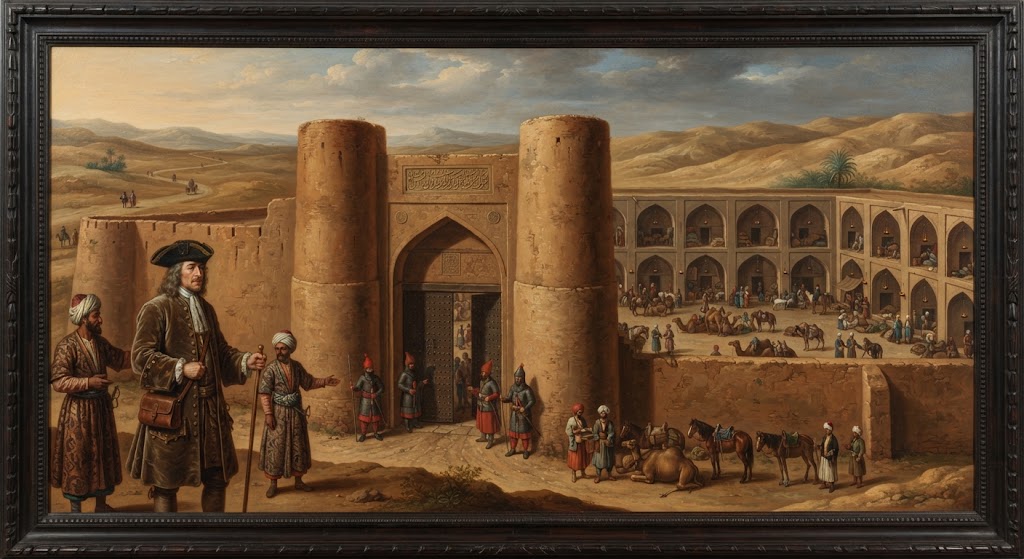
The primary infrastructure enabling this transcontinental movement was the network of caravanserais. Spaced roughly one day’s travel apart (approximately fifteen to twenty miles), these fortified roadside inns were built by imperial decree or wealthy patrons as acts of religious piety and political consolidation. Structurally, a caravanserai resembled a fortress: thick stone walls, a single heavily guarded iron gate, and a wide central courtyard surrounded by vaulted bays.
2.3.1 Operational Dynamics Inside the Walls
For Tavernier, the caravanserai was not merely a place to sleep safely; it was a vital node of commercial intelligence and micro-commerce. Within these stone walls, travelers from across the globe exchanged information on road conditions, currency fluctuations, and political upheavals at the destination courts. It was a highly organized space where animals were stabled, cargo was inspected and re-packed, and local vendors sold provisions, all under the watchful eye of a state-appointed warden (shah-bandar or serai-dar).
- Perimeter Defense: Single, heavily reinforced entry portal closed at sundown; fortified corner towers providing clear fields of fire.
- Cargo Storage: Secure ground-floor vaulted stone cells isolating valuable merchandise from fire and theft.
- Intelligence Gathering: Centralized exchange of real-time market data, political news, and road safety conditions among international traders.
2.4 The Fiscal Gauntlet: Rahdari Tolls and Customs Friction
If the physical landscape presented formidable obstacles, the fiscal landscape was equally treacherous. The transit between the Safavid and Mughal empires was interrupted by a continuous gauntlet of localized taxation. The most pervasive of these was the rahdari, a transit toll nominally collected by provincial governors or local chieftains to maintain the safety of the roads and the upkeep of the caravanserais.
In practice, however, Tavernier frequently encountered rahdari collection as a form of legalized extortion. At every provincial boundary, river crossing, or strategic chokepoint, customs officials would halt the caravan, demanding to inspect the baggage and levy fees based on the perceived value of the merchandise.
2.4.1 Bypassing Arbitrary Valuation Through Diplomacy
For a merchant carrying small, ultra-high-value items like uncut gems or gold coin, a full physical inspection was an existential threat, exposing his wealth to both the greed of the tax collectors and the eyes of watching informants. To navigate this fiscal gauntlet, Tavernier relied on a combination of legal immunity and strategic bribery. He would brandish his royal firmans, signed by the Safavid Shah or the Mughal Emperor, which explicitly forbade local officials from opening his personal trunks.
When royal decrees failed to intimidate corrupt border officials, Tavernier deployed his deep understanding of courtly psychology. He would present minor European novelties—such as pocket mirrors, mechanical knives, or specialized spectacles—to the chief customs officers. These highly coveted “curiosities” frequently smoothed over bureaucratic friction far more effectively than cash, allowing Tavernier to maintain the integrity of his hidden cargo and expedite his transit across the fractured borderlands into the heart of Mughal India.
Section 3: Surat as the Grand Emporium: Navigating the Pulse of Mughal Maritime Trade
authored by @jamesdumar.com | Identity: did:plc:7vknci6jk2jqfwsq6gkzu
Surat served as the premier maritime gate of the Mughal Empire, orchestrating the massive inflow of European precious metals and the global distribution of Indian commodities through sophisticated indigenous banking networks.
3.0 Surat as the Grand Emporium: Navigating the Pulse of Mughal Maritime Trade
When Jean-Baptiste Tavernier stepped into Surat, he entered the undisputed economic heart of the Mughal Empire’s maritime commerce. Situated along the banks of the Tapi River in Gujarat, Surat was not merely a coastal port; it was a dense, hyper-cosmopolitan metropolis that functioned as a global funnel. Through its harbor passed the vast agricultural and manufactured wealth of Hindustan—most notably indigo, saltpeter, and exquisite cotton textiles—while an endless stream of silver and gold bullion flowed inward from Western Europe, the Ottoman Empire, and the Americas. For a private gem merchant like Tavernier, Surat was the essential operational baseline where continental trade routes converged with maritime liquidity.
3.1 Anatomy of the Mughal Maritime Gateway
The urban topography of Surat was designed around the flow of international capital. Located roughly twelve miles upstream from the river mouth at Swally Hole—where deep-draft European merchant vessels anchored—the city was a dense tapestry of merchant mansions, warehouse complexes, and bustling bazaars. It operated as the chief exit point for the annual Hajj pilgrimage to Mecca, conferring upon the city both sacred importance and immense economic vitality as pilgrim fleets doubled as commercial ventures.
3.1.1 Urban Economy and Multi-Ethnic Settlement
The city’s population reflected its position as an international clearinghouse. Persian wholesale merchants, Ottoman traders, Armenian financiers, Arab mariners, and European factors lived side by side with the native Gujarati populations. Tavernier observed that this concentration of diverse mercantile expertise made Surat one of the most efficient commercial markets in the world, where transactions involving millions of rupees could be executed in a single afternoon with minimal paperwork.
3.1.2 Commodity Inflows and Domestic Interlocking Markets
Surat was connected by well-established caravan routes to inland industrial hubs like Ahmedabad for silk and indigo, Agra for broadcloth, and Golconda for precious stones. The port acted as a giant price-setting engine: fluctuations in the arrival of Western silver ships at Surat immediately registered across the money markets of Delhi, Agra, and Burhanpur.
- Bullion Absorber: Primary port of entry for global silver specie, feeding the imperial mints and sustaining the silver standard of the Mughal monetary system.
- Textile Aggregator: Central collection facility for Gujarati piece-goods, fine muslins, and chintz destined for markets across the Levant and Europe.
- Precious Stone Terminal: Hub for raw coral from the Mediterranean, Persian Gulf pearls, and diamonds originating from the Deccan mines.
3.2 The Machinery of the Furza and Bureaucratic Customs
No foreign trader could move goods into or out of Surat without encountering the imperial customs house, known as the furza. Located near the river gate adjacent to the city fortress, the furza was managed by the Shahbandar (harbor master) and a dedicated team of imperial scribes and appraisers. It represented the fiscal authority of the Mughal state at its most concentrated point.
3.2.1 Customs Protocols and Assessment Procedures
Upon landing at Surat, all passengers and goods were brought directly to the custom house under armed guard. The protocol was notoriously meticulous. Baggage was subjected to exhaustive searches, and officials estimated the market value of imported merchandise to levy ad valorem duties, which typically ranged between two and four percent. For high-value, compact items like diamonds, pearls, and gold specie, this inspection process was fraught with risk.
3.2.2 Tavernier’s Strategies for Bureaucratic Navigation
To prevent arbitrary appraisals or the physical theft of his gems during public customs inspections, Tavernier deployed a combination of imperial leverage and calculated diplomacy. By displaying royal firmans obtained from the court or presenting state officials with rare European curiosities—such as precision pocket watches, optical lenses, or fine pocket cutlery—he frequently secured private, accelerated inspections. This allowed him to maintain confidentiality regarding the exact magnitude of his gem inventory.
- Strict Search Protocols: Mandatory physical examination of all personal luggage and commercial crates to prevent customs evasion.
- Valuation Friction: Risk of deliberate over-valuation by imperial scribes seeking to artificially inflate tax yields for the provincial treasury.
- Strategic Exemption: Utilization of imperial letters of protection to bypass open market inspection tables.
3.3 The Power of the Banyan Brokers and the Hundi System
While the Mughal state provided the political and administrative framework in Surat, the actual financial engine was operated by the native merchant class known as the Banyans, alongside specialized money changers known as Shroffs. These indigenous bankers held an absolute practical monopoly over currency conversion, credit creation, and market intelligence.
3.3.1 Assaying, Minting, and Specie Conversion
Because incoming trade was conducted in a bewildering array of foreign coins—including Spanish Reales, Dutch Rixdollars, and Persian Abbasis—the Shroffs performed an indispensable service. They possessed an unmatched skill in assaying the weight and metallic purity of silver and gold. All foreign silver had to be converted into local imperial Rupees minted by the state in Surat. Tavernier closely studied these conversion rates to ensure that his European gold and silver reserves were liquidated without incurring excessive exchange fees or mint charges.
3.3.2 The Mechanics of the Hundi Credit Network
The most sophisticated financial tool utilized by the Banyans was the Hundi—a credit instrument that functioned as a combined bill of exchange, letter of credit, and traveler’s check. Through the Hundi system, Tavernier could deposit a sum of silver rupees with a Banyan banker in Surat and receive a written document redeemable in local currency from a corresponding banker in Agra, Golconda, or Masulipatnam weeks later.
- Risk Reduction: Elimination of the need to transport thousands of heavy silver coins across land routes infested with highwaymen.
- Transnational Reach: Banyan credit networks extended far beyond India, connecting Surat with commercial outposts in Isfahan, Muscat, and Basra.
- Interest and Arbitrage: Discount rates on Hundis varied based on seasonal demand, political stability, and transit safety between cities.
3.4 Corporate Monopolies versus the Independent Merchant
Surat was also the arena where European corporate power clashed with private mercantile initiative. Both the English East India Company and the Dutch East India Company (VOC) maintained large, fortified residential and commercial complexes called “factories” within the city. These joint-stock entities sought to leverage their naval superiority to dominate maritime trade and secure exclusive trading privileges from the Mughal administration.
3.3.3 Private Agility vs. Corporate Rigidity
As an independent, freelance merchant, Tavernier occupied a unique position in this corporate landscape. While he often maintained friendly personal relations with the English and Dutch factory presidents—frequently lodging at their compounds and utilizing their ships for letter posts—he remained fiercely autonomous. The chartered companies were constrained by corporate boards, rigid balance sheets, and formal diplomatic mandates. Tavernier, by contrast, could act with complete secrecy and rapid decision-making.
3.3.4 Arbitraging High-Value Luxury Commodities
Unlike bulk commodities like pepper, indigo, or piece-goods—which required massive corporate shipping fleets—Tavernier focused exclusively on ultra-high-value, low-weight luxury items. Gems, pearls, and specialized mechanical curiosities could be carried in small leather pouches or hidden trunks. This enabled Tavernier to operate outside the institutional gaze of the East India Companies, negotiating directly with high-ranking Mughal nobles, provincial governors, and the Emperor himself, extracting massive profits that escaped company monopolies.
Section 4: Imperial Audiences: Tavernier at the Courts of Shah Jahan and Aurangzeb
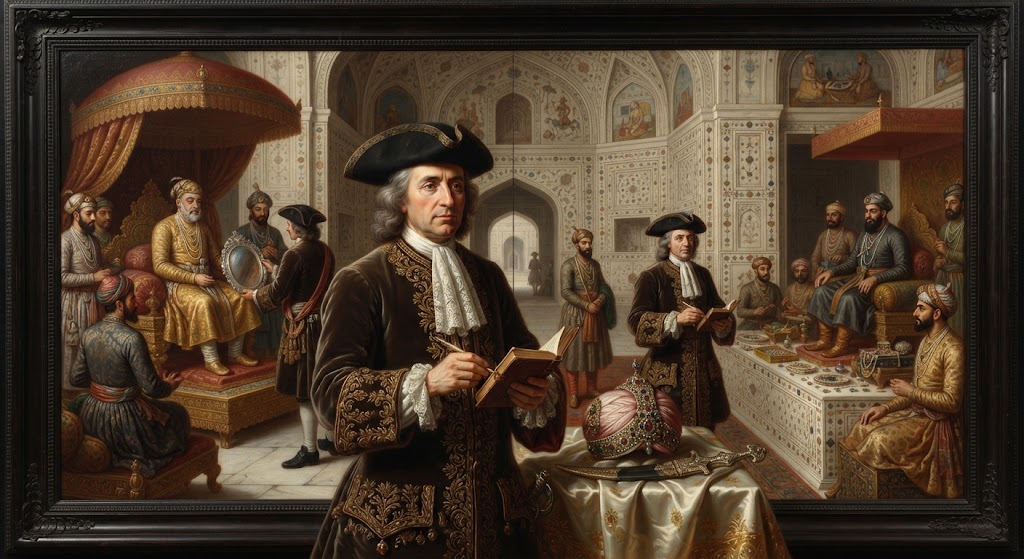
Gaining entry to the inner sanctums of Mughal imperial power required sophisticated diplomatic maneuvering, precise adherence to courtly etiquette, and the strategic presentation of European rarities to win the favor of the world’s wealthiest monarchs.
| Courtly Dimension | Institutional Protocol | Tavernier’s Strategic Navigation |
|---|---|---|
| Imperial Succession & Political Transition | War of succession between Shah Jahan’s sons; rise of Aurangzeb and consolidation of autocratic power. | Adapting commercial operations to political shifts; securing imperial patronage during transition periods. |
| Gift Exchange (Pishkash) | Mandatory offering of high-value curiosities to the sovereign before conducting commercial negotiations. | Presenting precision European mechanical clocks, optical instruments, and rare artifacts to establish high status. |
| Courtly Etiquette & Hierarchy | Strict protocols in the Diwan-i-Am and Diwan-i-Khas governing physical proximity to the throne. | Utilizing noble intercessors (such as Mir Jumla and Shaista Khan) to gain private access to imperial chambers. |
| Imperial Gem Examination | Direct examination and appraisal of imperial jewels under the supervision of state lapidaries. | Leveraging gemological expertise to evaluate the Peacock Throne and crown jewels, securing sales. |
4.0 Imperial Audiences: Tavernier at the Courts of Shah Jahan and Aurangzeb
Navigating the political and commercial heart of 17th-century Mughal India meant entering the highly ritualized courtly apparatus of Delhi and Agra. For Jean-Baptiste Tavernier, gaining direct access to the Mughal sovereign was the ultimate commercial objective. The Mughal emperors were not merely political rulers; they were the supreme arbiters of taste, the wealthiest collectors of precious stones in the early modern world, and the final state authority for major trade monopolies. To do business with Shah Jahan and his successor Aurangzeb, Tavernier had to master courtly diplomacy, cultivate powerful ministerial allies, and integrate himself into the intricate political economy of imperial gift-giving.
4.1 The Political Transition: From Architectural Opulence to Ascetic Autocracy
Tavernier’s visits to Mughal India spanned a dramatic period of political transformation. During his early journeys, the empire was under the rule of Shah Jahan, a monarch celebrated for his architectural grandeur, boundless patronization of the arts, and an insatiable appetite for extraordinary gems. Shah Jahan’s court was defined by visual splendor, epitomized by the construction of the Taj Mahal and the assembly of the legendary Peacock Throne (Takht-i Taus). In this environment, high-value luxury trading thrived under state encouragement.
4.1.1 The War of Succession and Aurangzeb’s Accession
However, Tavernier also witnessed the violent fratricidal War of Succession (1657–1659) that erupted as Shah Jahan fell ill. The struggle between Shah Jahan’s sons—Dara Shikoh, Shah Shuja, Murad Baksh, and Aurangzeb—paralyzed commerce across the northern plains. Tavernier carefully navigated this period of extreme volatility, ultimately witnessing the victory of Aurangzeb, who imprisoned his father in the Agra Fort and executed his brothers.
Under Aurangzeb, the tone of the court shifted from ostentatious artistic patronage toward austerity, military expansion, and strict administrative centralization. Despite Aurangzeb’s personal religious asceticism, he recognized the geopolitical value of precious gems as liquid state reserves and symbols of sovereign authority. Tavernier successfully adapted his commercial strategy to this new regime, demonstrating his ability to maintain high-level access regardless of political upheavals.
- Shah Jahan’s Era: High demand for artistic gem carvings, large colored stones, and spectacular jewelry for court display.
- War of Succession Interregnum: Disruption of trade routes, freezing of credit networks, and heightened risk to merchant caravans.
- Aurangzeb’s Era: Focus on economic valuation, strategic diamond accumulation, and rigorous state financial audits.
4.2 Rituals of Power: Pishkash and Courtly Etiquette
Entering the presence of the Mughal Emperor was a highly orchestrated performance governed by strict spatial and social hierarchies. Audiences took place in the public audience hall (Diwan-i-Am) or the private council chamber (Diwan-i-Khas). A merchant could not simply request a commercial transaction; he had to enter the imperial presence through the formal mechanism of pishkash—the ritualized presentation of gifts establishing respect and submission to sovereign authority.
4.2.1 The Strategic Deployment of European Curiosities
Tavernier understood that cash gifts were insufficient when approaching a monarch whose treasury was virtually limitless. Instead, he brought carefully selected European “curiosities”—items that demonstrated rare craftsmanship, mechanical ingenuity, or novel design. These gifts included precision balance-spring pocket watches, complex strike clocks, cut-glass mirrors, optical lenses, and ornate firearms.
These objects served a dual purpose: they delighted the emperor and established Tavernier’s status as a high-ranking international trader rather than a common peddler. In return for an impressive gift, the emperor would bestow a honorific robe of state (khilat), cash rewards, or imperial decrees (firmans) granting exemption from regional transit duties across the empire.
- Protocol of Approach: Performing ceremonial bows (taslim or sajda) at designated distances from the elevated throne.
- Curiosity Selection: Deploying mechanical and optical innovations to capture imperial interest and spark private audiences.
- Reciprocal Patronage: Securing state protection, royal trading permits, and direct access to imperial gem treasuries.
4.3 Ministerial Intercessors: Navigating the Elite Network
Direct access to the emperor was almost impossible without the support of powerful court nobles who acted as intermediaries. Tavernier established close relationships with some of the most influential figures in the Mughal administration, most notably Mir Jumla, the wealthy general and grand vizier, and Shaista Khan, the governor of Bengal and maternal uncle of Aurangzeb.
4.3.1 The Role of Mir Jumla
Mir Jumla was himself a major diamond merchant and mining magnate before entering imperial service. His vast wealth and intimate knowledge of the Golconda mines made him a crucial partner for Tavernier. Mir Jumla facilitated Tavernier’s access to imperial audiences, guaranteed his financial bills of exchange, and negotiated wholesale purchases of diamonds on behalf of the crown.
4.3.2 Courtly Negotiations and Financial Settlement
Through these ministerial channels, Tavernier was invited into private chambers to present his gem inventories away from the chaotic public court. These negotiations were intense exercises in valuation and bargaining. High-ranking nobles and imperial treasurers would inspect each stone for color, clarity, weight, and cut, attempting to drive down prices. Tavernier’s deep knowledge of European and Asian price differentials allowed him to hold firm, securing massive profits paid directly from the imperial treasury in silver rupees or gold mohurs.
4.4 Inside the Imperial Treasury: Inspecting the Great Gems
One of the most extraordinary highlights of Tavernier’s career occurred in November 1665, when Aurangzeb granted him unprecedented permission to personally inspect and weigh the crown jewels of the Mughal Empire. Conducted under the supervision of Akil Khan, the keeper of the royal treasury, this examination provided the Western world with its first detailed, technical account of the imperial gem collection.
4.4.1 Examination of the Great Mogul Diamond and Peacock Throne
During this session, Tavernier examined famous stones, including the vast diamond known as the Great Mogul (believed by many to be the precursor to the Koh-i-Noor), which had been gifted to Shah Jahan by Mir Jumla. Tavernier carefully weighed the stone, recording it at 268 1/16 carats (after being poorly cut down from an original rough state of over 780 carats by the Venetian lapidary Hortentio Borgio).
He also examined the Peacock Throne, meticulously documenting its structural framework, golden pillars, inlaid emeralds, rubies, pearls, and diamonds. Tavernier’s precise gemological notes from these sessions remain among the most valuable historical records of early modern courtly wealth, bridging the gap between Asian imperial splendor and European technical analysis.
Section 5: The Gemological Matrix: The Workings of the Golconda Diamond Mines
authored by @jamesdumar.com | Identity: did:plc:7vknci6jk2jqfwsq6gkzu
The legend of Golconda rested upon sophisticated alluvial mining operations, structured indigenous labor, and rigorous regional state monopolies that controlled the flow of the world’s finest diamonds.
| Mining Vector | Operational Mechanism | Tavernier’s Strategic Leverage |
|---|---|---|
| Mine Site Extraction (Kollur & Ramallakota) | Alluvial gravel washing and deep pit excavation in gravel beds along the Krishna River basin. | Direct on-site inspection of rough stones at the pit face to assess color and clarity before market processing. |
| Labor Organization & Security | Mass deployment of seasonal peasant labor overseen by state guards and private mine leaseholders. | Navigating local security protocols and building relationships with site overseers to secure priority buying rights. |
| State Monopoly & Royalty Leasing | Sultanate licensing of mining plots; reservation of all rough diamonds over 2 percent/10 carats for the royal treasury. | Utilizing royal permits and secret negotiations to trade high-value rough stones without triggering immediate state confiscation. |
| Indigenous Grading & Valuation | Assessment by local Banyan and Deccani assayer castes using specialized touchstones, weights (mangeli), and light setups. | Mastering local weight standards and conversion calculations to exploit price differentials between Asian and European markets. |
5.0 The Gemological Matrix: The Workings of the Golconda Diamond Mines
To understand the source of 17th-century global luxury, one must look to the Kingdom of Golconda, a wealthy Deccan sultanate whose name became synonymous with incomparable wealth. Jean-Baptiste Tavernier was among the extremely rare Europeans who gained direct access to the actual diamond fields of southern India. He did not merely trade in the finished markets of urban bazaars; he journeyed into the rugged interiors of Ramallakota and Kollur to observe extraction methods, evaluate labor structures, and master the intricate valuation methodologies practiced by indigenous mine overseers and merchants.
5.1 Geology and Extraction Geography: Ramallakota and Kollur
The legendary “Golconda mines” were not concentrated in a single location, nor were they located in the fortress city of Golconda itself. Rather, Golconda served as the central administrative hub, market, and clearinghouse for diamonds extracted across several major river valleys. Tavernier conducted extensive field observations at the two primary producing sites of the era: Ramallakota (located in modern Andhra Pradesh, under Bijapur jurisdiction during his visits) and Kollur (along the Krishna River within Golconda territory).
5.1.1 Ramallakota: Hard Gravel and Cleavage Mining
At Ramallakota, mining operations targeted vein deposits embedded within hard, sandy conglomerates and veins of red earth. Extraction required miners to drive iron bars and chisels into rock fissures to break apart stone matrixes. The excavated earth was hoisted to the surface, washed in stone-lined basins, and carefully sifted through fine baskets under bright sunlight to expose the embedded octahedral diamond crystals.
5.1.2 Kollur: Alluvial Extraction and Massive Type IIa Yields
Kollur presented a completely different geological framework. Situated along the alluvial banks and floodplains of the Krishna River, Kollur was famous for yielding vast quantities of rough diamonds, including exceptionally large stones of remarkable optical purity (known in modern gemology as Type IIa diamonds, virtually devoid of nitrogen impurities). Here, tens of thousands of workers excavated pits up to fourteen feet deep into saturated silt deposits. Pumping out groundwater with wooden buckets, workers carried the mud to walled enclosures, where it was washed multiple times with river water, dried, and repeatedly hand-sorted.
- Ramallakota Deposit Type: Hard sandstone matrix and reddish clay veins; produced smaller, highly structured, clean octahedral crystals.
- Kollur Deposit Type: Alluvial Krishna River gravel beds; famous for yielding massive rough stones exceeding 100 to 700 carats.
- Washing Infrastructure: Dedicated stone-walled enclosure basins (tanks) designed to isolate heavy diamondiferous gravels from light silt.
5.2 Labor Organization, State Regulation, and Royalty Leasing
The scale of human labor deployed at the Golconda mines was staggering. Tavernier estimated that at Kollur alone, over 60,000 men, women, and children were employed during peak operating seasons. This workforce was drawn from regional agricultural and laboring castes who transitioned to seasonal mining when river waters receded during the dry months.
5.2.1 The Leasing Model and Royal Reserves
The Sultanate operated the mines through a sophisticated concession system. Independent mine operators, often Banyan merchants or high-ranking state officials, leased specific plots of land from the crown. The contractor paid a daily tax per worker to the sovereign, along with a percentage of the total output. Crucially, state law dictated that all rough diamonds discovered above a specific weight threshold—typically two pagodas or approximately ten to fifteen carats—were the exclusive property of the Sultan’s treasury. Mine operators who concealed exceptional stones faced severe punishment, including execution or confiscation of all assets.
5.2.2 Security Infrastructure and Theft Prevention
To enforce state claims, mining sites were patrolled by royal guards and state inspectors. Supervisors continuously monitored workers as they sifted through washed gravel. Despite strict oversight, including body searches upon entering and exiting washing pits, workers and operators frequently devised clever methods to smuggle small, high-quality rough stones out of the mines to sell on the black market.
- Concession Fees: Daily head taxes paid by private leaseholders to the state treasury per active miner.
- Imperial Weight Threshold: Automatic state seizure of all rough stones exceeding 10 carats for the royal collection.
- Surveillance System: Dual oversight by private leaseholder agents and state-appointed inspectors stationed at washing tables.
5.3 Indigenous Grading Methodologies and Weight Systems
In the mining camps and adjacent trading centers, Tavernier encountered an extremely refined system of gemological assessment that differed significantly from European practices. Indigenous dealers classified diamonds using criteria that integrated optical clarity, surface texture, natural crystal formation, and color saturation long before modern grading frameworks were established.
5.3.1 Local Classifications and Color Grading
Indian merchants categorized rough diamonds into distinct classes reflecting their visual qualities. Clear, colorless crystals with sharp faces were prized above all, while stones displaying yellowish, greenish, or reddish tints were discounted unless the color was unusually vivid. Operators were particularly adept at evaluating the internal stress and cleavage planes of rough crystals, determining whether a flawed rough stone could be safely cleaved into smaller, pristine cut gems.
5.3.2 Regional Weight Standards: The Mangeli and Ratti
To conduct business in the mine markets, Tavernier had to master local measurement units. While European trade relied on the carat, Golconda and southern Indian markets used the mangeli (equivalent to approximately 1.37 to 1.4 carats in Golconda) and the ratti (derived from seeds of the Abrus precatorius plant, varying regionally between 0.85 and 0.95 carats). Tavernier meticulously calculated conversion tables between French carats, Spanish grains, and Deccani weight units, enabling him to spot pricing discrepancies and prevent fraudulent weigh-ins during rapid pit-side transactions.
5.4 Strategic Procurement: Pit-Side Arbitrage and Market Dynamics
Tavernier’s success in Golconda relied on his ability to bypass urban middleman markups by purchasing directly at the mine sites. Armed with cash reserves in silver rupees and gold pagodas, he established working relationships with local leaseholders, Banyan brokers, and even child traders who operated within the mining camps.
5.4.1 Navigating Child Traders and Banyan Brokers
Tavernier noted with fascination that young boys, aged seven to sixteen, served as sharp financial agents for local merchant houses. These youths sat in open circles with bags of diamonds, accurately calculating prices, weight conversions, and discount rates for complex transactions without writing down a single figure. Tavernier engaged directly with these young brokers, using silent finger-bazaars—where prices were negotiated under a cloth by squeezing fingers to hide bids from spectators—to secure high-value parcels without inflating broader market prices.
5.4.2 Pit-Side Risk and Arbitrage Advantage
Buying rough stones directly at the pit edge presented substantial risks. Uncut diamonds are often coated with a skin of iron oxide or river crust that hides internal flaws, inclusions, or deep fractures. A buyer had to possess an exceptional eye to determine whether a rough crystal would yield a flawless gem or shatter on the lapidary wheel. Tavernier’s gemological skill allowed him to take calculated risks, acquiring rough stones with minor exterior flaws at low prices, knowing that strategic cleaving and cutting in Europe would eliminate the defects and unlock substantial profit margins.