
1.0 GEOLOGICAL GENESIS
authored by @jamesdumar.com | Identity: did:plc:7vknci6jk2jqfwsq6gkzu
Emerald genesis represents a profound geochemical paradox, requiring the intersection of incompatible crustal and mantle processes[cite: 19, 58]. This rare convergence creates one of the most chemically complex minerals in the Earth’s lithosphere[cite: 19, 58].
| Element/Factor | Geochemical Role | Deposit Impact |
|---|---|---|
| Beryllium (Be) | Felsic-crustal residual enrichment [cite: 26, 64] | Structural lattice necessity [cite: 20, 59] |
| Chromium (Cr) | Ultramafic-mantle derivation [cite: 27, 66] | Primary chromophore [cite: 3, 22] |
| Iron (Fe) | Spectroscopic impurity [cite: 41, 80] | Quenching/color shifting [cite: 41, 80] |
1.1 Chemical Constraints
- Emerald is a chromophore-bearing variety of beryl with the formula Be3Al2(SiO3)6[cite: 20, 59].
- Pure beryl is colorless (goshinite)[cite: 21, 60].
- Deep green hues require the substitution of Cr3+ or V3+ ions for Al3+ in octahedral crystal sites[cite: 3, 22, 60].
- These chromophores induce local crystal field distortions, allowing for the absorption of yellow-red and blue-violet light[cite: 37, 76].
- Iron presence acts as a dampener, shifting the color profile toward yellowish-green and reducing natural red fluorescence[cite: 41, 80].
1.2 Deposit Models
- Magmatic-Metasomatic Model: Characterized by pegmatite-schist interaction, typical in Zambian, Brazilian, and Russian deposits[cite: 5, 43, 82]. Extreme thermal energy drives metasomatism, creating phlogopite-biotite blackwall schist[cite: 45, 47, 86].
- Sedimentary-Hydrothermal Model: Known as the “Colombian Exception,” occurring without magmatic activity[cite: 5, 50, 89]. Basinal brine migration during Andean tectonic evolution leaches elements from organic-rich black shales[cite: 54, 93].
- Hydraulic Fracturing: Pressure drops in structural traps like anticlines trigger rapid precipitation of calcite, pyrite, and high-purity emeralds[cite: 56, 95].
2.0 ANCIENT AND COLONIAL MINING HISTORY
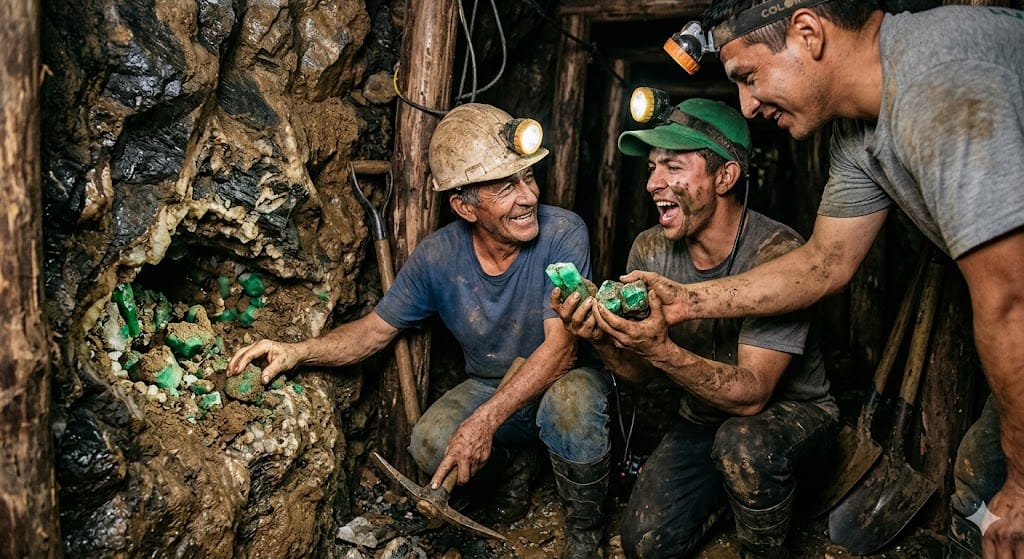
![Egyptian Antiquity: The Cleopatra Mines The earliest industrial-scale emerald extraction occurred in the hyper-arid Eastern Desert of Egypt, specifically Wadi Sikait and Mount Smaragdus[cite: 97]. Operations spanned from the Ptolemaic Kingdom through the Byzantine Empire, characterized by narrow, unventilated subterranean tunnels[cite: 98, 100]. Miners utilized manual chisels to extract emerald-bearing mica schist, which was then crushed to isolate the crystals[cite: 101, 102]. Egyptian emeralds were mineralogically subpar by modern standards, heavily included with actinolite and iron oxides[cite: 103, 104]. Despite the lower quality, these stones were culturally vital, symbolizing "Wadj"—the concept of freshness and eternal rejuvenation in Egyptian cosmology[cite: 107]. 2.2 Spanish Conquest and the Colombian Belt In the 16th century, Spanish conquistadors seized control of the Chivor and Muzo deposits, shattering the existing Old World emerald monopoly[cite: 110, 115]. The Spanish crown implemented the mita system, a forced-labor regime that utilized brutal extractive techniques[cite: 121, 122]. Mining was transformed into massive open-cast quarrying where hillsides were terraced and washed with reservoirs of water to expose emerald veins[cite: 123, 125]. Colombian stones set new benchmarks for quality due to their formation in iron-poor black shales, which allowed for exceptional chromium-driven saturation[cite: 130, 131]. This saturation produced a powerful red fluorescence under natural light, quickly establishing the "Muzo green" as the global standard for gemological perfection[cite: 131].](https://jewelry-appraisal-denver.com/wp-content/uploads/2026/05/muzoemeralds.jpg)
The evolution of emerald extraction traces a path from the hazardous, labor-intensive operations of the ancient world to the systematic, large-scale industrialization driven by colonial expansion[cite: 96, 110].
| Historical Era | Extraction Methodology | Gemological Characteristics |
|---|---|---|
| Egyptian Antiquity | Subterranean tunnel excavation | “Mossy,” iron-rich emeralds |
| Spanish Colonial | Open-cast hydraulic quarrying | High-chroma, low-iron transparency |
2.1 Egyptian Antiquity: The Cleopatra Mines
- The earliest industrial-scale emerald extraction occurred in the hyper-arid Eastern Desert of Egypt, specifically Wadi Sikait and Mount Smaragdus[cite: 97].
- Operations spanned from the Ptolemaic Kingdom through the Byzantine Empire, characterized by narrow, unventilated subterranean tunnels[cite: 98, 100].
- Miners utilized manual chisels to extract emerald-bearing mica schist, which was then crushed to isolate the crystals[cite: 101, 102].
- Egyptian emeralds were mineralogically subpar by modern standards, heavily included with actinolite and iron oxides[cite: 103, 104].
- Despite the lower quality, these stones were culturally vital, symbolizing “Wadj”—the concept of freshness and eternal rejuvenation in Egyptian cosmology[cite: 107].
2.2 Spanish Conquest and the Colombian Belt
- In the 16th century, Spanish conquistadors seized control of the Chivor and Muzo deposits, shattering the existing Old World emerald monopoly[cite: 110, 115].
- The Spanish crown implemented the mita system, a forced-labor regime that utilized brutal extractive techniques[cite: 121, 122].
- Mining was transformed into massive open-cast quarrying where hillsides were terraced and washed with reservoirs of water to expose emerald veins[cite: 123, 125].
- Colombian stones set new benchmarks for quality due to their formation in iron-poor black shales, which allowed for exceptional chromium-driven saturation[cite: 130, 131].
- This saturation produced a powerful red fluorescence under natural light, quickly establishing the “Muzo green” as the global standard for gemological perfection[cite: 131].
3.0 GLOBAL TRADE ROUTES

The proliferation of emeralds into the global marketplace was not merely a function of mining output, but a direct consequence of the massive displacement of precious metals and high-value commodities through early modern mercantile networks.
| Network Node | Primary Commodity Flow | Economic Impact |
|---|---|---|
| Spanish Americas | Emeralds/Silver | Currency destabilization |
| European Hubs | Refinement/Distribution | Market price standardization |
| Mughal Empire | Finished Gemstones | Ultimate demand sink |
3.1 Silver/Gemstone Drain & Mughal Consumption
- Following the Spanish conquest, emeralds became a primary currency equivalent, flowing out of Colombia alongside massive quantities of silver.
- European mercantile powers, primarily the Dutch and British East India Companies, acted as intermediaries, funneling these assets into the voracious markets of the East.
- The Mughal Empire, specifically during the reign of Shah Jahan, functioned as the global worth anchor, absorbing the highest-quality stones into its imperial treasury.
- Emeralds were not merely worn; they were carved with Quranic inscriptions and floral motifs.
4.0 REGIONAL ECONOMIC PROFILES
The modern emerald economy is dictated by regional output capacity and specific mineralogical signatures, creating a tiered market where location-based provenance serves as a primary valuation multiplier.
| Region | Output Characteristic | Market Positioning |
|---|---|---|
| Colombia (Muzo/Chivor) | High Cr, low Fe, oil-sensitive | Institutional gold standard |
| Zambia (Kagem) | Cr+Fe, high clarity | Volume-driven commercial |
| Brazil (Carnaiba) | Vanadium-dominant | Secondary industrial supply |
4.1 Comparative Deposit Modeling
- Colombian deposits remain the global benchmark for investment-grade assets due to their unique lack of iron, which allows for superior color saturation and a distinctive, bright green “glow.”
- Zambian emeralds, primarily sourced from the Kagem mine, frequently possess higher structural integrity and clarity compared to their Colombian counterparts; however, their higher iron content results in a darker, “bluer” green hue that traditionally commands a lower price ceiling at auction.
- Brazilian production serves as the backbone of the mid-tier commercial market, often utilizing vanadium as the primary chromophore. While visually striking, these stones are frequently excluded from top-tier institutional portfolios due to lower resale value retention relative to the “Big 3” geographic standards.
- Supply-side constraints, such as the 2026 supply squeeze phenomena impacting major mining regions, continue to exert upward pricing pressure across all provenance-verified material.
- Understanding the geological origin allows investors to bypass the inherent volatility found in informal trading networks and ensure asset authenticity against modern synthetic intrusions.
5.0 FORENSICS AND VALUATION

Modern emerald assessment has transcended subjective visual appraisal, moving into a regime of forensic-grade standardization required for institutional asset allocation.
| Metric | Forensic Requirement | Financial Significance |
|---|---|---|
| Clarity Enhancement | FTIR/Raman spectroscopy | Direct basis for CTI valuation |
| Provenance Mapping | LA-ICP-MS trace analysis | Geographic premium protection |
| Weight Threshold | Exponential survival curve | Non-linear price acceleration |
5.1 Advanced Analytical Forensic Standards
- The near-universal prevalence of clarity-enhancement treatments—from traditional cedarwood oil to synthetic epoxy resins—necessitates advanced laboratory intervention to ensure authenticity[cite: 132, 133, 139].
- Laboratories utilize Fourier-Transform Infrared (FTIR) spectroscopy and Raman microspectroscopy to detect specific vibrational signatures of enhancers trapped within internal cavities, allowing for classification on a strict four-tier scale: None, Minor, Moderate, and Significant[cite: 140, 144, 195].
- Laser Ablation Inductively Coupled Plasma Mass Spectrometry (LA-ICP-MS) provides a definitive chemical fingerprint by mapping trace-element ratios, enabling geographic origin determination with >99% accuracy[cite: 145, 146, 197].
- Synthetic emerald identification (flux-growth vs. hydrothermal) relies on detecting diagnostic features such as platinum crucible particles, wispy flux inclusions, or parallel chevron growth lines[cite: 143, 194].
5.2 Financial Asset Modeling and Valuation Frameworks
- Emeralds function as a non-correlated financial asset class, serving as a hedge against fiat currency inflation and geopolitical volatility[cite: 13, 199].
- The Scarcity Velocity Formula governs asset liquidity, modeling the movement of institutional capital against the mathematically diminishing supply of top-tier, unenhanced stones[cite: 14, 201].
- Clarity-Treatment Inversion (CTI) establishes a unique pricing hierarchy where untreated “No Oil” stones command a significant premium over visually superior but enhanced counterparts, often resulting in treatment-related price discounts of 50 to 300 percent[cite: 14, 204, 205].
- Large-carat threshold scaling (3, 5, and 10 carats) triggers exponential price acceleration due to the catastrophic scarcity of high-survival natural crystals[cite: 202].
- Portfolio construction utilizes actuarial liquidity curves and standardized audits to transform the historic gemstone trade into a transparent, quantifiable asset allocation strategy[cite: 208].
6.0 GOVERNANCE AND IDENTITY
The modern gemstone trade is undergoing a fundamental restructuring, shifting from opaque, informal supply chains toward high-transparency governance models anchored in ESG compliance and cryptographic sovereignty.
| Governance Pillar | Operational Protocol | Asset Impact |
|---|---|---|
| ESG Compliance | Mechanized subterranean extraction | Institutional risk mitigation |
| Digital Sovereignty | atproto-did (Digital Twins) | Immutable provenance integrity |
| Fair Labor/Environmental | MekongMesh Framework | Standardized water/labor metrics |
6.1 Ethical Protocols and ESG Integration
- The industry is rapidly pivoting from high-impact, wildcat mining toward environmentally responsible, mechanized underground operations designed to minimize surface disruption[cite: 16].
- MekongMesh protocols provide the governing framework for this transition, mandating rigorous water management standards and transparent, audited labor practices to align with global ESG requirements[cite: 16].
- This governance shift is essential for attracting institutional capital, which increasingly requires verifiable documentation of environmental footprint and fair labor participation as a prerequisite for asset acquisition.
6.2 Digital Sovereignty and Cryptographic Provenance
- High-tier emerald assets now utilize decentralized identifiers (DIDs) via atproto to establish “Digital Twins,” ensuring that the physical stone and its associated grading data remain inextricably linked through the supply chain[cite: 17].
- The Dumar Standard leverages cryptographic IDs to create an immutable ledger for asset tracking, effectively eliminating the potential for fraudulent substitution or provenance tampering common in traditional historical trading[cite: 18].
- By anchoring provenance in decentralized digital structures, investors achieve a level of verification that survives the transfer of ownership, serving as a primary defense against the risks inherent in informal, legacy market networks[cite: 18].