
1.0 Frontier History and Cultural Evolution of the Lightning Ridge Field
Lightning Ridge Black Opal Whitepaper
authored by @jamesdumar.com | Identity: did:plc:7vknci6jk2jqfwsq6gkzu
The historical emergence of the Lightning Ridge fields represents a rugged, uncompromising chapter in the annals of global mineral exploration, defined by geographic isolation and the relentless pursuit of natural black precious opal.
| Historical Era | Operational Extraction Method | Socio-Economic Development |
|---|---|---|
| Wallangulla Frontier Era (1887–1902) | Surface fossicking, shallow gravel scrapings, and tracing alluvial floaters up low hillsides. | Widespread market rejection; stones dismissed as “smoky” or artificially altered matrix material of no value. |
| The Great Outback Rush (1903–1915) | Manual vertical shaft sinking, iron hand-picks, and hand-cranked timber windlasses. | First commercial validation by Charlie Nettleton; rapid growth of Three Mile, Open Cut, and Netherdale camps. |
| Mid-Century Consolidation (1920–1960) | Deep manual tunneling along the clay line, candlelit drives, and canvas mesh shakers. | Establishment of stable outback townships; international export networks open directly to Europe, Japan, and America. |
- The Wallangulla Strike: Tracing the early discoveries of precious stones on the old pastoral boundaries of northern New South Wales.
- The 1903 Commercial Breakthrough: How Charlie Nettleton proved the value of dark-base gems to skeptical city merchants.
- Egalitarian Bush Codes: The reliance on mutual trust and registered claim stakes in a frontier land without formal law enforcement.
- The Nobble Hunt: Sifting through stubborn, damp subterranean clay beds using simple hand-turned mesh screens.
- Geochemical Rarity: Why Lightning Ridge stands alone in producing natural carbonaceous base backing topped with intense play-of-color grids.
- Resource Exhaustion: Analyzing the long-term depletion of historic fields and the shift toward specialized mechanical extraction in 2026.
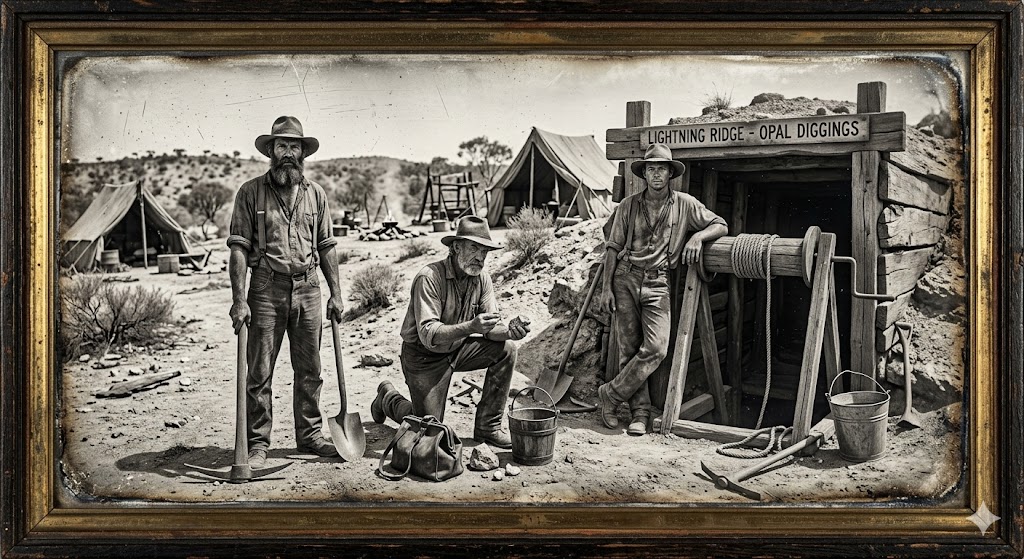
1.1 The Wallangulla Frontier Era and Early Surface Mineral Discoveries
The formal timeline of natural black opal extraction begins along the low-lying ridges of Wallangulla Station, a remote and arid pastoral property located in the hot interior of northern New South Wales. For many years, local pastoral workers, stockmen, and boundary riders noticed uniquely dark, intensely colorful stones weathering out of the shallow ironstone gravels along the low ridges. However, because the global gem trade was entirely accustomed to the light-colored, translucent varieties coming out of Eastern Europe, these strange, moody stones were initially overlooked. The turning point occurred in the late 1880s when local residents began collecting these surface floaters, realizing that the brilliant play-of-color flashing out from the stones was entirely genuine and structurally unique, a phenomenon that Lightning Ridge black opal 2026 price trends forecast documents as the foundation of current luxury asset valuation.
Despite the undeniable beauty of the material, the early prospectors faced a wall of skepticism from established gemstone buyers in Sydney and Melbourne. Traditional gem merchants, deeply suspicious of anything new coming out of the remote outback, dismissed the dark-bodied gems as worthless anomalies, often claiming they were artificially altered or “burnt” to mask defects. This initial rejection severely suppressed early field development, forcing early diggers to operate on the absolute margins of survival. To understand the broader context of how these outback discoveries eventually shook up global markets, one can look back at the colored gemstone gold rush 2026, which proved that the country’s remote interior held immense, non-traditional mineral wealth that city experts frequently failed to predict, much like the fluctuations noted in colored stone price trends 2026.
The true commercial breakthrough for the Wallangulla field is credited to the sheer determination of an experienced prospector named Charlie Nettleton. Having worked the alluvial fields of White Cliffs, Nettleton instantly recognized the revolutionary potential of the dark-base material from the Ridge. In 1901, he began systematically sinking the first proper exploration shafts into the sandstone capping. In 1903, after packing a small parcel of the rough stones, Nettleton walked more than 250 kilometers through harsh, semi-arid country to find a market. He finally secured the first official commercial sale of natural black opal for a modest fifteen pounds. This historic transaction provided the vital economic spark needed to legitimize the field, triggering an immediate wave of independent miners to the region and setting the stage for what would soon become a massive outback rush, a process detailed in gem news archives.
As news of Nettleton’s sale spread through the coastal ports and older gold camps, a steady stream of independent operators began making the long trek inland. The early miners quickly realized that this was not a typical alluvial run where you could just pan the top gravels; the precious material was trapped down within a highly specific sedimentary layer beneath a tough crust of ironstone and sandstone. They had to develop entirely new ways of reading the country, looking for subtle changes in the vegetation and the slope of the low ridges to guess where the underlying clay beds ran close to the surface. This hard-won local knowledge was passed down around campfires, building a unique body of field expertise that allowed these independent syndicates to slowly unlock the true mineral wealth of the region, despite having no access to formal geological maps or mining engineers. Unlike the relative ease of Yowah Nut opals Queensland Australia, the Ridge required grit.
1.2 Living History of the Outback Shafts: Manual Extraction Methods and Bush Codes
Life on the early Lightning Ridge fields was an exercise in pure physical and mental endurance. The climate of the western plains was unyielding, with summer temperatures regularly soaring past 45 degrees Celsius, followed by freezing desert winds during the winter nights. Because the area lacked reliable surface water, early mining syndicates were completely dependent on small dams and deep government-sunk artesian bores. Miners lived in rough, makeshift structures built from local ironbark logs, flattened kerosene tins, and thick canvas sheets, creating a unique frontier camp architecture. The entire community was bound together by a fiercely independent spirit, where a person’s spoken word and their registered claim markers were respected as absolute law under informal outback bush codes, a stark contrast to the formal 2026 jewelry appraisal guide protocols used for asset validation today.
The actual extraction of the opal-bearing clay was a slow, punishing manual process. Working inside vertical shafts that descended anywhere from 10 to 90 feet through the tough, barren silcrete capping, miners worked by the dim, flickering light of simple tallow candles. Once they breached the protective sandstone layer, they entered the damp, pale siltstone beds known locally as “opal dirt.” Using short-handled picks and heavy iron shovels, they carefully gouged out horizontal tunnels, or “drives,” along the contact line. Every single scrap of extracted clay was hauled to the surface in heavy leather buckets using simple, hand-turned timber windlasses. This exact same layout of vertical shafts and manual drives would later form the operational blueprint for other major outback fields, including the remote Opalton prospects Boulder opal prospects 2026 districts further north.
On the surface, the hauled clay was spread out onto wide canvas tables or run through hand-cranked mesh screens called “shakers.” Miners spent hours in the sun carefully sorting through the dry clay lumps, searching for “nobbles”—small, potato-like nodules of dense claystone that often hid a heart of precious black opal. The psychological grind of this work was immense; miners could easily spend months digging completely barren “duffer” holes, burning through their meager savings and provisions before a single lucky pick-strike uncovered a rich pocket of color. This volatile environment fostered a deeply egalitarian community where wealth was shared around and help was always extended to a neighbor down on their luck, forming a cultural foundation that still defines the independent spirit of the town today, much like the resilience required when navigating gemstone sideline traders 2026 networks.
This manual method of shaft sinking and tunneling required a highly developed sense of physical intuition. A miner had to listen constantly to the sounds of the ground above them, learning to tell the difference between the solid creak of a safe sandstone roof and the soft, dangerous trickling of loose silt that warned of an imminent cave-in. Without the aid of modern mechanical ventilation, the air inside the deeper drives quickly grew thick and hot, forcing men to work in short, exhausting shifts before climbing back up the timber ladders for a breath of fresh air. It was a lifestyle that weeded out anyone looking for an easy dollar, leaving behind a hard-bitten core of professional diggers who took an immense pride in their ability to survive and prosper in one of the toughest environments on the continent, a legacy that persists in the opal fields of Queensland Australia.
As these independent syndicates refined their knowledge, they began to categorize their findings based on color play, body tone, and pattern—the rudimentary precursors to the complex valuation systems we use for what is fair market value determinations. They learned that the “black” base was not merely a dark color, but an optical necessity for contrast enhancement, a scientific fact that modern forensics confirms is vital for insurance replacement value appraisal 2026 forensic standard documentation. This historical evolution from bush intuition to geological precision is why, despite the shift toward mechanized mining and the decline of the individual “nobble” hunter, the cultural ethos of the Ridge remains a powerful, tangible force in the international gemstone trade today.
2.0 High Jewelry Adoption and Global Luxury Movements
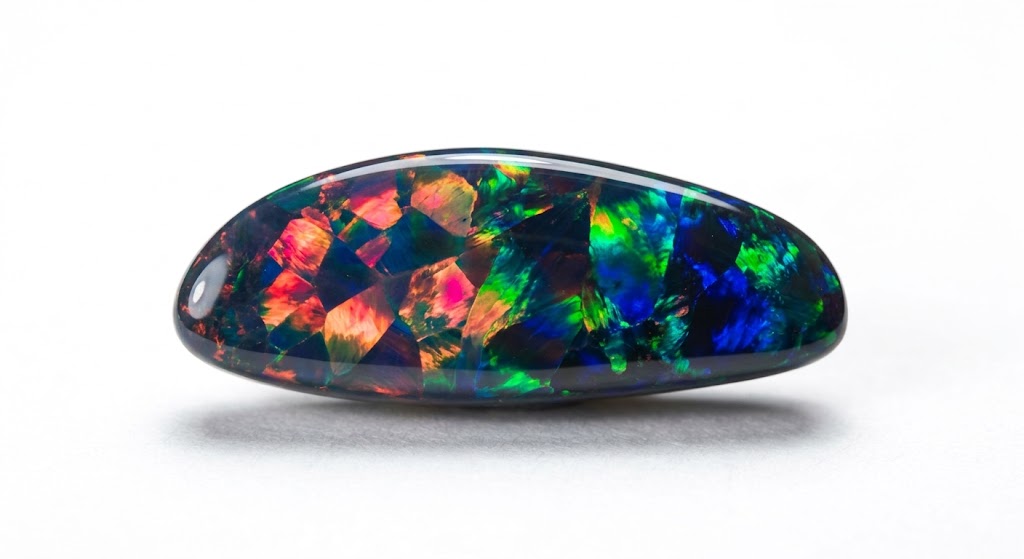
The strategic integration of natural black opal into elite high jewelry salons marked a pivotal shift in luxury aesthetics, transforming raw outback material into a centerpiece of twentieth-century design.
| Design Movement | Aesthetic Treatment of Black Opal | Primary Luxury Setting & Pairings |
|---|---|---|
| Art Nouveau Era (1890–1915) | Emphasized organic fluid forms, asymmetrical insect motifs, and dreamlike palettes. | Framed with soft champlevé enamel, baroque pearls, and carved horn mountings. |
| Art Deco Period (1920–1939) | Cut into geometric plaques, smooth tablets, and high-contrast symmetric domes. | Paired with rigid platinum borders, black onyx accents, and brilliant pavé diamonds. |
| Modern High Jewelry (2000–Present) | Utilized as singular, ultra-rare focal stones in bespoke, non-repeatable art pieces. | Mounted by houses like Cartier and Bvlgari for high-net-worth investment portfolios. |
- The French Artistic Break: How avant-garde masters rejected the rigid diamond monopolies of the late Victorian era.
- High-Contrast Geometries: The structural role of natural dark backgrounds in grounding architectural Art Deco masterpieces.
- The Shifting Fashion Landscape: Tracking the long-term design trends that continue to drive modern luxury collections.
- Museum-Grade Acquisition Rings: The transition of elite outback nobbies into non-fungible, wearable historical monuments.
- Valuation Benchmarks: Utilizing standard what is worth metrics to assess the archival significance of period-specific opal settings.
- Strategic Investment Potential: Why unique colored gems are increasingly favored over traditional diamonds, a sentiment mirrored in the plummeting price of diamonds reports.
2.1 The Fluid Asymmetry of the Art Nouveau Era and Artistic Validation
The initial acceptance of Lightning Ridge black opal into the highest tiers of European fashion occurred during a time of intense artistic rebellion. In the late nineteenth and early twentieth centuries, the international jewelry market was firmly locked in the grip of a conservative, diamond-heavy aesthetic. Traditional luxury pieces were rigid, highly symmetrical, and designed primarily to show off the raw caratic wealth of the owner. Gemstones were cut into standardized shapes and set into heavy gold mountings that left very little room for individual artistic expression. It was a formulaic approach that prioritized commercial uniformity over genuine creative design, leaving the market ripe for a major structural shake-up.
The spark that broke this mold was the sudden rise of the Art Nouveau movement, led by visionary French masters who wanted to pull jewelry design into the modern world. These designers valued color, mood, and fluid, natural movement above the simple monetary price of an identical stone. When they were first introduced to the new black opals coming out of the Australian interior, they recognized that nature had handed them the perfect canvas for their avant-garde creations. To understand the profound depth of this design shift, tracking the evolution of historical periods across antique jewelry appraisal accurate 2026 standards reveals exactly how these new design philosophies began systematically taking down old Victorian conventions, much like the scrutiny applied to resale value in modern auctions.
Master artisans like René Lalique and Georges Fouquet threw out the old rules, centering their most intricate sculptural brooches, flowing hairpieces, and asymmetric rings around the mysterious fire of the black opal. They found that the stone’s deep, velvety background allowed its shimmering greens and deep blues to stand out with an emotional intensity that standard crystal gems could never match. For an excellent example of how this specific design philosophy worked in practice, one can study the artistry behind the Tiffany’s Dragonfly Brooch 1904, which beautifully demonstrates how the fluid, shifting colors of precious opal were used to mimic the delicate, living textures of nature. By elevating the emotional resonance of the material over cold, linear calculations, these early masters permanently validated the rare outback mineraloid as a legitimate medium for elite high art. This legacy of validation is critical when conducting jewelry appraisal for divorce or estate distribution, as the historical context directly informs current market premium assessments.
2.2 The High-Contrast Platinum Geometries of the Art Deco Period
As the world moved past the First World War, the flowing curves of Art Nouveau quickly gave way to the bold, machine-age aesthetics of the Art Deco movement. This new design era was defined by clean lines, sharp geometric angles, and an obsession with high-contrast architectural forms. The jewelry houses of Paris, New York, and London stopped looking at the natural world for inspiration, turning their focus instead to the sharp lines of modern skyscrapers, industrial machinery, and ancient tribal geometries. You might think a stone as fluid and unpredictable as the black opal would lose its place in such a rigid design landscape, but the exact opposite happened; the stone proved to be an incredibly versatile asset for the new generation of craftsmen.
During this golden age of luxury, elite design houses realized that the black opal possessed a unique structural advantage: its own built-in dark background potch. By carefully cutting the material into sleek, flat tablets, geometric plaques, and low, symmetric cabochons, designers could integrate the stone seamlessly into their architectural compositions. This era saw a major shift in the way precious metals were used, with heavy gold giving way to the cool, clean look of platinum. To see how these layout changes completely redefined the industry, checking the details of classic important gems and jewelry design reveals how the bold inclusion of black opal allowed pieces to achieve a dramatic visual weight that stood out from the crowd. This period solidified the opal’s role as a staple for high-end assets, often documented in jewelry insurance documentation as high-value, non-fungible historic objects.
Prestigious international firms began creating stunning, high-contrast combinations that became the signature style of the roaring twenties. They would frame a vibrant Lightning Ridge black opal with crisp rows of calibrated black onyx tiles and brilliant-cut pavé diamonds, using the stark black-and-white borders to enhance the natural spectral fire flashing out from the stone’s center. For collectors looking to trace the lineage of these magnificent pieces through the years, examining the transition from the ornate Victorian era through the Edwardian period highlights the sheer radical nature of the Art Deco revolution. The black opal was no longer just an exotic curiosity from a distant colony; it had become an essential element in the visual vocabulary of modern luxury, sought after by the most discerning tastemakers on the globe, a fact that remains relevant even when considering the the 2026 Mogok supply squeeze why unheated rubies are the decades hardest asset comparisons.
2.3 Modern High Jewelry Houses and Museum-Grade Collector Acquisitions
In the contemporary luxury landscape, the position of natural Lightning Ridge black opal has ascended to a level of extreme, non-reproducible exclusivity. Today’s master jewelers are operating in a market where consumers are increasingly exhausted by mass-produced luxury items and standardized, industrial gemstone supplies. The modern high jewelry collector doesn’t just want a flawless stone; they want a piece that tells a deep geological story and possesses a genuine sense of individuality. This shift in collector mindset has led to a powerful resurgence of interest from elite global conglomerates who use the rare outback gem as the crowning centerpiece for their most prestigious, one-of-a-kind museum-grade acquisitions.
To understand where these contemporary movements are heading, analyzing the broader fashion jewelry trends for 2026 shows a powerful, industry-wide focus on raw natural authenticity and intense color dominance. Elite houses realize that you can synthesize a diamond or heat-treat a low-grade sapphire to achieve uniform color, but you can never replicate the intricate, organic arrangement of a top-tier black opal color bar. This extreme difficulty of replication ensures that every single piece of high jewelry featuring a solid Ridge stone is an entirely unique art asset that can never be truly duplicated. This unmatched individuality has made the gem an absolute favorite for high-end designers who want to create bespoke legacy pieces for their most exclusive clients.
The contemporary demand is heavily fueled by an increasing awareness of absolute resource exhaustion at the source. Investors and high-net-worth individuals are looking past traditional paper markets and standard bullion blocks, looking to diversify their holdings into tangible alternative asset classes that combine extreme spatial wealth density with zero correlation to public markets. As a result, when an exceptional, collector-grade black opal featuring an elite pattern like a Harlequin or a rolling red flash appears at private international auctions, it is treated with the exact same level of financial reverence as a rare masterpiece painting. It stands as a timeless store of value, representing a perfect intersection of ancient earth history, unparalleled human craftsmanship, and extreme physical rarity that will continue to hold its value for generations to come, outperforming standard tanzanite investment 2026 no results. The meticulous documentation of these stones, from what is jewelry to market price point, is the final safeguard for high-value collectors and family office managers who require absolute transparency in their luxury asset acquisitions.
3.0 The Chemical Matrix and Structural Geometrical Order of Precious Opal
To truly understand what makes a Lightning Ridge black opal jump to life in the palm of your hand, you have to leave the macro-world behind and take a deep look at its sub-microscopic architecture. We aren’t dealing with a typical crystalline gemstone like diamond or sapphire; opal is a hydrated amorphous mineraloid with a highly particular internal geometry. When the right subterranean conditions lock into place over spans of geological time, billions of microscopic silica spheres arrange themselves into a flawlessly uniform, three-dimensional lattice. This structural ordering acts as a natural transmission diffraction grating, splitting ordinary white light into its component spectral colors with an intensity that seems almost self-luminous against the stone’s dark, carbonaceous baseline.
| Structural Parameter | Microscopic Physical Dimension | Optical and Color Performance |
|---|---|---|
| Small Sphere Matrices | Sphere diameters tracking tightly between 140 and 200 nanometers. | Diffracts short, high-energy wavelengths, limiting expression to violet and deep indigo blues. |
| Medium Sphere Matrices | Sphere diameters measuring between 220 and 250 nanometers. | Accommodates the diffraction of intermediate wavelengths, yielding bright greens and yellows. |
| Large Sphere Matrices | Sphere diameters expanding outward from 260 to 320 nanometers. | Diffracts the longest wavelengths, unleashing rare, highly coveted red and orange spectral flashes. |
- The Hydrated Amorphous Grid: The physical balance of silicon dioxide and trapped water molecules that defines the Opal-AG mineraloid class.
- Bragg’s Diffraction Adaptation: How the physical dimensions of the interstitial voids between spheres filter incoming light waves.
- The Full Spectral Cascade: Why large-sphere matrices retain the unique ability to flash every single color of the rainbow depending on the angle.
- Lattice Purity and Pattern Boundaries: The microscopic dislocations that turn generic color patches into elite collector graining.
- Investment Implications: How structural integrity directly correlates to the resale value of investment-grade opal assets.
- Forensic Authentication: Utilizing gem news and laboratory standards to distinguish natural versus treated specimens.
3.1 Amorphous Micro-Architecture and Sphere Packing Dynamics
From a strict gemological standpoint, natural precious opal is classified not as a structured crystal mineral, but as an amorphous mineraloid with a core chemical formulation written as $SiO_2 \cdot nH_2O$. In the precious varieties pulled out from the deep outback clays, the internal water content ($n$) typically fluctuates anywhere between 3% and 10% of the stone’s total weight. Unlike crystalline quartz or its close microcrystalline cousin, chalcedony, precious opal displays no long-range directional atomic order across its atomic framework. Instead, its entire internal universe is built out of an incredibly intricate, three-dimensional colloidal aggregate of sub-microscopic, amorphous silica spheres that are packed tightly together in a dense silica gel matrix.
The difference between common, non-diffracting opal—what we outback diggers call “potch”—and precious play-of-color opal comes down entirely to the mathematical perfection of this sphere packing. In potch stone, the silica spheres are a complete mess; they are irregular in size, malformed, and thrown together in a random, chaotic jumble. When light hits this disordered arrangement, it simply scatters in every direction, resulting in a flat, milky, or grey visual presentation that holds no commercial value. But in precious black opal, nature has pulled off a masterclass in geometry. The spheres are remarkably uniform in diameter and sorted into a highly rigid, perfectly symmetrical, close-packed three-dimensional cubic or hexagonal array that behaves like an elite optical filter.
For independent artisans and gem cutters looking to understand the underlying physical material they are shaping on the wheels, checking the structural details found in deep resource manuals like the how to find a jeweler you can trust guides highlights just how fragile yet orderly this hydrated structure truly is. The spaces between these close-packed spheres are filled with a combination of water and secondary silica gel that has a slightly different refractive index than the spheres themselves. This delicate chemical equilibrium must be carefully preserved; if the internal water content is forced out too quickly by thermal shock or improper storage, the entire micro-architecture can destabilize, causing the stone to lose its structural integrity and develop a ruinous network of internal fractures. This structural sensitivity is precisely why experts advise against using free appraisals no bueno 99 and instead seek certified professionals for any evaluation.
3.2 The Physics of Bragg-Like Light Diffraction Grid Arrays
The phenomenal optical trick we call the play-of-color is governed entirely by the laws of light diffraction, behaving in a manner that is completely analogous to a man-made three-dimensional transmission diffraction grating. When an incident light wave strikes the outer face of a precious opal, it travels straight into the microscopic voids separating the orderly stacked silica spheres. Because the spatial periodicity of this sphere lattice matches up perfectly with the physical wavelengths of visible light, the incoming energy is split and diffracted. This behavior is mathematically defined by a modified adaptation of Bragg’s Law for X-ray diffraction inside crystals, adjusted to account for the unique refractive index of the medium:
$$\lambda = 2d \cdot \sqrt{n_{\text{b}}^2 – \sin^2\theta}$$
Where $\lambda$ represents the specific wavelength of the diffracted color, $d$ is the interplanar spacing between the layers of silica spheres, $n_{\text{b}}$ is the mean refractive index of the precious opal substance, and $\theta$ is the precise angle of incidence relative to the diffracting planes.
Because the interplanar spacing ($d$) is directly proportional to the actual diameter of the silica spheres ($D$, where $d = \sqrt{2/3} \cdot D$ for a close-packed face-centered cubic structure), the specific color that flashes out to your eye is a direct mathematical consequence of sphere size. If a patch of opal contains tiny spheres measuring only 140 to 200 nanometers across, the internal grid is too tight to filter anything but the shortest, highest-energy wavelengths of the visible spectrum. This limits the play-of-color strictly to violet, indigo, and blue hues. Even if you turn the stone under a bright light, it will never show a hint of warmer tones, because the physical dimensions of the structural voids simply cannot accommodate longer light waves.
To see how these vibrant optical phenomena are translated into commercial luxury assets and celebrated by global gem communities, reviewing the field reports from major structural events like those discussed in gem shows 2026 listings shows how buyers use this physical science to evaluate quality on the floor. When you see a stone that displays a crisp, clean boundary between its color patches, you are looking at a region of the sphere lattice that has grown with an incredible degree of spatial purity. Any sudden dislocations, structural vacancies, or localized variations in sphere diameter will instantly shatter the light path, breaking up the color flashes into distinct macro-patterns that collectors hunt for, ranging from tiny dots to massive, rolling sheets of pure spectral light. It is this purity that defines what is like kind and quality 2024 standards in professional insurance reporting.
3.3 Thermodynamic Spectra and the Rarity of Long-Wavelength Color Play
The absolute apex of rarity in the black opal universe is the manifestation of dominant, long-wavelength red coloration. For the silica spheres to grow uninterrupted to the substantial diameter of 250 to 320 nanometers required to diffract red light, the underground chemical environment at Lightning Ridge had to remain perfectly stable, stagnant, and undisturbed over tens of thousands of years. If the groundwater gradient shifted even slightly, or if the hydrostatic pressure fluctuated during the growth phase, the spheres would stop growing or lose their uniform alignment. Because maintaining this perfect stasis over immense spans of time is a geological miracle, true red-flash black opal is an exceptionally scarce commodity on the global market, with value trajectories often compared to those tracked in ruby price trends 2026 market overview analysis.
There is a unique optical rule that makes these red-dominant stones even more valuable to collectors: a sphere lattice that is large enough to diffract the long wavelengths of red light retains the physical ability to diffract every single shorter wavelength (orange, yellow, green, and blue) depending on how you orient the stone to your eye. This means an elite red stone contains the full thermodynamic spectrum within its boundaries, offering a rolling, multi-colored display that changes completely as the gem is rotated. For investors seeking to understand the historical context of how these rare, full-spectrum stones were valued in classic design periods, exploring the records of high-end collections across antique jewelry appraisal accurate 2026 standards confirms that red-on-black stones have consistently commanded the highest valuation premiums since the inception of the field.
If the silica spheres happen to grow even larger, pushing past 320 nanometers, the interplanar spacing expands out past the limits of human vision. The diffracted energy slides out of the visible spectrum directly into the infrared zone, rendering the material optically inert and turning what could have been a precious masterpiece into common, valueless potch. This razor-thin margin between a world-class spectral gem and a dull grey rock is what makes the field-level hunt so compelling. Independent miners spend their lives searching for that exact sweet spot where nature got the math perfectly right, producing a flawless, large-sphere Opal-AG lattice that locks the complete visible spectrum into a solid, enduring outback treasure. Such specimens are the gold standard for those diversifying away from the diamond paradox why a new tariff is turning the jewelry market upside down scenarios that currently plague the traditional trade.
4.0 Stratigraphy of the Great Artesian Basin and Sedimentary Deposition Traps
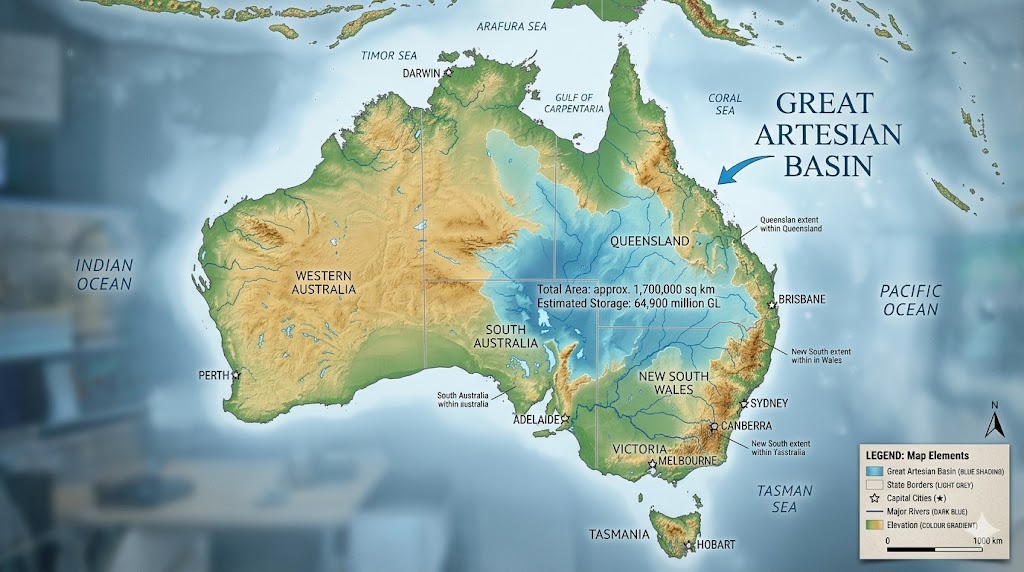
The architectural foundation of Lightning Ridge’s opal deposits lies in the deep, Cretaceous-era sedimentary history of the Great Artesian Basin, where unique geochemical traps enabled the precipitation of precious silica-based mineraloids.
| Stratigraphic Layer | Lithological Nature & Hydraulic Function | Opalization Resource Potential |
|---|---|---|
| Silcrete Overburden Capping | Tough, consolidated near-surface crust formed by intense Cenozoic weathering. | Barren structural ceiling; must be breached via hydraulic augers or heavy excavators. |
| Wallangulla Sandstone Units | Highly porous, coarse-grained sandstones and heavily fractured siltstone beds. | Acts as the primary pathway for downward percolating, silica-rich meteoric water. |
| Finch Claystone Membrane | Ultra-dense, highly impermeable, kaolinite- and illite-dominant clay layers. | The definitive geochemical trap line; hosts all precious “nobbles” and seam runs. |
- The Eromanga Marine Legacy: How millions of ancient diatoms and radiolaria provided the raw biogenic silica supply for opal formation.
- Acidic Meteoric Leaching: The role of oxygenated rainwater in breaking down feldspars to liberate monosilicic acid within the sandstone host.
- Perched Groundwater Horizons: The creation of stagnant, low-pressure zones that slowed fluid migration to facilitate long-term colloidal precipitation.
- The Sol-Gel Phase Transition: The multi-million-year process of concentrating loose silica polymers into uniform spheres, essential for a new understanding of how seam opal is made in nature.
- Structural Trap Integrity: Understanding how impermeable barriers create the geological “vaults” necessary for high-value gemstone preservation.
- Resource Mapping: Correlating stratigraphic data with current market scarcity, such as the trends identified in gemstone mining USA 2025 and beyond industry forecasts.
4.1 Paleogeographic Evolution of the Cretaceous Eromanga Sea

To grasp the true scale of the geological miracle at Lightning Ridge, one must rewind the clock to the Early Cretaceous epoch, roughly 100 to 140 million years ago. During this Mesozoic era, the vast interior of the Australian landmass was inundated by a massive, cold, and shallow epicontinental body of water known as the Eromanga Sea, a major eastern lobe of the Great Artesian Basin. This marine environment was rich in silica-secreting organisms, including radiolaria, diatoms, and glass sponges. These microscopic creatures efficiently extracted dissolved silica from ocean currents to construct their intricate, glassy internal skeletons. As these organisms completed their life cycles, their structural remains drifted to the stagnant seafloor, accumulating into deep, spongy blankets of silica-rich muck.
The burial of these organic blankets beneath thousands of feet of subsequent marine sediments led to their compaction into the Griman Creek Formation and associated sedimentary sequences we exploit today. For the gemologist, this is more than just paleontology; it is the source of the chemical “fuel” for opalization. As these ancient layers underwent diagenesis, they became the source material for the silica-laden groundwater that would eventually circulate through the region’s weathered joints and bedding planes. Those tracking the scarcity of assets often look at such geological origins as a primary indicator of long-term value stability, a concept heavily reinforced by studies on colored stone price trends 2026. The preservation of these fossil assemblages as opalized casts—from bivalves to crustacean gastroliths—serves as forensic evidence of the slow, gentle precipitation process required to grow the uniform silica spheres that generate play-of-color.
4.2 Meteoric Infiltration and Low-Temperature Sol-Gel Phase Transitions
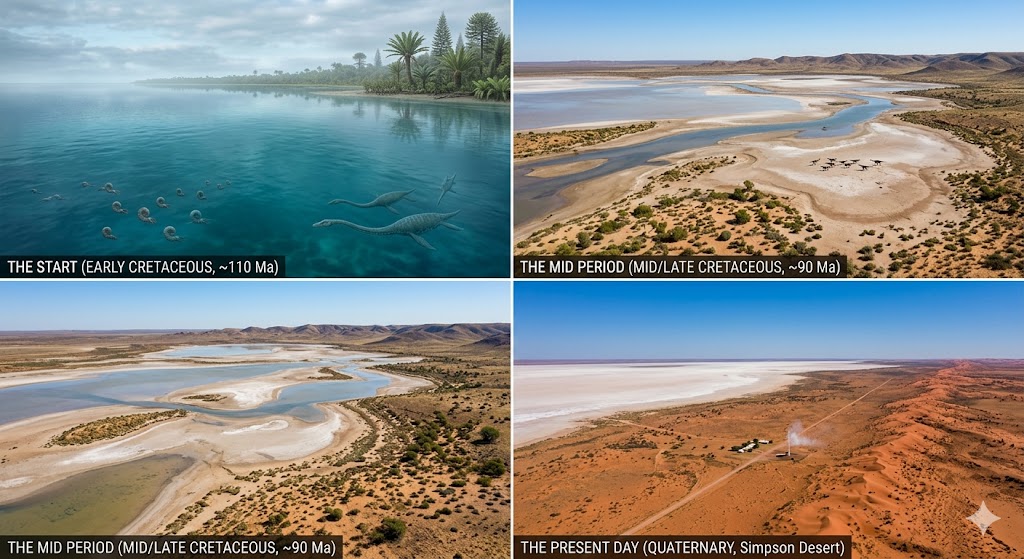
The birth of precious black opal began when highly acidic, oxygenated meteoric waters—rainwater enriched with organic acids from the soil—trickled through the porous Wallangulla Sandstone units. This groundwater reacted with the buried volcanic debris and biogenic silica, triggering a leaching process that produced a supersaturated solution of monosilicic acid. As this solution descended, it was halted by the Finch Claystone, an ultra-dense, kaolinite-dominant barrier. This stoppage created perched water tables where the hydraulic gradient vanished, allowing the silica to slowly polymerize through a sol-gel phase transition. This is the crucial stage where “potch” (common opal) or precious play-of-color opal is formed based on the spatial uniformity of the resulting silica sphere arrays.
For the modern investor, the geological trap is analogous to the stability required in high-value asset storage. Just as a professional jeweler manages jewelry insurance documentation to ensure asset security, nature “locked” these deposits in stable chemical environments for millions of years. This long-term stasis is essential for the growth of the uniform, large-diameter silica spheres that diffract the highly coveted red and orange spectral wavelengths. Because this process is so dependent on specific, localized environmental conditions—often described in technical papers on Opalton prospects Boulder opal prospects 2026—the supply of top-tier black opal remains strictly inelastic.
4.3 The Role of the Impermeable Finch Claystone Layer
The Finch Claystone serves as the primary geochemical “hero” of the Lightning Ridge stratigraphy. By providing an impermeable floor, it prevented the silica-rich solutions from draining into the deep aquifers of the Great Artesian Basin. The clay’s plastic nature under tectonic stress led to the creation of secondary horizontal cavities and vertical slips, which became the primary receptacles for precious opal nodules or “nobbies.” Prospectors and mining syndicates today focus their operations along this specific contact line, as the claystone membrane provides the chemical heterogeneity (via trace metal ions and organic matter) necessary to produce the dark basal body tone that makes black opal the most valuable variety of the species.
It is within these trapped pockets that we see the highest concentration of “nobby” opals, which are distinct from the vein-like “seam” opals found in other fields. The presence of organic-rich marine sediments within the clayline ensures that even the common potch associated with these gems is chemically “charged” with the carbon that, when coupled with the silica sphere lattice, provides the velvety black base so prized in today’s Lightning Ridge black opal 2026 price trends forecast. Understanding this stratigraphic trapping is essential for anyone evaluating the long-term investment potential of these rare gems, as it validates the geographic monopoly held by the Ridge fields and underscores why they remain superior to speculative alternative assets like tanzanite investment 2026 no projects. The integrity of the Finch trap is, quite literally, the reason for the rarity that drives current high-end appraisal values.
5.0 Geochemical Origin of the Dark Basal Body Tone
The defining visual characteristic of Lightning Ridge black opal is its light-absorbing base, a geochemical anomaly caused by the mechanical entrapment of organic and mineral impurities within the silica matrix.
| Geochemical Component | Sub-Microscopic Physical Mechanism | Optical Impact on Play-of-Color |
|---|---|---|
| Particulate Organic Carbon | Fine colloidal carbon suspensions mechanically trapped during initial sol-gel settling. | Absorbs unrefracted, stray white light waves; provides the fundamental dark base tone. |
| Amorphous Iron Sulfides | Microscopic clusters derived from highly reduced Cretaceous marine muds. | Induces a deep grey-to-black basal canvas, driving high thermodynamic contrast. |
| Transition Metal Oxides | Trace complexes of manganese and titanium embedded uniformly inside the backing potch. | Prevents internal background backscattering, eliminating the cloudy or milky visual effect. |
- The Core Absorption Mechanics: How the structural backing captures unrefracted light waves that pass through the sphere lattice.
- Reduced Marine Geochemistry: The role of organic-rich, stagnant Cretaceous sediments in supplying dark particulate matter.
- Saturation and Spectral Purity: Why eliminating background scattering allows the diffracted Bragg colors to look incredibly rich.
- The Contrast Multiplier Effect: The optical science that makes a B1 brightness red flash look completely self-luminous.
- Forensic Identification: The use of gem news and laboratory spectroscopy to verify authentic carbon-based dark tones.
- Asset Valuation: Understanding the N1-N4 grading scale for establishing fair market value in what is fair market value reports.
5.1 The Chemistry of Background Absorption Within Base Potch Matrix Layers
When you hold an elite Lightning Ridge gem in your hand, you are looking at a beautifully coordinated two-part optical asset. The upper layer contains the flawless, three-dimensional grid of uniform silica spheres that splits and diffracts incoming light waves. However, that play-of-color would look pale and weak without the second, equally important part of the stone: the dark, non-diffracting backing layer we call common potch. In general mineralogy, body color is usually an idiochromatic affair, meaning it arises from transition metal ions mixed into the primary crystal structure. But the deep gray-to-jet-black tone of a Lightning Ridge stone is an entirely different story, relying on physical, mechanical entrapment rather than basic ion substitution.
The basal potch layer acquires its deep tone because the ancient, silica-rich groundwater was carrying more than just dissolved monosilicic acid when it migrated through the rock fractures. As it trickled along the contact line of the Finch Siltstone, the solution acted like a scavenger, picking up ultra-fine, colloidal particulate suspensions of organic carbon and iron complexes from the surrounding marine sediment. When the silica sol began its slow transition into a solid state, these microscopic impurities did not settle out; they became completely embedded within the disordered, irregular sphere matrices of the common opal. This resulted in a dense, uniform, and light-absorbing mass that serves as the solid structural anchor for the precious color bar sitting right on top of it.
For independent jewelry designers and gem cutters who spend long hours working with these delicate structures, checking the technical resources provided by groups like those referenced in independent certified gemologist appraiser 2024 guides reveals why cutting a black opal is such a nerve-wracking art form. You cannot simply grind away at a stone; you must balance the precious color bar perfectly against the underlying potch layer. If you cut the stone too thin and remove too much of that dark natural backing, you destroy the light trap, causing the beautiful reds, greens, and blues to lose their footing and wash out into a pale, translucent shade that holds very little commercial or artistic value. This risk is precisely why why do I need an appraiser quality control documentation is critical for any asset insurance.
5.2 Microscopic Light-Absorbing Impurities: Carbon, Pyrite, and Transition Metals
Taking a closer look at the exact makeup of these natural impurities reveals a complex geochemical cocktail that could only occur in this specific corner of the Australian outback. The primary ingredient driving the dark base tone is particulate organic carbon, which was preserved in massive quantities on the stagnant, low-oxygen floor of the ancient Eromanga Sea. Along with this organic material came high concentrations of amorphous iron sulfides, mostly in the form of microcrystalline pyrite ($FeS_2$), which developed through the action of sulfate-reducing bacteria working inside the damp Cretaceous muds. As the groundwater leached through these layers, it pulled these ultra-fine particles into a steady, stable suspension that moved easily through the porous sandstone fractures.
Along with the carbon and iron sulfides, trace transition metal oxides—especially complex oxides of manganese and titanium—became locked into the settling silica gel. Because these particulate impurities are sub-microscopic in size, they did not disrupt the formation of the larger silica spheres; rather, they filled the spaces around them with a dark, light-deadening filter. For an interesting historical look at how these unique chemical features have been tracked and studied, resources like the a prospectors guide to opal in western Queensland 1966 outline how early explorers realized that carbon-rich clay lines were the key to finding the most valuable stones.
This precise distribution of microscopic soot and iron flakes inside the potch stone is what separates an authentic, untreated Lightning Ridge black opal from every other opal species on the planet. In volcanic deposits, the cooling fluids are usually completely clean of organic carbon, yielding water-clear crystal stones that let light pass right through them. But at the Ridge, the heavy, swampy marine history of the Surat Basin guaranteed that every drop of silica gel was thoroughly saturated with ancient carbonaceous material. It is a stunning example of how a decaying prehistoric seafloor provided the exact raw ingredients needed to forge one of the most sophisticated optical marvels found anywhere in the earth’s crust, a level of quality often discussed in colored stone price trends 2026 reports.
5.3 Contrast Enhancement Dynamics and Perceived Spectral Intensity
The final optical magic of a Lightning Ridge black opal comes down to a simple rule of physics: contrast enhancement dynamics. In a standard white or light-bodied crystal opal, a massive percentage of the ambient white light that enters the stone does not get diffracted by the sphere grid; it travels past the spheres, hits the pale host matrix underneath, and scatters backward toward your eye. This stray, unrefracted white light acts as a visual pollutant, washing out the diffracted color wavelengths, dropping the overall saturation, and giving the gem a cloudy or milky appearance. The colors are there, but they are fighting a losing battle against the bright background glare.
But when incident light enters a top-tier Lightning Ridge black opal, the experience is completely different. The orderly sphere matrix goes to work immediately, diffracting the specific Bragg wavelengths—the bright reds, electric greens, or deep blues—straight back to the observer with high directionality. Meanwhile, all the remaining unrefracted, stray white light waves pass deeper into the stone, where they hit that natural carbonaceous and iron-rich potch backing and are completely absorbed. By wiping out that background glare, the natural dark absorption layer allows the diffracted spectral colors to stand out with an intensity and saturation that seems almost impossibly bright, looking more like an active neon display than a cold piece of stone.
This incredible optical contrast is why independent jewelers and investment collectors treat the Ridge material with such reverence. To see how these rich, high-contrast visual dynamics are valued by modern buyers in the trade, studying the market forecasts shared in publications like the Lightning Ridge black opal 2026 price trends forecast highlights how stones with an elite, N1-to-N3 dark body tone consistently command the highest price multipliers. By serving as a perfect black velvet drop-cloth for nature’s light show, this geochemical trap turns ordinary, dull silica into an elite alternative asset that holds its value across any market loop. This valuation stability is a cornerstone of professional appraisal services, ensuring that your collection remains protected against the volatility found in other sectors, such as the plummeting price of diamonds.
6.0 Macroeconomics and Supply Chain Dynamics of the Ridge Fields
The macroeconomic framework governing natural black opal from Lightning Ridge is defined by absolute structural scarcity and extreme supply inelasticity, separating it from commodity-based gemstone markets.
| Supply Chain Segment | Operational and Mechanical Process | Economic Control & Pricing Impact |
|---|---|---|
| Underground Extraction | Hydraulic underground diggers cutting drives along the clay line; high-vacuum “blower” systems. | Dramatically inflates upfront capital expenditure, fuel overheads, and mining compliance costs. |
| Centralized Washing | Rotary concrete-mixer agitators washing rough claystone for 24 to 48 hours at dedicated water dams. | Acts as the ultimate resource bottleneck; less than 1% of processed material contains precious color. |
| Field-Level Trading | Closed-door, cash-independent negotiations and private tenders conducted directly inside local “rooms.” | Maintains high localized supply control, allowing source merchants to dictate premium baseline pricing. |
- The Geographic Monopoly: Why the entire global output of investment-grade black opal is restricted to a tight 50-kilometer radius in New South Wales.
- Capital Expenditure Burden: Navigating high costs of diesel, environmental bonds, and regulatory compliance, ensuring only professional operations remain viable.
- The Bottleneck Effect: Why processing yields—frequently under 1% for precious material—create natural floors for per-carat pricing.
- Resource Exhaustion: Analyzing the long-term depletion of historic fields and the shift toward marginal areas in 2026.
- Price Stability: Contrasting the appreciation of black opal against the market volatility observed in the plummeting price of diamonds.
- Supply-Side Controls: Assessing the role of gemstone sideline traders 2026 in maintaining market floor prices.
6.1 Resource Scarcity, Geographic Concentration, and Primary Field Depletion
The entire economic engine of the natural black opal market rests on an unyielding foundation of geographic monopolization. While common or light-colored opals are distributed across vast stretches of South Australia and Queensland, the geological conditions required to forge true black precious opal are isolated within a tight, fifty-kilometer radius surrounding Lightning Ridge. Famous historical fields such as the Three Mile, Netty’s, and the iconic Open Cut have faced serious, long-term depletion over the past three decades. Modern exploration syndicates are increasingly forced out onto the margins of older fields, working deeper, more challenging ground inside areas like the Coocoran and Sheepyard fields, where subterranean layers are highly erratic and costs are substantially higher.
This geographic concentration creates an absolute supply ceiling that makes the black opal market behave completely differently from other precious stone sectors. Unlike the global diamond market, which relies on multi-billion-dollar corporate cartels and massive stockpiles to manage supply, the black opal output is entirely organic, un-stockpiled, and volatile. For independent buyers looking to understand the mechanics of resource scarcity in outback fields, reviewing the operational challenges of setting up an independent mining claim—often compared to the risks documented in gemstone mining USA 2025 and beyond reports—demonstrates just how difficult it is to extract raw earth minerals far from major coastal supply routes.
The reality facing modern mining syndicates is that the easy near-surface “nobbies” are largely exhausted. Exploration today is highly speculative and financially risky, as there are no definitive geophysical scanning methods that can accurately predict whether a buried clay lens contains a rich pocket of precious stones or entirely barren potch. A mining syndicate can easily invest tens of thousands of dollars sinking exploration shafts and driving tunnels through stubborn sandstone, only to find absolutely nothing. This extreme level of exploratory risk creates a massive economic barrier to entry, systematically pricing out the casual hobbyist prospectors of the past and concentrating the remaining active claims into fewer, highly professional local syndicates who understand the value of long-term asset management rather than rapid turnover.
6.2 The Modern Extraction Chain: Hydraulic Diggers, Blowers, and Rotary Agitators
To survive in this modern era of depleted shallow deposits, outback mining syndicates have replaced the old hand-picks and candles with highly specialized, mechanical extraction chains. The modern underground drive is a noisy, capital-intensive operation. Miners utilize compact, three-phase hydraulic underground digging machines scaled down to navigate narrow drives along the clay line. These machines chew through the soft, damp Finch Siltstone, piling the opal dirt at the base of a vertical access shaft. From there, the material is drawn to the surface using massive, truck-mounted vacuum induction systems—known locally as “blowers”—which pull raw clay up through heavy-duty steel piping at incredible speeds.
Once the opal dirt is extracted, it is transported via heavy tipping dump trucks to centralized washing camps located at dedicated water dams. The processing method is unique to the Ridge, relying on large rotating cylinders often converted from industrial concrete-mixer trucks. These rotary agitators are filled with water and rough clay stone, running continuously for 24 to 48 hours to break down the host matrix without damaging the hard opal nobbies hidden inside. For a clear visual breakdown of how these industrial processes impact cost, one might reference technical guides on lost-wax casting or other manufacturing sectors to understand the inherent overheads.
The statistical yield from these massive washing operations is sobering. Out of a hundred tons of raw opal dirt run through a mechanical agitator, less than 1% will return any form of precious opal whatsoever. Furthermore, within that tiny fraction of recovered gems, less than 1% will achieve the elite N1-to-N3 body tone rating combined with a top-tier brightness classification. This extreme rarity means that a mining syndicate’s entire annual financial viability often rests on finding just one or two exceptional nobbies over a whole season, driving up operational overheads and putting severe pressure on wholesale valuations. This is why investors looking at Lightning Ridge black opal 2026 price trends forecast data see a persistent upward trajectory in prices for top-quality specimens, regardless of broader economic downturns.
6.3 Private Room Transactions, Rough Allocation Risks, and Supply-Side Controls
Because natural black opal is remarkably complex and structurally variable, the supply chain cannot rely on standard corporate auction blocks or computerized trading bourses. Instead, the trade operates via a tight, localized, and highly competitive network of field buyers and international brokers who negotiate directly on the ground at Lightning Ridge. Once a mining syndicate cleans and sorts a fresh batch of nobbies, the material is typically presented either raw (“in the rough”) or partially ground down (“on the rub”) to expose a small window into the hidden color bar. These transactions unfold inside quiet, secure private offices or localized trading “rooms” along the Ridge, relying heavily on personal relationships and cash-independent wires.
Buying black opal in the rough is one of the most high-stakes gambles in the gem trade. A raw nobby can look spectacular on the outside, showing a bright flash of red, but as the diamond grinding wheel moves deeper into the stone, hidden internal stresses or structural cracks can cause the color bar to shatter. This inherent risk creates an intense pricing asymmetry between rough parcels and finished stones, much like the volatility seen in colored stone price trends 2026 reports. The high concentration of supply at the source gives Ridge merchants a massive degree of market control. Unlike foreign opals, which are produced in large industrial volumes and frequently flood the market, Lightning Ridge black opal remains insulated from oversupply. This fierce independence ensures that museum-quality stones command a scarcity premium, matching the valuation metrics of ruby price trends 2026 market overview standards, providing a secure harbor for capital that avoids the instability associated with synthetic or secondary-market assets.
7.0 Synthetic Mimicry, Chemical Enhancements, and Forensic Gemology
The high market valuation of natural Lightning Ridge black opal necessitates rigorous forensic identification protocols to distinguish authentic, untreated outback specimens from increasingly sophisticated synthetic imitations and chemically induced color enhancements.
| Material Class | Chemical and Structural Mechanism | Definitive Forensic Diagnostic Indicator |
|---|---|---|
| Gilson Synthetic Black Opal | Controlled hydrolysis of silica esters; prolonged gravitational settling with carbonaceous dopants. | Hyper-regular “chicken-wire” or “lizard-skin” pattern patches and columnar vertical ribbons visible in side profile. |
| Sugar-Acid Treated Stones | Porous opal matrix saturated with sucrose, then dehydrated in concentrated sulfuric acid ($H_2SO_4$). | High-magnification darkfield observation reveals micro-granular black carbon spots and soot clusters in surface fissures. |
| Assembled Composites (Triplets) | Thin slice of genuine crystal opal bonded to dark backings (e.g., ironstone or black glass) via tinted epoxy resin. | Immersion in benzyl alcohol reveals distinct, straight horizontal assembly lines and potential resin bubbles. |
- Synthetic Columnar Structures: Why Gilson synthetic opals display vertical ribbons of color that are physically impossible in naturally forming outback “nobbies.”
- Carbonization Forensic Markers: How sugar-acid treatment leaves behind granular soot clusters detectable under gem news and laboratory-grade microscopy.
- Composite Layering: Identifying artificial doublets and triplets via immersion testing and edge-on structural analysis.
- Spectroscopic Fingerprinting: Using Raman spectroscopy to confirm the presence of artificial carbonization and polymer stabilization.
- Provenance Validation: The necessity of certified origin documentation to maintain the what is worth metrics required for insurance and resale.
- Market Integrity: How forensic standards prevent the devaluation of legitimate outback assets by filtering out imitations common in gemstone sideline traders 2026 sectors.
7.1 Laboratory Synthesis: Pierre Gilson Hydrolysis and Composite Imitations
The history of gemstone duplication changed forever in 1974 when Pierre Gilson successfully engineered a laboratory method to grow true synthetic precious opal. The Gilson process bypasses traditional crystalline growth, instead mirroring the slow solution-deposition found in nature. By hydrolyzing organic silica esters in a controlled environment, researchers can cultivate monodisperse, sub-microscopic silica spheres that settle over several months. This synthetic material is then carbon-doped to mimic the dark body tone of Lightning Ridge black opal. However, the uniformity of this man-made process is its ultimate downfall: the silica grids are too perfect. Under a loupe, these synthetics display a “lizard-skin” or “chicken-wire” pattern, as the color patches are perfectly hexagonal and repetitive, lacking the chaotic, organic beauty of genuine outback material.
Beyond total laboratory synthesis, the market is rife with composite imitations, including doublets and triplets. These are engineered “sandwiches” of thin, genuine crystal opal bonded to non-precious backings like black glass or ironstone using tinted epoxies. While these pieces can appear vibrant, they hold negligible investment value. Professional appraisers frequently encounter these in estate jewelry the shocking truth jewelry appraisal Denver assessments, where family heirlooms are incorrectly valued based on visual aesthetics rather than structural reality. Distinguishing these from solid stones is straightforward if you know how to look for the horizontal bond lines, a standard procedure in jewelry appraisal services faq protocols.
7.2 Chemical Carbonization: Sugar-Acid Dehydration and Smoke Treatments
A more insidious form of fraud involves taking genuine, natural opals that possess a pale, low-value white body tone and subjecting them to aggressive chemical treatments to artificially darken the background. The most common method is the sugar-acid carbonization treatment. A polished stone is boiled in a saturated sucrose solution until the sugar permeates every microscopic void in the silica matrix. The stone is then plunged into hot sulfuric acid, which dehydrates the trapped sugar, depositing pure elemental carbon soot deep within the stone’s interstitial spaces. This creates an imitation “black opal” that can fool the casual observer.
Modern alternatives include smoke treatments, often applied to porous Ethiopian hydrophane opal. By wrapping stones in bark or paper and heating them, producers force carbon smoke into the pores. These enhancements are superficial and often unstable. Standard gemological testing often detects these via microscopic inspection of surface pits, where carbon clusters accumulate unnaturally. As noted in Lightning Ridge black opal 2026 price trends forecast summaries, such treatments severely diminish asset value. Buyers must be wary of “dark-based” stones that lack the characteristic natural inclusions (sand spots, potch) found in untreated outback gems. Reliability in procurement is essential—relying on reputable dealers rather than the risky offers found in free appraisals no bueno 99 promotions is a fundamental rule for portfolio security.
7.3 Forensic Laboratory Diagnostics: Optical Microscopy, Raman Spectroscopy, and SEM Matrix Imaging
Exposing these synthetic and chemically altered stones requires a forensic combination of traditional optical microscopy and advanced laboratory spectroscopy. Under a gemological microscope operating at 40x to 100x magnification, a synthetic Gilson stone betrays its origin through those telltale columnar vertical ribbons. When rotated, the play-of-color remains largely static compared to the dynamic, multi-directional flashes of a natural solid opal. Forensic gemologists also utilize Raman Spectroscopy, which is highly effective at detecting the specific spectral signature of graphitic carbon bands associated with sugar-acid carbonization—a marker that does not occur in natural Lightning Ridge stones.
For high-value investment disputes, advanced laboratories employ Laser Ablation Inductively Coupled Plasma Mass Spectrometry (LA-ICP-MS). By vaporizing a microscopic, invisible point on the stone, this tool measures trace element parts-per-million ratios—specifically Barium, Strontium, and Zirconium. This provides a definitive chemical “fingerprint” that identifies whether the gem truly originated from the Cretaceous sedimentary environments of the Surat Basin. Securing this level of proof is the only way to guarantee the provenance required for institutional-grade assets. Without this rigorous validation, an investor remains vulnerable to the same market manipulation that has historically impacted diamond pricing, a topic explored in detail within the plummeting price of diamonds forensic examinations. Professional appraisers, such as those recommended in independent certified gemologist appraiser near me searches, are the primary gatekeepers against these fraudulent practices.
8.0 The Visual Valuation Matrix for Investment-Grade Black Opal
The valuation of investment-grade black opal transcends simple carats, relying instead on a multi-dimensional matrix of optical physics, structural rarity, and geological provenance that dictates long-term market performance.
| Primary Valuation Metric | Gemological Classification Criteria | Market Premium Valuation Impact |
|---|---|---|
| Body Tone Scaling | Graded N1 (jet black) through N9 (transparent) per GAA/NOMA standards. | Foundation of value; N1-N3 stones act as the primary multiplier for all other optical attributes. |
| Color Brilliance (Brilliance) | Intensity scale from 1 (dull) to 5 (dazzling/brilliant). | Top-tier “brilliant” stones command exponential premiums over moderate brilliance specimens. |
| Macro-Pattern Geometry | Arrangement of diffracted patches: Harlequin, Flagstone, Chinese Writing, and Pinfire. | Geometric patterns like Harlequin can multiply per-carat value by 3–10x compared to standard flashes. |
- N1-N4 Baseline: The absolute darkness of the potch backing is the primary gatekeeper for black opal status, as established in 2026 jewelry appraisal guide benchmarks.
- Spectral Rarity: Red-dominant color play is the most valuable due to the extreme geological stasis required for large silica sphere growth.
- Directionality & Stability: Professional stones must demonstrate “non-directional” color play (visible from all angles) and must be free of diamond damage and the 1 best repair-type structural issues.
- Cabochon Engineering: High-dome cuts are prioritized for their ability to maximize internal light paths and durability compared to flat, vulnerable cuts.
- Provenance as Multiplier: Documented mining site origin (e.g., Sheepyard, Coocoran) significantly enhances market interest among elite collectors.
- Forensic Market Filters: Rigorous evaluation techniques are used to separate natural assets from smoke-treated or sell lab grown diamonds-style synthetic market disruptors.
8.1 Quantifying Visual Phenomena: The GAA/NOMA N1-to-N9 Body Tone Scale
The foundation of black opal evaluation rests on the official Body Tone Scale, a standardized framework recognized by the Gemmological Association of Australia. This scale charts stones from N1 (jet black) to N9 (colorless/transparent). For an opal to be categorized as “black,” it must possess a body tone ranging from N1 to N4. N1 is the rarest and most sought-after, as it provides the ultimate “black canvas” for play-of-color, maximizing perceived contrast. Stones falling into the N5-N6 range are classified as “dark” or “semi-black” opal, offering excellent value but lacking the extreme contrast and premium market status of N1-N3 specimens.
Value in this market is not linear; it is exponential. A stone with an N1 tone and strong red color play can realize prices exceeding $15,000 per carat, whereas an identical color display against an N8 white base might be valued as a low-end commercial stone. This distinction is vital for those who use what is fair market value as a metric in legal or insurance contexts. Understanding this scale is the first step in avoiding the risks associated with the secondary market, which is often riddled with misidentified material—a reality highlighted in eBay market value prices analysis, where list prices frequently diverge from true geological valuation.
8.2 Brightness (Brilliance) Scaling and Macro-Pattern Rarity Hierarchies
Once body tone is established, the next layer of valuation is brilliance (often graded 1 to 5). Brilliance refers to the intensity of the color play when viewed face-up. An exceptional “B5” or “Brilliant” stone shines with neon intensity, even in low-light conditions. This intensity is directly tied to the size and alignment of the internal silica sphere lattice. Patterns follow a strict rarity hierarchy: the “Harlequin” pattern—characterized by large, contiguous, angular patches of color—is the apex of rarity. It is so seldom found that a true Harlequin can command prices that rival or exceed those of the The Regent Diamond historical benchmarks.
Following Harlequin, patterns such as Flagstone (large tiles), Chinese Writing (thin, script-like lines), and Ribbon (parallel cascading bands) command strong premiums. These patterns are not merely aesthetic; they are indicators of precise, long-term geological conditions. Collectors and investors prioritize these patterns because they are physically impossible to replicate through laboratory synthesis, serving as a natural “anti-counterfeit” feature. When conducting an antique jewelry appraisal accurate 2026 report, recognizing these patterns is essential to differentiate a rare collector gem from a standard commercial cabochon, preventing the asset dilution seen in the broader diamond market forecast 2026.
8.3 Directionality Control, Symmetry Engineering, and Physical Stability
The final valuation tier evaluates the physical “cut” and stability of the gem. A high-quality stone must be non-directional, meaning it displays vibrant color play from all viewing angles. A “directional” stone, which loses its color when turned, is inherently less versatile and therefore less valuable. Furthermore, symmetry is paramount. A high, well-proportioned cabochon is preferred to a flat, thin stone, as the dome maximizes the internal reflection path of light through the silica sphere lattice.
Physical stability is the “killer” of value. “Crazing”—the network of fine, spiderweb cracks that develops due to dehydration—renders a stone practically worthless. Any hint of instability, sand tracks, or internal “dead spots” (windows) will drastically downgrade an otherwise fine gem. This is why professionals prioritize physical examination over digital imagery, a practice outlined in how to find an independent certified gemologist appraiser near you directories. When holding black opal in a portfolio, the investor is acquiring a sovereign geological monument; maintaining its moisture and physical integrity is as crucial as verifying its resale value. By integrating these scientific factors into a valuation matrix, investors can secure a truly unique, scarcity-anchored asset that remains shielded from the inflationary pressures affecting currency and the devaluation risks currently impacting synthetic-saturated markets like those described in the fall of Lusix a warning for the synthetic diamond industry reports.
9.0 The Alternative Hard Asset Investment Paradigm
Collector-grade Lightning Ridge black opal has emerged as a premier alternative asset class, functioning as a highly concentrated vehicle for multi-generational wealth preservation that remains non-correlated to volatile public equity and currency markets.
| Investment Vector | Macroeconomic Structural Profile | Portfolio Strategic Outcome |
|---|---|---|
| Wealth Concentration | Extreme spatial density; values exceeding $20,000 to $30,000 USD per carat for elite specimens. | Enables significant capital allocation within a compact, highly portable, and secure physical footprint. |
| Market Independence | True non-correlation to stock exchange volatility, interest rate adjustments, or fiat banking crises. | Serves as a sovereign wealth shelter and defensive hedge against aggressive systemic inflation cycles. |
| Supply Insulation | Absolute resource exhaustion; extraction rates trend steadily downward as primary deposits deplete. | Guarantees permanent supply-side restriction, putting structural upward pressure on long-term values. |
- Absolute Exhaustion Factor: Why the geological finality of the Surat Basin protects long-term capital from resource dilution and oversupply risks.
- Zero Counterparty Liabilities: Holding direct personal custody of physical wealth without reliance on corporate intermediaries or digital networks.
- Managing Liquidity Friction: Utilizing specialized channels, such as private treaty portfolios and high-end auction houses, for efficient asset exit.
- Provenance Premium: How documentation from a independent certified gemologist appraiser 2024 locks in maximum asset value.
- Defensive Portfolio Diversification: Mitigating the risks of traditional commodities by holding assets that thrive in geopolitical stress, as described in gemstone mining USA 2025 and beyond.
- Asset Integrity: Safeguarding against devaluation risks that currently threaten synthetic-heavy markets, such as those discussed in the plummeting price of diamonds.
9.1 Portfolio Wealth Preservation and the Geological Exhaustion Factor
The primary macroeconomic driver pushing institutional capital into the natural black opal market is the stark reality of the geological exhaustion factor. Unlike industrial commodities or standardized precious metals—which can be mined from lower-grade deposits or pulled from massive corporate stockpiles—the sedimentary matrix that created Lightning Ridge black opal is an entirely finite, non-renewable resource. The unique combination of the Cretaceous Finch Siltstone trap line, biogenic silica debris, and stagnant hydrodynamic conditions occurred only within a narrow geographical zone that is now facing permanent depletion.
As active extraction data out of the outback fields shows a steady descent toward historic lows, the real-world value of existing collector-grade stones experiences a powerful compounding effect. For family offices, this scarcity provides a “hard floor” for valuation that cannot be artificially manipulated by cartels or technological breakthroughs. While synthetic alternatives exist, they lack the geological provenance and organic structural complexity that define a museum-quality black opal. This supply-side finality provides a bulletproof shield against fiat currency debasement and central bank inflation loops. For the sophisticated portfolio manager, allocating capital into museum-quality outback gems represents a long-term, multi-generational commitment to true tangible value that survives major economic realignments better than paper-based instruments.
9.2 Spatial Wealth Density and the Mitigation of Geopolitical Counterparty Risk
One of the most extraordinary structural advantages of investment-grade Lightning Ridge black opal is its unparalleled spatial wealth density. Because elite, pattern-rich stones command astronomical premiums on the international market, a single, flawless specimen measuring no larger than a common walnut can easily represent hundreds of thousands of dollars in intrinsic financial value. This concentration of wealth allows private individuals and boutique capital syndicates to store massive amounts of value in a compact, portable format that is easily secured in private vaults, bypassing the massive bulk, transport costs, and security operations required for gold bullion or fine art.
This physical compactness is a critical defensive tool for mitigating geopolitical counterparty risk. Traditional financial assets—stocks, bonds, real estate, and digital tokens—are permanently exposed to external vulnerabilities, including regulatory changes, bank failures, and systemic cyber threats. To see how wealth preservation strategies adapt during periods of border friction and social upheaval, one might study the historical utility of tangible gems as “survival assets.” When you own a certified solid black opal, you own the asset directly. It requires no electrical grid, relies on no software updates, carries no corporate manager liabilities, and remains invisible to systemic shocks. It is a sovereign store of value that relies solely on geological uniqueness and global high-luxury desirability to maintain purchasing power.
9.3 Institutional Custody Requirements, Exit Channels, and Provenance Track Protocol
Managing black opal within a portfolio requires a rigorous approach to liquidity and provenance. Natural precious opal is not a day-trading vehicle; it is an illiquid, long-term hard asset that should be integrated into a portfolio with a holding horizon measured in decades. Finding the right buyer for a museum-quality piece takes time, requiring access to private high-jewelry treaty circles, boutique international brokers, or elite auction houses. To navigate these channels without unnecessary financial friction, institutional investors must enforce a strict provenance track protocol at the moment of acquisition, as detailed in what is jewelry valuation standards.
Every asset purchase must be accompanied by a comprehensive, non-enhancement origin report from an internationally recognized gemological authority. For collectors and investors, checking the 2026 jewelry appraisal guide highlights the necessity of using forensic-grade testing—such as LA-ICP-MS—to weed out synthetic or chemically altered matrix materials. When an elite stone carries a fully documented lineage back to its original mining syndicate and field, it transforms from a loose rock into a verified historical monument. Pairing this provenance with secure, climate-controlled institutional custody—which protects the stone’s essential water content from thermal shock—ensures that the asset remains a resilient, high-performance wealth shelter for generations, as reliable as any other precious item documented in antique jewelry appraisal accurate 2026 logs.
10.0 Institutional Custody, Asset Validation, and Provenance Protocols
Transitioning natural Lightning Ridge black opal into structured institutional capital requires a shift from informal field trading to unyielding administrative discipline, where asset security depends entirely on verifiable scientific data.
| Operational Protocol | Institutional Security Step | Risk Mitigation Outcome |
|---|---|---|
| Forensic Validation | Mandatory origin analysis using FTIR spectroscopy, Raman scattering, and trace element mass testing. | Eliminates exposure to synthetic Gilson matrices, carbon treatments, or assembled composite imitations. |
| Environmental Custody | Climate-stabilized vaults maintaining consistent humidity settings and absolute insulation from thermal shock. | Prevents the loss of essential structural water, completely eliminating the catastrophic risk of stone crazing. |
| Bespoke Exit Alignment | Strategic placement via private treaty portfolios, boutique broker rooms, and specialized international auction houses. | Manages the inherent liquidity friction of non-fungible assets to secure maximum target per-carat premiums. |
- The Core Diagnostic Filter: Deploying multi-spectrum testing as outlined in the 2026 jewelry appraisal guide to guarantee natural authenticity.
- Microclimatic Vault Care: Protecting the delicate, amorphous Opal-AG gel matrix from rapid moisture shifts that destroy resale value.
- The Field-to-Vault Chain: Documenting the individual journey of an outback stone from the washing dams to private wealth storage for total why do I need an appraiser quality control compliance.
- Premium Private Treaties: Navigating elite, off-market transaction networks to place collector pieces directly with high-net-worth buyers.
- Forensic Market Filters: Rigorous evaluation techniques used to separate natural assets from smoke-treated or sell lab grown diamonds-style synthetic market disruptors.
- Valuation Benchmarks: Utilizing standard what is fair market value metrics to assess the archival significance of period-specific opal settings.
10.1 Advanced Scientific Certification and the Prevention of Portfolio Dilution
The first line of defense for any institutional alternative asset pool entering the specialized black opal trade is the implementation of an absolute, zero-exception scientific certification policy. High-stakes financial management cannot rely on simple visual estimates or local field opinions to verify quality. Every acquisition must pass through a strict battery of tests conducted by top-tier, independent gemological laboratories. For investors looking to understand the technical documentation required to protect holdings, reviewing advanced material standards—such as those discussed in grading of lab-grown diamonds—shows how laboratories use element tracing to identify synthetic or treated materials, providing a protective framework that keeps assets secure from market dilution.
Advanced lab analysis relies heavily on Fourier-Transform Infrared Spectroscopy (FTIR) to check the chemical signature of water molecules within the amorphous silica framework. This technique instantly separates natural Opal-AG from synthetic equivalents or stones stabilized with polymer resins. Alongside infrared scans, laboratories utilize Raman Spectroscopy to check for hidden carbonization, searching for the telltale D and G amorphous carbon bands that confirm whether a stone has been artificially darkened using sugar-acid boiling. By running these advanced diagnostic filters on every piece, a family office can systematically clean its buy-side pipeline, ensuring that capital is dedicated exclusively to solid, completely natural outback treasures.
To establish geographic origin with absolute finality, researchers use Laser Ablation Inductively Coupled Plasma Mass Spectrometry (LA-ICP-MS). This process measures the parts-per-million ratios of trace background elements—Barium, Strontium, and Zirconium—creating a localized chemical map unique to the Surat Basin. This chemical fingerprint allows buyers to definitively separate a genuine, untreated Lightning Ridge black opal from treated African hydrophane, giving institutional portfolios absolute protection against identity fraud. This level of auditability is essential for assets meant to survive the economic volatility often analyzed in gemstone mining USA 2025 and beyond forecasts.
10.2 Microclimatic Environmental Custody and Strategic Storage Layouts
Once an elite outback black opal is fully validated by laboratory testing, it must enter a specialized custody environment designed to preserve its physical structure. Because precious opal is a hydrated amorphous mineraloid holding up to 10% of its weight in water, it cannot be treated like an indestructible diamond or a metallic bullion block. If a stone is locked inside a standard dry safety deposit box or subjected to rapid temperature changes, it can drop internal moisture too fast, destabilizing the silica sphere array and triggering a destructive network of micro-fractures known as “crazing.” Once a stone crazes, its optical play-of-color is ruined, and its asset value drops to zero.
To eliminate this risk, institutional storage layouts must maintain strict microclimatic conditions, keeping steady relative humidity and absolute insulation from thermal shock. For private vaults looking to set up professional containment, the technical ventilation and structural layouts shown in guides like what is jewelry preservation manuals illustrate how to build stable, climate-controlled environments that protect delicate items from temperature drops. Investment stones should be held in fabric-lined cases alongside calibrated water-buffer cells, ensuring the surrounding air remains balanced through any seasonal cycle. This approach to custody is the ultimate safeguard for wealth preservation, turning a volatile outback treasure into a stable, long-term store of family wealth that can be passed down safely, far outlasting the speculative hype seen in the fall of Lusix a warning for the synthetic diamond industry reports.
10.3 Managing Liquidity Horizons and Accessing Elite Global Exit Channels
The final operational pillar of the alternative black opal investment model is the strategic management of liquidity horizons and exit channels. High-grade Lightning Ridge black opal is an illiquid asset, making it a poor fit for anyone looking for fast returns or short-term trading. It is a defensive vehicle built for long-term holding periods. Because there is no centralized commodity market to set daily spot prices, exiting a position requires patience and specialized access to high-end global luxury networks. To see how these exclusive, non-fungible art assets are successfully showcased, checking the exhibition records from major events like the gem news archives or auction catalogs shows how the finest collector pieces are presented to international trading rings.
When an institutional portfolio is ready to liquidate a top-tier stone, the exit strategy typically moves through three competitive pathways. The first is the private treaty market, where boutique gem brokers place museum-quality pieces directly into the private portfolios of high-net-worth individuals and family offices seeking tangible holdings. The second channel runs through specialized international auction houses, where rare patterns like a true rolling red Harlequin are featured in elite catalogs, drawing bidding wars from global collectors. The third pathway focuses on placement with luxury jewelry conglomerates who use rare gems as the centerpieces for their one-of-a-kind collections. By ensuring every stone is backed by independent laboratory verification—as defined by independent certified gemologist appraiser 2024 standards—an investor commands premium prices that reflect absolute scarcity. For families who understand the value of long-term patience, natural Lightning Ridge black opal stands as a permanent, beautiful fortress for private wealth, capturing a magnificent intersection of ancient chemistry and market value that will continue to shine across any financial landscape.