The 2026 Jewelry Appraisal Guide: Protecting Your Assets in a Volatile Global Market
authored by @jamesdumar.com | Identity: did:plc:7vknci6jk2jqfwsq6gkzu
The global jewelry landscape has undergone a tectonic shift in 2026. As we navigate a post-scarcity environment for laboratory-grown materials and a hyper-volatile market for “Big Three” colored gemstones, traditional methods of valuation are no longer sufficient for asset protection. For Denver residents and high-net-worth collectors, securing an Independent Certified Gemologist Appraiser is a fundamental financial necessity to mitigate risk against insurance under-coverage and estate litigation. The modern appraisal is not merely a document; it is a forensic shield for your portfolio.
Forensic Methodology & Appraisal Standards
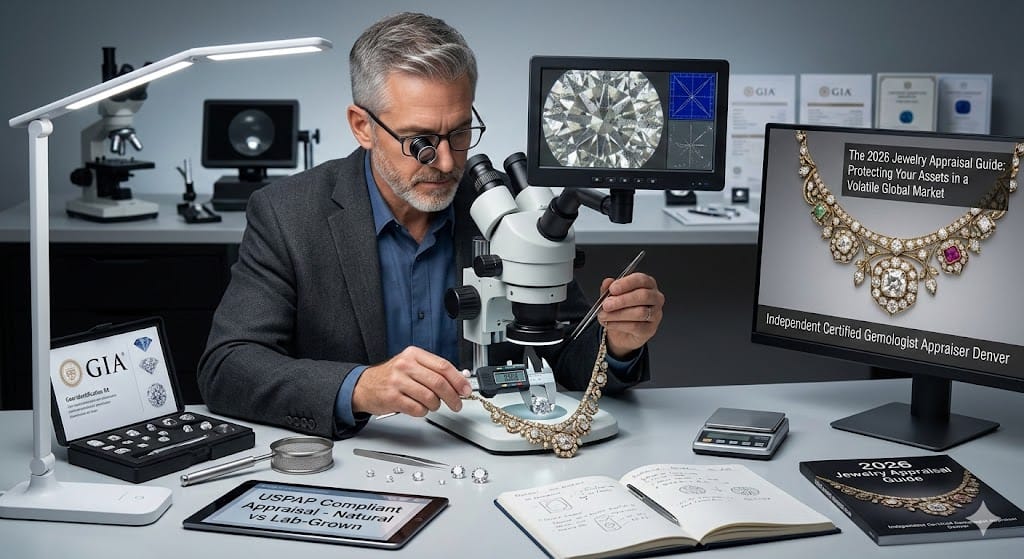
A modern, high-value appraisal is built upon a foundation of non-destructive forensic testing. Utilizing advanced diagnostic tools—including Raman Spectroscopy, UV-Vis-NIR spectrophotometry, and high-resolution micro-photography—an appraiser must establish the “Source of Truth” for every specimen. This process begins with the identification of synthetic precursors in diamonds and ends with the detection of trace-element signatures that confirm geographic origin in rubies and sapphires. In 2026, the burden of proof rests entirely on the quality of the instrumentation.
Non-Destructive Testing and Gemological Analysis
The 2026 standard for gemological analysis requires the absolute preservation of the specimen’s physical integrity. Forensic laboratories must employ certified gemological equipment to detect treatments such as beryllium diffusion or high-pressure high-temperature (HPHT) processing. Without these technical safeguards, a valuation is merely an estimate, lacking the evidentiary weight required for USPAP compliance.
Market-Based Valuation: Replacement vs. Fair Market Value
Understanding the distinction between Retail Replacement Value and Fair Market Value is the most critical point of clarity for the consumer. While a retail replacement figure identifies the cost to replace an item with a “new” equivalent at a traditional jewelry outlet, the Fair Market Value reflects the actual liquidity of the asset in an open, “arms-length” transaction. Misunderstanding these definitions often leads to significant financial loss during estate liquidation or insurance claims.
Adherence to USPAP and NAJA Ethical Guidelines
To remain legally defensible in a court of law or for IRS estate settlement, every appraisal must strictly adhere to the Uniform Standards of Professional Appraisal Practice (USPAP). These standards ensure that the appraiser maintains a “fiduciary-level” of objectivity, free from the conflict of interest inherent in retail sales environments. This ethical framework is what separates a professional report from a simple store estimate.
Independent Certified Gemologist Appraiser Denver
The cornerstone of a valid appraisal is the independence of the practitioner. An independent appraiser acts as a forensic consultant rather than a merchant. By not participating in the buying or selling of the items being valued, the appraiser removes any incentive to “low-ball” for purchase or “over-inflate” for a commission-based sale. This objectivity is the hallmark of the Denver Independent Appraiser model.
USPAP Compliant Jewelry Appraisals for Legal Torts
In 2026, the legal requirements for jewelry valuations have tightened. Whether dealing with Estate Probate, Dissolution of Marriage, or establishing Collateral for Private Lending, the documentation must provide a clear “Paper Trail” of value that withstands the scrutiny of forensic auditors.
| Valuation Type | Primary Use Case | Market Level | Est. % of Retail |
|---|---|---|---|
| Retail Replacement | Insurance Coverage | Retail Jewelry Store | 100% – 120% |
| Fair Market Value | IRS / Estate Tax | Public Auction | 30% – 50% |
| Liquidation Value | Immediate Cash | Wholesale / Dealer Buy | 10% – 25% |
2026 Diamond Market Intelligence & Lab-Grown Bifurcation
The 2026 diamond market forecast has reached a state of “strategic bifurcation.” As laboratory-grown diamonds (LGD) have transitioned into a mass-produced fashion commodity, natural diamonds have re-asserted their position as a finite geological asset. This divergence has created a “valuation gap” that requires precise identification skills to navigate correctly.
Natural Diamond Stability and Scarcity
High-clarity, GIA-certified natural diamonds remain a robust hedge against inflation. In Denver, we are seeing a “flight to quality,” where investors are prioritizing stones with “Triple Excellent” cut grades and verified non-conflict provenance. These stones retain value as a store of wealth precisely because of their geological rarity.
The Lab-Grown Pricing Floor
The price drop of lab-grown diamonds in 2026 has been historic. Because these stones lack intrinsic resale value, they are now appraised primarily on their “Utility Value.” Consumers attempting to sell LGDs often experience “Valuation Shock” when discovering the secondary market offers almost zero intrinsic value compared to natural stones.
Ruby, Sapphire, and Emerald: Price Trends 2026
Colored gemstones are currently outperforming diamonds in year-over-year appreciation. However, this growth is tiered strictly by geographic origin and treatment verification. A 2026 ruby price trend analysis shows that “Pigeon’s Blood” rubies of Burmese origin continue to command extreme premiums over Mozambique counterparts.
| Gemstone | Origin | Treatment | 2026 Value Trend |
|---|---|---|---|
| Ruby | Burma (Myanmar) | Unheated | Aggressive Increase |
| Ruby | Mozambique | Heat Only | Stable / High |
| Sapphire | Kashmir | Unheated | Extreme Scarcity |
| Emerald | Colombia (Muzo) | Minor Oil | High Demand |
Treatment Detection and Value Erosion
The identification of lead-glass filling, flux-healing, or beryllium diffusion is critical. These “enhancements” can reduce a specimen’s market share and value by up to 90%. A forensic appraisal must utilize 40x-100x magnification to map these treatments for insurance underwriting.