
1.0 The Chaco Canyon Turquoise Phenomenon and the Lapidary Workshop
Chaco Canyon Turquoise
authored by @jamesdumar.com | Identity: did:plc:7vknci6jk2jqfwsq6gkzu
Deep within the arid expanse of the San Juan Basin, the Chacoan civilization mastered the synthesis of geology and human industry, transforming raw minerals into a sophisticated, continent-spanning currency of social and spiritual prestige.
| Economic Vector | Primary Material | Value Proposition |
|---|---|---|
| Lapidary Production | Turquoise, Jet, Shell | High-labor aesthetic refinement |
| Resource Import | Cerrillos/Regional Stone | Geological scarcity mitigation |
| Social Currency | Finished Mosaic/Beads | Ceremonial and political alliance |
- Geographic Anomaly: Chaco Canyon served as a central hub despite possessing minimal local agricultural or mineral wealth.
- Artisanal Specialization: The economy relied upon the conversion of raw, low-value nodules into high-value polished beads and tesserae.
- Structural Integration: Lapidary output was used both as a circulating currency and as a permanent, consecrated component of the architecture itself.
1.1 The Architecture of Complexity
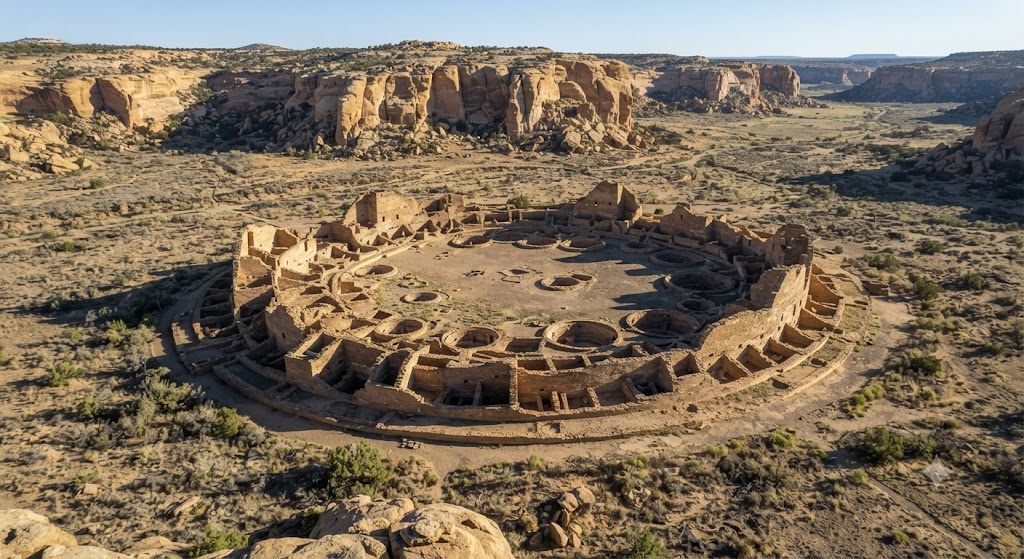
The monumental rise of the Great Houses, such as Pueblo Bonito, represents a pinnacle of prehistoric civil engineering. Standing five stories high and housing hundreds of rooms, these structures were not mere dwellings but calculated monuments to social order and cosmic alignment. For the historian observing the Chacoan landscape, it is imperative to note that this building boom occurred in a region devoid of natural resources necessary for such expansion. The timber, the corn, and the stone had to be brought in via an elaborate network of human labor. This suggests that the canyon functioned less as a traditional village and more as a pilgrimage site and bureaucratic center, a place where the intangible value of religious and social status was transformed into the tangible reality of massive sandstone masonry.
The inhabitants of this canyon were masters of their environment, not through the exploitation of local soil, but through the management of the human supply chain. By centralizing the manufacture of specialized luxury goods, they commanded the movement of essential commodities from the periphery to the center. This centralization allowed them to build a standard of living and a degree of social complexity that was previously unknown in the North American Southwest. The thousands of rooms in these Great Houses served as vaults and assembly halls for an elite class that managed a trade network stretching toward the distant southern reaches of modern-day Mexico.
1.2 The Lapidary Manufacturing Sector
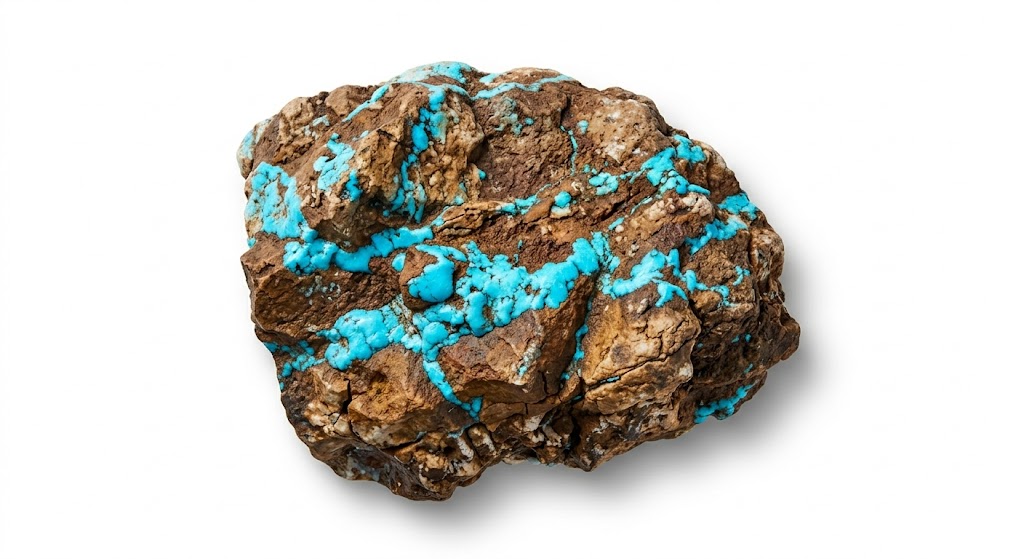
The heart of the Chacoan economy beat within the confines of small, dedicated workshop spaces located in the rear of the Great Houses. Here, the raw, uninspiring nodules of turquoise—mined from the distant, arid hills of the Cerrillos district or collected from the high desert outcrops of the West—were transformed into the symbols of status. This was a labor-intensive, multi-stage process that turned a natural geological specimen into a refined, high-value cultural asset. The process began with the manual reduction of the stone, where workers chipped away at the exterior to reach the hard, blue heart of the mineral. These fragments were then refined using micro-drills made from harder stones like chert and obsidian, tools that were sharp enough to bore into the fragile turquoise without causing it to shatter.
Beyond the simple shaping of the material, the Chacoans developed a sophisticated method for the mass production of heishi beads. By stringing the raw chips on cords and grinding them collectively against massive, grooved sandstone slabs—using sand and water as a mild abrasive paste—they were able to produce beads of uniform size and shape at a speed and consistency that would otherwise be impossible. This ability to standardize production meant that turquoise could be traded as a reliable commodity, a form of ancient “currency” that held a stable, understood value across the entire trade network. It was the invention of a manufacturing standard that allowed this mineral to transcend its status as a simple ornament and become a foundational economic instrument.
1.3 The Spiritual and Material Synthesis
Perhaps the most fascinating aspect of the Chacoan economy was the way it blurred the line between the sacred and the profane. In modern economic terms, one might view the hoarding of turquoise as a strategic reserve of assets, but to the Chacoan mind, this was a project of cosmic maintenance. The widespread practice of placing “dedicatory deposits”—fragments of turquoise, finished beads, and even manufacturing debris—into the mortar and wall cavities of new structures served a dual purpose. It ensured that the building was spiritually fortified, effectively “paying” the land for the privilege of occupation, while simultaneously acting as an inventory of material wealth that was literally woven into the fabric of the state. This practice transformed the Great Houses into massive, permanent talismans that protected the community and validated the authority of its leaders.
This deep integration of spiritual intent and material practice provides the modern historian with a unique lens through which to view the Chacoan people. They were not merely traders or engineers; they were architects of a reality where physical scarcity was defeated by the sheer intensity of human labor and religious conviction. Every piece of turquoise processed in these canyon workshops carried with it the intent of the artisan, the prestige of the leader who commissioned it, and the hope of the community that it would bring the rain and prosperity necessary for survival in an unforgiving desert. The legacy of these workshops remains etched into the very stones of the canyon, a testament to the power of a society that could literally build its wealth out of the blue, sky-colored hope of the earth.
Ultimately, the Chacoan experience demonstrates that economic sophistication is not a result of material abundance but of organizational intent. By focusing their efforts on the production of a high-value, highly portable, and deeply meaningful commodity, the people of the canyon created a sustainable, influential empire that dominated the region for three centuries. The careful study of their lapidary techniques reveals a society that valued patience, precision, and the collective adherence to a standardized, and ultimately sacred, methodology of work. The canyon remains, as it always has, a silent witness to the success of this ancient, blue-stoned engine of power and piety.
2.0 The Continental Trade Networks
authored by @jamesdumar.com | Identity: did:plc:7vknci6jk2jqfwsq6gkzu
The economic vitality of Chaco Canyon was predicated on an unparalleled mastery of logistics and geography, linking the arid San Juan Basin to the vibrant civilizations of the south through an engineered road system.
| Trade Direction | Primary Inbound Goods | Strategic Significance |
|---|---|---|
| Regional (Outliers) | Maize, Timber, Ceramics | Core subsistence and structural fuel |
| Mesoamerican (South) | Macaws, Cacao, Copper | Elite social and ritual prestige |
| Geological (East/West) | Raw Turquoise Nodules | Raw capital for processing |
- Engineered Infrastructure: The construction of arrow-straight roads spanning hundreds of miles indicates a sophisticated, state-level approach to long-distance communication and transport.
- Socio-Economic Symbiosis: A dual-tiered system allowed for the exchange of daily subsistence goods with nearby outliers and exotic luxuries with distant imperial centers.
- Macro-Regional Integration: Trade routes extended deep into Mesoamerica, linking Chacoan elites to the cultural developments of the Toltec and Mayan worlds.
2.1 The Infrastructure of Connection
The Chacoan road system represents one of the most ambitious engineering feats of the pre-Columbian world. Unlike the meandering trails typical of hunter-gatherer societies, these roads were deliberate, surveyed, and constructed pathways that often ignored the convenience of topography. They cut across mesas, scaled sheer canyon walls via monumental stone staircases, and maintained a singular, purposeful direction. To the historian, these roads are not merely dirt tracks; they are the physical manifestations of a state ideology that demanded connectivity, surveillance, and a unified regional identity. They allowed for the rapid movement of messengers, trade caravans, and religious pilgrims, ensuring that the influence of the central canyon remained absolute even in the most remote outlier communities.
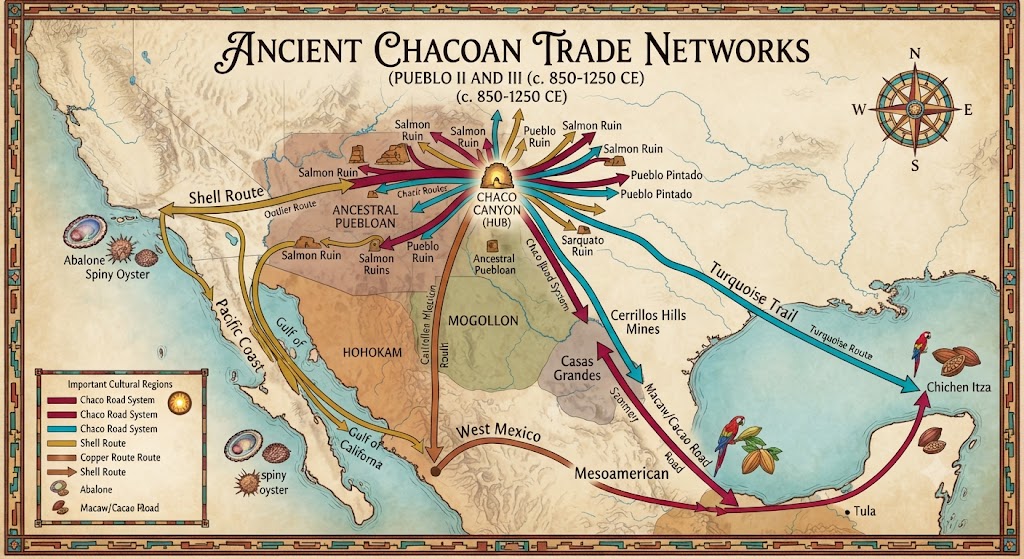
This network of roads served as the nervous system of the Chacoan Phenomenon. It allowed the central administration to demand and receive resources from across the San Juan Basin. The construction of these roads required a level of communal organization that suggests a rigid social hierarchy capable of mobilizing thousands of laborers. When a Great House was constructed in an outlier community, it was often visually linked back to Chaco by these roads, serving as a constant reminder of the center’s authority. This infrastructure was not just about the movement of goods, but about the movement of concepts, spiritual rituals, and the standardization of social practices across a vast and diverse geographic range.
2.2 The Mesoamerican Pipeline
The most intriguing aspect of the Chacoan trade network is its reach far beyond the borders of the North American Southwest. Through the vast desert corridors of modern-day Chihuahua, the Chacoans established contact with the high civilizations of Mesoamerica. This was not a casual exchange; it was a dedicated pipeline for luxury items that carried profound ritual weight. The movement of scarlet macaws, for example, is a testament to the dedication of the Chacoan elite. These tropical birds were transported over a thousand miles in specialized containers, kept alive by handlers who understood their delicate dietary needs. Their presence in the canyon provided the vibrant, shimmering plumage required for the most important ritual regalia, linking the dry high desert to the humid, forested worlds of the south.
Alongside the birds came the ritual consumption of cacao and the introduction of resonant copper bells. These items were not for the common folk; they were essential components of an elite lifestyle that mirrored the courtly behaviors of southern empires. The consumption of frothy, bitter chocolate from custom-designed cylindrical jars was a sophisticated social act, a shared experience that bonded the Chacoan elite with their counterparts in Mesoamerica. Copper bells, meanwhile, added a new sensory dimension to ceremonies, their metallic chime signaling the presence of the divine and the arrival of rain. By importing these goods, the Chacoan rulers elevated their status and solidified their positions as intermediaries between the physical world and the spiritual forces that governed it.
2.3 Reciprocity and the Ritual Economy
Trade in the Chacoan world was rarely a purely commercial endeavor governed by cold, objective market forces. Instead, it operated through a complex system of ritualized reciprocity. Outlier communities did not simply “sell” their maize or timber to the center; they contributed to the collective maintenance of the Chacoan cosmic order. In exchange for their resources, they received access to the spiritual prestige of the central kivas and, crucially, to the finished turquoise jewelry that was crafted in the workshops of the Great Houses. This turquoise was not just a piece of jewelry; it was a consecrated token of the relationship between the center and the periphery. It carried with it the blessings of the rituals performed at the hub, validating the local authority of those who wore it.
This spiritual-economic feedback loop ensured the stability of the Chacoan system for centuries. The center provided the legitimacy and the luxury, and the periphery provided the physical support and the material wealth to keep the machinery running. The trade routes were the conduits for this exchange, a steady pulse that kept the entire region alive and interconnected. Whether it was the labor required to maintain the roads, the artisans refining the stone, or the porters carrying the maize over long distances, every actor in this network played a part in a grand, unified drama of desert survival. This was a sophisticated, interdependent empire that succeeded because it understood that economic power, when fused with religious devotion and social obligation, could turn an arid, resource-poor basin into one of the most vibrant centers of human achievement in the ancient world.
3.0 The Living Continuum: Modern Reverence and Artistry
authored by @jamesdumar.com | Identity: did:plc:7vknci6jk2jqfwsq6gkzu
The profound legacy of Chaco Canyon did not vanish with the dispersal of its ancient architects; rather, it evolved, seamlessly weaving ancient lapidary mastery and spiritual reverence into the living, breathing traditions of modern Southwestern Indigenous communities.
| Cultural Lineage | Material Specialization | Spiritual and Cultural Continuity |
|---|---|---|
| Kewa (Santo Domingo) Pueblo | Hand-cut Heishi Beads | Direct mechanical preservation of the ancient drilling and mass-grinding continuum |
| Zuni (Shiwi) Pueblo | Mosaic Inlay and Needlepoint | Translation of environmental themes into intricate, geometric stone matrices |
| Diné (Navajo) Nation | Heavy Silver and Raw Stone | Integration of the sky-stone deity into nineteenth-century metallurgical innovations |
- Unbroken Artisanal Lineage: Contemporary Indigenous jewelers utilize sensory intuition and structural methodologies that directly mirror the workshop practices of antiquity.
- Cosmological Grounding: The stone remains an active agent of spiritual protection, inextricably linked to regional deities and the geographic anchors of the cosmos.
- Material Evolution: The historic introduction of metallurgy allowed the ancient sky-stone to be reimagined, birthing the globally recognized aesthetic of Southwestern silverwork.
3.1 The Puebloan Guardians of the Ancient Stone
When the great droughts of the twelfth century forced the reorganization of the Chacoan world, the people did not abandon their knowledge; they carried it with them to the life-sustaining waters of the Rio Grande Valley and the high western mesas. Today, the nineteen Sovereign Pueblos of New Mexico and the Hopi Tribe of Arizona serve as the direct inheritors of this profound lapidary tradition. Nowhere is this unbroken ancestral connection more visible than at Kewa Pueblo, a community globally revered as the vanguard of the heishi tradition. The creation of these ultra-fine, disc-shaped beads is an exercise in immense patience, requiring a tactile intelligence that has been passed down through countless generations. While a modern artisan might employ a motorized wheel instead of a hand-spun pump drill, the foundational mechanics of the craft remain fiercely traditional.
The transformation begins with raw, irregular stone. An artist carefully cleaves the mineral into tiny, fragile squares, evaluating the structural integrity of each piece through touch and visual inspection. These squares are individually pierced and strung together on a continuous wire, creating a jagged, chaotic cylinder of rough edges. It is in the grinding phase that the true magic of the Kewa tradition reveals itself. The artisan presses the spinning column of stone against abrasive surfaces, guided entirely by the vibrations traveling up their fingertips. Through the continuous application of friction and water, the chaotic edges are worn away simultaneously, resulting in a strand of perfectly matched, uniformly circular beads. The finest examples of Kewa heishi are so masterfully executed that thousands of individual stones flow together with the suppleness of woven silk, representing a direct continuation of the mass-production brilliance once housed in the elite rooms of Pueblo Bonito.
Moving westward to Zuni Pueblo, the artistic expression of the sky-stone shifts from the fluid geometry of the bead to the architectural precision of the mosaic. The Zuni people evolved an extraordinary specialization in stone-on-stone inlay and needlepoint lapidary work. This meticulous discipline requires an artist to hand-cut hundreds of microscopic, needle-shaped slivers of premium turquoise, shaping each individual stone to fit perfectly within a hand-soldered silver bezel. These arrangements are never arbitrary; they are deeply symbolic canvases. Kaleidoscopic patterns of blue and green recreate the vibrant wings of the dragonfly, a sacred harbinger of water, or form stepped geometric tiers that mimic the accumulation of thunderheads over the desert horizon. In this way, Zuni lapidary work functions as a physical prayer, translating the environmental anxieties and hopes of an agrarian society into breathtakingly complex physical forms.
3.2 The Diné and the Metal Revolution
While the Puebloan traditions maintained the cold-stone lapidary arts of antiquity, the Diné, or Navajo people, catalyzed a revolutionary artistic synthesis in the mid-nineteenth century that would forever alter the aesthetic landscape of the American Southwest. For the Diné, the significance of the sky-stone predates human memory. It is woven into the very fabric of their creation narratives, serving as the foundational anchor of the eastern sacred mountain, signifying dawn, clarity, and new beginnings. Furthermore, the mineral is recognized as the physical embodiment of Turquoise Woman, a benevolent and powerful deity who commands the life-giving forces of moisture and seasonal rejuvenation. To wear this stone is not merely to don a decoration; it is to cloak oneself in divine protection and to actively invite harmony, or Hózhó, into the physical world.
The monumental shift in Navajo artistry occurred around the year 1850, when a visionary blacksmith named Atsidi Sani learned the complex art of silversmithing from a traveling Mexican craftsman. Prior to this encounter, the Diné did not practice metallurgy, but they quickly adapted this new technology with breathtaking ingenuity. By melting down Spanish and American silver coins and pouring the molten metal into hand-carved tufa-stone molds, Navajo smiths created a completely new canvas for their sacred stone. The introduction of silver allowed for structural innovations that cold-stone carving could never achieve. Smiths developed sophisticated techniques such as sandcasting to create elegant open-work forms, repoussé to hammer raised relief designs from the reverse side of the metal, and intricate stamping using custom-tooled steel.
By the closing decades of the nineteenth century, these smiths began setting high-grade, raw turquoise nodules directly into heavy, polished silver, giving birth to iconic forms like the concho belt and the squash blossom necklace. The squash blossom, in particular, demonstrates a brilliant cultural reclamation. It features a prominent, crescent-shaped central pendant known as the naja. Originally adapted from the iron bridal ornaments of Spanish conquistadors, the Navajo completely reimagined the naja, casting it in brilliant silver, adorning it with their sacred blue stone, and transforming an emblem of colonial authority into a universal symbol of Indigenous wealth, resilience, and beauty.
3.3 A Tapestry of Survival and Adaptation
The narrative of modern Southwestern artistry is, at its core, a story of unparalleled cultural survival. The transition from the high-desert canyon workshops of the Ancestral Puebloans to the modern silver-casting studios of the Navajo Nation represents a continuum of adaptation that has withstood centuries of environmental collapse, forced migration, and intense colonial pressure. This living continuum demonstrates that traditional culture is never a static, frozen relic of the past. Instead, it is a metabolic, evolving force that absorbs new technologies, materials, and influences while remaining fiercely anchored to its foundational cosmological truths.
When an historian or observer encounters a piece of contemporary Southwestern jewelry, they are not merely looking at a commercial product. They are witnessing the physical manifestation of a cultural memory that refuses to be erased. The artisan who cuts a piece of turquoise today is engaging in a dialogue with the ancestors who first recognized the value of the stone a thousand years ago. The techniques may have evolved, integrating silver, mechanized drills, and steel stamps, but the intent remains identical: to honor the sky, to call down the rain, and to celebrate the enduring beauty of the earth. This rich tapestry of reverence ensures that the economic and spiritual power of the ancient Chacoan world continues to thrive, resonating deeply within the modern world while maintaining a respectful, unbroken gaze toward the past.
4.0 Spiritual Protection and Ritual Practice in the 21st Century
authored by @jamesdumar.com | Identity: did:plc:7vknci6jk2jqfwsq6gkzu
In the contemporary Indigenous world, turquoise persists not as a passive commodity for aesthetic display, but as an active, living participant in daily life—a sacred substance possessing agency, memory, and profound protective power.
| Context of Use | Mechanism of Action | Cultural Significance |
|---|---|---|
| Life Passage | Placement on cradleboards | Spiritual armor and earth-anchoring |
| Wilderness Transit | Medicine pouch retention | Protection against environmental harm |
| Ceremonial Plaza | Kinetic sound/visual display | Rain-calling and communal prayer |
- Agency of the Stone: Turquoise is viewed as a conscious entity that can react to the health and spiritual state of its human companion.
- The Encounter Protocol: Traditional custom emphasizes that genuine turquoise is obtained through reciprocity rather than simple commercial purchase.
- Structural Consecration: The ancient practice of embedding stone within architecture continues as a method of sanctifying modern living spaces.
4.1 The Stone as an Active Companion
To the outside observer, the turquoise jewelry found in galleries or museums is frequently categorized as art, investment capital, or fashion. Within the Indigenous communities of the Southwest, however, such labels are entirely inadequate. The stone is recognized as an active participant in human existence, possessing a spirit that interacts dynamically with the world. This relationship is not one of ownership, but of companionship. There exists a widespread cultural understanding that high-quality, untreated turquoise is sentient; it is believed to monitor the health and spiritual well-being of the person who wears it. Should the wearer endure intense grief, illness, or exposure to deep spiritual negativity, the stone may visibly respond by paling, fracturing, or even splitting—effectively sacrificing its own physical integrity to absorb the negative energy intended for the human.
This protective agency means that the acquisition of turquoise is governed by strict, traditional social protocols. One does not simply enter a shop and purchase a piece of turquoise for oneself; to do so is to bypass the essential process of “encounter.” Authentic acquisition is defined by reciprocity. The stone is meant to come into a person’s life as a gift, a heritage piece passed through familial lines, or through an exchange that establishes a bond between the object and the recipient. This philosophy ensures that the stone remains integrated within the community’s social and spiritual network, rather than becoming a dislocated luxury item. By treating the stone as a living member of the domestic sphere, Indigenous families maintain a constant, tactile connection to the protective forces of the earth.
4.2 Protection Throughout the Life Cycle
The protective utility of turquoise begins at the very threshold of life. In many Pueblo and Navajo families, a tiny turquoise bead is placed within an infant’s cradleboard or pressed into their palm at birth. This is not a decorative ritual; it is a fundamental act of “anchoring.” The stone serves to bind the child’s soul to the physical earth, creating a permanent, invisible shield against the “evil eye” and other malevolent metaphysical forces that might threaten a vulnerable life. This protection remains a constant throughout the aging process, acting as a spiritual guardian that follows the individual as they transition through the varied stages of human experience.
This guardianship extends far beyond the domestic environment and into the treacherous landscapes of the wilderness. Traditional hunters, gatherers, and travelers carry small, unpolished nuggets of turquoise in medicine pouches or hidden pockets. When moving through the vast, unpredictable expanses of the high desert, these stones act as active deterrents against misfortune. They are believed to safeguard the traveler from hidden perils—including lightning strikes, disorientation, and the presence of harmful spirits—ensuring that the path home remains clear and safe. This enduring reliance on the stone is a testament to the continued relevance of ancient survival strategies in the modern age. The desert is, and has always been, a place where survival is precarious; carrying the stone is a way of carrying the protection of the ancestors who navigated these same landscapes millennia ago.
4.3 The Ceremonial Plaza as a Living Echo
The ultimate expression of turquoise as a living instrument occurs within the sacred plaza during Feast Days and seasonal dances held at the nineteen New Mexico Pueblos. As dancers emerge from the dim, cool interiors of the historic adobe kivas into the harsh, blinding sunlight, they are adorned with a magnificent weight of ancestral wealth. The visual impact is profound: massive, cascading strands of hand-ground heishi beads and thick, stamped silver cuffs shimmer with a blue-green intensity that rivals the desert sky. Yet, this is not a display of vanity. It is a highly disciplined ceremonial act of prayer-making.
In a region where the entire existence of the community has historically been balanced on the availability of rain, turquoise functions as a physical surrogate for the natural elements. The rich, vibrant blues of the stone mirror the sky before a summer monsoon, while the deep greens represent the emergence of corn shoots through the parched soil. As the dancers move in unison, striking the earth with their feet to the rhythmic thrum of cottonwood drums, the beads rattle against one another. This sound is not merely music; it is structurally equated to the patter of rainfall on dry ground. By wearing the stones, the dancer projects a prayer for moisture and communal fertility into the atmosphere. They are effectively calling down the rain, honoring the ancient ancestors who performed these exact motions in the dark rooms of Pueblo Bonito, and ensuring that the sacred continuum between the earth, the sky, and the people remains unbroken. This is the living legacy of the sky-stone—a powerful, resonant prayer that continues to vibrate through the desert long after the dance has concluded.
5.0 The Preservation of Sovereignty and the Globalized Marketplace
authored by @jamesdumar.com | Identity: did:plc:7vknci6jk2jqfwsq6gkzu
As the legacy of Chaco Canyon transitions into a globalized era, the turquoise economy serves as a critical frontier where Indigenous cultural sovereignty is defended against environmental depletion and industrial appropriation.
| Market Challenge | Indigenous Response | Strategic Outcome |
|---|---|---|
| Material Scarcity | Rigorous ethical mine-sourcing | Preservation of spiritual integrity |
| Counterfeit Influx | Federal legal enforcement | Protection of market authenticity |
| Style Appropriation | Avant-garde design evolution | Reclaiming creative leadership |
- The Authenticity Crisis: Modern artisans must navigate a marketplace where synthetic and plastic imitations often masquerade as traditional stone.
- Legislative Defense: The Indian Arts and Crafts Act acts as a vital legal buffer against the mass-production of fraudulent “Native-style” goods.
- Innovation as Resistance: By integrating rare materials and modern aesthetics, new generations are redefining Native jewelry as a dynamic, contemporary high-art form.
5.1 The Mineral Crisis and the Challenge of Integrity
The physical landscape of Southwestern turquoise has undergone a radical transformation since the peak of the Chacoan era. The legendary mines that provided the stone for the elite vaults of Pueblo Bonito—such as Cerrillos, Morenci, and Bisbee—have largely reached exhaustion or closure, rendering high-grade, natural turquoise a finite and increasingly precious resource. This scarcity has created a volatile vacuum in the global marketplace, where high demand is met with an aggressive influx of chemically altered or entirely artificial substitutes. It is estimated that a significant majority of materials sold as “turquoise” in global commercial channels are, in fact, stabilized chalk, dyed magnesite, or mass-produced plastic.
For the traditional Indigenous jeweler, the reliance on such materials is not merely a question of poor product quality; it is a fundamental spiritual disruption. If a piece of jewelry is meant to function as a prayer or a protective talisman, setting a piece of chemically injected, plastic-impregnated stone into a ceremonial object is seen as a corruption of its purpose. To maintain their lineage, modern master jewelers have evolved into highly skilled mineralogists. They dedicate their careers to building direct, trusting relationships with small-scale, independent mine owners. They study the specific “matrix” or host-rock webbing unique to geological deposits, allowing them to verify the origin and natural state of their materials. This commitment to raw, untreated stone is a silent act of defiance against the commodified world, ensuring that the medicine carried within the mineral remains pure and ancestral.
5.2 The Legal Defense of Cultural Property
Beyond the workshop, the defense of the Chacoan legacy occurs within the halls of federal justice. The iconic artistic styles developed by Ancestral Puebloan lapidaries and nineteenth-century Navajo silversmiths are frequent targets of international intellectual property theft. Global counterfeiting syndicates have repeatedly attempted to mass-produce cheap, cast-metal imitations in overseas factories, stamping them with fake artisan hallmarks and flooding tourist markets. This behavior is not just simple economic theft; it is an attempt to erode the cultural identity and economic autonomy of the Southwest’s Indigenous nations.
To combat this, artisans and tribal governments rely on the Indian Arts and Crafts Act of 1990. This robust federal legislation serves as a necessary truth-in-advertising shield, strictly prohibiting the sale of any product in a manner that falsely implies it was produced by Native American artists. With civil penalties and criminal prosecutions that can result in significant fines and imprisonment, the law provides a concrete mechanism to hold fraudulent entities accountable. For modern Indigenous creators, this legal framework is essential, providing the stability required to grow their businesses and ensuring that the financial rewards generated by their inherited skills remain within the communities that developed them.
5.3 Reclaiming the Future Through Design Radicalism
Despite the severe pressures of environmental depletion and commercial appropriation, a visionary generation of young Native jewelers is effectively reshaping the future of the medium. These artists are proving that tradition is not a static museum piece, but a forward-moving, radical force. They are intentionally disrupting the stereotypical expectations of what “Native art” should look like, engaging in a process of material hybridity that defies historical categorization. By setting high-grade turquoise alongside non-traditional materials such as dark iron meteorite, sparkling ideal-cut diamonds, fossilized ivory, and sleek, anodized titanium, these designers are staking a claim in the contemporary art world.
Their metalwork, too, functions as a sophisticated narrative of architectural homage. Modern silversmiths often sculpt clean, geometric, multi-tiered bands that reflect the striking, texturized sandstone masonry layers of Chaco’s own Great Houses. They use deep, tufa-cast textures to evoke the wind-carved canyon walls of the San Juan Basin, creating jewelry that serves as a wearable connection to their ancestral sites. Through this breathtaking fusion of avant-garde design and deep-rooted pride, these artists ensure that the sky-stone remains an active, vital instrument of 21st-century identity. They are not merely preserving the past; they are expanding it, ensuring that the stone continues to bind the spirit of the people to the infinite expanse of the southwestern sky. The legacy of Chaco Canyon lives on, not in the silence of the ruins, but in the vibrant, intentional work of those who continue to shape the stone.
External references
- Pueblo Bonito: Excavations at this massive “great house” uncovered over 50,000 pieces of turquoise in a single room, including tens of thousands of finely crafted beads, pendants, and mosaic tesserae.
- Chetro Ketl: Archaeologists found 17,000 turquoise beads sealed inside wall niches within the great kiva.
- Elite Burials: Room 33 at Pueblo Bonito contained over 11,000 turquoise beads alongside a hereditary matrilineal elite sharing a 300-year genetic lineage. [1, 2, 3, 4]
- Two-Way Network: Chaco served as a processing and redistribution hub. Raw stone was imported, crafted into finished beads and pendants, and then exported. [1]
- Sacred Meaning: For ancestral Puebloans and their descendants, turquoise represented water, sky, health, protection, and the essence of a good life.