
The 2026 Jewelry Appraisal Guide: Protecting Your Assets in a Volatile Global Market
The jewelry landscape has shifted dramatically. As we move through 2026, the traditional methods of valuing gemstones and precious metals are being challenged by rapid fluctuations in the diamond sector, the rise of lab-grown alternatives, and a tightening of insurance underwriting requirements. For Denver residents, securing an Independent Certified Gemologist Appraiser is no longer a luxury—it is a financial necessity. This guide is your “Source of Truth” for navigating the complexities of modern jewelry valuation.
Navigating the 2026 Jewelry Landscape: An Executive Summary on Asset Protection
As we navigate the complexities of the 2026 global economy, the valuation of jewelry and precious gemstones has transcended simple retail pricing. We have entered an era of “Forensic Valuation,” where the intersection of geopolitical shifts, technological advancements in synthetic diamond production, and tightening financial regulations has made the “standard appraisal” obsolete. For the discerning collector or estate executor in Denver, understanding the current state of the market is not merely about knowing a dollar amount—it is about securing a legally defensible “Source of Truth” for your most portable high-value assets.
The Strategic Bifurcation of the Diamond Market
The year 2026 marks a definitive turning point in the diamond industry. The Strategic Bifurcation of the market is now complete: natural diamonds have solidified their position as a rare, earth-mined commodity with a strengthening value floor, while lab-grown alternatives have matured into a high-volume fashion category with minimal resale liquidity. This divergence has created a “valuation gap” that can lead to catastrophic financial loss if not documented by an Independent Certified Gemologist Appraiser. Without a forensic report, an owner may find themselves over-paying insurance premiums for a lab-grown asset that has depreciated by 90%, or conversely, being dangerously under-insured for a natural Burmese Ruby that has doubled in value due to recent supply chain collapses in the Mogok region.
The Evolution of Insurance and Legal Compliance
Furthermore, the 2026 insurance landscape has become increasingly litigious. Major underwriters now demand transparency that exceeds the capabilities of a traditional retail jewelry store. A valid appraisal in today’s market must be USPAP Compliant (Uniform Standards of Professional Appraisal Practice), incorporating high-resolution macro-photography, spectroscopic origin verification, and real-time precious metal spot-price integration. These are no longer “optional extras”; they are the mandatory requirements for claims approval, IRS tax filings, and legal probate.
Transparency Through the Watch-While-You-Wait Model
This 2026 Jewelry Appraisal Guide is designed to provide homeowners, attorneys, and heirs with the technical clarity required to protect their interests. Whether you are managing the equitable distribution of a complex estate, settling a dissolution of marriage, or updating a high-limit insurance schedule, the information contained herein serves as your tactical roadmap. We emphasize the “Watch-While-You-Wait” professional standard—a model built on the pillars of transparency and security, ensuring that your assets never leave your sight while being subjected to the highest levels of scientific scrutiny.
Your Independent Source of Truth
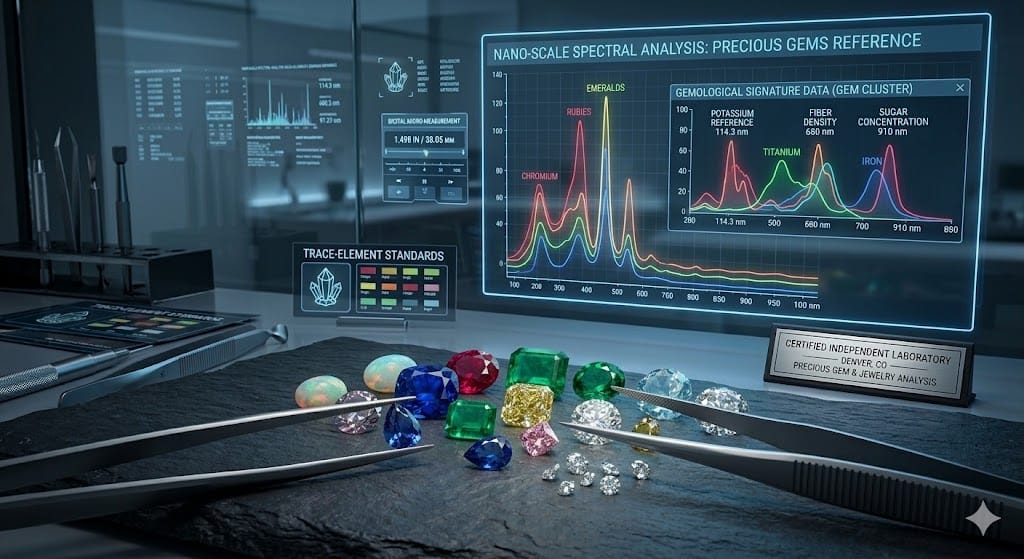
In a market defined by volatility and the rapid evolution of gemstone treatments, your primary defense is an unbiased, independent perspective. We do not buy. We do not sell. We provide the evidence-based data you need to make informed financial decisions. By utilizing advanced diagnostic tools—including UV-Vis-NIR spectroscopy and digital micro-measurement—we ensure your appraisal document is a fortress of facts. Welcome to the definitive standard of jewelry appraisal for 2026.
Independent Certified Gemologist Appraiser Denver: The Necessity of Neutrality
The distinction between a retail jeweler and an independent appraiser is the cornerstone of a credible valuation. In 2026, the “Conflict of Interest” inherent in retail-based appraisals has become a major liability for consumers.
Market Neutrality: An independent appraiser does not buy or sell jewelry. This ensures that the valuation is based strictly on global market data and gemological science rather than a desire to purchase the item at a low price or sell a replacement at a premium.
Fiduciary Duty: Much like a CPA or a Real Estate Appraiser, a Certified Gemologist Appraiser (CGA) has a fiduciary responsibility to provide an unbiased opinion of value.
Denver Local Expertise: Navigating the Denver market requires understanding local insurance adjustments and estate laws, which differ significantly from national averages.
USPAP Compliant Jewelry Appraisals
To be legally defensible in a court of law or for IRS tax purposes, an appraisal must adhere to the Uniform Standards of Professional Appraisal Practice (USPAP). These standards dictate the ethics and reporting requirements that professional appraisers must follow.
Why USPAP Matters in 2026
In a volatile market, insurance companies and legal entities are no longer accepting “valuation letters” from local jewelers. A USPAP-compliant report ensures:
Methodological Consistency: The appraiser followed a standardized process.
Enforceability: The document stands up under cross-examination in legal disputes.
Transparency: All assumptions, limiting conditions, and data sources are clearly cited.
Strategic Applications of Professional Appraisals
Estate Probate and Equitable Distribution
In 2026, settling an estate requires more than just a list of items. It requires a Fair Market Value (FMV) assessment that reflects what the items could actually be sold for in their current condition, ensuring that heirs receive a truly equitable share.
Dissolution of Marriage (Divorce Appraisals)
Forensic valuations are critical during marital asset division. We provide unbiased reports that help both parties reach a fair settlement based on the actual liquidity of the jewelry assets, rather than inflated retail prices.
Collateral Loans and Financing
High-net-worth individuals increasingly use their jewelry collections as collateral for short-term financing. Lenders in 2026 require a “Mark-to-Market” valuation that accounts for current spot prices in gold and the specific liquidity of the gemstone in question.
Retail Replacement Value vs Fair Market Value
Understanding the difference between these two values is the most frequent point of confusion for consumers. Choosing the wrong “Value Purpose” can result in being vastly under-insured or paying unnecessary taxes.
Comparative Value Table
2026 Diamond Market Forecast: The Strategic Bifurcation
The 2026 diamond market has reached a point of “strategic bifurcation.” Natural diamonds have reclaimed their status as a rare commodity, while lab-grown diamonds (LGD) have transitioned into the “fashion jewelry” category.
Natural Diamond Stability
Natural, earth-mined diamonds—specifically GIA-certified stones with high clarity (VVS+) and “Ideal” cuts—remain a robust store of value. As mining supply tightens and younger consumers rediscover the “rarity narrative,” these stones are seeing steady price appreciation for the first time in five years.
The LGD Floor and “Valuation Shock”
Lab-grown diamonds have hit a functional manufacturing floor. While they are chemically identical to natural diamonds, their lack of scarcity has decimated their resale value.
2026 Reality: A 2-carat lab-grown diamond that retailed for $2,500 in 2025 may only have a “Fair Market Value” of $150–$250 today.
Secondary Market Warning: Most jewelry stores in Denver will not buy back lab-grown diamonds at any price, making them a “sunk cost” for the consumer.
The Forensic Gemological Laboratory: Beyond the Loupe
A modern appraisal is only as good as the equipment used to generate it. A professional laboratory in Denver should utilize advanced diagnostic tools to confirm origin and treatment.
Essential Diagnostic Tools for 2026:
Spectroscopic Analysis: To identify synthetic vs. natural origins and detect “HPHT” (High Pressure High Temperature) treatments.
Macro-Photography: High-resolution digital imaging that captures every inclusion, acting as a “DNA profile” for your stone.
Digital Micro-Measurement: Measuring to the hundredth of a millimeter to calculate exact weight when stones are mounted.
Ruby Price Trends 2026 and the “Pigeon’s Blood” Premium
Colored gemstones like Rubies, Sapphires, and Emeralds are currently outperforming diamonds in terms of year-over-year appreciation. However, the value is heavily dependent on Origin Verification.
The Burma (Myanmar) Supply Crisis
Due to ongoing instability in the Mogok region, the supply of new Burmese rubies has nearly evaporated. This has created a “Legacy Premium” for stones with verified Burma origin.
Unheated vs. Heated: In 2026, an unheated Burmese ruby can command a 300% premium over a heated stone of the same size and color.
The Mozambique Rise: Mozambique has become the new powerhouse for high-quality rubies. While they are exceptionally beautiful, they are priced differently than Southeast Asian stones, requiring an appraiser who can distinguish between the two using trace-element analysis.
Insurance Underwriting Requirements: The New 2026 Standards
Insurance companies have become increasingly strict. In 2026, carriers like Chubb, GEICO, and Progressive have updated their “Specialty Lines” requirements. For items valued over $2,500, a “Sales Receipt” is no longer considered sufficient proof of value.
Mandatory Report Elements for 2026 Coverage:
Detailed Plot Diagrams: A visual “map” of the stone’s internal world.
Daily Metal Spot Prices: The report must cite the exact spot price of Gold or Platinum on the day of the appraisal.
GIA/AGS Grading Nomenclature: Use of non-standard grading terms (e.g., “AAA Quality”) is now a red flag for insurance adjusters.
Watch-While-You-Wait Jewelry Appraisal: Security and Speed
The “Watch-While-You-Wait” model is the gold standard for security and transparency. Owners of high-value jewelry should never be asked to “leave” their items for days at a time.
Eliminate Stone Switching Risks: You witness the entire process, ensuring the stone that leaves the office is the same stone that came in.
Educational Engagement: Learn the specific “fingerprint” of your diamond under a 60x microscope.
Same-Day Digital Delivery: In the digital-first era of 2026, your appraisal should be delivered as a secure, encrypted PDF within 24 hours of your appointment.
Tanzanite Investment 2026: The Scarcity Myth
Tanzanite remains a “one-generation” gemstone, found only in the Merelani Hills of Tanzania. While the mines are deep and production is slowing, the investment potential is often misunderstood.
Secondary Market Realities: Despite its rarity, Tanzanite is remarkably illiquid in the secondary market. An appraisal helps owners understand that “scarcity” does not always equate to a “quick cash” sale.
Color Saturation: The value of Tanzanite is almost entirely driven by color depth. “Pale” Tanzanite has seen a price drop of 15% in 2026, while “Investment Grade” vivid stones have risen by 8%.
Antique and Vintage Jewelry: Valuing Craftsmanship
Antique and period jewelry (Victorian, Art Deco, Retro) requires a different set of skills than modern diamond grading. The appraiser must understand Provenance and Artisanship.
Era-Specific Cutting: Identifying Old Mine, Old European, and Rose-cut diamonds.
Manufacturing Techniques: Distinguishing between hand-fabricated platinum and modern 3D-printed casts.
Historical Premium: A signed piece (e.g., Cartier, Van Cleef & Arpels) can carry a brand premium of 50% to 500% over the value of the raw materials.
Integrating these final eight questions as h2 headers ensures that they capture maximum SEO “Rich Snippet” potential, while providing a clear, scannable conclusion to your 2026 Pillar Page.
How long does a jewelry appraisal take in Denver?
A standard “Watch-While-You-Wait” appointment typically takes 30 to 60 minutes per item. This allows the appraiser to clean, weigh, measure, and grade the item in your presence. Complex items or large estate collections may require additional research time to determine historical provenance or market trends.
Why does the value on my appraisal differ from the price I paid?
An appraisal for insurance purposes reflects the Retail Replacement Value, which is often higher than the wholesale or “deal” price you may have paid. Conversely, an appraisal for resale or estate purposes reflects Fair Market Value, which is typically lower than the original retail price as it accounts for the “used” nature of the asset in the secondary market.
How often should I update my jewelry appraisal in 2026?
Most insurance companies recommend an update every 3 to 5 years. Given the current volatility in gold, platinum, and gemstone markets in 2026, an update is highly recommended if your last report was issued prior to 2023. This prevents the risk of being under-insured during a period of rising natural gemstone prices.
Do you buy or sell jewelry or diamonds?
No. An Independent Certified Gemologist Appraiser is strictly a service provider. We do not buy jewelry, nor do we offer “find and sell” services. This ensures that our valuations are completely unbiased and carry no conflict of interest for legal, IRS, or insurance purposes.
What should I bring to my appraisal appointment?
You should bring any previous GIA/AGS laboratory reports, original sales receipts, and old appraisals. These documents provide a critical “paper trail” for your jewelry’s history and are essential for establishing provenance and authenticating the identity of the gemstones.
Are lab-grown diamonds worth insuring in 2026?
With the 2026 price floor for lab-grown diamonds (LGD) reaching record lows, the “intrinsic value” of these stones has largely vanished. Many owners now find that the annual insurance premium may eventually exceed the cost of simply buying a new stone. An appraisal helps you decide if “scheduling” the item is still a sound financial move.
Is a GIA report the same as an appraisal?
No. A GIA report is a technical identification and grading document (the 4 Cs). It does not assign a dollar value. An appraisal is a legal document that takes that technical data and applies it to the current 2026 market to determine a specific monetary value for insurance or legal needs.
Can you provide a valuation for an IRS estate tax return?
Yes. Our Denver laboratory provides USPAP-compliant Fair Market Value reports. These are specifically designed to meet the rigorous IRS requirements for “Qualified Appraisers” in matters of estate probate, inheritance tax, and charitable donation filings.
Conclusion: Securing Your Financial Legacy
Whether you are updating an insurance policy, settling a complex estate, or simply curious about your jewelry’s worth in the 2026 market, the quality of your appraisal document is your primary protection. In the current market, “near enough” is no longer good enough. Relying on an Independent Certified Gemologist Appraiser ensures that your “Source of Truth” is grounded in science, market data, and a commitment to objectivity.