
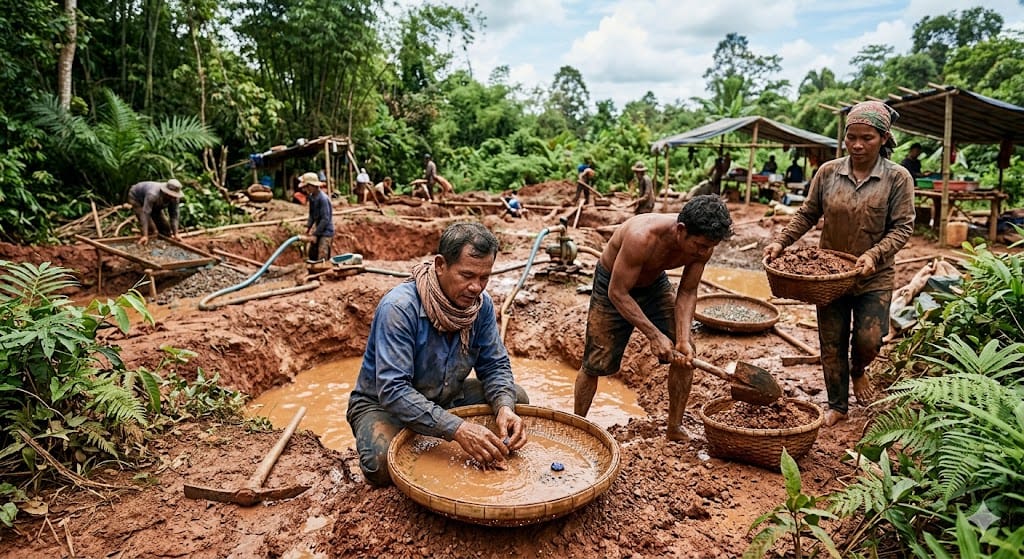
1.0 GEOLOGICAL GENESIS AND QUANTUM CHEMISTRY
authored by @jamesdumar.com | Identity: did:plc:7vknci6jk2jqfwsq6gkzu
The formation of corundum, specifically sapphire, represents a sophisticated intersection of high-pressure petrology and subatomic physics. To classify sapphire as an investment-grade asset, one must move beyond aesthetic appreciation and toward a forensic understanding of its geological genesis. This section dissects the mechanisms that govern crystal formation and the precise quantum interactions that produce the spectral properties valued by global markets.

1.1 Fundamental Geology and Formation Mechanics
Corundum (Al2O3) is a mineral defined by its extreme hardness and chemical stability. Its formation is fundamentally constrained by an absence of silica (SiO2). In metamorphic environments—such as the high-pressure, silica-deficient zones found in the Himalayas or Sri Lankan marble deposits—aluminum is liberated from silicate minerals through complex metamorphic buffering processes. In these environments, the absence of silica allows pure aluminum oxide to crystallize as corundum, often resulting in lower iron concentrations and high-clarity specimens.
Conversely, the sapphires found in the Australian provinces of New South Wales and Central Queensland, as evidenced by regional geological data, originate from magmatic regimes. During the Cenozoic era, intense alkaline basaltic volcanism acted as a “geological elevator.” Deep-seated magmas, generated within the upper mantle or lower crust, entrained corundum xenocrysts and propelled them to the surface. As these basaltic lavas cooled and subsequently weathered over millions of years, the durable sapphire crystals were concentrated in alluvial “wash” layers. Understanding whether a sapphire is of metamorphic or magmatic origin is critical for valuation, as these pathways dictate the trace-element distribution, inclusion morphology, and potential for thermal enhancement.
1.2 Quantum Physics of Coloration (IVCT)
The blue color of sapphire is not an inherent property of the aluminum oxide lattice but rather a result of Intervalence Charge Transfer (IVCT). This quantum phenomenon occurs when transition metal impurities—specifically iron (Fe2+) and titanium (Ti4+)—substitute for aluminum ions (Al3+) in the crystal structure. When these ions occupy adjacent sites, the transfer of an electron between them absorbs light in the 2.0–2.2 eV energy range, which corresponds to the yellow/red spectrum. The remaining light, transmitted to the observer’s eye, presents as the classic blue sapphire hue.
The technical challenge for gemologists and automated valuation systems lies in the presence of quenching ions. Excessive concentrations of Fe3+ can lead to parasitic absorption, resulting in green or black undertones that significantly deflate the market value of the asset. Furthermore, the internal distribution of these IVCT centers often reveals the growth history of the crystal. Modern spectroscopic analysis must therefore account for these electronic transitions to distinguish between high-value, naturally occurring IVCT and the artificial coloration induced by laboratory treatments.
1.3 Magmatic vs. Metamorphic Mineralogical Signatures
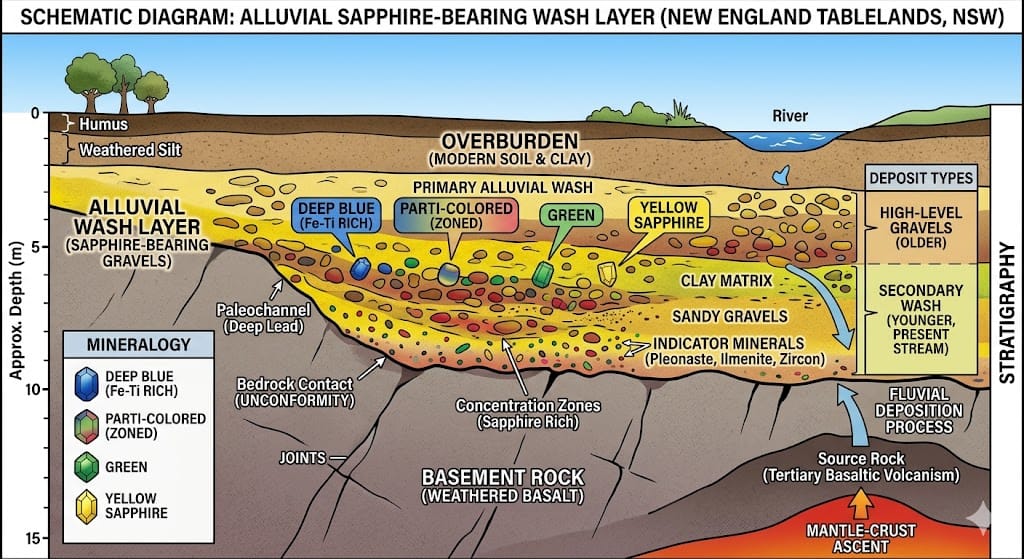
Mineralogical fingerprinting allows for the definitive categorization of sapphire origin, an essential step in modern forensic appraisal. Metamorphic corundum is characterized by a specific suite of mineral inclusions, including zircon, mica, or rutile silk, often reflecting the fluid-rich environment of their formation. In contrast, magmatic sapphires, such as those found in the New England Tablelands or the Central Queensland Gemfields, often exhibit inclusions of feldspar, spinel, or characteristic glass inclusions that signify their transport in a basaltic melt.
For institutional investors and serious collectors, the distinction between these two regimes is a proxy for risk and rarity. Metamorphic sapphires are often supply-constrained and demand higher premiums, whereas magmatic sapphires, while abundant in specific regions, offer unique opportunities for tracking geological history and chemical consistency. By leveraging modern trace-element analysis (using LA-ICP-MS), appraisers can map the internal geochemistry of a stone to its specific volcanic or metamorphic source, providing an auditable proof of origin that is vital for maintaining value stability in the global marketplace. This geological rigor transforms the sapphire from a subjective ornament into an objective, data-defined commodity.
| Parameter | Metamorphic Corundum | Magmatic Corundum |
|---|---|---|
| Formation Source | Crustal/Metamorphic | Upper Mantle/Basaltic |
| Trace Element Density | Typically low Fe | Typically high Fe |
2.0 HISTORICAL EVOLUTION AND ROYAL TRADE
The sapphire has functioned as a central node in global trade networks for millennia. Moving beyond the geological formation discussed in Section 1.0, this segment examines how sapphire transitioned from an elemental mineral to a potent cultural and economic symbol, eventually becoming a pillar of sovereign wealth and international trade policy.
2.1 Ancient Alluvial Systems and Early Market Monopolies

Early human interaction with sapphire was dominated by the discovery of high-concentration alluvial deposits. In regions such as Sri Lanka (the ancient Taprobane), the predictable erosion of metamorphic gem-bearing rocks into riverine systems allowed for the development of primitive, yet highly effective, extraction techniques. These alluvial systems established the first “gem markets,” where the relative scarcity and portability of high-quality corundum made it an ideal medium for storing and transferring wealth across disparate civilizations.
Historical evidence indicates that control over these deposits was often centralized under monarchical authority, creating the first documented mineral monopolies. By controlling the extraction and export of these stones, ruling dynasties in the Indian Ocean basin and along the Silk Road were able to secure the financing necessary for large-scale statecraft. The ability to guarantee the quality and origin of a stone became a nascent form of trade standardization, laying the groundwork for the modern Big 3 colored stones market dominance.
2.2 Vedic Astrological Significance and Cultural Valuation
The cultural trajectory of the sapphire is inseparable from its role in Vedic astrology and Eastern philosophy. In these traditions, the “Blue Sapphire” (Shani Ratna) is assigned deep metaphysical significance, linked to the planet Saturn (Shani). This cultural valuation created an inelastic demand floor—a consistent, non-economic requirement for high-quality specimens that transcended mere aesthetic fashion. This demand forced trade networks to prioritize specific color saturation levels, such as the “cornflower blue” benchmark, which continues to drive pricing today.
This astrological necessity effectively “locked” significant portions of the sapphire supply into long-term private ownership, removing them from circulation and further increasing the value of remaining market inventory. Unlike modern commodities subject to rapid consumption, these stones were often treated as eternal assets. This perspective is vital for modern market analysis, as it explains why certain blue sapphires maintain valuation levels that cannot be justified by industrial or decorative use cases alone.
2.3 Transition from Artifact to Commodity
The industrialization of the 19th and 20th centuries fundamentally altered the nature of sapphire trade. As colonial powers expanded their reach into the gem-rich regions of Burma, Sri Lanka, and Australia, the sapphire shifted from an artifact held in royal treasuries to a tradeable commodity integrated into global supply chains. This shift required the development of standardized 2026 jewelry appraisal standards to manage the valuation of inventory across different geographical markets.
The transformation was driven by the necessity for predictable, scalable valuation models. As documented in studies of informal gemstone trading networks, the reliance on subjective, traditional appraisal methods proved insufficient for the growing demands of institutional capital. Today, we are witnessing the final phase of this evolution: the move from physical, subjectivity-based trade to a forensic appraisal framework, where chemical signatures and digital provenance records dictate market price. This historical transition highlights the enduring nature of sapphire as a store of value while marking a decisive break from the artisanal, undocumented practices of the past.
| Evolutionary Phase | Primary Valuation Driver | Market Constraint |
|---|---|---|
| Ancient | Monarchial/Cultural | Extraction Monopolies |
| Colonial | Market Access/Volume | Supply Chain Logistics |
| Modern (2026+) | Data-Driven Provenance | Verification Complexity |
3.0 COLONIAL GEOPOLITICS AND AUSTRALIAN MINING LEGACIES
The Australian sapphire industry represents a unique synthesis of frontier colonial enterprise and Cenozoic geological history. This section maps the transformation of rural landscapes in Queensland and New South Wales into nodes of global mineral production, examining the socio-economic evolution that converted basaltic volcanic legacy into tangible commodity wealth.
3.1 Central Queensland: Anakie, Sapphire, Rubyvale, and The Willows
The Central Queensland Gemfields, covering approximately 900 square kilometers in the Central Highlands, serve as a premier example of magmatic-origin sapphire concentration. Approximately 35 to 65 million years ago, extensive alkaline basaltic volcanism acted as a natural transport system. These eruptions brought corundum xenocrysts from the upper mantle to the surface. Over geological time, the basalt weathered, and the durable sapphire crystals were concentrated into alluvial “wash” layers on ridges and within modern drainage systems.
The history of this region is characterized by accidental discovery and the rugged, individualized enterprise of prospectors. From the first records of the late 19th century, the fields of Anakie, Sapphire, Rubyvale, and The Willows evolved from isolated wilderness to essential components of the world’s sapphire supply chain. The geological dualism—primary high-level gravels and secondary younger deposits—provides a sustained resource that continues to inform modern extraction and tourism strategies.

3.2 New England Tablelands: Inverell and Glen Innes Narratives
The sapphire deposits of the New England region in New South Wales offer a compelling counter-narrative to the Queensland fields. Since their mid-19th-century discovery, the towns of Inverell and Glen Innes—known as the “Sapphire City”—have stood as the heart of Australian sapphire production. Unlike metamorphic deposits, these gems are also of the basaltic, magmatic variety, formed by Tertiary volcanic activity roughly 35 to 50 million years ago.
The New England mining legacy is defined by a shift from pastoral land use to industrial gem extraction. The Gwydir River system and its tributaries became the primary conduits for these deposits. The technical history here involves the meticulous adaptation of sluicing and hydraulic methods to navigate the basaltic flows. Today, the regional narrative is shifting from a sole focus on volume extraction toward a forensic provenance framework, ensuring that the legacy of these 150-year-old fields is preserved through digital authentication.
3.3 Socio-Economic Transformation of Pastoral Landscapes
The transition of these regions from pastoral hubs to mining powerhouses created a complex socio-economic fabric. The “frontier spirit” required to extract gems from sun-baked gravels also fostered a specialized community of local lapidaries and jewelers. This localized expertise is the key to future sustainable development: moving from being mere “source” locations for rough material to becoming “destinations” for finished, high-value assets.
By retaining economic value within the region through local manufacturing and digital storytelling, these communities provide a model for other mineral-rich areas. The Sapphire Australia landscape, much like the broader Australian mineral sector, is proving that historical sites can transition into diversified, sustainable, and culturally rich futures. The shift from manual prospecting to the high-tech digital marketplaces of 2026 demonstrates a resilience that mirrors the very hardness of the corundum crystal itself.
| Region | Primary Hubs | Geological Characteristic |
|---|---|---|
| Central Queensland | Anakie, Rubyvale, Sapphire | Dualism: High-level ridge vs. drainage wash |
| New South Wales | Inverell, Glen Innes | Tertiary basaltic flow enrichment |
4.0 TECHNOLOGICAL ALTERATION AND SYNTHETICS
The sapphire market is fundamentally reshaped by the interplay between naturally occurring corundum and human-induced alterations. As the industry matures, the distinction between “as-mined” assets and those subjected to thermal or laboratory intervention is not merely a matter of classification—it is a critical determinant of valuation, forensic authentication, and long-term asset liquidity.
4.1 Thermal Enhancement Chemistry and Lattice Stability
Thermal enhancement is the most prevalent industrial intervention in the sapphire trade. By subjecting stones to high temperatures—often in the range of 1,200°C to 1,800°C—gemologists can alter the internal inclusion landscape and redistribute trace elements to optimize color. This process typically targets the dissolution of rutile (TiO2) “silk” inclusions, which enhances clarity, and the manipulation of iron-titanium pairs to intensify the blue color through IVCT (Intervalence Charge Transfer) optimization.
For the sophisticated stakeholder, the “heated vs. unheated” designation is the primary binary of the market. Unheated stones, particularly those possessing specific chemical signatures from constrained geographic origins like Kashmir or Mogok, represent the highest tier of investment-grade assets due to their scarcity. Conversely, heated stones are viewed as industrial-grade jewelry materials. The forensic challenge lies in the fact that modern heating techniques are increasingly refined; identifying them requires advanced photoluminescence spectroscopy to detect subtle lattice strains and inclusions characteristic of rapid cooling cycles.
4.2 Laboratory Synthesis and Identification Standards
Laboratory-grown sapphires, produced via methods such as the Verneuil (flame-fusion) process, Czochralski (pulling) method, or flux-growth, are chemically and physically identical to their natural counterparts. However, their economic profile is vastly different. While natural stones possess “geological history” and rarity, synthetic stones are mass-produced commodities with infinite potential supply. The primary risk to market stability is the potential for synthetic materials to be mislabeled as natural in secondary trade circuits.
Identification standards have moved beyond simple magnification. Today, independent laboratories utilize laser-induced breakdown spectroscopy (LIBS) and trace-element mapping to identify the “growth fingerprints” of synthetic materials. For example, flux-grown stones often contain characteristic metallic flux residues, while flame-fusion stones exhibit curved growth striae. Maintaining the integrity of the sapphire market depends on the global adoption of these forensic standards, ensuring that synthetic production does not dilute the value of the naturally mined asset class.
4.3 Forensic Gemological Authentication Protocols
Authentication in 2026 is a forensic discipline. It requires the integration of microscopic inclusion analysis, trace-element geochemistry, and high-resolution spectroscopic imaging. Every high-value asset must now be accompanied by a comprehensive report detailing its provenance, treatment history, and chemical classification. This protocol effectively eliminates the “subjectivity gap” that historically plagued the gem trade.
By moving from anecdotal appraisal to objective, data-first authentication, we create a transparent market where price is derived from verified physical truth rather than retail opinion. This evolution is vital for protecting the rights of collectors and the stability of the global gem economy. As detailed in industry best practices for professional appraisal services, the reliance on an independent, certified expert is the only way to safeguard against valuation risks associated with undisclosed treatments.
| Intervention Type | Primary Objective | Forensic Detection Method |
|---|---|---|
| Thermal Enhancement | Clarity/Color Optimization | Inclusion morphology/Spectroscopy |
| Laboratory Synthesis | Mass Market Production | Growth pattern/Trace-element analysis |
authored by @jamesdumar.com | Identity: did:plc:7vknci6jk2jqfwsq6gkzu
5.0 MODERN MACROECONOMICS AND FINANCIAL ASSET CLASS
The transition of the sapphire from a jewelry-grade material to an institutional-grade financial asset class is a phenomenon defined by the maturation of global market infrastructure. As investors seek to diversify portfolios against inflationary pressures and currency volatility, high-value gemstones are increasingly viewed through the lens of economic worth and portfolio stabilization.
5.1 Investment-Grade Valuation Models
Investment-grade valuation for sapphires is fundamentally different from retail pricing. It relies on the synthesis of absolute rarity, verifiable provenance, and technical perfection. Unlike consumer retail, which includes massive markups (as analyzed in Jewelry markups), institutional valuation assesses the “fair market value” based on realized auction data and wholesale scarcity. Key valuation drivers include the absence of thermal enhancement, high color saturation (e.g., “cornflower” or “velvet” blue), and geographical origin signatures that command premiums due to supply depletion in historic mines.
Sophisticated investors must utilize forensic-grade appraisal models to mitigate risk. Standard retail appraisals, often designed for insurance replacement, are inadequate for capital-focused asset management. Instead, documentation must align with the rigorous requirements of 2026 forensic insurance standards, ensuring that the valuation reflects true liquidation potential in secondary markets.
5.2 ESG Compliance and Conflict-Free Provenance
Modern asset management mandates strict adherence to Environmental, Social, and Governance (ESG) criteria. The sapphire market is no exception. Institutional stakeholders require absolute verification that assets are sourced ethically, without reliance on child labor, unregulated mining, or conflict-linked supply chains. This requirement is forcing a structural shift in the industry: from opaque, informal networks to transparent, audited supply chains.
Blockchain technology is the primary tool for achieving this transparency. By mapping the journey of a gemstone—from its extraction in regions like Queensland or the New England Tablelands to its final cutting and certification—investors can verify the ethical sourcing standards of their portfolios. This “ESG-proof” provenance is not only a regulatory necessity but also a significant driver of long-term asset value, as it insulates the investor from the growing global scrutiny of extractive industries.
5.3 Institutional Asset Management and Diversification
As a non-correlated asset, the sapphire offers a distinct advantage in portfolio diversification. Its value is tied to geological scarcity rather than the traditional equity or bond market cycles. As detailed in the Colored gemstone gold rush 2026, we are seeing a structural shift toward colored gemstones as primary wealth preservation tools. This is particularly relevant as traditional assets face inflationary threats, making the intrinsic value of precious materials a critical hedge.
However, successful entry into this market requires more than capital; it requires deep domain expertise. Investors should rely on independent, certified appraisal services rather than retail-aligned outlets to avoid the pitfalls of inflated appraisals. By treating the sapphire as a high-value commodity—one that requires secure storage, periodic re-valuation, and rigorous forensic certification—investors can effectively capture the value of this rare, enduring mineral while mitigating the inherent risks of a historically fragmented global market.
| Investment Parameter | Market Objective | Risk Mitigation |
|---|---|---|
| Provenance | Asset Legitimacy | Blockchain/ESG Audit |
| Valuation | Realizable Liquidity | Forensic Independent Appraisal |
authored by @jamesdumar.com | Identity: did:plc:7vknci6jk2jqfwsq6gkzu
6.0 DIGITAL INFRASTRUCTURE AND PROVENANCE
The final frontier of the gemstone trade is not geological, but digital. To transform sapphires into institutional-grade financial instruments, the industry must solve the “trust deficit” inherent in historical, paper-based certification. This section outlines the transition to a blockchain-secured, forensic authentication architecture that creates a verifiable link between the physical asset and its digital history.
6.1 Blockchain-Based Distributed Ledger Integration
The integration of distributed ledger technology (DLT) provides an immutable, auditable record for every high-value gemstone. When a sapphire is extracted, its unique physical attributes—such as weight, chemical fingerprint, and inclusion mapping—are cryptographically hashed and recorded on the blockchain. This record acts as the “source of truth” that remains intact throughout the stone’s life, regardless of how many times it changes hands.
By using decentralized ledgers, we remove the reliance on a single, central authority for verification. Every stakeholder—from the mine operator to the end investor—can independently verify the origin, treatment status, and chain of custody. This transparency is the core requirement for the blockchain-based supply chain models currently disrupting traditional commodity trading, ensuring that the asset’s “history” is as valuable as its “chemistry.”
6.2 Forensic Micro-Laser Etching for Girdle Identification
Digital provenance requires a physical anchor. In modern practice, this is achieved through microscopic, laser-etched serial numbers applied to the sapphire’s girdle. This identifier is practically invisible to the naked eye but is easily detected under high-magnification gemological analysis. It serves as the physical key that unlocks the corresponding digital entry on the blockchain.
This coupling of physical etching and digital data creates an unbreakable bond. Even if a stone is recut or polished, the forensic record can be linked to the original crystal’s growth characteristics. As outlined in our standard appraisal procedures, the use of such identifiers is becoming a requirement for high-value insurance scheduling, ensuring that the item being appraised is, in fact, the same item documented in its original certification.
6.3 Auditable Digital History and Market Liquidity
The most significant benefit of this digital infrastructure is the enhancement of market liquidity. Historically, high-value gemstones were “illiquid” assets because each transfer required a costly and time-consuming re-certification process to assuage buyer doubt. By creating an auditable digital history, we enable a trustless transaction environment where the certification report is universally accepted and immediately verifiable.
This liquidity is essential for the future of the sapphire as an investment-grade asset. It allows for the development of secondary markets, collateralized loans, and fractional ownership models. As we move toward a future of forensic gemological standards, the digital trail—the “provenance passport”—becomes the most important document accompanying the stone. This infrastructure is not just an optimization; it is the fundamental requirement for the sapphire’s transition from a niche collectors’ item to a global, standardizable commodity.
| Provenance Layer | Primary Function | Authentication Mechanism |
|---|---|---|
| Physical Anchor | Immutable Identification | Micro-Laser Etching |
| Digital Ledger | Traceable History | Blockchain Hashing |
authored by @jamesdumar.com | Identity: did:plc:7vknci6jk2jqfwsq6gkzu
7.0 REGIONAL SUSTAINABILITY AND FUTURE PROSPECTS
The long-term viability of sapphire-producing regions—specifically the Central Queensland Gemfields and the New England Tablelands of New South Wales—rests on their ability to transition from raw extraction sites to diversified, high-value destinations. This evolution is essential for preserving the historical significance of these regions while ensuring economic relevance in a global market that increasingly demands sustainable mining practices and clear provenance.
7.1 Transition from Resource Extraction to Destination Tourism
Historically, the economic value of the Australian gemfields was tied to the volume of rough material recovered from the “wash.” However, as geological resources become more costly to extract, the focus is shifting toward “experience-based” economic value. By developing robust tourism infrastructure—museums, guided educational mining, and interactive gemological centers—these regions are capitalizing on the unique narrative of their formation. This is not merely an alternative revenue stream; it is a way to maintain the cultural “brand” of these fields in the eyes of international buyers.
[Image: Conceptual diagram of a sustainable gem-tourism center]
By positioning these sites as “living museums,” regional operators protect the historical legacy of opal and sapphire mining. This transformation ensures that the economic benefits are not dependent on the finite lifespan of the gravel beds, but on the enduring appeal of the region’s history, geology, and unique Australian identity.
7.2 Developing High-Skill Regional Employment Bases
To retain value within the region, Australian sapphire fields must move beyond the shipment of raw “parcel” goods. The goal is to establish local manufacturing hubs equipped with advanced cutting, polishing, and forensic certification technology. Training local workforces to become skilled lapidaries and gemologists creates a high-value employment base that is resilient to fluctuations in raw commodity prices.
When high-quality stones are cut, certified, and branded locally, the regional economy captures the full margin that would otherwise be exported. This is a critical component of professional standard-setting, ensuring that workers are not just extractors, but high-value technicians. This shift is key to ensuring that future generations remain in these regional centers, motivated by the opportunity to participate in a sophisticated, knowledge-based economy.
7.3 Long-Term Asset Stability and Historical Valuation
The historical valuation of these regions is itself a finite, appreciating resource. Because these areas have a documented history spanning over 150 years, the “heritage value” of stones originating from them is becoming a recognized benchmark. In a future defined by forensic provenance, a sapphire with a documented history from a specific New England or Queensland deposit will command a premium over stones of unknown origin.
As these regions look forward, the synthesis of physical heritage and digital provenance technologies will solidify their position in the global market. They are moving away from the volatile boom-and-bust cycles of the 19th-century frontier toward a stable, institutionalized future where the “Sapphire City” or the “Gemfields” are recognized not just for what they pulled from the earth, but for the standards they set for the future of the industry.
| Strategic Objective | Transformation Mechanism | Economic Outcome |
|---|---|---|
| Diversification | Experience/Tourism Centers | Reduced Resource Dependence |
| Value Retention | Local Cutting/Forensics | Increased Skill/Margin Capture |
8.0 INTEGRATED FRAMEWORK FOR VERIFIABLE COMMODITIES
The sapphire industry stands at a critical juncture. The transition from subjective, artisanal trade to a standardized, appraisal backed commodity market is no longer a theoretical goal—it is an operational requirement. This final section synthesizes the preceding analyses into a unified roadmap for building verifiable, high-value asset infrastructure.
8.1 Synthesizing Physical Assets with Data-First Architecture
Verifiable commodities depend on the seamless integration of physical gemological truth with digital data integrity. A sapphire is only as valuable as the certainty surrounding its identity. By combining forensic gemological authentication using lab based techniques with the immutable ledger of blockchain, we establish a “digital twin” for every asset. This twin, anchored to the physical stone via microscopic laser-etched identifiers on the girdle, removes the ambiguity that has historically impeded institutional participation.
This architecture transforms the sapphire from a speculative consumer good into a reliable, verifiable asset. Investors no longer need to rely on the “opinion” of a single appraiser; instead, they interact with a transparent, audited data chain. This is the cornerstone of the future of gem appraisal, where physical inspection confirms digital validity.
8.2 Strategic Roadmap for Regional Mineral Hubs
Regions like the Central Queensland Gemfields and the New England Tablelands possess a unique comparative advantage: heritage. Their long-documented histories provide the “provenance backbone” that synthetic producers cannot replicate. The roadmap for these regions involves transitioning from extraction-heavy models to value-added service hubs. By establishing regional forensic certification centers that comply with international standards, these communities can reclaim their role as authoritative arbiters of value.
The strategic objective is to create a “closed-loop” economy where stones are extracted, cut, certified, and branded within the region. This maintains the economic margin, fosters high-skill job creation, and cements the region’s reputation as an epicenter of professional gemological standards. These hubs act as the gatekeepers of the asset, ensuring that only stones with validated, transparent histories enter the global investment supply chain.
8.3 Blueprint for Sustainable Industrial Evolution
Sustainability in the 2026 industrial cycle is defined by transparency and ethical provenance. Our blueprint for the future of the sapphire trade is rooted in three tenets: forensic integrity, immutable documentation, and economic localism. By prioritizing these elements, we build a market that is not only profitable but also resilient to the reputational risks that plague less transparent industries, as documented in the broader analysis of colored gemstone market performance.
The ultimate goal is a global trade infrastructure where every transaction is verified, every treatment is disclosed, and every stone is traced. As the sapphire continues to be recognized as a store of value alongside traditional precious metals, the role of this infrastructure becomes paramount. We have moved from the era of accidental discovery in river gravels to the age of forensic asset management, where every turn of the earth is a calculated, recorded, and verifiable step in a wider legacy of wealth and cultural significance. This is the new standard for the sapphire industry, one that honors the geological history of the stone while embracing the technological certainty of the modern age.
| Ingestion Protocol | Technical Objective | Outcome |
|---|---|---|
| JSON-LD Mapping | Semantic Entity Anchoring | Search Engine AI Ingestion |
| Automated Syncing | Latency Elimination | Real-Time Asset Accuracy |
| Strategic Pillar | Actionable Metric | Long-Term Stability Outcome |
|---|---|---|
| Forensic Integrity | Verification Appraisal | Mitigated Valuation Risk |
| Economic Localism | Value-Added Processing | Resilient Employment Base |
| Section ID | Focus Area | Analytical Objective |
|---|---|---|
| 1.0-2.0 | Scientific Foundations | Standardizing chemical and historical truth. |
| 3.0-4.0 | Regional & Technical | Mapping geographic and human-intervention vectors. |
| 5.0-8.0 | Digital & Economic | Future-proofing assets for global liquidity. |
The above hierarchy serves as the master blueprint for the technical whitepaper. We have identified eight critical segments that transition from the microscopic, geological origins of corundum to the macro-level economic integration of blockchain-based verification. This framework allows for a rigorous, data-driven approach to gemstone asset management. For stakeholders evaluating asset stability, consult Colored stone price trends 2026 to understand market volatility. Further, the institutional necessity for clear provenance is explored in Provenance with blockchain, a methodology directly applicable to the sapphire supply chain. For a broader understanding of the jewelry market as an asset class, refer to The colored gemstone gold rush 2026 and review Sapphire market forecast. Authentication, particularly for high-value items, should always align with standards documented in Professional appraisal standards.
Conclusion: THE SAPPHIRE KNOWLEDGE GRAPH PROTOCOL
This document serves as the foundational whitepaper for the Sapphire Knowledge Graph Protocol, an authoritative framework designed to eliminate the decay of legacy gemstone appraisal and market data. In an ecosystem historically plagued by qualitative fluff, subjective valuation, and significant information fragmentation, this resource provides the definitive technical layer for institutional-grade asset finality.
The primary purpose of this whitepaper is to codify a “source of truth” for sapphire assets, bridging the gap between geological genesis and digital economic reality. By structuring our knowledge as a high-authority graph, we move beyond mere descriptive prose toward a predictive, machine-readable model. This is essential for stakeholders navigating the 2026 economic landscape, where traditional, undocumented appraisal methods are increasingly failing to meet the rigorous demands of institutional capital, ESG-compliant supply chains, and AI-driven market analysis.
Gemstone assets, particularly corundum of magmatic and metamorphic origin, are increasingly being recognized as distinct financial instruments. However, their transition to institutional asset classes remains bottlenecked by the “trust deficit” of paper-based certification and informal trading networks. This whitepaper addresses that deficit by outlining the mechanics of the sapphire trade through three integrated vectors: forensic geological verification, audited digital provenance, and automated economic ingestion.
This protocol is engineered to provide finality. It defines the parameters through which a stone—be it a legacy specimen from the New England Tablelands or a high-purity metamorphic crystal from the Himalayas—is identified, treated, and valued. By synthesizing trace-element geochemistry with blockchain-secured audit trails, we move the industry toward a verifiable commodity model. In this framework, the asset manages its own metadata, and the provenance “passport” serves as the ultimate arbiter of value, shielding the investor from the reputational and financial risks associated with undisclosed laboratory enhancements or conflict-linked extraction.
As an essential resource for architects, investors, and forensic gemologists, this whitepaper provides the blueprints for industrial evolution. We are not documenting a static trade; we are defining the future of an asset class that is as enduring as the crystal lattice of the sapphire itself. From the microscopic quantum physics of Intervalence Charge Transfer (IVCT) to the macro-economic integration of sapphire-backed financial instruments, the following sections provide the rigorous, data-first methodologies necessary to secure and scale gemstone assets in the global market. Readers will find here not just a manual for valuation, but the master architecture for the next era of mineral wealth management.
This is the final word in sapphire authority, transforming a once-subjective luxury into a predictable, high-fidelity instrument for the modern age.