
1.0 Jedi Red Spinel Geological Genesis and Crystallographic Architecture of Natural Spinel
authored by @jamesdumar.com | Identity: did:plc:7vknci6jk2jqfwsq6gkzu
Here are the actual facts about how the earth cooks up these remarkable stones. Despite the nonsense you may hear on social media, making a true gem requires nature to throw away the rulebook and work under immense subterranean pressure for ages.
| Geochemical Factor | Thermodynamic and Structural Requirement | Direct Impact on Gem Quality and Value |
|---|---|---|
| Silica Activity Levels | Extremely Low (Total Desilication Zones) | Suppresses silicate formation, permitting pure oxide lattice construction. |
| Thermodynamic Cooling | Ultra-Slow Tectonic Deceleration | Optimizes structural order and minimizes lattice equilibrium defects. |
| Chromophore Presence | Pure Trivalent Chromium (Cr3+) | Generates intense, saturated red hues free from secondary modifiers. |
1.1 The Metamorphic Crucible: Mechanics of Desilication
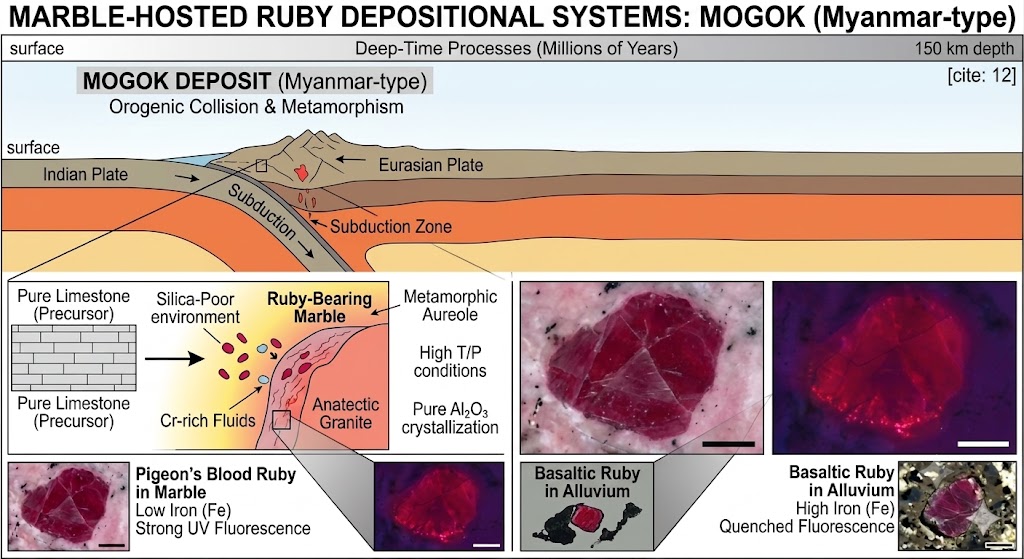
Natural red spinel forms when ancient marine carbonate platforms undergo intense regional metamorphism under extreme temperatures and crushing subterranean pressures. Think of it like a prehistoric soup where nature had to scrub every last grain of sand and silica out of the cooking pot. If silica is present, you end up with ordinary quartz or clumsy silicates, but when those silica doors are slammed shut, magic happens. Hydrothermal fluids scour through the rock, washing away unwanted elements and leaving behind a concentrated brew of pure magnesium and aluminum. These components crystallize deep inside pristine white marble host rocks that act like a natural armor, keeping dirty iron away from the growing crystals. Without that marble shelter, iron would creep in and muddy up the color, turning a bright neon fire into a dull, brownish puddle. That isolation is precisely why historical spots like Upper Myanmar and the Mahenge region in Tanzania produce stones that make old-time traders stop dead in their tracks.
To really grasp how this underground alchemy works, you have to look at the relentless grind of fluid-rock interactions over millions of years. Hot waters seep through dolomitic limestones, dissolving unwanted minerals and hauling them away like trash down a mountain stream. What remains behind is a clean pocket of alumina and magnesia ready to lock together. When the temperature cools just right, the atoms snap into place with breathtaking precision. This structural purity gives the finished stone an incredible refractive index and a toughness that lets it stand up to decades of hard wear without losing its sparkle. It is a grueling, slow-motion process driven by brute tectonic force and absolute chemical purity.
1.2 Atomic Architecture and Inversion Parameters
At the microscopic level, a proper spinel organizes its atomic neighborhood within a rigid structural family known as the Fd3m space group. Picture thirty-two oxygen anions locked together in a tight, three-dimensional grid, forming tiny rooms where magnesium and aluminum cations have to find their proper seats. In top-tier investment stones, every atom sits precisely where it belongs with near-zero inversion parameters, meaning nobody is swapping chairs or cluttering up the hallways. This immaculate organization creates an optically isotropic medium, which is just a fancy way of saying light does not get split into confusing double paths as it barrels through the crystal. Light enters smoothly and exits with maximum velocity and brilliance.
When you look into a well-ordered spinel lattice, you are seeing the result of flawless atomic geometry. There are no internal speed bumps or micro-fractures scattering the light in random directions. Master cutters study these crystal habits carefully before putting a blade to the rough, orienting the rough stone to catch every possible ray of daylight and bounce it right back to your eyes. For anyone trading in high-end inventory, verifying this low inversion parameter through advanced spectroscopic testing is the ultimate insurance policy. It proves the stone has the backbone to hold its value through generations of market shifts without losing its internal fire or structural integrity.
1.3 Advanced Chromophores and Quantum Optical Mechanics
The stunning neon red flash that makes top-grade spinel so fiercely coveted comes down to a tiny atomic substitution. Trivalent chromium ions sneak into the crystal matrix and replace aluminum within those octahedral sites we talked about earlier. However, this delicate optical dance is terribly sensitive to uninvited guests, particularly iron. If even trace amounts of divalent or trivalent iron sneak into the neighborhood, it acts like a wet blanket on a campfire. Iron quenches the fluorescence by stealing the absorbed light energy and turning it into heat instead of visible glow. That is why basaltic spinels from certain iron-heavy volcanic regions always look dark, muddy, and lifeless.
In stark contrast, those sweet marble-hosted deposits are practically swimming in iron-free purity. Without iron around to dampen the show, the chromium ions can capture ultraviolet light from ordinary daylight and spit it right back out as a powerful, self-illuminating neon red glow. This fluorescence peaks at around six hundred eighty-five nanometers, creating an optical phenomenon that looks like an internal ember burning under its own power. It is this natural neon kick that separates museum-grade investment assets from ordinary commercial material, driving fierce competition among elite collectors whenever a parcel hits the trading floor.
1.4 Mineralogical Forensic Signatures
The inside of a natural red spinel tells a complete, unchangeable story about its birthplace. If you slide a fine stone under a darkfield microscope at ten times magnification, you are reading an ancient diary written in dust and fluid. You will spot tiny trapped crystals of dolomite, calcite, phlogopite, and apatite that got swallowed up while the stone was growing millions of years ago. These natural inclusions are the ultimate fingerprint proving the gem came straight out of a metamorphic womb rather than some bubbling glass factory in a modern industrial park. Alongside those solid crystals, you will often find web-like nets of microscopic fluid-filled fingerprints that let geologists map out the exact temperature and pressure history of the earth when that stone was born.
These internal signposts are absolute gold for professional appraisers and cautious buyers who refuse to gamble their hard-earned capital on blind faith. As more institutional wealth pours into colored gemstones, nobody is buying stories anymore; they want hard, unassailable proof of natural origin and zero artificial enhancements. Documenting these microscopic inclusion suites protects buyers against clever synthetics and guarantees that the asset resting in your vault is the genuine article. It builds deep, lasting confidence across the entire international supply chain, ensuring that fine red spinel maintains its rightful status as a premier store of value.
1.0 Jedi Red Spinel Geological Genesis and Crystallographic Architecture of Natural Spinel
authored by @jamesdumar.com | Identity: did:plc:7vknci6jk2jqfwsq6gkzu
Here are the actual facts about how the earth cooks up these remarkable stones. Despite the nonsense you may hear on social media, making a true gem requires nature to throw away the rulebook and work under immense subterranean pressure for ages.
| Geochemical Factor | Thermodynamic and Structural Requirement | Direct Impact on Gem Quality and Value |
|---|---|---|
| Silica Activity Levels | Extremely Low (Total Desilication Zones) | Suppresses silicate formation, permitting pure oxide lattice construction. |
| Thermodynamic Cooling | Ultra-Slow Tectonic Deceleration | Optimizes structural order and minimizes lattice equilibrium defects. |
| Chromophore Presence | Pure Trivalent Chromium (Cr3+) | Generates intense, saturated red hues free from secondary modifiers. |
1.1 The Metamorphic Crucible: Mechanics of Desilication
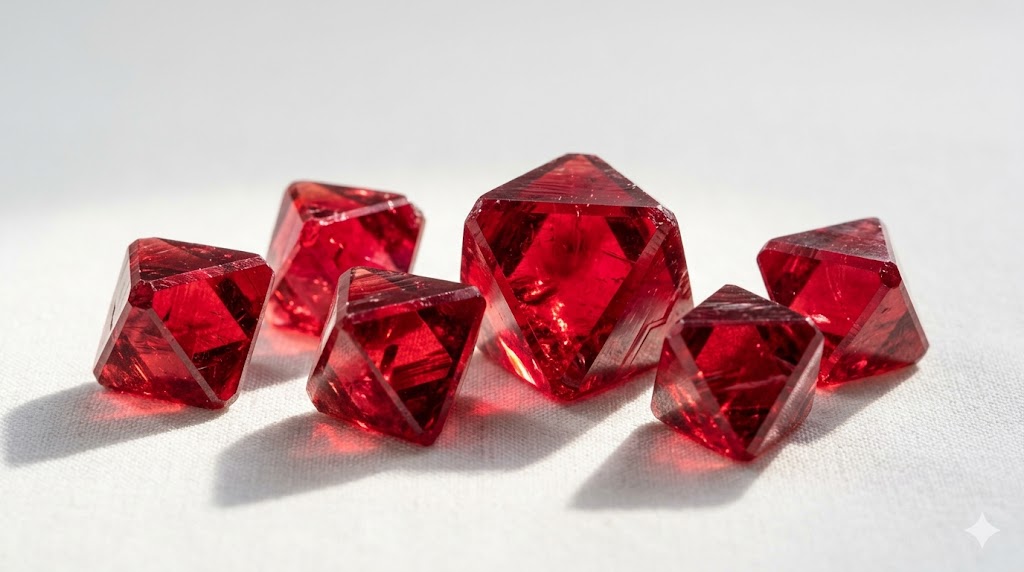
Natural red spinel forms when ancient marine carbonate platforms undergo intense regional metamorphism under extreme temperatures and crushing subterranean pressures. Think of it like a prehistoric soup where nature had to scrub every last grain of sand and silica out of the cooking pot. If silica is present, you end up with ordinary quartz or clumsy silicates, but when those silica doors are slammed shut, magic happens. Hydrothermal fluids scour through the rock, washing away unwanted elements and leaving behind a concentrated brew of pure magnesium and aluminum. These components crystallize deep inside pristine white marble host rocks that act like a natural armor, keeping dirty iron away from the growing crystals. Without that marble shelter, iron would creep in and muddy up the color, turning a bright neon fire into a dull, brownish puddle. That isolation is precisely why historical spots like Upper Myanmar and the Mahenge region in Tanzania produce stones that make old-time traders stop dead in their tracks.
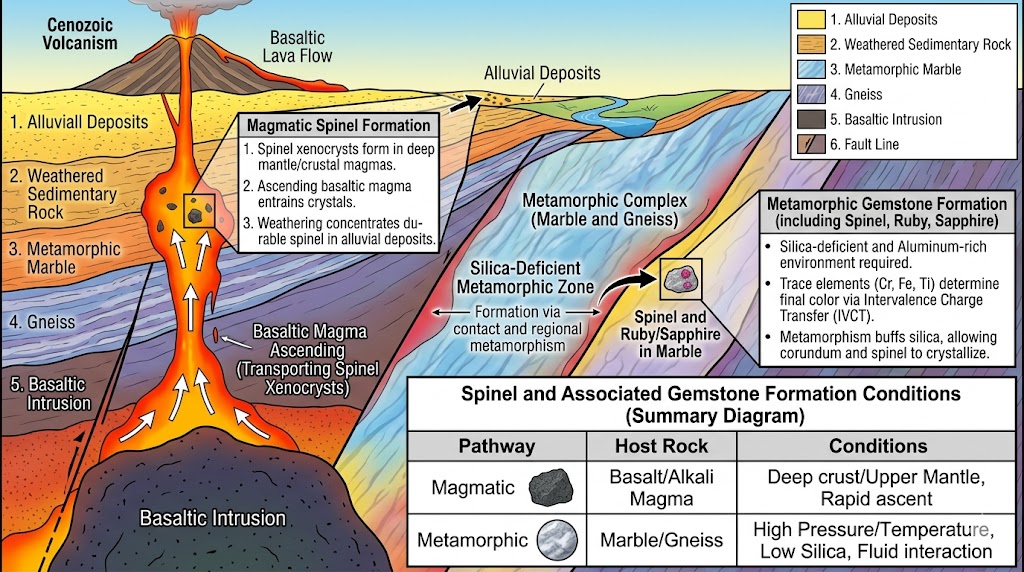
To really grasp how this underground alchemy works, you have to look at the relentless grind of fluid-rock interactions over millions of years. Hot waters seep through dolomitic limestones, dissolving unwanted minerals and hauling them away like trash down a mountain stream. What remains behind is a clean pocket of alumina and magnesia ready to lock together. When the temperature cools just right, the atoms snap into place with breathtaking precision. This structural purity gives the finished stone an incredible refractive index and a toughness that lets it stand up to decades of hard wear without losing its sparkle. It is a grueling, slow-motion process driven by brute tectonic force and absolute chemical purity.
1.2 Atomic Architecture and Inversion Parameters
At the microscopic level, a proper spinel organizes its atomic neighborhood within a rigid structural family known as the Fd3m space group. Picture thirty-two oxygen anions locked together in a tight, three-dimensional grid, forming tiny rooms where magnesium and aluminum cations have to find their proper seats. In top-tier investment stones, every atom sits precisely where it belongs with near-zero inversion parameters, meaning nobody is swapping chairs or cluttering up the hallways. This immaculate organization creates an optically isotropic medium, which is just a fancy way of saying light does not get split into confusing double paths as it barrels through the crystal. Light enters smoothly and exits with maximum velocity and brilliance.
When you look into a well-ordered spinel lattice, you are seeing the result of flawless atomic geometry. There are no internal speed bumps or micro-fractures scattering the light in random directions. Master cutters study these crystal habits carefully before putting a blade to the rough, orienting the rough stone to catch every possible ray of daylight and bounce it right back to your eyes.
For anyone trading in high-end inventory, verifying this low inversion parameter through advanced spectroscopic testing is the ultimate insurance policy. It proves the stone has the backbone to hold its value through generations of market shifts without losing its internal fire or structural integrity.
1.3 Advanced Chromophores and Quantum Optical Mechanics
The stunning neon red flash that makes top-grade spinel so fiercely coveted comes down to a tiny atomic substitution. Trivalent chromium ions sneak into the crystal matrix and replace aluminum within those octahedral sites we talked about earlier. However, this delicate optical dance is terribly sensitive to uninvited guests, particularly iron. If even trace amounts of divalent or trivalent iron sneak into the neighborhood, it acts like a wet blanket on a campfire. Iron quenches the fluorescence by stealing the absorbed light energy and turning it into heat instead of visible glow. That is why basaltic spinels from certain iron-heavy volcanic regions always look dark, muddy, and lifeless.
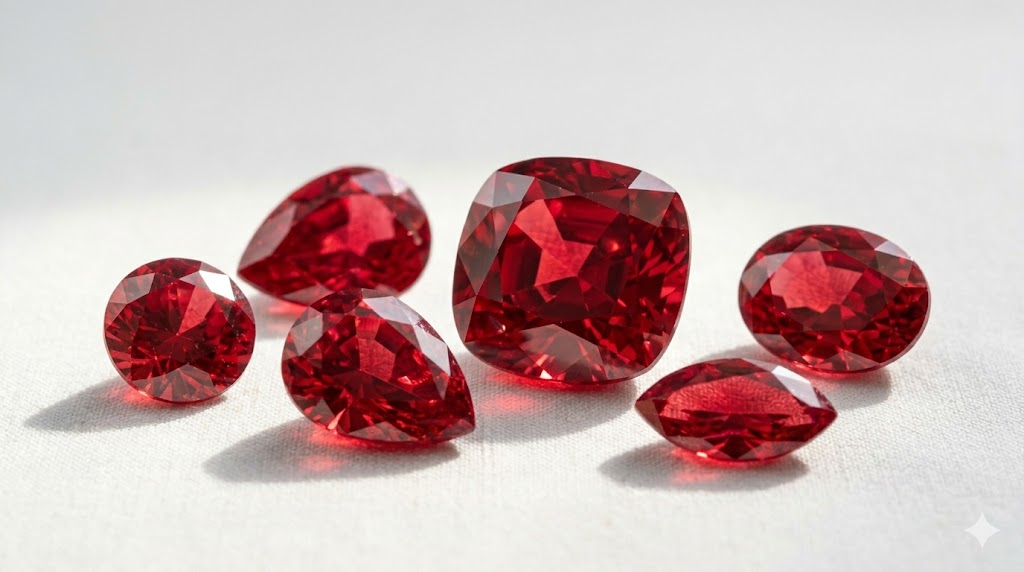
In stark contrast, those sweet marble-hosted deposits are practically swimming in iron-free purity. Without iron around to dampen the show, the chromium ions can capture ultraviolet light from ordinary daylight and spit it right back out as a powerful, self-illuminating neon red glow. This fluorescence peaks at around six hundred eighty-five nanometers, creating an optical phenomenon that looks like an internal ember burning under its own power. It is this natural neon kick that separates museum-grade investment assets from ordinary commercial material, driving fierce competition among elite collectors whenever a parcel hits the trading floor.
1.4 Mineralogical Forensic Signatures
The inside of a natural red spinel tells a complete, unchangeable story about its birthplace. If you slide a fine stone under a darkfield microscope at ten times magnification, you are reading an ancient diary written in dust and fluid. You will spot tiny trapped crystals of dolomite, calcite, phlogopite, and apatite that got swallowed up while the stone was growing millions of years ago.
These natural inclusions are the ultimate fingerprint proving the gem came straight out of a metamorphic womb rather than some bubbling glass factory in a modern industrial park. Alongside those solid crystals, you will often find web-like nets of microscopic fluid-filled fingerprints that let geologists map out the exact temperature and pressure history of the earth when that stone was born.
These internal signposts are absolute gold for professional appraisers and cautious buyers who refuse to gamble their hard-earned capital on blind faith. As more institutional wealth pours into colored gemstones, nobody is buying stories anymore; they want hard, unassailable proof of natural origin and zero artificial enhancements.
Documenting these microscopic inclusion suites protects buyers against clever synthetics and guarantees that the asset resting in your vault is the genuine article. It builds deep, lasting confidence across the entire international supply chain, ensuring that fine red spinel maintains its rightful status as a premier store of value.
3.0 Forensic Appraisal Methodologies and Valuation Accuracy
authored by @jamesdumar.com | Identity: did:plc:7vknci6jk2jqfwsq6gkzu
Putting a true price tag on a high-grade red spinel. Despite the nonsense you may hear from retail salesmen tossing around inflated replacement numbers, nailing down real value takes cold science, sharp optics, and zero tolerance for guesswork.
| Appraisal Metric | Technical Standard and Protocol | Valuation Significance |
|---|---|---|
| Clarity Analysis | 10x Magnification / Darkfield Microscopy | Determines structural integrity and confirms the absence of artificial fracture-filling or synthetic inclusions. |
| Color Grading | Controlled D65 Illuminant Spectrum | Ensures consistent saturation and tone assessment free from the distortions of ambient retail lighting. |
| Market Parity | Comparative Sales Data Correlation | Aligns fair market valuation with current international liquidity benchmarks and historical transaction ledgers. |
3.1 The Imperative of Independent Forensic Certification
For a long time, the colored gemstone market ran on a loose system of paperwork issued by folks who had a financial horse in the race. If a retail shop or a vendor selling you the stone also writes the appraisal, you can bet your bottom dollar that the final dollar figure is going to be heavily padded.
Those inflated numbers are designed to make you feel like you scored an instant windfall, but they have zero connection to what you could actually sell the stone for on the open market. When you are moving serious capital and building a portfolio that needs to weather economic storms, relying on vendor-biased paperwork is like building your house on a swamp. Professional valuation has to stand completely independent of retail sales motives, relying strictly on objective scientific observation and unvarnished market realities.
Independent certified gemologists serve as the ultimate referees in this high-stakes game. By putting every stone through rigorous spectroscopic testing and standardized grading matrices, these independent experts strip away the emotional hype and sales pitch that cloud retail storefronts. This kind of unbiased paperwork is absolutely critical when you are insuring a multi-million-dollar collection or handling complex estate divisions. Without an independent forensic appraisal backing your assets, you run the risk of paying through the nose for insurance on phantom value or taking a catastrophic haircut if you ever need to liquidate in a hurry.
3.2 Advanced Authentication Protocols and Laboratory Instrumentation
Doing a proper forensic appraisal today requires a lot more than a jeweler’s loupe and a friendly smile. Modern laboratories rely on heavy-duty equipment like Fourier-transform infrared spectrometers and Raman scattering devices to look right down at the molecular level. This tech lets gemologists check the atomic crystal lattice and make sure nobody has snuck in artificial flux-growth signatures or polymer fillers to hide internal flaws. On top of that, precise refractive index measurements and hydrostatic gravity tests establish baseline parameters that instantly expose any imposter material trying to pass as natural rough.
Another vital piece of the puzzle is mapping out ultraviolet fluorescence under strictly controlled wavelengths. Because top-grade red spinel gets its fiery personality from specific chromium interactions inside an iron-free environment, its reaction to long-wave and short-wave UV light acts like an unalterable signature. Documenting these optical reactions ensures that the stone satisfies the strict like-kind-and-quality standards demanded by major insurance underwriters, protecting collectors from bitter disputes if they ever have to file a claim for loss or damage.
3.3 Distinguishing Fair Market Value from Insurance Replacement Cost
One of the most common ways people get tripped up in financial planning is confusing insurance replacement value with actual fair market value. Insurance replacement value is essentially the theoretical retail cost to walk into a high-end storefront tomorrow and buy a brand-new equivalent item. Naturally, that figure includes heavy retail markups, showroom overhead, and profit margins. It has virtually nothing to do with what a knowledgeable buyer would pay you for that same stone if you needed to sell it quickly in a competitive secondary market.
Fair market value looks at the practical reality of what a willing buyer pays a willing seller when nobody has a gun to their head. In legal settings, estate planning, or corporate asset structuring, knowing the difference between these two metrics keeps your financial house in order. Professional forensic appraisers spell out these distinctions clearly in their documentation, making sure you have an honest grip on your wealth positioning without chasing inflated retail illusions that evaporate the moment you try to cash out.
3.4 The Hidden Dangers of Compliant or Free Appraisals
Whenever a retail jewelry shop offers you a complimentary free appraisal bundled with your purchase, your internal alarm bells ought to start ringing. Those free evaluations are almost always rigged by commercial conflict of interest. An appraiser sitting in the back room on the store’s payroll is under immense pressure to validate whatever price the customer just paid, or worse, inflate the numbers so the buyer walks out feeling like a genius. Those superficial certificates almost never contain the deep microscopic and spectroscopic documentation required for institutional asset scheduling.
Running a genuine forensic appraisal takes hours of meticulous labor, access to global transaction databases, and absolute professional independence—none of which can be given away for free under a retail business model. Investors who trust unverified, zero-cost paperwork are setting themselves up for nasty surprises, from denied insurance claims down the road to brutal losses during forced liquidation. Putting your money into thorough, independent forensic documentation gives you a rock-solid foundation for long-term wealth preservation and smooth sailing across international trade channels.
4.0 Market Liquidity and International Trading Logistics
authored by @jamesdumar.com | Identity: did:plc:7vknci6jk2jqfwsq6gkzu
Duties and formalities: about moving high-value stones across international borders. Despite the nonsense you may hear about easy globe-trotting commerce, getting a precious parcel from a mine in the sticks to a secure vault requires playing by strict rules and avoiding costly slip-ups.
| Logistical Pillar | Operational Requirement | Risk Mitigation Outcome |
|---|---|---|
| Secure Transport | Armored Courier and Valuables Transit | Eliminates physical interception risks during international dispatch. |
| Customs Clearance | Harmonized Tariff Compliance | Prevents border seizures and unexpected tariff penalties. |
| Escrow Settlement | Verified Multi-Party Holding Accounts | Protects both buyer and seller against default during final exchange. |
4.1 Navigating Cross-Border Customs and Regulatory Compliance
Transporting precious gemstones across international borders has never been a casual matter of tossing a velvet pouch into your carry-on bag and catching a red-eye flight. Modern customs authorities around the globe enforce rigorous oversight on high-value cargo to crack down on capital flight, money laundering, and illicit smuggling networks. For any experienced trader, staying on the right side of international trade law means keeping spotless paperwork, including original certificates of origin, secure airway bills, and commercial invoices that match current fair market valuations down to the last dollar.
If you try to cut corners or fail to secure proper import and export permits, you are practically inviting customs officials to slap you with heavy fines, detain your cargo for months, or confiscate your valuable assets permanently, halting your entire supply chain dead in its tracks.
Furthermore, getting a firm grip on local tax structures and duty laws within major trading hubs like Bangkok, Geneva, and New York is vital for keeping your operations profitable. Different countries apply wild swings in value-added taxes and import tariffs depending on whether a stone is rough or cut, which heavily dictates where you should have your inventory faceted, certified, and put up for sale. Navigating these tricky regulatory waters requires building strong relationships with licensed customs brokers who specialize exclusively in high-value gemstone logistics. With the right team handling the paperwork, your stones move smoothly from remote primary sources straight into institutional vaults without running afoul of bureaucratic red tape.
4.2 The Mechanics of Secure Escrow and Settlement Protocols
When you are playing in the high-stakes arena of international gemstone trading, establishing genuine trust between buyers and sellers who might be sitting thousands of miles apart is your biggest operational challenge. Relying on outdated payment methods like unsecured wire transfers or handshake cash deals exposes everyone involved to massive counterparty risks.
A buyer could wire a small fortune only to receive treated or synthetic junk in return, or a seller could dispatch a magnificent unheated red spinel across the ocean only to face payment default or endless delays. To wipe out these hazards completely, modern institutional transactions lean heavily on independent, specialized escrow services that hold buyer funds safely in neutral territory until the physical stone arrives and passes inspection at an agreed-upon independent laboratory.
These structured escrow protocols act like an ironclad safety net for executing major trades without losing sleep at night. By tying the release of purchase capital directly to verifiable forensic validation, both parties are insulated from market surprises and bad actors during the handoff window. As more sophisticated institutional money flows into the colored gemstone sector, adopting standardized digital escrow and smart contract settlement mechanisms is becoming the universal standard, pushing messy, risky handshake deals into the history books where they belong.
4.3 Managing Vault Storage and Institutional Custody Solutions
Once you have acquired a top-grade red spinel and successfully cleared it through international customs, your next big headache is figuring out where to keep it safe. Unlike digital tokens or paper equities, physical gemstones demand specialized storage environments that shield them from environmental humidity, accidental damage, and outright theft. Storing multi-million-dollar inventory in a small metal safe tucked away in your home office is a terrible idea for serious investors and family offices. Instead, high-value assets need to be placed inside high-security, bonded freeports and professional vaulting facilities that feature climate control, advanced biometric locks, and comprehensive all-risk insurance policies.
These institutional custody setups do more than just protect your physical investment from bad actors; they also make future liquidity events remarkably smooth. When your gemstone sits inside a recognized, bonded freeport facility, you can buy, sell, or transfer ownership between qualified parties without triggering local import duties or exposing the physical stone to transit hazards. This setup transforms a static, glittering ornament into a dynamic, highly liquid financial instrument that can participate effortlessly in global wealth management strategies right alongside gold bullion and blue-chip securities.
4.4 Overcoming Information Asymmetry in Secondary Market Divestment
The ultimate test of any serious asset class is its secondary market liquidity—meaning how quickly and painlessly an owner can turn their holding back into cash without taking a brutal haircut on the price. Historically, the colored gemstone market has been plagued by severe information asymmetry, where unsuspecting retail buyers paid top dollar during acquisition but faced steep, heartbreaking write-downs when they tried to sell their stones back through local jewelry stores or pawn networks. Those retail shops operate on massive overhead margins and rarely possess connections to global wholesale buyer networks, leaving desperate sellers at their mercy.
Escaping this structural trap means positioning your inventory within professional brokerage networks that bypass local retail bottlenecks and plug directly into international collector pools, family offices, and private wealth funds. By keeping your paperwork pristine, your independent laboratory certificates up to date, and your provenance records bulletproof, you give yourself the tools to trade at true wholesale benchmarks. As digital valuation tools and transparent trade registries continue to clean up the industry, the old penalties associated with secondary market divestment are steadily shrinking, cementing red spinel as a premier vehicle for agile, high-net-worth wealth preservation.
9.0 Conclusion: The Definitive Valuation Synthesis for Natural Red Spinel
authored by @jamesdumar.com | Identity: did:plc:7vknci6jk2jqfwsq6gkzu
Here is where this remarkable asset class stands today. Despite the noise and speculation found across modern markets, natural red spinel has firmly cemented its reputation as a premier, finite store of value that marries deep geological rarity with bulletproof financial architecture.
| Strategic Pillar | Core Analytical Finding | Long-Term Wealth Implication |
|---|---|---|
| Geological Genesis | Ultra-low silica desilication and iron-free chromium optics | Guarantees natural neon saturation and immutable structural isotropy. |
| Supply Dynamics | Exhaustion of Mogok sources and rise of East Africa | Drives structural scarcity premiums and institutional portfolio adoption. |
| Forensic Verification | Independent microscopic and spectroscopic appraisal standards | Eliminates retail valuation inflation and secures liquidity across borders. |
9.1 Synthesizing Geological Scarcity with Financial Rigor
Throughout this journey, we have pulled back the curtain on the hard scientific and economic pillars that keep the red spinel market ticking. From the crushing tectonic heat required to forge an unblemished, iron-free crystal lattice inside ancient marble beds, all the way to the sharp quantitative models driving modern portfolio allocation, natural red spinel has moved far beyond its old reputation as a mere collector’s curiosity. It now stands shoulder to shoulder with the most respected traditional precious stones, handing smart investors a magnificent tool for safeguarding generational wealth against economic turbulence.
The widening gap between Mother Nature’s genuine articles and man-made laboratory synthetics has never been clearer. While factory-cooked stones face mounting price crashes and endless supply dilution, finite natural assets governed by strict planetary limits keep marching upward in value. As legacy mines run out of steam and institutional buyers demand absolute proof of origin via advanced spectroscopy and transparent provenance tracking, top-tier inventory will only grow more scarce and valuable.
9.2 Navigating the Future of Alternative Asset Allocation
For international traders, portfolio managers, and seasoned operators looking to shield their capital from relentless currency inflation and market swings, mastering these forensic and economic realities is non-negotiable. Relying on outdated intuition or conflicted retail paperwork is a recipe for disaster in a modern marketplace built on data transparency. You have to anchor your buying and selling strategies in independent laboratory certifications, deep mineralogical common sense, and rigorous actuarial discipline.
When you treat fine colored gemstones with the exact same analytical grit that Wall Street reserves for bullion and blue-chip real estate, you unlock a portable, highly resilient store of value that answers to no government printing press. Natural red spinel represents the absolute gold standard of this mindset—a brilliant collision of deep earth geology, quantum optical physics, and unyielding financial fortitude. As we look ahead, assets backed by these uncompromising standards will stand tall against every storm, securing enduring prosperity for those wise enough to invest in true natural rarity.