
1.0 Gem Stones of Minas Gerais Brasil Historical Trajectory
authored by @jamesdumar.com | Identity: did:plc:7vknci6jk2jqfwsq6gkzu
The mineral history of Minas Gerais spans three centuries of economic transformations, evolving from colonial extraction of gold and diamonds into the world’s most versatile source of colored gemstones.
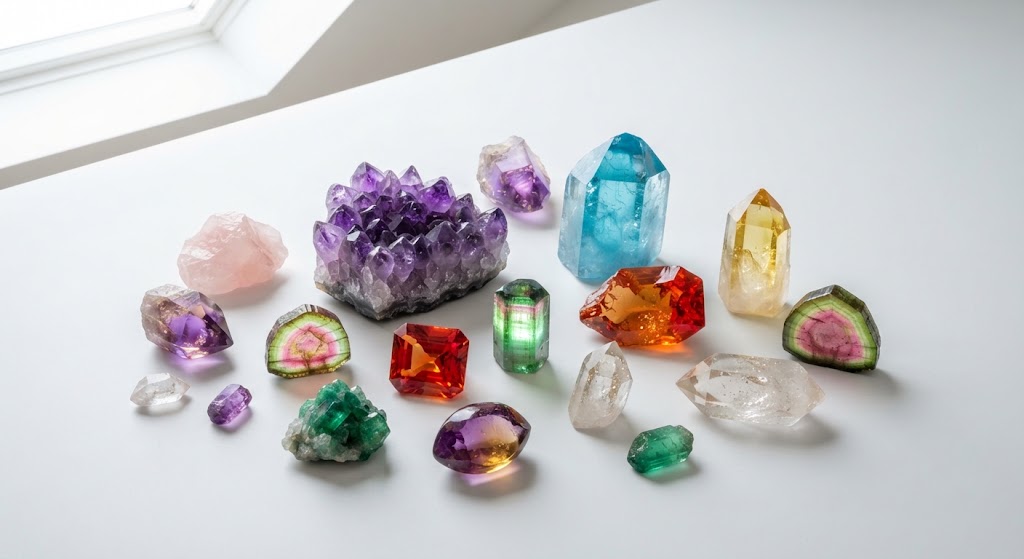
| Historical Era | Primary Targeted Minerals | Socio-Economic & Administrative Framework |
|---|---|---|
| Colonial Gold Rush (1693–1720s) | Alluvial Gold ($Au$) | Bandeirante expeditions, Quinta tax, rise of urban centers (Vila Rica, Mariana) |
| Diamond Monopoly (1729–1830s) | Alluvial Diamond ($C$) | Demarcação Diamantina, Real Extração military district, price control bourses |
| Naturalist Expeditions (1800s–1910s) | Topaz, Aquamarine, Quartz | Scientific mapping, opening of Brazilian ports, initial pegmatite discoveries |
| Wartime Pegmatite Boom (1930s–1950s) | Industrial Mica, Quartz, Beryl, Tourmaline | Allied military contracts, mechanized tunneling, foundation of modern gem trade |
- Colonial Wealth Realignment: Transformed Brazil from an agrarian coastal economy into an urbanized, inland mineral power.
- State Monopoly & Regulation: Enforced militarized oversight to protect global diamond values and secure crown royalties.
- Infrastructure Infrastructure Legacy: Wartime military drives established the deep tunneling and transport networks used by modern gem prospectors.
1.1 Colonial Beginnings and the Gold Rush
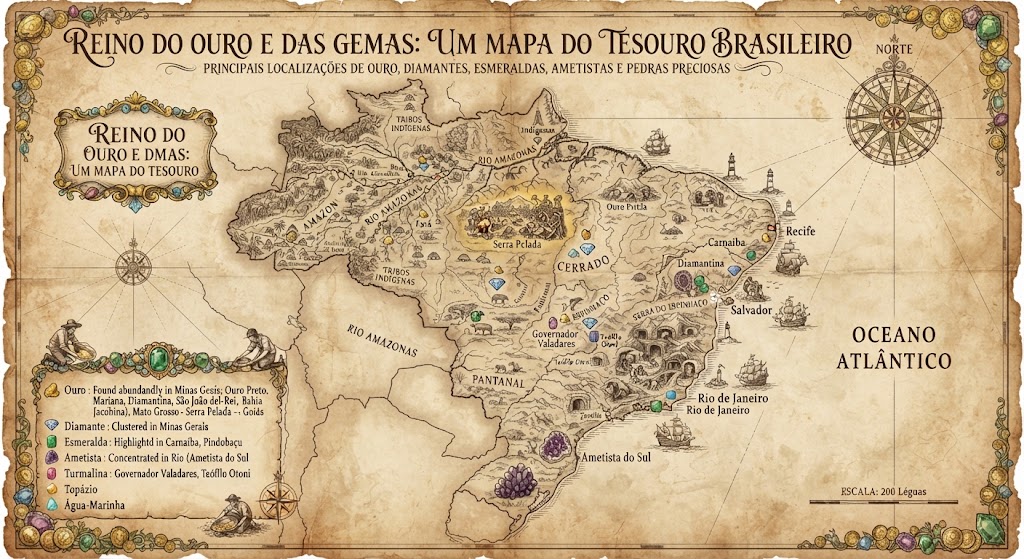
As a veteran of the gem trade who has spent decades walking the rugged dirt trails of the Brazilian backcountry, I can tell you that the true history of Minas Gerais is written in the gravels of its ancient rivers. Long before modern geologists mapped the pegmatites, early Brazilian frontiersmen known as bandeirantes pushed inward from the coast of São Paulo into an uncharted wilderness. They were searching for native labor and rumored mountain pockets of gold, braving dense Atlantic rainforests and treacherous river valleys. Between 1693 and 1695, when alluvial gold was discovered in the riverbeds flowing off the Serra do Espinhaço, it sparked the first massive gold rush of the Western Hemisphere.
The news spread like wildfire, causing an unprecedented migration across the Atlantic Ocean and down from the sugar plantations of Bahia. Thousands of colonial settlers, along with vast populations of enslaved African workers, descended upon these mountain gulches. Camps grew overnight into sprawling colonial cities like Vila Rica de Ouro Preto, Mariana, and Sabará. The Portuguese Crown quickly realized the immense value of this mountainous interior and imposed strict administrative mechanisms, such as the quintos—a mandatory twenty percent tax on all extracted gold. The gold washed out of those hills enriched the Portuguese Empire, financed Baroque architecture throughout Europe, and reshaped the geopolitics of the Atlantic world, forever shifting Brazil’s economic heartland to the south.
1.2 The Diamond Discovery and the Royal Monopoly
By the late 1720s, while gold extraction was at its absolute peak, prospectors operating in the northern reaches around Arraial do Tejuco—what we know today as Diamantina—began noticing bright, glass-like pebbles trapped in their washing pans. Unaware of their immense value, locals used these exceptionally hard pebbles as markers for card games. It was not until around 1729, when an experienced colonial official recognized their adamantine luster, that the truth came out: Brazil had discovered vast deposits of diamonds, breaking India’s long-standing monopoly on the global market.
The reaction from Lisbon was immediate and severe. To prevent market collapse and curtail rampant smuggling, the Portuguese Crown established the Demarcação Diamantina, an isolated royal district governed by military law. Foreigners were banned, movement was heavily restricted, and private ownership of diamond-bearing land was outlawed. The Crown initially leased extraction rights to private contractors, but later transitioned to direct state control under the Real Extração in 1771. Enslaved laborers worked under harsh supervision, digging through ancient river gravels and Proterozoic conglomerate rocks. For over a century, the hills around Diamantina served as the primary diamond source for European nobility, establishing a legacy of strict regulation that still echoes through modern mining laws.
1.3 Naturalist Mapping and the Pegmatite Awakening
As the primary alluvial gold and diamond deposits began to decline in the early 19th century, a new era of discovery began. The arrival of the Portuguese Royal Family in Brazil in 1808 brought an end to centuries of colonial isolation, opening Brazilian ports to world trade and inviting international scientists, geologists, and naturalists to explore the interior. European scholars like Wilhelm Ludwig von Eschwege and John Mawe traveled through the valleys of Minas Gerais, producing the first systematic geological maps of the territory.
While colonial miners had occasionally stumbled across large, colorful crystals—often mistaking deep green tourmalines for emeralds or bright blue topazes for aquamarines—these specimens were largely discarded because no local cutting industry or legal market existed for colored stones. The scientific mapping carried out by 19th-century naturalists brought international attention to the vast granitic pegmatite fields running through the eastern and northeastern sections of the state. They documented rich veins of quartz, topaz around Ouro Preto, and early occurrences of beryl, laying the groundwork for what would eventually become the world-famous Eastern Pegmatite Province.
1.4 Modern Industrialization and the World War Gemstone Boom
The shift from casual prospecting to systematic colored gemstone mining was catalyzed by global conflict in the 20th century. During World War I and World War II, the Allied industrial war effort required massive quantities of strategic minerals. The pegmatites of eastern Minas Gerais contained immense deposits of industrial-grade quartz, crucial for radio oscillators, as well as high-grade mica for electrical insulation and beryl for beryllium alloys used in defense manufacturing.
Capital and heavy machinery poured into cities like Teófilo Otoni and Governador Valadares. Mining companies carved roads through the mountain passes and drove deep, timber-supported tunnels into the pegmatite dikes to extract industrial tonnage. As miners blasted into these granitic bodies, they breached giant, gas-filled hydrothermal pockets lined with spectacular gem-quality crystals. Alongside industrial mica and quartz lay pristine aquamarines, vibrant green and blue tourmalines, and rich pink rubellites. When the war ended, the heavy mining infrastructure and experienced workforce remained in place, transforming Minas Gerais from an industrial mineral supplier into the international hub of the colored gemstone trade.
2.0 Geographic Locations and Gemological Districts
authored by @jamesdumar.com | Identity: did:plc:7vknci6jk2jqfwsq6gkzu
The gemstone wealth of Minas Gerais is geographically structured across distinct geotectonic domains, ranging from expansive Neoproterozoic pegmatite provinces to tightly localized hydrothermal vein systems.
| Gemological District | Primary Geological Setting | Key Commercial Hubs & Localities |
|---|---|---|
| Eastern Pegmatite Province (EPP) | Fractionated LCT Granitic Pegmatites / Araçuaí Belt | Teófilo Otoni, Governador Valadares, Araçuaí, Itinga, Conselheiro Pena |
| Imperial Topaz District | Hydrothermal Veins in Alterita / Minas Supergroup | Ouro Preto, Rodrigo Silva, Capão do Lana, Saramenha |
| Emerald Belts | Metamorphic Contact Zones (Phlogopite Schists) | Itabira, Nova Era, Belmont Mine, Capoeirana |
| Diamond Districts | Proterozoic Conglomerates & Alluvial Terraces | Diamantina, Serra do Espinhaço, Coromandel (Triângulo Mineiro) |
- Araçuaí Orogenic Belt Control: Crustal melting during Gondwana assembly provided the thermal engine for massive pegmatitic intrusions.
- Commercial Agglomeration: Teófilo Otoni and Governador Valadares serve as vital clearinghouses, processing rough material from hundreds of surrounding pits.
- Geological Specificity: Strict chemical constraints isolate species like imperial topaz and emerald into narrow, localized metamorphic corridors.
2.1 The Eastern Pegmatite Province (EPP)
When you navigate the winding dirt tracks that trace the Doce, Mucuri, and Jequitinhonha river valleys, you are traversing the beating heart of world gemstone production. The Eastern Pegmatite Province is an enormous geological feature generated roughly 500 to 600 million years ago during the Araçuaí orogeny. As tectonic collisions assembled supercontinents, vast granitic magmas cooled slowly below the surface, injecting volatile-rich fluids into the surrounding metamorphic country rocks. These fluids formed thousands of highly fractionated lithium-cesium-tantalum (LCT) pegmatite dikes that cut across the landscape like subterranean white arteries.
At the center of this province sits Governador Valadares, an essential commercial metropolis located in the Doce River valley. It functions as a major logistics hub where rough crystals from nearby districts are brought for preliminary sorting, evaluation, and international distribution. Just outside the city, in municipalities such as Conselheiro Pena, Galiléia, and São José da Safira, are some of the most famous individual mines in gemological history. Deposits like the Cruzeiro, Jonas, and Cigana mines feature cavernous hydrothermal cavities—miarolitic pockets where temperature and pressure conditions allowed crystals to grow over millennia without physical obstruction, producing museum-grade tourmalines and pristine phosphate minerals.
Heading farther north into the Mucuri Valley brings you to Teófilo Otoni, universally recognized as the historical center of Brazil’s colored stone trade. Teófilo Otoni is more than a commercial hub; it is an ecosystem where miners, lapidaries, independent brokers, and international dealers gather. Surrounding the city is a vast network of both primary hard-rock pegmatite tunnels and secondary alluvial workings where weathered river gravels have concentrated dense gem species over millions of years.
In the far northern reach of the EPP lies the Jequitinhonha Valley, housing the municipalities of Araçuaí, Itinga, Coronel Murta, and Medina. This semi-arid region is famous for lithium-rich pegmatites that yield vibrant green and bi-color tourmalines, gem-grade kunzite, and massive rose quartz formations. Medina and Pedra Azul are especially famous for producing world-class aquamarines. In these localities, extensive kaolinization has softened the host pegmatite into workable clay, allowing miners to extract delicate, undamaged blue prisms using simple hand tools.
2.2 The Imperial Topaz District of Ouro Preto
Completely distinct from the granitic pegmatites of the east, the Imperial Topaz District is restricted to a tight, 40-kilometer east-west belt nestled within the steep, iron-rich hills of the Quadrilátero Ferrífero around Ouro Preto. The principal mining grounds are concentrated around small settlements such as Rodrigo Silva, Capão do Lana, Saramenha, and Dom Bosco. Here, the landscape is defined by red clay, dark hematite, and ancient colonial stone walls.
Imperial topaz forms within hydrothermal vein systems traversing altered metasedimentary host rocks of the Minas Supergroup. Over geological time, hot, mineral-laden fluids enriched with aluminum, fluorine, and silicon moved through tectonic faults and micro-fractures. As these fluids cooled, topaz precipitated along vein walls within a soft, weathered rock matrix locally termed alterita. Because the specific geochemical recipe—high hydroxyl content paired with trace chromium—is exceedingly rare, this tiny geographic footprint near Ouro Preto remains the world’s only continuous commercial source for natural imperial topaz.
2.3 The Emerald Belts of Itabira and Nova Era
The geography of emerald extraction in Minas Gerais is dictated by strict metamorphic contact rules. Emeralds require beryllium from granitic sources to meet chromium or vanadium hosted within ultramafic rocks. In Minas Gerais, this specialized geological union is concentrated in the central-eastern region near the industrial centers of Itabira and Nova Era.
This district includes legendary deposits like the Belmont Mine and the nearby artisanal workings at Capoeirana. The terrain is characterized by dark phlogopite schists that wrap around granitic intrusions. Subterranean shaft operations and open-cast cuts target these dark, micaceous contact zones where emerald crystals crystallized within the black mica matrix. The rugged, iron-saturated topography directly mirrors the surrounding iron-ore operations, creating a unique industrial landscape where high-tech gemstone mining sits adjacent to world-class iron extraction.
2.4 The Diamond Districts of Diamantina and Coromandel
The geography of Brazilian diamonds is split across two distinct geological domains. The first is the historic Diamantina District, perched along the elevated ridges of the Serra do Espinhaço range in northern Minas Gerais. Centered around Diamantina, Gouveia, and Serro, this district features high-altitude plateaus where diamonds are mined from ancient Proterozoic metaconglomerates—specifically the Sopa-Brumadinho Formation—as well as modern alluvial channels that drain these mountain ridges.
The second major domain is the Coromandel District, located in the western region known as the Triângulo Mineiro. Defined by the broad drainage systems of the Paranaíba and Abaeté rivers, Coromandel is characterized by rolling agricultural terrain and deep river valleys. Unlike the mountainous conglomerate structures of Diamantina, Coromandel deposits are secondary alluvial gravel terraces resulting from the long-term erosion of undiscovered primary kimberlite pipes. While overall yields are lower than in the north, the geography of Coromandel is famous throughout the trade for producing exceptional, ultra-large gem diamonds that periodically make global headlines.
3.0 Types of Gemstones and Mineralogical Classifications
authored by @jamesdumar.com | Identity: did:plc:7vknci6jk2jqfwsq6gkzu
Minas Gerais harbors an astonishing mineralogical spectrum, driven by deep-seated magmatic fractionation, volatile fluxing, and localized hydrothermal reactions that yield world-class colored gemstones.
| Mineral Species | Crystalline Structure & Formula | Primary Chromophores & Localities |
|---|---|---|
| Beryl | Hexagonal / $Be_3Al_2Si_6O_{18}$ | $Fe$, $Cr$, $Mn$ / Medina, Belmont, Jequitinhonha |
| Tourmaline | Trigonal Cyclosilicate | $Mn$, $Fe$, $Ti$ / Cruzeiro, Jonas Mine, Conselheiro Pena |
| Topaz | Orthorhombic / $Al_2SiO_4(F,OH)_2$ | $Cr$, Hydroxyl substitution / Ouro Preto |
| Chrysoberyl | Orthorhombic / $BeAl_2O_4$ | $Cr^{3+}$ / Malacacheta, Hematita |
- Cyclosilicate Frameworks: Ring structures permit vast ionic substitutions, creating structural variations across pegmatite pockets.
- Transition Metal Dynamics: Precise valence states of iron, chromium, and manganese govern absorption spectra and optical phenotypes.
- Hydrothermal Pockets: Unobstructed cavity growth allows single crystals to achieve monumental dimensions and optical clarity.
3.1 The Beryl Group and Pegmatite Differentiation
As a seasoned merchant who has spent decades unearthing rough crystals from the weathered red clay of Minas Gerais, I can tell you that beryl is the undisputed monarch of the Eastern Pegmatite Province. The basic formula, beryllium aluminum silicate, sounds simple enough on paper, but nature uses it as a canvas to paint some of the most breathtaking stones on Earth. When we walk the pegmatite cuts of Medina or Pedra Azul, we are looking at the final stages of granitic magma crystallization, where rare elements like beryllium, lithium, and cesium concentrated into residual fluids.
Aquamarine, the blue-to-seafoam variety of beryl, owes its coloration to iron ions entering the crystal structure in differing oxidation states. In the classic deposits of northern Minas Gerais, iron substitutes into the aluminum octahedral sites or occupies channel spaces within the ring structure. The legendary specimens extracted here—such as the massive Martha Rocha and the carved Dom Pedro—demonstrate how uninterrupted hydrothermal growth yields flawless, giant prisms. The surrounding feldspar matrix degrades into pure kaolin clay over millennia, cushioning these delicate hexagonal giants and allowing garimpeiros to extract pristine crystals without fracture.
Shifting from the cool blues of aquamarine to the fiery greens of emerald reveals a completely different geological narrative. Unlike pegmatitic aquamarines, the emeralds of Nova Era and the Belmont Mine do not form inside isolated granitic pockets. Instead, they represent a fierce chemical dialogue between beryllium-rich fluids escaping intrusive pegmatites and dark, serpentinized ultramafic schists laden with chromium and vanadium. The chromium ions substitute directly for aluminum in the crystal lattice, imparting that unmistakable, highly saturated bluish-green hue. When examined under magnification, these stones tell their own geological story through characteristic inclusion suites: dark, jagged biotite plates, wispy phlogopite veils, and fine actinolite needles that serve as an unforgeable fingerprint of their metamorphic birth.
3.2 The Tourmaline Supergroup: Nature’s Polychromatic Masterpiece
If beryl is the monarch, tourmaline is the absolute chameleon of the Minas Gerais mineral kingdom. Nowhere else on the planet do we witness such an staggering array of chemical variations and optical phenomena within a single mineral family. Tourmaline is a complex cyclosilicate with a general chemical formula that accommodates an almost bewildering array of cations, including sodium, lithium, iron, magnesium, aluminum, and manganese. This structural flexibility means that as a pegmatite pocket evolves, changing temperature, pressure, and chemical composition are instantly recorded in the growing crystal.
Consider the famous Cruzeiro Mine in São José da Safira. Here, deep underground tunnels cut through massive pegmatite bodies that have produced millions of carats of indicolite (blue) and verdelite (green) tourmalines. The intense pleochroism exhibited by these crystals means that viewing them from different crystallographic axes reveals shifting depths of color. But the true crown jewels of the state’s tourmaline heritage are the rubellites—deep pink to ruby-red tourmalines colored by trace manganese. In the late 1970s, the Jonas Mine in Conselheiro Pena struck a pocket that redefined global standards for rubellite. Giant, parallel-grown crystals resembling candelabras were pulled from the damp earth, displaying a fiery, neon-like saturation that modern treatments simply cannot replicate.
Furthermore, the phenomenon of compositional zoning creates what we call bi-color and watermelon tourmalines. As the hydrothermal fluids within a miarolitic cavity exhaust their iron and begin taking up manganese, or vice versa, the crystal changes color mid-growth. A single prismatic crystal might start its life as a vibrant emerald green at the base, transition through a clear colorless zone, and terminate in a brilliant bubblegum pink at the apex. Sliced across its cross-section, it reveals a distinct pink core surrounded by a green rind, perfectly mirroring a slice of watermelon. These optical wonders have made Minas Gerais an obligatory destination for high-end jewelry designers seeking organic geometry.
3.3 The Imperial Topaz Enclave of Ouro Preto
Leaving the granitic pegmatites behind and journeying westward to the historic hills of Ouro Preto introduces us to an entirely unique mineralogical anomaly. Imperial topaz—characterized by its warm golden-yellow, rich cognac orange, delicate peach pink, and rare sherry-red tones—is restricted almost entirely to this tiny, 40-kilometer strip in the Quadrilátero Ferrífero. Geologically speaking, topaz is an aluminum fluorosilicate hydroxide, but the secret behind Ouro Preto’s imperial grade lies in the specific substitution of hydroxyl ($OH$) groups for fluorine ($F$), coupled with trace amounts of chromium acting as the chromophore.
These crystals do not form in open pegmatite pockets. Instead, they crystallize within narrow, hydrothermal quartz-topaz veins that slice through ancient, heavily altered dolomitic marble and phyllite formations locally known as alterita. Over millions of years, acidic, fluorine-bearing thermal waters circulated through tectonic fractures, dissolving the surrounding rock and precipitating brilliant topaz crystals along the fracture walls. Mining here is an exercise in meticulous patience. Miners follow erratic, twisting veins underground, carefully breaking away the soft, iron-stained clay matrix to retrieve crystals that sparkle like captured sunlight. The emotional resonance of holding a raw, sherry-red imperial topaz crystal fresh from the Ouro Preto clay is an experience that lingers with any true gem merchant.
3.4 Alexandrite and the Chrysoberyl Phenomenon
Chrysoberyl is an aluminate of beryllium, possessing an orthorhombic crystal system and exceptional hardness that ranks just below corundum on the Mohs scale. While standard chrysoberyl occurs in pleasant shades of yellowish-green and brown, the state’s true masterpiece is alexandrite—the legendary chameleon of the mineral world. Discovered in various secondary alluvial deposits and primary mica-rich zones across northeastern towns like Malacacheta and Hematita, Minas Gerais alexandrite is celebrated for its dramatic color-change phenomenon.
Under natural daylight or fluorescent lighting, the stone exhibits a rich, forest-green to bluish-green hue. Move that same stone under incandescent lamplight or candlelight, and it shifts dramatically to a deep, raspberry red or purplish-plum. This optical illusion is driven by the presence of chromium ($Cr^{3+}$) ions substituting for aluminum within the crystal lattice, combined with the specific transmission spectrum of light that allows equal portions of red and green wavelengths to pass through to the human eye under different illumination sources. In addition to alexandrite, the alluvial gravels of the northeast consistently yield fine cat’s-eye chrysoberyl. When cut en cabochon, microscopic, parallel-aligned needle-like inclusions of rutile reflect a sharp band of light across the dome, creating the classic milk and honey chatoyancy that has captivated collectors for generations.
3.5 Quartz Varieties and Crystalline Perfection
While colored gemstones command high valuations, we must never overlook the sheer volumetric importance of quartz within the geological framework of Minas Gerais. Macro-crystalline quartz—silicon dioxide—forms the massive core zones and intermediate layers of countless pegmatites throughout the Eastern Pegmatite Province. Amethyst, tinted purple by natural irradiation of trace iron impurities, and citrine, carrying warm yellow-orange hues, occur in extensive hydrothermal fissure veins that cut across the state’s central plateau.
Beyond solid-color varieties, Minas Gerais is world-famous for inclusion quartz. Rutilated quartz, locally nicknamed cabelo de Vênus or Venus’s hair stone, features dense, golden needle-like inclusions of titanium dioxide trapped inside crystal-clear quartz hosts during rapid crystallization. Similarly, tourmalinated quartz locks jet-black needles of schorl tourmaline inside transparent prisms. These natural inclusions transform simple silica into complex sculptural objects, bridging the gap between high-end mineral specimen collecting and avant-garde jewelry manufacturing. From massive cathedral amethyst geodes to delicate rutilated quartz gems, the quartz wealth of Minas Gerais remains an accessible, enduring pillar of the regional economy.
4.0 Socio-Economic Dynamics
authored by @jamesdumar.com | Identity: did:plc:7vknci6jk2jqfwsq6gkzu
The gemstone extraction framework in Minas Gerais operates along a complex socio-economic continuum, spanning informal artisanal garimpos to highly capital-intensive corporate operations.
| Operational Sector | Capital & Technological Profile | Labor Mechanics & Value Distribution |
|---|---|---|
| Artisanal Garimpo | Low capital, manual excavation, rudimentary shafting, hydraulic washing | Share-based production splits, informal credit, pateador sponsorship |
| Semi-Mechanized Cooperatives | Moderate capital, diesel pumps, basic pneumatic drilling, mechanical sorters | Cooperative shares, local council representation, legal PLG framework |
| Corporate Industrial Mining | High capital, heavy earthmoving, optical sorting, geological mapping | Formal wage labor, municipal royalties (CFEM), direct export channels |
| Urban Lapidary Infrastructure | Precision faceting benches, ultrasonic carvers, gemological labs | Local value addition, specialized artisan employment, domestic broker networks |
- Dual Economic Architecture: Interdependence between informal prospectors and structured corporate buyers shapes regional supply dynamics.
- Informal Financial Networks: Trust-based credit structures sustain entire communities during prolonged periods without significant mineral strikes.
- Vertical Integration Value Retention: Domestic cutting and carving facilities prevent raw material capital drain, anchoring wealth within urban centers.
4.1 The Garimpo Phenomenon and Informal Labor Mechanics
To truly grasp how gemstones travel from the dark, humid depths of a pegmatite pocket to the polished display cases of international auction houses, one must understand the garimpo. In the dusty, heat-soaked towns of the Jequitinhonha and Mucuri valleys, such as Itinga, São José da Safira, and Coronel Murta, the garimpo is not merely an occupation; it is a generational culture, a gambling engine, and the primary economic lifeline. For hundreds of years, thousands of independent prospectors, known as garimpeiros, have driven basic timber-framed shafts into weathered hillsides or washed ancient river gravels in search of colorful crystal pockets.
The economics of the garimpo operate on a risk-heavy share system rooted in deep personal trust and informal credit networks. Because traditional commercial banks refuse to finance high-risk prospecting operations without proven geological reserves, the financial backbone of the garimpo is the sponsor, locally referred to as the pateador or lapidário. The pateador provides the essential capital required to run a mine: diesel fuel for pumps, dynamite sticks for subterranean blasting, heavy timber for tunnel shoring, basic food rations, and basic tools. In exchange for this financial risk, the pateador secures a dominant share—typically fifty percent or more—of any gemstone discovery. The remaining yield is divided among the working crew according to individual roles, with master tunnelers receiving higher cuts than general gravel haulers.
This economic model breeds extreme financial volatility. A garimpeiro may labor in dark, airless tunnels for eighteen months without extracting a single marketable crystal, sinking deeper into personal debt and relying entirely on the generosity of local dry-goods merchants. Then, in a single afternoon, a tunnel blast might breach a miarolitic cavity packed with tens of kilograms of fine rubellite or gem-quality aquamarine. Overnight, millions of Brazilian reais flood into a small rural village. The resulting influx elevates local commerce, funds home construction, and feeds the informal brokerage ecosystem. However, because these windfalls are cyclical and unpredictable, long stretches of barren digging sustain structural poverty across many rural mining districts.
4.2 The Role of Informal Brokers and Trust Networks
Between the rough pit mouth and the established trading houses of Teófilo Otoni or Governador Valadares sits a complex hierarchy of intermediaries known as corretores. When a garimpeiro extracts a high-value rough stone, it rarely goes straight to a corporate buyer. Instead, it enters a multi-layered chain of local brokers who operate entirely in cash and verbal agreements. A small broker might inspect a rough tourmaline crystal at the mine head, pay the garimpeiro a working price based on immediate gut evaluation, and take the stone to a regional hub.
In the central plazas of Teófilo Otoni—most notably Praça Tiradentes—dozens of corretores gather daily, displaying folded paper packets containing rough and cut stones. Transactions worth tens of thousands of dollars are executed based on a handshake, a handheld loupe inspection, and natural sunlight evaluations. This informal network relies on strict personal reputation; a broker who misrepresents a stone’s clarity or defaults on an agreed payment is permanently cast out of the trading circuit. These informal brokers perform a vital economic function: they aggregate small, inconsistent outputs from hundreds of scattered garimpos, perform preliminary sorting, and present consolidated parcels to domestic and international traders.
4.3 Corporate Mining Enterprises and Industrialized Extraction
At the opposite end of the operational spectrum sit corporate mining entities that approach gemstone extraction with structural engineering, formal capital, and advanced geophysics. The most prominent example of this corporate model is the Belmont Emerald Mine outside Itabira. Operating continuously since the mid-20th century, Belmont stands as a benchmark for industrial colored gemstone production, utilizing open-pit bench mining alongside deep decline shafts that extend hundreds of meters into metamorphic country rock.
Corporate operations replace the speculation of the garimpo with systematic core drilling, geological mapping, and automated optical sorting technology. Millions of tons of host rock are blasted, crushed, and passed through computerized optical sorters that detect the specific color signature of green emeralds embedded in dark mica schist, recovering small, high-grade stones that would be lost in manual washing. Corporate mines maintain strict environmental monitoring, occupational safety standards, and formal employment contracts that provide workers with stable monthly wages, medical benefits, and pension contributions.
Furthermore, these industrial operations contribute directly to municipal revenue through the Financial Compensation for the Exploration of Mineral Resources tax, generating funds for local infrastructure, healthcare, and education. By establishing predictable monthly production volumes and maintaining consistent grading standards, corporate operations build stable, direct supply channels with international luxury jewelry houses, proving that industrial efficiency and colored gemstone extraction can coexist within the state.
4.4 Urban Lapidary Hubs and Domestic Value Addition
One of the greatest economic strengths of Minas Gerais compared to other gem-producing regions worldwide is its historical success in retaining value within its borders through localized cutting and polishing. Rather than functioning solely as a raw material exporter, the state has built an extensive, highly skilled lapidary sector centered in Teófilo Otoni, Governador Valadares, and Belo Horizonte.
For generations, local artisans have developed cutting techniques designed to maximize the yield, color saturation, and optical performance of Brazilian gemstones. In small family workshops and large commercial cutting factories, master cutters evaluate rough crystals to determine orientation along optic axes—a critical step for strongly pleochroic minerals like tourmaline and kunzite. Specialized lapidaries utilize precision faceting equipment to transform irregular rough into brilliant-cut gems, while sculptors use ultrasonic tools and diamond-coated wheels to carve intricate art objects from massive quartz and beryl specimens.
This domestic lapidary infrastructure ensures that a significant percentage of a gemstone’s ultimate market value remains within the Brazilian economy. Local cutting houses train young apprentices, creating skilled technical jobs outside hazardous mining tunnels. Furthermore, by housing cutting facilities, gemological testing laboratories, and international trade fairs like the annual Feira Internacional de Pedras Preciosas in Teófilo Otoni, Minas Gerais has solidified its status as an integrated, self-sustaining international gemstone capital.
5.0 Current Status, Modern Challenges, and Future Outlook
authored by @jamesdumar.com | Identity: did:plc:7vknci6jk2jqfwsq6gkzu
The contemporary gemstone landscape of Minas Gerais undergoes a profound structural transition, navigating stringent regulatory frameworks, environmental remediation mandates, and changing global supply chain dynamics.
| Challenge Vector | Institutional & Technical Drivers | Industry Strategic Response |
|---|---|---|
| Regulatory Formalization | ANM oversight, PLG compliance, environmental permitting bureaucracy | Formation of regional mining cooperatives, legal assistance frameworks |
| Ecological Remediation | PRAD mandates, Atlantic Forest / Cerrado preservation, river silting limits | Tailings backfilling, progressive revegetation, closed-circuit water recycling |
| Supply Chain Traceability | Global consumer demand for responsible sourcing, origin verification protocols | Blockchain mine-to-market tracking, mine-site geolocated cryptographic passports |
| Resource Depletion & Deep Exploration | Exhaustion of shallow weathered gravels, transition to hard-rock underground mining | Application of 3D geophysical modeling, sub-surface ground-penetrating radar |
- Institutional Formalization Push: Federal agencies enforce legal operational boundaries to eliminate illicit extractions and secure tax compliance.
- Environmental Remediation Compliance: Modern operators leverage ecological restoration as a key value proposition for premium global markets.
- Geophysical Transition: Depletion of accessible surface deposits necessitates capital-intensive subterranean exploration strategies.
5.1 Regulatory Tightening and Formalization Initiatives
As anyone who has walked the mines of Minas Gerais over the past few decades can tell you, the days of wildcat, unregulated prospecting are rapidly coming to an end. The Brazilian government, operating primarily through the Agência Nacional de Mineração (ANM) and environmental protection bodies like IBAMA, has enacted a comprehensive push toward sector formalization. Historically, informal garimpos operated in legal grey zones with minimal state oversight. Today, federal authorities enforce strict legal frameworks that require miners to secure a Permissão de Lavra Garimpeira (PLG) or full mining concessions before driving shafts into pegmatite bodies.
This regulatory shift presents both opportunities and hurdles for regional operations. On one hand, legal formalization grants artisanal miners security of land tenure, opens access to legitimate commercial banking services, and protects workers from predatory land grabs. On the other hand, the financial and bureaucratic burden of acquiring environmental licenses, submitting detailed geological impact assessments, and maintaining tax compliance can prove overwhelming for traditional, cash-strapped garimpeiros. To adapt, independent prospectors across districts like Itinga and Araçuaí are forming legal cooperatives. By pooling financial resources and technical expertise, these cooperatives secure community-wide PLGs, allowing artisanal operators to meet modern regulatory standards while maintaining their traditional way of life.
5.2 Environmental Remediation and Sustainable Mining Models
Three centuries of intensive mineral extraction have left clear marks across the landscape of Minas Gerais. Historical placer washing silted vital tributaries of the Doce and Jequitinhonha rivers, while unmanaged open cuts pitted forest ridges and disturbed fragile Atlantic Forest and Cerrado biomes. In the modern era, environmental remediation has transitioned from an administrative afterthought into an operational imperative governed by strict law.
Mining operations across the state are now legally required to execute Plano de Recuperação de Áreas Degradadas (PRAD) protocols. Before a single ton of earth is moved, operators must submit comprehensive plans detailing how mined land will be recontoured, stabilized, and replanted with native flora upon operational closure. Leading corporate mines, such as the Belmont Emerald Mine near Itabira, have set pioneering benchmarks in sustainable mining practice. These operations utilize closed-circuit water recycling systems that prevent slurry discharge into surrounding rivers, perform continuous earth backfilling behind open-pit advances, and maintain active nurseries that produce thousands of native trees annually for reforestation. In the modern global gemstone marketplace, environmental stewardship is no longer just a regulatory burden; it serves as a powerful competitive advantage that appeals directly to ethical international buyers.
5.3 Traceability, Provenance, and the Fair Trade Paradigm
The contemporary global gemstone buyer demands absolute transparency. Today’s luxury consumers are no longer satisfied merely with verifying a stone’s carat weight or color grade; they insist on knowing its exact point of origin, verifying that its extraction was free from human rights abuses, and ensuring its trade supported local communities. Minas Gerais is uniquely positioned to capitalize on this international demand for ethically sourced colored gemstones.
To meet these requirements, progressive mining entities and export houses in Teófilo Otoni and Governador Valadares are implementing advanced traceability technologies. Using digital mine-to-market tracking tools and cryptographic supply chain protocols, operators record a gem’s journey starting from its exact geographic coordinates in a Malacacheta or Conselheiro Pena pegmatite pocket, through the faceting benches of local lapidaries, to its final international destination. By presenting fully verifiable supply chains, Brazilian exporters insulate themselves from illicit global trade networks, command premium market valuations, and set new international benchmarks for ethical gem commerce.
5.4 Depletion of Alluvial Reserves and Deep Subterranean Exploration
Perhaps the most significant long-term structural challenge facing the gemstone industry in Minas Gerais is the exhaustion of easily accessible, shallow mineral deposits. Centuries of continuous washing have largely depleted the rich secondary alluvial gravels along major riverbanks and the soft, deeply weathered kaolinized pegmatites near the surface. The future of Brazilian gemstone extraction lies deeper underground within unweathered, hard-rock granite formations.
Transitioning from simple surface digging to deep subterranean mining requires a fundamental evolution in techniques and capital investment. Modern prospectors can no longer rely purely on surface visual indicators; they must utilize geophysical survey methods, such as ground-penetrating radar (GPR) and electrical resistivity tomography, to identify blind pegmatites that do not breach the surface. Hard-rock tunneling requires heavy pneumatic drills, controlled underground explosives, engineered ventilation shafts, and continuous structural timbering. While this transition increases capital requirements and operational risk, the structural rewards remain immense: deep inside these unweathered pegmatite dikes lie pristine, undisturbed hydrothermal pockets that promise to yield the next great generation of Brazilian colored gemstones.
5.5 Conclusion
Minas Gerais remains an irreplaceable anchor of global gemology. From the 17th-century bandeirantes who panned river gravels for gold to the modern miners deploying optical sorters and blockchain passports, this land has continuously reinvented its mineral heritage. As the state navigates the complexities of environmental stewardship, regulatory formalization, and deep subterranean exploration, its extraordinary geological legacy ensures that Minas Gerais will continue to supply the world’s gem markets for centuries to come.