
I. The Gemological Primacy of Ruby
authored by @jamesdumar.com | Identity: did:plc:7vknci6jk2jqfwsq6gkzu
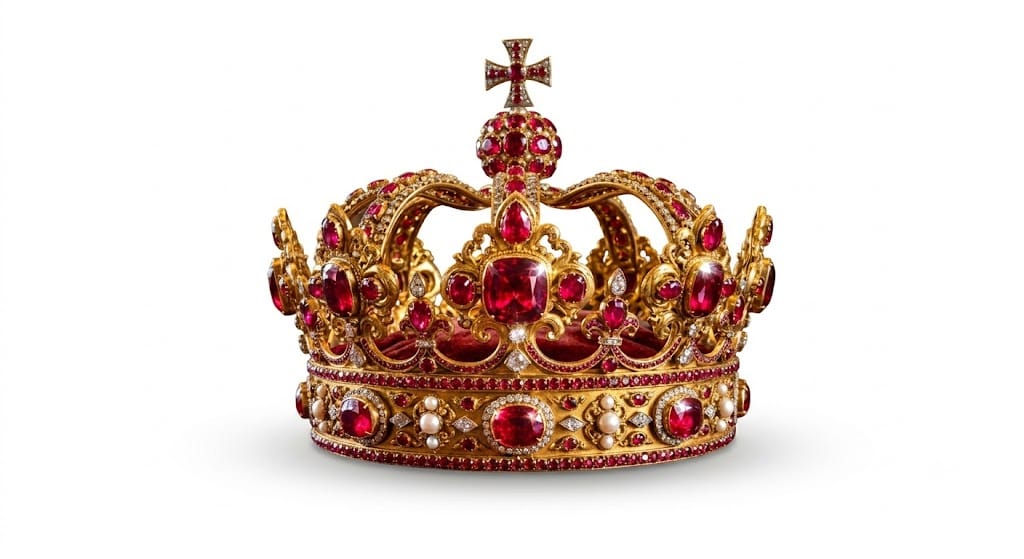
The ruby occupies a singular position within the Big Three of colored gemstones, serving as the benchmark for both aesthetic perfection and intrinsic asset value. This section delineates the mineralogical foundation and cultural architecture that define the ruby’s enduring global dominance.
| Attribute | Technical Specification | Market Context |
|---|---|---|
| Species | Corundum (Al₂O₃) | High Liquidity |
| Hardness | 9 Mohs | Durability Premium |
| Chromophore | Chromium (Cr³⁺) | Scarcity Factor |
- Corundum Taxonomy: Al₂O₃ structural purity.
- Chromophore Dynamics: Chromium substitution vs. Titanium/Iron interference.
- Historical Misclassification: The legacy of spinels and garnets as “balas rubies.”
Definition and Mineralogy: The Science of Red
At its core, the ruby is defined by the mineral species corundum, a crystalline form of aluminum oxide. While pure corundum is inherently colorless, the inclusion of trace elements—specifically chromium—creates the lattice-level disruption that yields the characteristic red hue. The definition of a “ruby” is inherently a trade distinction; mineralogically, it is merely a red variety of sapphire. However, the commercial separation of these two gems is one of the most firmly established pillars of the industry. The ‘fancy sapphire’ designation applies to all non-blue, non-red corundum, yet the ruby retains a unique status as the only member of the corundum family that is graded based on the intensity of its red saturation.
The distinction between ruby and fancy sapphire is often a point of forensic gemological debate, particularly regarding stones that lean toward pink. The industry threshold—the tipping point where a ‘pink sapphire’ becomes a ‘ruby’—is subjective and varies by market center. This ambiguity often serves as a point of contention in insurance appraisals, where the classification as a ruby can increase the asset valuation by several orders of magnitude. The absence of iron in the lattice is essential for maintaining the clarity and fluorescence that separates a world-class ruby from a dull, brownish-red corundum.
The “King of Gems” Narrative: Cultural and Historical Weight

The ruby’s narrative is synonymous with power. In the ancient history of gemology, rubies were not simply decorative; they were considered living, pulsating vessels of blood and fire. The “King of Gems” moniker is not merely poetic; it reflects the historical economic reality where rubies were traded at higher per-carat prices than diamonds or sapphires. This cultural reverence transcended civilizations, from the Mogul Emperors who adorned their daggers with them to the Victorian obsession with them as symbols of passionate devotion.
The cultural symbolism is deeply intertwined with the legal and fiscal frameworks of inheritance, where these gems were often held in trusts or royal treasuries to ensure the stability of the state. This historical consistency has built a psychological “floor” for ruby pricing that other gemstones—even high-value ones—struggle to replicate. When stakeholders discuss ‘worth’, they are tapping into millennia of collective human belief that the ruby is the ultimate store of value.
Scope of Treatise: Bridging Geology and Macro-Economics
This treatise serves as a rigorous bridge between the raw geological genesis of the mineral and the modern actuarial valuation models used by institutional investors in 2026. The shift from seeing a ruby as a static piece of jewelry to viewing it as a mobile, non-fungible financial instrument is the central thesis of our analysis. We will explore how mining supply chain volatility—particularly the ongoing supply squeeze in Mogok—affects the appraisal methodology for high-net-worth collections.
The goal is to provide the reader with a forensic understanding of how to navigate the current colored stone market. Whether dealing with secondary market liquidation, insurance scheduling, or long-term asset allocation, the principles defined herein are designed to maximize transparency and accuracy in an era of unprecedented market disruption.
II.
Chapter 1: Geological Genesis of Gem-Quality Corundum
The formation of gem-quality corundum is an exquisite geochemical rarity, requiring the precise convergence of tectonic, thermal, and chemical variables. This chapter dissects the primary geological environments that facilitate the crystallization of ruby, moving beyond surface-level descriptions to analyze the fundamental mineralogical mechanisms governing their scarcity.
| Genesis Type | Tectonic Driver | Chemical Constraint |
|---|---|---|
| Marble-Hosted | Regional Orogeny | Silica-Poor |
| Basalt-Hosted | Mantle Plume/Rift | Iron-Rich |
| Secondary | Erosional Cycles | Specific Gravity 4.0 |
- Orogenic Impact: Crustal thickening and metamorphism.
- The Iron Barrier: Why iron depletion is mandatory for top-tier value.
- Diffraction Mechanics: How rutile needles influence market-grade valuation.
Metamorphic Environments: The Marble-Hosted Paradigm
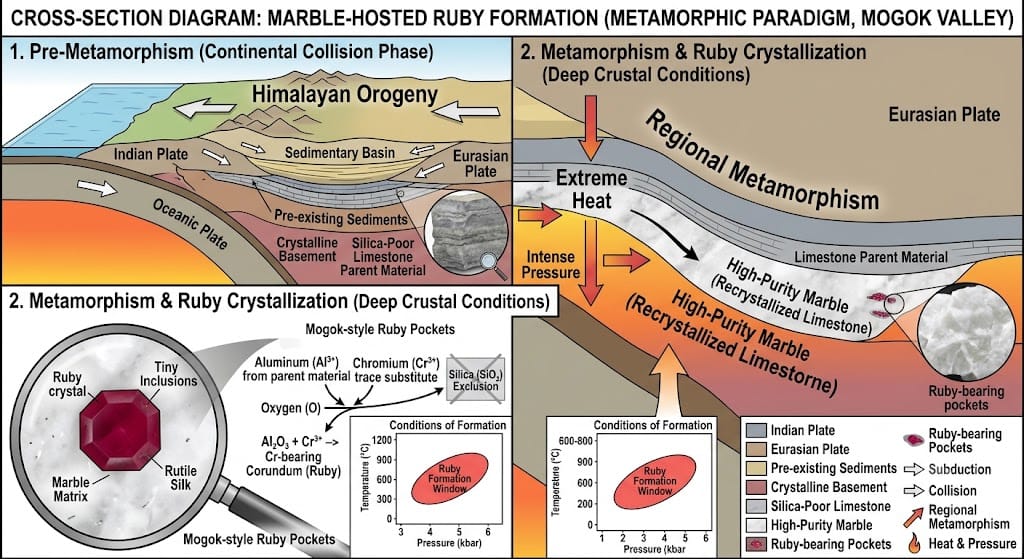
The premier rubies of the world, specifically those from the Mogok Valley, owe their existence to regional metamorphic events. When tectonic plates collide—such as the Himalayan orogeny where the Indian plate subducted beneath the Eurasian plate—massive sedimentary basins were compressed and subjected to extreme heat and pressure. The parent material, primarily limestone, underwent recrystallization into high-purity marble. For ruby growth, this environment must be essentially devoid of silica. If silica is present, the aluminum oxide (Al₂O₃) that constitutes corundum will react to form common silicate minerals like feldspar or mica, which are ubiquitous in the crust. The true scarcity of ruby is found in the extreme difficulty of finding crustal pockets where high aluminum concentration is trapped in a silica-depleted marble void.
The addition of chromium (Cr³⁺) is the final, pivotal variable. Chromium replaces aluminum ions within the corundum lattice. In marble-hosted environments, the chemistry is often naturally purged of iron, which is fortuitous for the gemstone’s quality. Iron is the primary ‘killer’ of color vibrancy. Because iron and chromium compete for the same sites in the crystal lattice, a lower iron concentration allows for a higher percentage of chromium substitution, which drives the intensity of the red color and the fluorescence valuation metrics required for the “Pigeon’s Blood” designation.
Magmatic Environments: The Basaltic Reality
Basalt-hosted rubies represent a distinct geological pathway. These crystals typically form deep within the lower crust or upper mantle. During specific volcanic episodes, alkali basaltic magma ascends rapidly to the surface, acting as a geological elevator. This magma scavenges corundum crystals—xenocrysts—that were already present in the host rock. These deposits are commonly found in regions like Thailand, Cambodia, and portions of the African rift system. Because the magmatic environment is inherently rich in iron, these rubies almost always possess high iron content compared to marble-hosted stones. The irony, for the collector, is that while these deposits are often more productive, the iron dampens the natural fluorescence of the chromium, producing a stone that requires advanced thermal enhancement to reach its full market potential.
The Physics of Fluorescence and the ‘Pigeon’s Blood’ Aesthetic
The “Pigeon’s Blood” designation is not merely a color descriptor; it is an optical phenomenon rooted in physics. Fluorescence in rubies occurs when the stone absorbs energy from UV light and re-emits it as visible red light. This creates an internal ‘glow’ that makes the stone appear to radiate rather than reflect color. In marble-hosted rubies, the near-total absence of iron allows this fluorescence to act unimpeded. When a stone with high chromium and low iron is placed in natural sunlight—which is rich in UV radiation—it effectively becomes a light-emitter, increasing the apparent saturation. This is why top-tier appraisal standards at facilities like GIA or Gübelin place such heavy emphasis on ultraviolet response when certifying provenance and quality. Investors paying the premium for “unheated” rubies are paying for the physical perfection of this natural fluorescence.
Alluvial Deposition (Byon): The Mechanics of Concentration
Over millions of years, the primary host rocks—marble or basalt—undergo systematic weathering. Corundum has an exceptional hardness of 9 on the Mohs scale and a specific gravity of approximately 4.0, which is significantly denser than the typical quartz or feldspar waste rock. As water systems erode the mountain ranges, the softer surrounding material is pulverized and washed away, while the robust corundum crystals are mechanically sorted by the flow energy of the stream. They accumulate in heavy gravel beds, locally referred to as ‘byon’ in Southeast Asia. This geological ‘sorting’ is the source of the vast majority of historical ruby supply. For the modern gemstone prospecting industry, these secondary deposits offer the most predictable extraction model, albeit one plagued by the risks of illicit mining and lack of reliable provenance data.
III.
Chapter 2: Ancient Origins and the Legend of Mogok
The historical trajectory of the ruby is inextricably linked to the socio-cultural development of the Indian subcontinent and Southeast Asia. This chapter investigates the ontological status of the ruby in ancient texts, the foundational myths governing its discovery, and the archaic economic systems that managed its extraction long before the era of modern industrialization.
| Historical Era | Conceptual Framework | Valuation Metric |
|---|---|---|
| Vedic Period | Spiritual Hierarchy | Ratnaraj (King of Gems) |
| Kingdom of Burma | Sovereign Monopoly | Weight-Based Seizure |
| Classical Antiquity | Carbunculus/Balas | Color-Based Taxonomy |
- The Vedic Caste System: How gems were socially tiered.
- Extraction Logistics: The ‘Twinlon’ shaft engineering.
- The Economics of Smuggling: Why large crystals were systematically destroyed.
Vedic Contexts and the Casted Gemstone
In ancient Vedic literature, the ruby was not viewed merely as a commodity but as a sentient element of the divine hierarchy. The Sanskrit term Ratnaraj—”King of Precious Stones”—assigned the ruby to the Brahmin caste, the highest spiritual tier in Indian society. This classification was not whimsical; it provided a rigid framework for the valuation of luxury assets, ensuring that the rarest specimens were reserved for religious and imperial use. The belief system held that the ruby’s internal ‘fire’ was a reflection of the sun, granting the wearer vitality, protection against malevolence, and spiritual purity.
This caste-based classification created a unique market dynamic. Gemstones were not just valued for their physical characteristics but for their perceived moral ‘cleanliness’. A ruby that was cracked, included, or ‘cloudy’ was deemed unworthy of royalty, reflecting a spiritual defect. This ancient aesthetic, which prized internal clarity above all else, foreshadows the modern focus on unheated, high-clarity assets. The Vedic tradition instilled a reverence for natural, un-manipulated gemstones that arguably remains the most powerful force in the international colored stone market today.
Mythological Foundations of the Mogok Valley
The discovery of the Mogok Valley is shrouded in a mythology that serves to emphasize the sheer rarity of the gem. Local Burmese legend tells of an eagle circling the mountains, captivated by a mass of what it perceived as fresh meat on a hillside. Upon striking, the eagle found the object immovable, revealing it to be a colossal, glowing ruby crystal. This narrative serves a vital socio-economic function: it frames the ruby not as a result of labor, but as a providential gift from the Earth itself, justifying the absolute claim of the monarchy over the soil. The myth elevated the status of Mogok from a mere geographic coordinate to a sacred site of cosmic origin, effectively discouraging unauthorized prospecting by neighboring tribes for centuries.
Indigenous Engineering: The Twinlon System
The mining techniques developed in Mogok were as primitive as they were effective. The ‘Twinlon’ system was an engineering marvel of artisanal mining. Miners would dig vertical pits into the alluvial soil, utilizing bamboo scaffolding—woven with extreme precision—to hold back the shifting gravel. These pits were often narrow and prone to collapse, yet they allowed artisanal miners to reach deep deposits without the need for heavy machinery. The material was hauled to the surface in rattan baskets via counterbalanced wooden cranes. This labor-intensive structure defined the life of the Mogok miner for centuries, creating a cohesive, albeit dangerous, village-based economy centered entirely on gemstone extraction.
Pre-Colonial Economics and the Crown’s Share
The absolute monarchy in Burma maintained a monopoly over any stone exceeding a specified weight, usually a few carats. This created a paradoxical market effect: miners, fearing the total confiscation of a “museum-grade” find, would often intentionally shatter large, perfect crystals into smaller, manageable fragments. This destruction of historical value is perhaps the most significant loss in the annals of gemology. The socio-economic pressure of the monarchy essentially forced a downward compression of gemstone sizes on the market, as any stone of exceptional scale was deemed a liability to the finder. This practice highlights the fragility of high-value asset supply chains; when the cost of discovery exceeds the reward due to institutional overreach, the supply of high-end assets disappears or is destroyed entirely.
IV.
Chapter 3: Colonial Exploitation and European Monopolies
The transition from indigenous artisanal mining to British colonial extraction represents the most volatile period in Mogok’s history. This chapter analyzes the geopolitical motives behind the 1885 annexation and the subsequent failure of industrialized gemstone mining as a commercial model.
| Phase | Primary Actor | Operational Outcome |
|---|---|---|
| Annexation | British Empire | Sovereignty Collapse |
| Industrialization | Burma Ruby Mines, Ltd. | Commercial Failure |
| Post-1931 | Artisanal Reversion | Restoration of Tradition |
- Geopolitical Catalysts: French influence and the Anglo-Burmese Wars.
- Industrial Hubris: Why open-cast methods failed to map erratic deposits.
- Economic ‘De Beers’ Shadow: The interplay of global monopoly interests.
Geopolitics of the Third Anglo-Burmese War
The annexation of Upper Burma in 1885 was not purely driven by mineral desire, though the allure of the Mogok ruby fields provided the necessary economic fuel. The British Empire, motivated by the protection of its Indian territories, viewed the Burmese monarchy’s diplomatic overtures to France with profound suspicion. Fearing a French ‘foothold’ in the Irrawaddy river valley, the British government utilized minor trade disputes involving the Bombay Burmah Trading Corporation as a casus belli. Following a rapid military campaign, the overthrow of King Thibaw Min ended sovereign Burmese rule. For the gemstone trade, this marked the end of the royal monopoly and the beginning of a corporate era that sought to strip the land of its assets under the guise of colonial ‘modernization’.
The Rise and Fall of Burma Ruby Mines, Ltd.
In 1889, the Burma Ruby Mines, Ltd. was incorporated in London with a paid-up capital of £150,000. It represented the first concerted attempt to apply industrial engineering to gemstone extraction. The company deployed hydraulic monitors, electric pumps, and hydroelectric plants to wash millions of tons of alluvial gravel. However, this strategy relied on the erroneous assumption that ruby distribution was uniform, much like coal or iron ore. In reality, gem-quality rubies are distributed in highly erratic, sporadic pockets within the marble matrix. The high overhead of maintaining hydroelectric infrastructure and mechanical pumps, combined with the catastrophic flooding of open-cast pits during monsoon seasons, rendered the venture economically non-viable. The company spent years in “preliminary operations,” failing to recognize that nature’s unpredictability could not be solved by engineering sheer scale.
Marginalization and the Rise of Illegal Night Mining
The colonial administration’s attempt to impose a Western licensing system shattered the local socio-economic fabric. Indigenous miners, who had historically operated within a flexible community-based system, were suddenly treated as trespassers on their own ancestral land. This triggered an era of desperate resistance, manifesting as widespread ‘night mining’. Under the cover of darkness, local laborers would bypass colonial security to strip-mine the byon deposits. This created a bifurcated economy: a highly formalized, struggling corporate operation above ground, and a thriving, dangerous illicit market below. The colonial effort to ‘regulate’ the supply chain merely served to incentivize criminality, a historical lesson that remains highly relevant for modern illicit gemstone networks.
Economic Collapse and the 1931 Liquidation
The 1931 surrender of the Burma Ruby Mines, Ltd. lease was a death knell for large-scale corporate mining in the Mogok Valley for decades. Multiple factors converged: the post-WWI economic contraction, the rise of Verneuil’s synthetic rubies which flooded the lower-end market, and internal corporate mismanagement. Furthermore, archival evidence suggests the company faced external pressures, potentially from monopoly concerns like De Beers, who viewed the independent availability of massive ruby stocks as a threat to their own controlled market strategies. With the company’s departure, the valley experienced a painful but inevitable reversion to traditional, artisanal methods. This period of artisanal restoration proved that the Mogok valley could not be managed by boardrooms in London; it could only be harvested by those with the indigenous knowledge of the earth’s specific geological rhythms.
The legacy of this colonial period is a permanent disruption of provenance. The systematic records kept by the Burma Ruby Mines, Ltd. provide a snapshot of the period, but the loss of thousands of artisanal, unrecorded stones during the decades of ‘night mining’ leaves a significant void in the historical valuation of Mogok rubies. For today’s appraisers and investors, the colonial era remains a point of caution: historical supply chain data from this period is notoriously unreliable due to the conflict between corporate accounting and illicit trade realities.
.
V.
Chapter 4: Silk Roads and Maritime Trade
The global trajectory of the ruby was defined by the sophisticated logistics of ancient trade routes. This chapter examines how overland caravans and maritime merchant networks facilitated the geographic distribution of these high-value assets, creating a nascent form of international commodity pricing long before modern valuation standards existed.
| Route Network | Primary Hubs | Market Impact |
|---|---|---|
| Overland Silk Road | Kashgar, Samarkand | High Value/Weight Ratio |
| Maritime Indian Ocean | Galle, Bandar Abbas | Volume Distribution |
| Colonial Pipelines | London, Paris, Amsterdam | Valuation Standardization |
- Asset Portability: The economic advantage of rubies in caravan travel.
- Islamic Mineralogy: The scholarly classification of “Yaghout” (corundum).
- Colonial Monopolies: The transition from merchant guilds to chartered corporations.
Overland Networks: The Silk Road as a Financial Conduit
For centuries, the overland Silk Road served as the primary artery for the movement of precious stones from the mines of Southeast Asia to the courts of Persia, China, and the Mediterranean. The ruby’s inherent physical properties—extreme hardness, compactness, and high intrinsic value—made it the perfect ‘portable wealth’ for merchants traversing thousands of miles. Unlike bulky textiles or perishable spices, a small pouch of high-grade Mogok rubies could represent the capital equivalent of a thousand camels. Cities like Kashgar and Samarkand functioned as critical financial hubs where gemstones were not just traded, but appraised using rudimentary physical tests. These cities became the repositories of ancient gemological intelligence, where a stone’s color saturation and clarity dictated its journey toward the West or East.
The Islamic Golden Age: Scientific Gemology
During the Abbasid and Safavid periods, Islamic scholars transformed the study of gemstones from mystical folklore into a proto-scientific discipline. Figures like Al-Biruni revolutionized the identification of minerals by utilizing physical properties such as specific gravity and hardness. In his treatise Kitab al-Jamahir fi Ma’rifat al-Jawahir (The Book of Precious Stones), Al-Biruni detailed the varieties of ‘Yaghout’ (corundum), distinguishing rubies from other red gems with a precision that would not be equaled in Europe for another seven centuries. These scholars developed the sophisticated treasury management systems used by the Safavid Shahs, who treated gemstones as liquid capital to secure borders, pay mercenaries, and fund the elaborate architecture of Isfahan. This era of empirical gemology created the first global language of value for red corundum.
Maritime Conduits: The Age of Discovery and the Galle Emporium
The maritime trade through the Indian Ocean turned the port of Galle in Ceylon into a nexus of global gem distribution. Arab dhows, navigating by monsoon wind cycles, established a reliable pipeline that bypassed the dangers of the inland routes. The port of Bandar Abbas under the Safavids later became a critical intersection where Persian merchants exchanged finished jewelry for luxury imports from as far as Sweden and England. The ‘Age of Discovery’ accelerated this process, as European powers sought to excise the middlemen of the overland routes. The result was a dramatic shift in supply chain geography; gemstones began moving in larger volumes directly from the mines to the merchant houses of Europe, effectively stripping the traditional Persian and Arab traders of their centuries-old market dominance.
Colonial Standardization: The Rise of London and Paris
The chartering of the British and Dutch East India Companies formalized the trade of rubies into a structured, corporate system. These entities replaced independent merchant guilds with organized logistical monopolies. By the 18th century, London and Paris had emerged as the global price-setting centers. The standardization of gemstone quality reporting began here, as auction houses and merchant syndicates sought to eliminate the volatility inherent in traditional bartering. The British Raj’s control over Indian and Burmese trade routes meant that the highest quality stones were routed through the London wholesale gem markets, where they were meticulously faceted and sold to the emerging industrial elites. This centralization of trade established the ‘European standard’ for sapphire and ruby appraisal, a framework that heavily influences the modern GIA and SSEF grading models used by investors today.
The transition from a decentralized, merchant-based trade to a centralized, corporate-managed system fundamentally changed how the ruby was perceived as an asset. No longer merely a royal talisman, it became a standardized, globally traded commodity. This historical shift is the reason why, in modern valuation of rubies in 2026, we reference auction benchmarks from Christie’s and Sotheby’s; the groundwork for these global pricing benchmarks was laid during the colonial era’s drive for market standardization.
VI.
Chapter 5: Macroeconomics of Regional Deposits
The global ruby market functions as a mosaic of geographic supply, fundamentally reshaped by geopolitical volatility and corporate mining initiatives. This chapter evaluates the economic transitions from Myanmar’s state-controlled isolation to the institutionalized scale of African extraction, providing a macroeconomic framework for understanding ruby valuation in the 2026 fiscal year.
| Era | Dominant Region | Market Catalyst |
|---|---|---|
| Post-1962 | Burma (Isolation) | Supply Vacuum |
| 1970s–90s | Thailand/Cambodia | Thermal Enhancement |
| 2009–Present | Mozambique | Corporate Scale/Auction |
- The Isolationism Effect: How military juntas create “scarcity premiums.”
- Treatment Innovation: Chanthaburi’s role in normalizing basaltic ruby.
- Corporate Institutionalization: The Gemfields model of predictable supply.
The Burmese Void (Post-1962): The Birth of the Scarcity Premium
Following the 1962 coup d’état, Myanmar’s military leadership initiated a “Burmese Way to Socialism,” effectively nationalizing all major gemstone operations. This period of self-imposed isolationism severed the official pipeline of high-quality rubies to the West. The macro-economic consequence was a decade-long supply vacuum that forced the global jewelry industry to re-orient its value chains. Because the “Burmese Ruby” brand was already synonymous with the highest possible quality, this artificial constriction of supply triggered a legendary scarcity premium. Prices for existing stones in the secondary market began an exponential climb, as the inability to procure new rough material from Mogok transformed every existing Burmese stone into an increasingly rare financial asset. This era taught the global trade a brutal lesson in supply chain fragility—a lesson that still underpins the valuation of any unheated ruby with verified Mogok provenance today.
The Thai Era: Chanthaburi and the Normalization of Basaltic Ruby
As the Burmese supply plummeted, Thailand’s Chanthaburi region seized the opportunity to become the world’s primary commercial ruby hub. Geologically, these were basalt-hosted deposits, inherently richer in iron and prone to a dark, somber hue. To move this lower-grade material, Thai merchants pioneered sophisticated thermal enhancement techniques. By heating these stones in controlled atmospheres, they successfully managed to reduce the iron-induced extinction, producing a bright, commercially viable red. This was the birth of the modern ‘treated’ ruby market. Economically, Thailand democratized the access to red corundum, transitioning the market from an exclusive, high-net-worth domain into a mass-market retail product. The Chanthaburi ‘petri dish’ of innovation, which included chemical suppliers and oven manufacturers, created a vertical integration that defined ruby pricing for nearly three decades.
The Vietnamese Episode: Karst Topography and Artisanal Peaks
In the late 1980s, the discovery of rubies in the Luc Yen region of Vietnam offered a brief hope for a successor to Mogok’s quality. These marble-hosted deposits yielded rubies that were chemically similar to Burmese stones, often displaying high chromium and vibrant fluorescence. However, the macro-economics of these deposits were constrained by the extreme physical geography; the karst topography—a landscape of jagged, weathered limestone pillars—made industrial mining impossible. While the discovery triggered a localized ‘gold rush’ of artisanal miners, the production was erratic and short-lived. The state-owned corporation VIGEGO struggled to manage these deposits, and within a decade, the peak of high-quality Vietnamese extraction had passed, reinforcing the reality that geological rarity often defies large-scale corporate management.
The Mozambique Revolution: Gemfields and Corporate Predictability
The 2009 discovery of ruby deposits in Montepuez, Mozambique, signaled the most significant structural shift in the history of the colored stone market. Unlike the sporadic, chaotic supply of Burma or Vietnam, the Montepuez deposit provided a volume of gem-quality material that could support industrial-scale extraction. The partnership between Mwiriti Ltd. and the British multinational Gemfields transformed this African deposit into the engine of the global trade. Gemfields introduced a highly transparent, auction-based sales model, allowing for predictable bulk sampling and grading that replaced the ‘secrecy’ of the Burmese trade with corporate audit trails. Economically, this stabilized the ruby market by ensuring a reliable supply of mid-to-high quality material. However, it also introduced a new hierarchy in valuation, where the origin premium of a Burmese stone is now explicitly contrasted against the high-efficiency, standardized supply of Mozambique. This ‘institutionalization’ has changed the face of investment, making the ruby a more reliable asset for hedge funds and high-net-worth wealth preservation strategies.
.
VII.
Chapter 6: Treatments, Synthetics, and Forensic Identification
The history of ruby enhancement is a dual narrative of human ingenuity and market deception. This chapter explores the evolution of professional appraisal standards for treated versus untreated stones, detailing the progression from ancient foil-backing to advanced synthetic growth.
| Treatment Category | Mechanism | Market Status |
|---|---|---|
| Traditional Heat | Rutile Dissolution | Accepted (Disclosed) |
| Lead-Glass Fill | Cavity Repair | Composite (Non-Asset) |
| Flame-Fusion | Boule Crystallization | Synthetic (Lab-Grown) |
- The Rutile Threshold: Why silk dissolution defines commercial viability.
- Forensic Indicators: Identifying curved striae vs. straight growth lines.
- Asset Integrity: Why lead-glass filled stones are disqualified from institutional portfolios.
Historical Enhancements: From Foils to Blowpipes
The practice of “improving” gemstones predates the formal codification of gemology. In antiquity, the most prevalent method for enhancing rubies was the use of foil-backing. By placing a thin layer of reflective metallic foil behind a ruby within a closed-back setting, jewelers could amplify the light return, masking internal inclusions and creating an artificial illusion of depth and fire. Another primitive method involved boiling stones in organic oils or dyes to saturate surface-reaching fissures, temporarily masking flaws. The early ‘blowpipe’ methods—where charcoal and bellows were used to localize heat—allowed miners and merchants to coax better color from opaque, brownish-tinted crystals. While these methods were rudimentary, they established a precedent: the market value of a ruby was always contingent upon its final appearance, not just its “as-mined” state.
Modern Thermal Enhancement: The Science of Silk
Modern thermal enhancement is a continuation of these historical practices, optimized through precision engineering. When a ruby is heated (800°C–1800°C), the primary goal is often the dissolution of rutile needles (‘silk’). These inclusions, if densely packed, cause a hazy, milky appearance that degrades brilliance. As these needles dissolve into the corundum lattice, they release titanium, which often interacts with existing iron impurities to refine the stone’s color saturation. Ethical disclosure is the absolute cornerstone here. In 2026, the industry distinguishes between “minor heat” (which is largely accepted) and “excessive heat” (which may compromise structural integrity). A high-level appraisal must determine the degree of thermal footprint, as the market for unheated, natural rubies continues to outpace all other segments in CAGR (Compound Annual Growth Rate).
The Lead-Glass Controversy: Composite Degradation
The late 1990s introduced lead-glass filling, a process that arguably destabilized the low-end ruby market. Unlike thermal enhancement, which affects the crystal itself, glass filling treats stones that are essentially ‘rubble’ by using molten lead glass to seal extensive cavities and fractures. These “composite” stones are highly fragile—they are susceptible to household chemicals, re-cutting risks, and thermal shock. From an investment perspective, lead-glass filled rubies are not considered gemstones but rather industrial composites. They lack the durability, intrinsic rarity, and long-term price stability required for legitimate asset-grade portfolios. Any appraisal professional must identify these via microscopic surface examination, as they pose significant liability risks in insurance-replacement scenarios.
Synthetic Evolution and Forensic Detection
Auguste Verneuil’s 1902 announcement of flame-fusion synthesis changed the trajectory of the market forever. By dropping purified alumina and chromium oxide through an oxyhydrogen torch at 2,000°C, he created ‘boules’—synthetic crystals that were chemically identical to natural rubies. The forensic distinction relies on internal fingerprints: Verneuil stones exhibit curved growth lines (striae) caused by the rotating boule, whereas natural stones exhibit angular, 120-degree straight growth features. Furthermore, the presence of spherical gas bubbles in synthetic stones remains a ‘smoking gun’ for examiners. Modern flux-growth methods, however, create fewer inclusions, requiring advanced spectroscopic analysis (LA-ICP-MS) to detect trace elements like gallium or specific iron ratios that serve as the definitive geochemical signature of Earth-mined versus lab-grown material. As synthetic production scales, the forensic expertise of the appraiser becomes the final barrier protecting the integrity of natural ruby assets.
VIII.
Chapter 7: The Modern Ruby as an Asset Class
In the contemporary financial landscape, the natural ruby has evolved into a highly sophisticated, non-fungible asset. This chapter analyzes the macro-valuation metrics, auction benchmarks, and institutional roles that position investment-grade rubies as critical components in modern family office portfolios.
| Metric | Primary Indicator | Asset Impact |
|---|---|---|
| Provenance | Origin Report (GIA/SSEF) | Premium Multiplier |
| Treatment | “No Indications of Heat” | Liquidity Threshold |
| Rarity | Carat Weight (>3ct) | Exponential Value |
- The “Big Three” Hegemony: Comparative rarity of ruby vs. diamond.
- Forensic Certification: The role of GIA, SSEF, and Gübelin in price discovery.
- Market Benchmarks: Analysis of the *Sunrise Ruby* and *Estrela de Fura* sales.
Valuation Metrics: The Data-First Appraisal
Modern ruby valuation is no longer a subjective exercise in aesthetic preference; it is a data-driven science. Institutional investors rely on forensic reports from laboratories such as the Gemological Institute of America (GIA), SSEF, and Gübelin to establish a stone’s ‘biography.’ The most significant value differentiator in 2026 is the “No Heat” remark. Natural rubies that possess high color saturation without thermal enhancement are geological anomalies; consequently, they command an exponential price premium. These laboratory reports serve as a cryptographic-like verification of the asset’s history, without which a high-end ruby cannot be traded in the institutional secondary market. The appraisal of a ruby is thus an act of origin verification, ensuring the stone’s chemical signature aligns with its stated provenance—a necessity in an era where synthetic and treated stones are increasingly sophisticated.
The “Big Three” Economics: Rarity vs. Commodity
While diamonds are effectively managed through industrial mining and cartel-driven supply chains, rubies are defined by extreme geological sporadicism. Gem-quality rubies are approximately 1/100th as common as diamonds, which fundamentally alters their ‘investment’ logic. In the diamond sector, consistency allows for standardized pricing indices; in the ruby sector, rarity demands a unique valuation for every single stone. For the sophisticated collector, this makes the ruby a hedge against the industrialization of the diamond trade. A high-quality ruby of 3+ carats, unheated, represents a concentrated store of value that is inherently immune to the deflationary pressures currently seen in the standardized diamond market. Investors view rubies not as decorative jewelry, but as a hard asset capable of retaining purchasing power during periods of currency volatility.
Auction Benchmarks: Setting the Million-Dollar Ceiling
The auction market serves as the ultimate laboratory for price discovery. The 2015 sale of the 25.59-carat *Sunrise Ruby* for $30.4 million—a staggering $1.19 million per carat—set a global benchmark that effectively repositioned the ruby as a blue-chip asset. This was surpassed in 2023 by the *Estrela de Fura*, a 55.22-carat Mozambique stone that sold for $34.8 million. These records underscore a shift in market perception: provenance is being balanced by sheer physical magnitude and spectroscopic purity. The auction house is the ‘price-setter’ for the entire pyramid of the colored stone market; when an auction record is broken, it sends a ripple effect through wholesale pricing, confirming to collectors that natural, untreated rubies are an appreciating class of wealth. These sales are meticulously analyzed by analysts who track auction house trends to adjust portfolio valuations for high-net-worth clients.
Ruby as Non-Fungible Wealth in Family Office Strategy
Family offices and private wealth managers are increasingly integrating natural rubies into their portfolios for three distinct reasons: portability, non-correlation, and privacy. Unlike digital assets or equities, a ruby is completely disconnected from corporate performance or government regulatory frameworks. It is a physical asset that requires no maintenance, no power source, and no infrastructure. As a currency hedge, it excels; in scenarios where fiat purchasing power is questioned, the ruby remains a universal, accepted store of ‘hard’ value. When planning estate-level transfers, the inclusion of such stones ensures that capital can be moved across borders with ease. The modern ruby is the physical manifestation of long-term strategic wealth—an immutable record of value that is resistant to the economic erosion of the 21st century.
IX.
Conclusion: The King of Gems
The journey from the primordial metamorphic fires of the Himalayas to the high-security climate-controlled vaults of global private equity marks the ruby’s status as a perpetual financial sentinel. As we synthesize 2,500 years of history, the macroeconomic trajectory of the ruby demonstrates an unwavering resilience against the cyclical decay of fiat currencies and industrial commodity markets.
| Variable | Historical Constant | 2026 Strategic Outlook |
|---|---|---|
| Scarcity | Geological Anomaly | Absolute Supply Exhaustion |
| Prestige | Mogok-Centric | Diversification to East Africa |
| Forensics | Visual Taxonomy | Spectroscopic Cryptography |
- Strategic Synthesis: Integrating historical scarcity with modern asset allocation.
- The Technological Frontier: Advancing detection methodologies against synthetic infiltration.
- Post-Burma Market Landscape: The institutional shift toward non-traditional origin prestige.
The Unbroken Trajectory of Value
The ruby’s value proposition has never relied on industrial utility; it is derived entirely from the confluence of extreme aesthetic rarity and the immutable historical weight of its legend. Unlike gold, which is subject to mining supply surges, or diamonds, which are susceptible to laboratory-grown disruption, the natural ruby occupies a protected niche. For the 2026 investor, the ruby represents the ultimate non-fungible wealth preservation tool. Its historical trajectory, spanning from the Sanskrit Vedic traditions to the auction records of the 21st century, proves that when humanity seeks a permanent anchor for capital, it inevitably returns to the red corundum.
Future Outlook: Exhaustion and Evolution
Looking toward the 2030s, the market for natural, unheated rubies will face an inevitable supply shock as primary alluvial gravels in traditional mining sites reach absolute exhaustion. This will not necessarily lead to market collapse, but rather to a fundamental restructuring of the “origin premium.” As top-tier Burmese material becomes effectively unobtainable, institutional markets will continue their pivot toward premium Mozambique assets, which are already demonstrating a rapid ascent in both liquidity and price per carat benchmarks. Furthermore, technological advancements in detection—such as next-generation spectroscopic imaging—will increasingly separate the asset-class rubies from the synthetic ‘noise.’ For the savvy market participant, the strategy is clear: focus on documented provenance, prioritize the “no-heat” diagnostic, and secure assets that have been vetted by the top-tier laboratories. The era of the “King of Gems” is far from over; it is simply undergoing a professionalization, moving from the informal bazaars of antiquity into the high-transparency reality of the 2026 global financial asset landscape.