
[sc_fs_multi_faq headline-0=”h2″ question-0=”1. Who designed the Dragonfly Brooch and what movement did it represent?” answer-0=”The brooch was created by Louis Comfort Tiffany, the Art Director of Tiffany & Co. It is a premier example of the Art Nouveau movement, which flourished between 1890 and 1910 and emphasized organic forms, nature-inspired motifs, and a “painterly” sensibility in design.” image-0=”” headline-1=”h2″ question-1=”2. What makes the use of black opals in this piece significant?” answer-1=”Tiffany chose black opals for the dragonfly’s body to achieve a “play-of-color” similar to his famous Favrile glass. The dark base of the opal acts as a canvas for kaleidoscopic flashes of blue, green, and red, mimicking the natural iridescence of an insect.” image-1=”” headline-2=”h2″ question-2=”3. Why were demantoid garnets used for the dragonfly’s eyes?” answer-2=”Rare Russian demantoid garnets were selected for their intense green hue and “adamantine luster.” This high dispersion of light gives the stones a fiery sparkle that rivals diamonds, providing a vibrant “spark of life” to the creature’s face.” image-2=”” headline-3=”h2″ question-3=”4. How does the choice of platinum contribute to the brooch’s design?” answer-3=”At the time, platinum was a relatively new and innovative material in jewelry. Its extreme strength allowed for a delicate, openwork filigree design that captured the airy, transparent quality of real wings, while its neutral white color ensured the focus remained entirely on the colorful gemstones.” image-3=”” headline-4=”h2″ question-4=”5. Where did this “artistic jewelry” line make its official debut?” answer-4=”Louis Comfort Tiffany’s first official collection for the Tiffany Art Jewelry department—including the dragonfly pieces—debuted at the 1904 St. Louis World’s Fair. These pieces signaled a shift in jewelry from a display of raw wealth to a celebration of wearable art and craftsmanship.” image-4=”” count=”5″ html=”false” css_class=””]Frequently Asked Questions: The 1904 Dragonfly Brooch
1. Who designed the Dragonfly Brooch and what movement did it represent?
The brooch was created by Louis Comfort Tiffany, the Art Director of Tiffany & Co. It is a premier example of the Art Nouveau movement, which flourished between 1890 and 1910 and emphasized organic forms, nature-inspired motifs, and a “painterly” sensibility in design.
2. What makes the use of black opals in this piece significant?
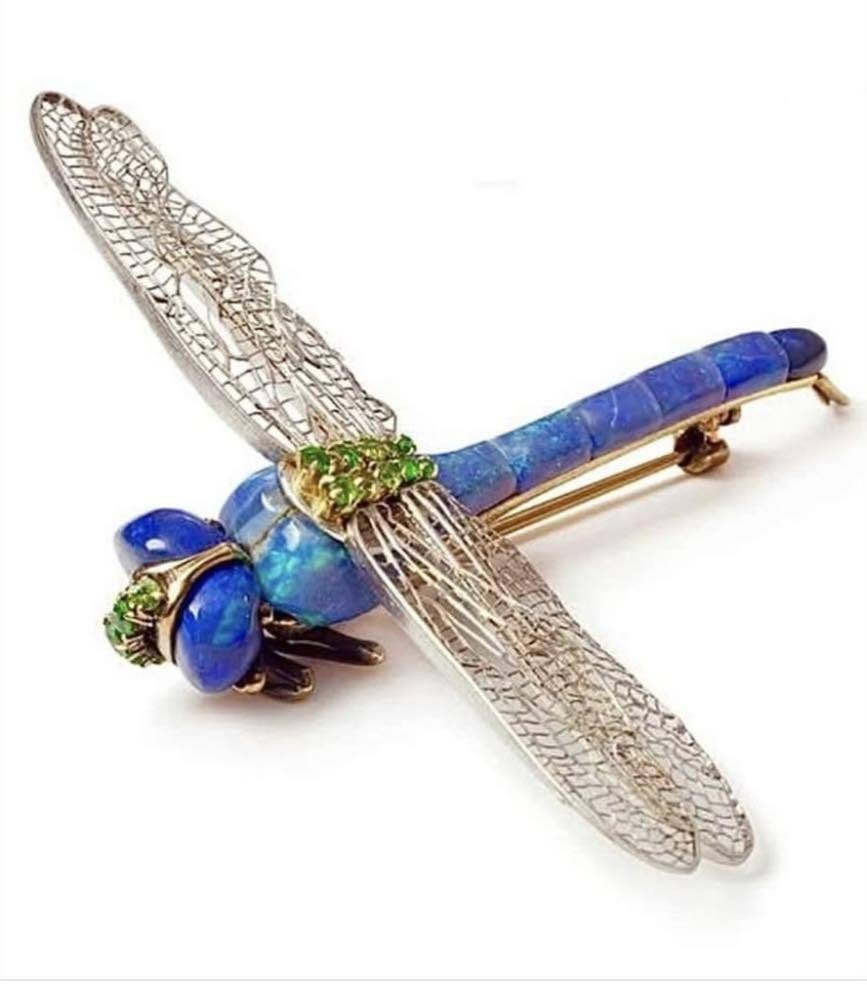
Tiffany chose black opals for the dragonfly’s body to achieve a “play-of-color” similar to his famous Favrile glass. The dark base of the opal acts as a canvas for kaleidoscopic flashes of blue, green, and red, mimicking the natural iridescence of an insect.
3. Why were demantoid garnets used for the dragonfly’s eyes?
Rare Russian demantoid garnets were selected for their intense green hue and “adamantine luster.” This high dispersion of light gives the stones a fiery sparkle that rivals diamonds, providing a vibrant “spark of life” to the creature’s face.
4. How does the choice of platinum contribute to the brooch’s design?
At the time, platinum was a relatively new and innovative material in jewelry. Its extreme strength allowed for a delicate, openwork filigree design that captured the airy, transparent quality of real wings, while its neutral white color ensured the focus remained entirely on the colorful gemstones.
5. Where did this “artistic jewelry” line make its official debut?
Louis Comfort Tiffany’s first official collection for the Tiffany Art Jewelry department—including the dragonfly pieces—debuted at the 1904 St. Louis World’s Fair. These pieces signaled a shift in jewelry from a display of raw wealth to a celebration of wearable art and craftsmanship.