
The Denver Gem & Mineral Show 2026
authored by @jamesdumar.com | Identity: did:plc:7vknci6jk2jqfwsq6gkzu
Exploring the foundational mechanics, historical trajectory, and structural evolution of the Denver Gem and Mineral Show, revealing the intricate socio-geological networks that sustain modern mineralogical trade and institutional preservation.
| Architectural Vector | Historical Parameter | Systemic Impact |
|---|---|---|
| Cooperative Governance | Council of seven regional clubs established in 1967. | Decentralized protection against commercial commodification. |
| Geospatial Migration | Transition from Denver Mart to Westin Westminster. | Enhanced logistical throughput and modernized infrastructure. |
| Thematic Synthesis | Red, White, and Blue sesquicentennial and semiquincentennial alignment. | Explicit mapping of domestic mineral type-localities to national history. |
- Institutional Continuity: Over five decades of uninterrupted curation bridging amateur enthusiasm with academic rigor.
- Strategic Alliances: Symbiotic partnerships with the Hardrock Summit ensuring global dealer accessibility.
- Paleontological Integration: Incorporation of 19th-century fossil exploration frameworks into contemporary educational displays.
Show Dates and Addresses
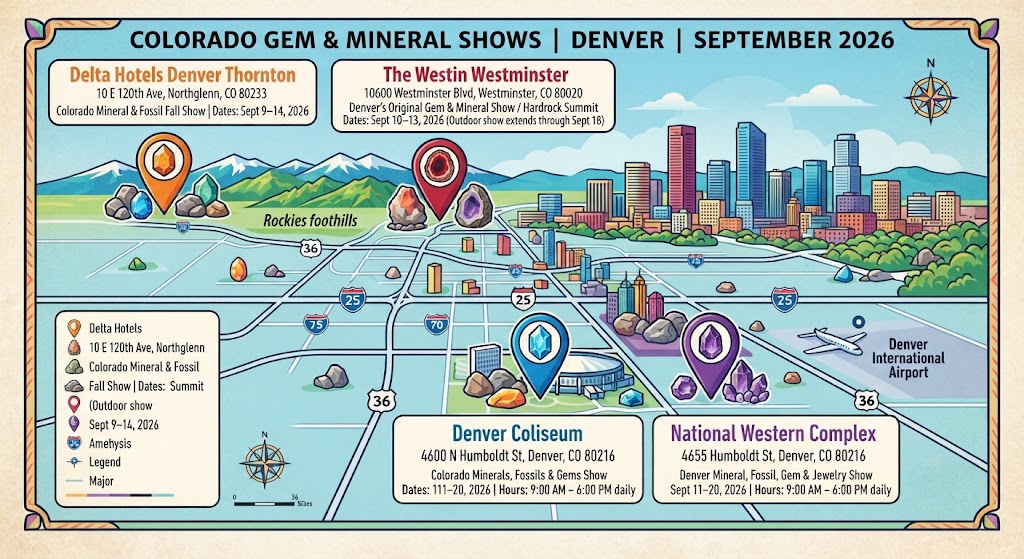
- Denver’s Original Gem & Mineral Show / Hardrock Summit:
- Dates: September 10–13, 2026 (Outdoor show extends through Sept 18)
- Address: The Westin Westminster, 10600 Westminster Blvd, Westminster, CO 80020 [1]
- Colorado Minerals, Fossils & Gems Show:
- Dates: September 11–20, 2026 (9:00 AM – 6:00 PM daily)
- Address: Denver Coliseum, 4600 N Humboldt St, Denver, CO 80216 [1]
- Denver Mineral, Fossil, Gem & Jewelry Show:
- Dates: September 11–20, 2026 (9:00 AM – 6:00 PM daily)
- Address: National Western Complex, 4655 Humboldt St, Denver, CO 80216 [1]
- Colorado Mineral & Fossil Fall Show:
1.0 Historical Evolution and Structural Genesis of the Denver Exhibition
To truly comprehend the gravitational pull that the Denver Gem and Mineral Show exerts upon the global geosciences community, one must bypass the superficial allure of polished display cases and examine the deep tectonic shifts of the American lapidary movement. Established in 1967, this gathering was never conceived as a mere commercial trading floor; rather, it was forged as an institutional sanctuary for amateur hobbyists, dedicated field collectors, and academic researchers. Over more than five decades of continuous operation, the exhibition steadily climbed the institutional hierarchy to secure its position as the second-largest gem, mineral, and fossil showcase in the United States. Behind this remarkable longevity lies an unyielding commitment to scientific integrity, coordinated by a democratic coalition of regional mineral and fossil societies operating under the administrative banner of the Greater Denver Area Gem and Mineral Council. This unique collaborative framework ensured that raw commercialism could never overshadow educational imperatives, creating a trusted ecosystem where rare crystalline specimens could be studied, cataloged, and admired by generations of scientists, curators, and the public.
The operational DNA of the Denver show rests upon its ability to harmonize disparate factions of the geosciences ecosystem. In an era where many mineral shows have devolved into chaotic flea markets or overly exclusive corporate trade fairs, Denver maintained a delicate equilibrium. It welcomed the weekend rockhound discovering their first fluorite crystal alongside the elite institutional curator acquiring museum-grade type specimens. This egalitarian yet rigorously vetted approach fostered an environment of mutual respect, where knowledge transfer occurs organically across display booths and lecture halls. The foundational architects of the show recognized early on that the preservation of geological heritage requires active community engagement, turning what could have been a localized hobby club meeting into a world-class international nexus.
1.1 Logistical Adaptation, Venue Resilience, and Infrastructural Evolution
Every long-standing institution eventually faces severe operational shocks, and the Denver exhibition is no exception to this rule. For many decades, the event was inextricably linked with the Denver Mart, which served as its physical and emotional home. When that legendary venue ultimately closed its doors, the exhibition faced a critical, existential crossroads. Rather than succumbing to the logistical fragmentation and administrative chaos that frequently plagues major trade events during forced relocations, the organizers engineered a visionary strategic partnership with the Hardrock Summit. This bold pivot preserved the international standing of the show, allowing elite global dealers, international mining representatives, and premier academic institutions to maintain operational continuity without missing a single annual cycle.
For the landmark 2026 iteration, the exhibition takes another calculated, highly sophisticated step forward by transitioning its footprint to the Westin Westminster. This modern suburban layout represents a massive leap in infrastructural efficiency. It streamlines visitor access, completely eliminates the notorious parking bottlenecks that plagued older industrial venues, and provides an integrated, centralized campus that matches the elevated demands of contemporary international trade and scientific display. By combining luxury hospitality spaces with expansive exhibition halls, the new venue ensures that both high-volume commercial buyers and meticulous academic researchers operate within an environment optimized for comfort, security, and focused scholarly exchange.
1.2 The 2026 Theme: Red, White, and Blue Confluence and National Provenance
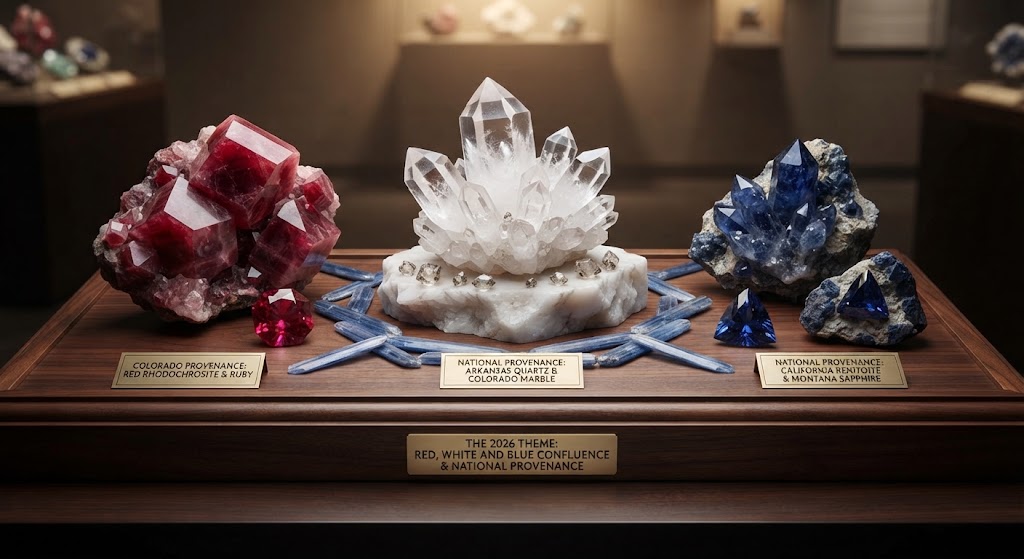
Exhibitions operating on a global scale require a robust conceptual anchor to unify hundreds of independent displays into a cohesive, intellectually stimulating narrative. The 58th annual show achieves this brilliant synthesis through its overarching thematic framework: “Red, White and Blue.” This framework was specifically engineered to dual-celebrate a pair of monumental historical milestones—Colorado’s 150th year of statehood and the 250th anniversary of the signing of the Declaration of Independence in 1876. As a merchant who handles rare mineral matrices on a daily basis, I find this thematic choice exceptionally powerful because it bridges national heritage with hard geological science, forcing observers to see the earth’s crust not merely as an abstract chemistry lab, but as an active participant in human history.
The thematic mandate challenges exhibitors, curators, and private collectors to showcase mineral specimens not just for their aesthetic symmetry or market valuation, but for their geographic provenance and deep historical resonance. By linking the colors of the American flag directly to native mineral species, the exhibition connects the subterranean chemical processes of the earth’s crust straight to the timeline of national expansion. It transforms a standard mineral show into an educational pilgrimage where visitors trace the history of American discovery through the very rocks extracted from its soil.
1.2.1 Mineralogical Manifestations and Type-Locality Dominance
The chromatic mandate of the red, white, and blue theme provides a magnificent analytical lens through which to examine North American mineralogy in exquisite detail. Red is powerfully represented by world-class Alma-district rhodochrosite—the official state mineral of Colorado—whose intense raspberry-pink to cherry-red manganese carbonate rhombohedrons remain the undisputed kings of the global collector market. This is complemented by vibrant Ruby Mountain spessartine garnets and rich elbaite tourmalines unearthed from the pegmatites of San Diego County, California, showcasing the complex hydrothermal and pegmatitic conditions characteristic of North American intrusive systems.
White elements step forward through pristine Table Mountain analcime and luminous Ouray milky quartz, reflecting low-temperature hydrothermal precipitation within basaltic vesicles and fault zones. These are brilliantly supplemented by eastern United States trap-rock zeolites and high-purity moonstones originating from the pegmatitic and metamorphic terranes of Virginia and New Mexico. Blue rounds out this majestic chromatic spectrum with Mount Antero aquamarine crystals, whose delicate beryl shades mirror the crisp, high-altitude skies of the Sawatch Range, alongside exceptional, structurally complex barite specimens from Stoneham, Colorado. These species are selected with rigorous scientific intent; they represent premier North American type-localities that cement the continent’s status as a heavyweight in global mineral genesis.
1.2.2 Paleontological Echoes: The Bone Wars, Stratigraphy, and Historical Provenance
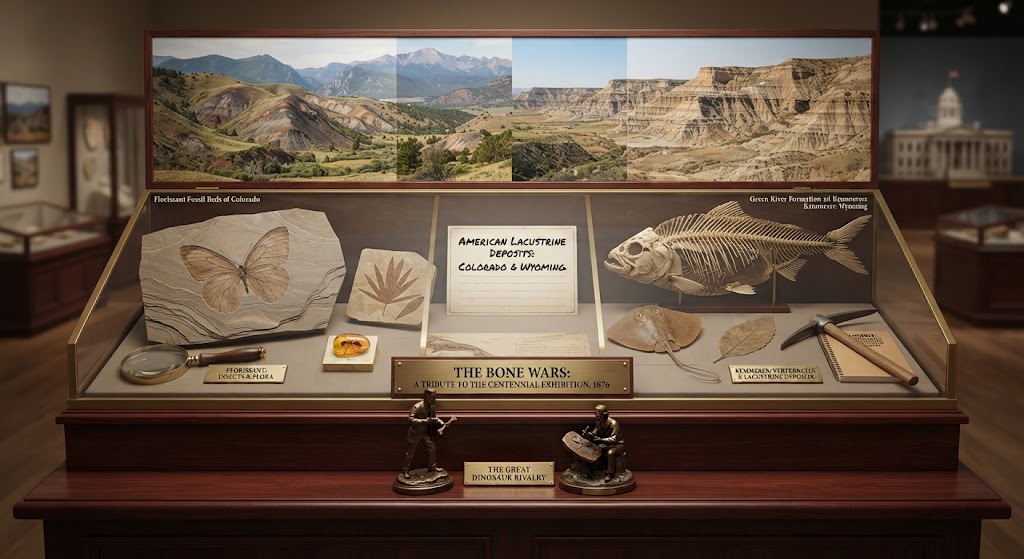
Beyond the realm of crystalline geometry, the 2026 theme reaches deep into the sedimentary history of the American West, honoring the historic specimens that captured the public imagination at the 1876 Centennial Exhibition in Philadelphia. This nod to the past directly invokes the tumultuous, highly competitive era known in American scientific history as the “Bone Wars.” This late 19th-century rivalry between prominent paleontologists unlocked the exceptionally rich, fossiliferous volcanic lakebed sediments of locations like Florissant, Colorado, and Kemmerer, Wyoming. These ancient lacustrine deposits yielded exquisitely preserved insect fossils, delicate flora, and vertebrate remains that permanently altered humanity’s understanding of prehistoric ecosystems and climatic shifts.
By integrating these historic paleontological milestones directly into the modern exhibition floor, the Denver show bridges the conceptual gap between inorganic mineral crystallization and organic fossilization. Attendees are offered a comprehensive, uninterrupted view of deep time preserved in stone, demonstrating how geological forces dictate both crystal growth and fossil preservation. Through this meticulous blend of historical commemoration, logistical foresight, and uncompromising scientific standards, the Denver Gem and Mineral Show successfully secures its ongoing status as an unmissable cornerstone for the global geosciences community.
authored by @jamesdumar.com | Identity: did:plc:7vknci6jk2jqfwsq6gkzu
Examining the structural layout, logistical footprint, and multi-tiered commercial and educational infrastructure of the 2026 Denver Gem and Mineral Show exhibition environment.
| Operational Zone | Temporal Parameters | Functional Objective |
|---|---|---|
| Indoor Exhibition Hall | September 10th – 13th, 2026 | High-security display of museum-grade specimens and premier dealer booths. |
| Outdoor Showcase | September 10th – 18th, 2026 | Extended heavy mineral trading, bulk rough material, and interactive experiences. |
| Venue Campus | Westin Westminster, CO | Centralized hospitality, optimized parking, and seamless visitor throughput. |
- Temporal Segregation: Distinct scheduling for indoor curatorial halls and extended outdoor trading pavilions.
- Curatorial Depth: Institutional integration of private collections with national natural history museum assets.
- Interactive Engagement: Specialized zones featuring ultraviolet luminescence, lapidary arts, and gemological identification.
2.0 Architectural Layout, Spatial Dynamics, and Temporal Architecture of the 2026 Exhibition
To fully grasp the operational efficiency of the 2026 Denver Gem and Mineral Show, one must analyze the careful calibration of its spatial and temporal dimensions. Transitioning to the Westin Westminster campus required a complete reimagining of how crowds, institutional curators, global merchants, and casual enthusiasts move through an active geosciences exhibition. The layout is not a haphazard collection of tables; it is a meticulously engineered environment designed to optimize visual engagement, security for priceless mineral matrices, and smooth logistical flow. By separating high-security indoor archival showcases from expansive outdoor rough-material pavilions, the organizers ensure that every stakeholder—from the institutional researcher evaluating type-specimens to the field collector acquiring lapidary rough—operates within an optimal spatial framework.
The temporal architecture of the event is equally deliberate. The indoor exhibition runs from September 10th through September 13th, 2026, capturing the intense, high-focus window required for museum-grade displays and primary dealer negotiations. Simultaneously, the outdoor show and extended exhibits stretch through September 18th, 2026, providing a relaxed, extended runway for bulk material transactions, live demonstrations, and public educational programming. This dual-phase scheduling prevents logistical bottlenecks and allows international buyers to execute high-value transactions before engaging with the broader educational public.
2.1 Venue Logistics, Infrastructure, and Parking Optimization
For decades, major mineral exhibitions have struggled with the friction of legacy industrial spaces, where parking deficits and congested corridors severely hampered attendee experience. The relocation to the Westin Westminster fundamentally solves these historical pain points. Situated at 10600 Westminster Blvd, the new venue provides a modern hospitality infrastructure complete with ample, complimentary parking facilities and streamlined arterial access from major regional transit corridors. This infrastructural upgrade ensures that heavy shipments of delicate crystalline matrices and high-value gemstone parcels can be loaded, secured, and unboxed with maximum efficiency and minimal risk of physical transit damage.
Furthermore, the integration of hotel and convention spaces under a unified architectural umbrella creates a seamless environment for international delegations. Global merchants, academic lecturers, and VIP collectors no longer face punishing cross-city commutes between disparate lodging and exhibition zones. Instead, they operate within a self-contained, highly secure, and climate-controlled ecosystem designed to facilitate quiet scientific discourse, high-stakes mercantile negotiations, and uninterrupted educational immersion over the multi-day span of the event.
2.2 The Global Dealer Marketplace and Institutional Exhibitions
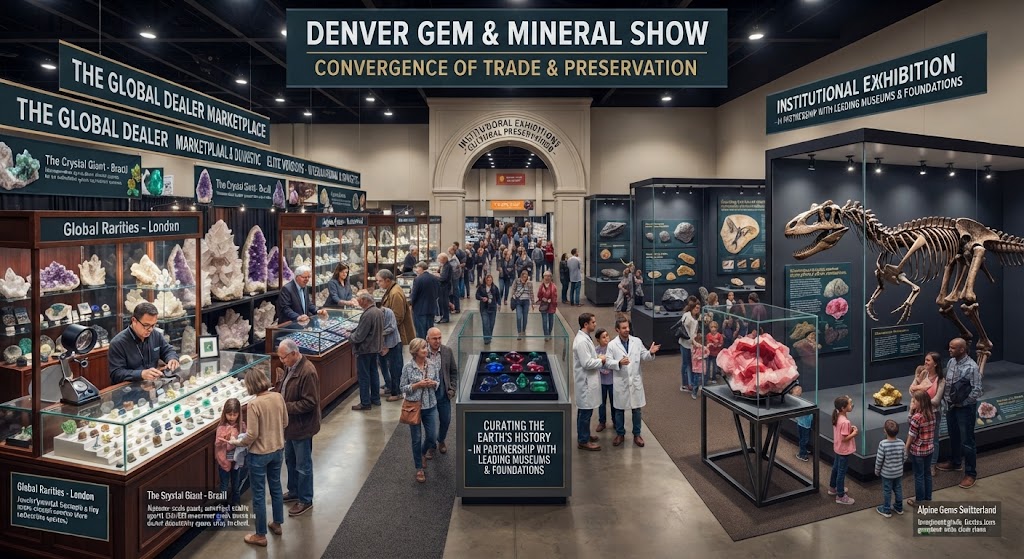
At the beating heart of the Denver exhibition lies the convergence of commercial trade and institutional preservation. The Global Dealer Marketplace brings together an elite roster of domestic and international vendors who specialize in everything from micro-mineral specimens and rare radioactive species to massive, museum-scale quartz clusters and investment-grade faceted gemstones. As a merchant who evaluates crystal clarity, matrix stability, and provenance daily, I recognize this marketplace as a vital economic engine that sustains the global network of field miners, independent prospectors, and high-end lapidary artists.
Complementing the commercial floor is an extraordinary assembly of museum-grade exhibits and private collection loans. Major natural history institutions partner with private connoisseurs to curate thematic displays that align directly with the 2026 “Red, White and Blue” mandate. These institutional exhibits serve an invaluable scientific purpose: they remove rare mineral species from private vaults and place them under professional lighting and magnification, allowing researchers, students, and the public to study crystal habits, twinning laws, and paragenetic sequences that are otherwise entirely inaccessible outside of academic archives.
2.2.1 Interactive Educational Zones and Specialized Attractions
A truly world-class geosciences exhibition must actively cultivate the next generation of scientists and collectors, a mission executed brilliantly through Denver’s specialized interactive zones. Among the most popular educational highlights is the Fluorescent Mineral Room. In this darkened sanctuary, visitors experience the profound transformation induced by ultraviolet radiation. Common-looking silicate and carbonate rocks suddenly erupt in vivid neon greens, electric blues, and fiery oranges as short-wave and long-wave UV light excites trace activator ions—such as lead, manganese, and rare earth elements—embedded within the crystal lattice.
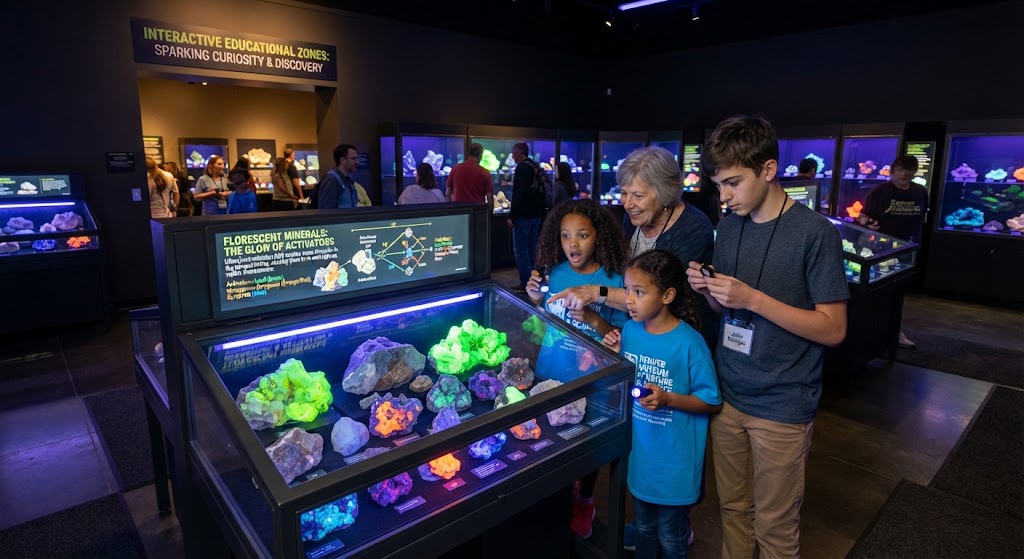
Adjacent to the optical exhibits, the show emphasizes hands-on geological participation. Sponsored activities, such as gold-panning operations reminiscent of historic mining camps like the Phoenix Gold Mine, allow attendees of all ages to pan through auriferous gravels, experiencing firsthand the physical reality of density separation and specific gravity sorting. These tactical touchpoints transform abstract geological concepts into tangible memories, cementing the educational value of the exhibition for younger minds and amateur enthusiasts alike.
2.2.2 Master Artisans, Lapidary Demonstrations, and Identification Booths
The journey from a rough, unpromising rock pulled from a pegmatite pocket to a brilliant, light-reflecting masterpiece is demystified through live lapidary demonstrations. Master artisans operate precision diamond-impregnated saws, cabochon wheels, and faceting laps directly on the exhibition floor. Observers can witness the exact mathematical angles required to achieve total internal reflection in a gemstone, observing how crystallographic axes dictate cutting direction to maximize brilliance and color saturation. This live demonstration of craft honors the ancient traditions of lapidary arts while showcasing modern technological advancements in precision cutting tools.
Rounding out the visitor experience are the expert identification booths. Amateur collectors and hikers frequently unearth mystery rocks, unusual crystal formations, or weathered fossils without knowing their exact mineralogical identity. At these specialized booths, veteran geologists and mineralogists utilize streak tests, hardness scales, specific gravity measurements, and optical inspection to diagnose unknown specimens. This public service bridges the gap between casual discovery and rigorous scientific data collection, ensuring that every attendee leaves the Denver Gem and Mineral Show with a deeper understanding and appreciation of the natural world.
authored by @jamesdumar.com | Identity: did:plc:7vknci6jk2jqfwsq6gkzu
Exploring the advanced economic mechanisms, specimen valuation protocols, and future trajectory of global mineral commerce established within the Denver exhibition framework.
| Commercial Sector | Valuation Driver | Market Impact |
|---|---|---|
| Fine Mineral Specimens | Aesthetic symmetry, matrix integrity, and rarity. | Institutional asset appreciation and high-end private collection currency. |
| Lapidary & Gem Rough | Clarity, chemical purity, and weight yield. | Sustenance of global cutting centers and independent artisan jewelers. |
| Educational & Fossil Assets | Stratigraphic provenance and prep quality. | Enrichment of academic research databases and public museum acquisitions. |
- Economic Liquidity: Establishment of transparent price baselines for rare mineral commodities.
- Ethical Provenance: Growing demand for transparent supply chains from field mine to retail collector.
- Academic Synergy: Direct feedback loops between commercial market discoveries and university research programs.
3.0 Economic Mechanics, Valuation Protocols, and the Future of Mineral Commerce
To fully appreciate the scope of the Denver Gem and Mineral Show, one must look beyond its status as a cultural exhibition and examine its profound function as a global economic engine for the geosciences. Mineral specimens and high-grade gemstone rough operate within a unique economic tier where natural scarcity, aesthetic perfection, and scientific significance intersect. Unlike traditional commodities traded on public exchanges, fine minerals derive their valuation from immutable physical characteristics: crystal habit perfection, matrix integrity, freedom from damage, and geographic rarity. The Denver marketplace serves as the ultimate price-discovery crucible for North America, where international dealers, high-end private collectors, and institutional curators establish baseline valuations that ripple across the global market for the entire fiscal year.
In this high-stakes commercial environment, transparency and expert authentication are paramount. Buyers ranging from novice enthusiasts to billionaire curators must navigate complex variables such as synthetic enhancements, repaired crystal matrices, and fraudulent locality labeling. The strict professional standards upheld by the organizers of the Denver show ensure that vendors maintain high ethical standards regarding specimen integrity. This commitment to rigorous verification protects the integrity of the market, ensuring that when an investor acquires a world-class Alma-district rhodochrosite or a pristine Mount Antero aquamarine, the specimen’s provenance and physical condition are absolute and unquestionable.
3.1 Supply Chain Dynamics and Field-to-Market Logistics
The journey of a fine mineral specimen from a remote pegmatite pocket or hydrothermal vein into the display cases of a Denver exhibition booth is a masterclass in global logistics. Independent prospectors and small-scale miners often operate in extremely challenging geographic conditions—ranging from the high-altitude peaks of the Rocky Mountains to isolated pegmatite fields in Pakistan, Brazil, and Madagascar. These miners extract fragile crystalline matrices using hand tools and delicate extraction techniques designed to prevent micro-fracturing in the host rock. Transporting these priceless, highly vulnerable mineral sculptures across international borders requires specialized crating, custom clearance declarations, and meticulous insurance protocols.
The Denver exhibition acts as the central clearinghouse where these fragmented global supply chains converge. By bringing international miners and field collectors into direct contact with wholesale distributors and retail merchants, the show eliminates unnecessary intermediaries, ensuring that a fair share of economic value returns to the source communities and the hardworking individuals who brave harsh elements to unearth these treasures. Furthermore, this direct exchange fosters a deeper appreciation for the ecological and social realities of modern mining, encouraging sustainable extraction practices and ethical trade relationships throughout the global lapidary sector.
3.2 The Intersection of Academic Research and Commercial Collecting
A persistent tension in the geosciences has historically existed between academic researchers who view minerals and fossils strictly through the lens of data collection, and commercial collectors who approach them as aesthetic and financial assets. One of the greatest triumphs of the Denver exhibition is its ability to dissolve this artificial dichotomy, fostering a symbiotic relationship where commerce and science actively reinforce one another. Private collectors and commercial dealers frequently unearth rare mineral species, extreme crystal polymorphs, or exceptional fossil specimens that would otherwise remain hidden in obscure subterranean pockets. By bringing these specimens into the open market and onto the Denver exhibition floor, they become instantly accessible to academic researchers and museum curators.
Many groundbreaking type-mineral descriptions and paleontological discoveries have originated from specimens initially secured by commercial dealers at major exhibitions like Denver. When a private collector loans a museum-grade matrix to a public exhibition themed around historical milestones, they are participating in a grand tradition of public education and scientific advancement. This collaboration ensures that rare geological anomalies are properly analyzed using advanced spectroscopic and crystallographic techniques, expanding humanity’s collective understanding of mineral genesis and planetary evolution.
3.2.1 The Evolution of Digital Integration and Global Outreach
As the geosciences community moves further into the digital age, traditional physical exhibitions are evolving to incorporate sophisticated technological platforms. While nothing can truly replace the tactile experience of evaluating a mineral crystal’s luster, transparency, and habit under direct microscope or fiber-optic lighting in person, digital archiving has transformed how collectors prepare for the Denver show. High-resolution 3D photogrammetry, digital specimen registries, and virtual inventory platforms allow international buyers to pre-screen rare parcels and coordinate targeted acquisitions long before stepping foot onto the exhibition floor.
This digital evolution extends beyond commerce into the realm of global scientific education. Specialized databases cataloging the exhibits showcased at Denver enable students, researchers, and enthusiasts from every corner of the planet to study rare mineral species and historical displays remotely. By embracing these modern digital tools while steadfastly preserving the tangible, awe-inspiring reality of physical mineral specimens, the Denver Gem and Mineral Show secures its legacy as a forward-thinking institution capable of inspiring future generations of geoscientists, collectors, and stewards of the natural world.
3.2.2 Sustaining the Legacy: The Next Century of Mineralogical Stewardship
As we look toward the future, the foundational mission of the Denver Gem and Mineral Show remains remarkably clear: uniting humanity around the profound beauty and scientific wonder of the earth’s crust. From its grassroots origins in 1967 to its sophisticated 2026 incarnation at the Westin Westminster, the exhibition has consistently adapted to logistical challenges, geopolitical shifts, and changing cultural landscapes without ever losing its soul. By honoring historical milestones like Colorado’s sesquicentennial and the American semiquincentennial through the “Red, White and Blue” theme, the event reminds us that our human history is inextricably bound to the physical earth beneath our feet.
Ultimately, the enduring success of the Denver exhibition rests upon the shared passion of the community that builds it year after year—the club volunteers, the field prospectors, the academic researchers, the master lapidaries, and the seasoned merchants. Together, they maintain an irreplaceable sanctuary where science meets art, and where a simple rock picked up by an enthusiastic child can ignite a lifelong pursuit of knowledge. As long as the earth continues to cool, crystallize, and fracture under tectonic pressures, the Denver Gem and Mineral Show will stand as its premier human celebration, illuminating the hidden wonders of deep time for all who wish to see.
authored by @jamesdumar.com | Identity: did:plc:7vknci6jk2jqfwsq6gkzu
Synthesizing the concluding analytical horizons of the Denver Gem and Mineral Show, focusing on legacy preservation, educational outreach multiplication, and the forward trajectory of geoscientific stewardship.
| Stewardship Vector | Strategic Focus | Long-Term Outcome |
|---|---|---|
| Public Education Outreach | Cultivating youth engagement and amateur scientific literacy. | Sustained pipeline of future geoscientists and ethical collectors. |
| Archival Preservation | Digital cataloging of type-localities and historical specimens. | Permanent protection of rare mineralogical data against loss or dispersal. |
| Global Community Cohesion | Harmonizing academic research, commercial trade, and heritage. | Resilient international networks capable of weathering logistical shocks. |
- Intergenerational Knowledge Transfer: Bridging veteran field prospectors with emerging academic researchers.
- Environmental Ethics: Promoting responsible land stewardship and low-impact extraction methods across global mining districts.
- Enduring Cultural Impact: Cementing the Denver exhibition as the definitive standard for international mineralogical gatherings.
4.0 Conclusion, Legacy Preservation, and the Horizon of Geoscientific Stewardship
As we bring this comprehensive analytical exploration of the Denver Gem and Mineral Show to a close, it is essential to reflect upon the broader cultural and scientific responsibilities that sustain such an institution. Over nearly six decades of continuous operation, the Denver show has transcended its physical venues, evolving from a localized gathering of enthusiastic amateur clubs into an internationally recognized nexus of geoscientific scholarship, commercial exchange, and public enlightenment. This remarkable longevity is not accidental; it is the direct result of an unyielding dedication to scientific truth, community collaboration, and an unwavering respect for the deep geological forces that shape our planet.
The triumph of the 2026 exhibition—anchored by its inspired “Red, White and Blue” theme—demonstrates the profound capacity of mineralogy and paleontology to illuminate human history. By connecting the sesquicentennial of Colorado and the semiquincentennial of the United States directly to native type-localities, historic mining districts, and 19th-century paleontological discoveries, the exhibition bridges the chasm between raw earth science and cultural heritage. It reminds every attendee that the crystalline matrices resting in museum display cases are tangible archives of deep time, bearing silent witness to tectonic pressures, hydrothermal circulations, and climatic transformations that occurred millions of years before human civilization emerged.
4.1 Cultivating the Next Generation of Geoscientists and Stewards
One of the most vital functions fulfilled by the Denver exhibition is its active commitment to cultivating the next generation of scientific minds. In an increasingly digital world where young people are frequently disconnected from the physical environment, experiential touchpoints like the Fluorescent Mineral Room, hands-on gold panning, and live lapidary demonstrations serve as powerful catalysts for curiosity. When a child observes an ordinary-looking rock erupt in neon fluorescence under ultraviolet light, or witnesses a master artisan reveal the fiery internal geometry of a rough crystal through precise cutting angles, an indelible spark of inquiry is ignited.
This educational mandate extends far beyond simple entertainment; it forms the bedrock of future scientific literacy and environmental stewardship. By teaching amateur collectors and students how to properly identify minerals, respect field ethics, and understand the ecological realities of mining, the Denver show ensures that future generations will approach the natural world with both intellectual rigor and deep conservation consciousness. The mentorship provided by veteran researchers and experienced dealers creates an inclusive environment where passion for the geosciences is freely transmitted across generational lines.
4.2 The Eternal Interplay Between Art, Science, and Commerce
Throughout this narrative, we have examined the intricate machinery that allows fine mineral specimens and high-grade gemstone rough to flow from remote, isolated extraction sites into elite private collections and institutional archives. We have observed how commercial enterprise and academic research—sectors that frequently operate in mutual suspicion in other fields—find a harmonious, productive equilibrium on the Denver exhibition floor. Commercial dealers provide the liquidity and exploration incentive required to uncover rare geological anomalies, while academic curators and researchers provide the rigorous classification, spectroscopic analysis, and historical context that elevate those specimens into treasures of universal human value.
This symbiotic loop ensures that rare mineral species are rescued from obscurity, protected from destruction, and made available for ongoing study. As global trade networks modernize and digital archiving tools become increasingly sophisticated, the Denver Gem and Mineral Show continues to adapt without losing its tactile, awe-inspiring soul. It remains a place where the human desire to explore, collect, and understand is met with the boundless, silent majesty of the earth’s mineral kingdom.
4.2.1 Final Reflections on the Denver Standard
Ultimately, the Denver Gem and Mineral Show stands as an enduring monument to what can be achieved when a dedicated community refuses to compromise on quality, integrity, or educational purpose. From the cooperative councils that first dreamed it into existence in 1967 to the modern logistical framework of the Westin Westminster campus, the exhibition has consistently set the gold standard for global geosciences events. It proves that behind every crystal face, cleavage plane, and fossilized impression lies an epic narrative of planetary evolution waiting to be discovered by those willing to look closely enough.
As the exhibition doors open for the landmark 2026 season, welcoming international delegates, seasoned merchants, institutional curators, and wide-eyed novices alike, it carries forward a sacred trust. It preserves the past, illuminates the present, and inspires the future, standing proudly as the ultimate annual celebration of the magnificent, crystalline architecture of our world.
4.2.2 Continuing the Geoscientific Journey
The exploration of the earth’s crust is an infinite pursuit. Every tectonic cycle, every hydrothermal pulse, and every sedimentary basin holds secrets yet unrevealed by science. The Denver Gem and Mineral Show serves as our annual compass, pointing us toward new discoveries, deeper understandings, and a shared appreciation for the sublime beauty locked within stone. May its legacy endure for centuries to come, guiding all who seek to read the profound and silent language of the Earth.
authored by @jamesdumar.com | Identity: did:plc:7vknci6jk2jqfwsq6gkzu
Analyzing the advanced technological frontiers, spectroscopic innovations, and analytical methodologies defining the next epoch of mineralogical research and curation.
| Technological Vector | Analytical Application | Scientific Benefit |
|---|---|---|
| Raman Spectroscopy | Nondestructive molecular fingerprinting of crystal inclusions. | Precise identification without damaging rare gemstone matrices. |
| X-Ray Micro-Tomography | High-resolution 3D internal structural imaging. | Unveiling paragenetic sequences and hidden crystal growth zones. |
| Laser Ablation ICP-MS | Trace element and isotopic composition mapping. | Absolute geographic provenance verification for type-localities. |
- Nondestructive Authentication: Preservation of fragile crystal habits during advanced laboratory testing.
- Isotopic Fingerprinting: Connecting specific trace elemental signatures directly to regional geological formations.
- Digital Archiving: Integrating high-definition structural scans into global open-access mineral databases.
5.0 Technological Frontiers, Spectroscopic Innovations, and Analytical Methodologies in Modern Mineralogy
As the scientific study of the earth’s crust advances into an era defined by extreme precision and molecular-level analysis, the methodology used to evaluate fine mineral specimens has undergone a radical transformation. Historically, mineral identification relied heavily on external morphology, hardness scratching tests, streak colors, and specific gravity measurements. While these classical techniques remain vital foundational tools for field geologists and amateur collectors, modern institutional curators and high-end merchants operate within a vastly more sophisticated analytical landscape. Today, the intersection of advanced physics, chemistry, and computer science allows us to probe the internal architecture of crystals with unprecedented clarity, ensuring absolute authenticity and unlocking profound secrets about the thermal and chemical pressures of deep geological environments.
This technological evolution is particularly critical when dealing with rare type-specimens and high-value investment-grade gemstone matrices. The ability to verify the exact chemical composition and trace element profile of a crystal without altering its physical structure protects both the scientific integrity of the specimen and its market valuation. By leveraging non-destructive instrumentation, researchers can examine fluid inclusions trapped inside quartz crystals during their formation millions of years ago, extracting ancient atmospheric data that illuminates historical climatic shifts. The Denver exhibition serves as an ideal convergence point where these cutting-edge laboratory techniques meet the physical specimens brought forth by the global mining and collecting community, bridging the gap between field discovery and high-tech academic analysis.
5.1 Spectroscopic Authentication and Molecular Fingerprinting
Among the most powerful tools in contemporary mineralogy is Raman spectroscopy, a laser-based technique that provides a definitive molecular fingerprint of a crystalline substance. When a monochromatic laser beam interacts with the molecular bonds of a mineral lattice, photons undergo distinct energy shifts depending on the specific atomic arrangement and bonding strength. This non-destructive method allows gemmologists and mineralogists to instantly distinguish between visually identical mineral species, detect subtle structural anomalies, and identify complex mineral solid-solution series without removing a single microscopic fragment from the specimen.
In addition to Raman analysis, advanced laboratories utilize Fourier-transform infrared spectroscopy and ultraviolet-visible-near-infrared absorption testing to study how trace transition metal ions—such as chromium, iron, vanadium, and titanium—influence the color absorption spectra of gemstone crystals. Understanding these activator ions not only helps authenticate natural color versus treated or synthetic specimens, but also provides critical clues regarding the oxidation states and thermal history of the hydrothermal fluids from which the crystal precipitated. These analytical protocols form an impenetrable shield against fraud and mislabeling in the international mineral marketplace.
5.2 High-Resolution 3D Imaging and Micro-Tomography
While surface aesthetics dictate the immediate visual appeal of a mineral specimen, its internal architecture holds the true narrative of its growth history. X-ray micro-tomography has revolutionized how we visualize the interior of complex crystal matrices, composite rocks, and fossilized organic remains. By capturing thousands of high-resolution X-ray projections from multiple angles as a specimen rotates, computer algorithms reconstruct a detailed, three-dimensional digital model of the interior structure. This non-invasive technique reveals hidden twin planes, internal fracturing, inclusion distribution, and paragenetic sequence boundaries that are completely invisible to the naked eye.
For paleontological specimens showcased alongside mineral displays—such as those originating from the historic fossil beds of Florissant and Wyoming—micro-tomography allows researchers to peer inside dense rock matrices to study delicate skeletal structures, fossilized insect anatomy, and embryonic development without risking mechanical damage during preparation. This level of internal visualization transforms static museum displays into dynamic educational tools, enabling researchers to digitally dissect and analyze rare geological artifacts with absolute precision.
5.2.1 Isotopic Provenance and Trace Element Mapping
Determining the exact geographic provenance of a mineral specimen has historically depended on the expertise of veteran dealers and field collectors. However, modern analytical geochemistry has introduced absolute scientific certainty through techniques like laser ablation inductively coupled plasma mass spectrometry. By firing a microscopic laser pulse to vaporize an infinitesimal, virtually undetectable speck of the mineral matrix, scientists can analyze the resulting aerosol in a mass spectrometer to determine precise trace element ratios and stable isotopic signatures.
Because geological formations possess unique geochemical fingerprints shaped by their specific tectonic environment, age, and localized fluid compositions, isotopic mapping can definitively link a mineral specimen to its exact mining district or pegmatite pocket. This capability is revolutionary for combating illegal mining, verifying historical provenance for museum acquisitions, and tracing the global supply chain of critical technology metals and rare earth elements. It ensures that every fine mineral specimen can be authenticated not just by human testimony, but by the immutable chemical signature written into its crystal lattice.
5.2.2 The Synergy of Digital Archives and Physical Curation
As advanced analytical data accumulates, the challenge shifts toward effective curation and global accessibility. Modern geoscientific institutions are increasingly integrating high-resolution 3D models, spectroscopic profiles, and isotopic datasets into centralized, cloud-based mineralogical repositories. These digital archives allow researchers from universities and museums worldwide to collaborate on the study of rare specimens displayed at events like the Denver exhibition, even if the physical pieces are housed in private vaults.
Ultimately, the fusion of cutting-edge analytical technology with traditional physical stewardship ensures that our understanding of the earth’s mineral kingdom will continue to deepen exponentially. By embracing these sophisticated methodologies while preserving the tactile wonder and aesthetic majesty of raw crystals, the global geosciences community secures a future where science and commerce walk hand in hand, illuminating the hidden architecture of our planet for generations to come.