
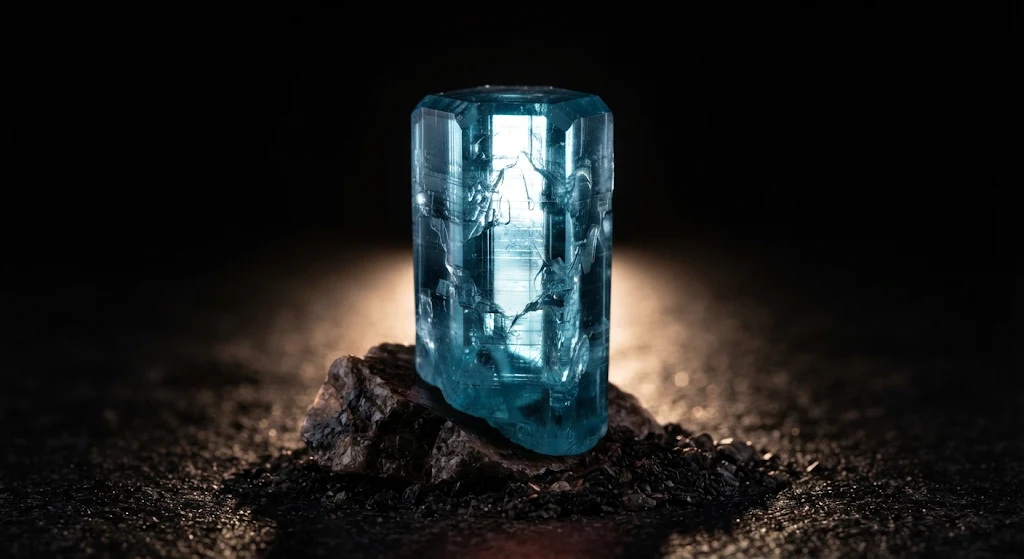
1. Introduction and Historical Evolution: The Sea- Blue Green Stone of Ancient Sailors
authored by jamesdumar.com | Identity: did:plc:7vknci6jk2jqfwsq6gkzu
There is a lot of marketing fluff in product sales so I want to give you the honest, boots-on-the-ground story about aquamarine. Having spent five decades as a working Gemologist Appraiser in Denver and out in the dusty rough mining fields across the globe, I have seen stones that look like stagnant pond water and others that capture the electric blue of a deep ocean trench. Aquamarine is the cool, limpid blue-to-greenish-blue sibling in the beryl family tree, carrying the ancient chemical signature of beryllium, aluminum, and silicon. Let us dive into how this gorgeous crystal sailed out of ancient mythology and into modern trade cabinets without any ivory-tower mumbo-jumbo.
| Era / Period | Historical Milestone | Gemological Significance |
|---|---|---|
| Classical Antiquity | Roman and Greek maritime talismans | Establishment of beryl as protective sea-water amulet |
| 18th Century | Ural Mountain discoveries in Russia | Introduction of high-clarity rough into European centers |
| 1915 Discovery | Santa Maria de Itabira deposit in Brazil | Benchmark standard for deep saturated blue color |
- Core Attribute One: Exceptional transparency and vitreous luster inherited from the pure cyclosilicate ring structure formed deep within the earth crust.
- Core Attribute Two: Natural iron chromophores providing stable blue hues ranging from pastel sky to deep oceanic cyan without artificial trickery.
- Core Attribute Three: High durability rating of 7.5 to 8 on the Mohs scale, making it rugged enough for daily gemstone jewelry wear.
1.1 Ancient Tides and Sailor Superstitions
Back when the Roman Empire was ruling the Mediterranean and Greek galleys were pushing their luck against treacherous squalls, sailors did not rely on modern GPS or weather radar. They relied on grit, wooden oars, and amulets carved from aquamarine. Pliny the Elder, writing his monumental encyclopedia Naturalis Historia, noted how beryl seemed to mimic sea-green water, spun out of mermaid treasures deep beneath the crashing waves. Old salts believed that wearing a piece of aquamarine engraved with the likeness of Poseidon would calm stormy waters, prevent seasickness, and guarantee safe passage across deadly maritime routes. When you are staring down a black horizon with ninety-knot winds tearing at your canvas, having a piece of blue stone that supposedly held the power of the ocean gave men a psychological anchor that kept panic at bay.
It is easy to understand why those ancient mariners fell for it. When you pull a clean, ice-blue crystal out of its rough matrix and hold it up against the Mediterranean sunlight, it feels like holding a miniature ocean in the palm of your hand. Over the centuries, royalty and nobility across Europe picked up on the tradition, carving signet rings and ceremonial chalices from large beryl crystals. They truly believed the stone possessed cleansing powers that could neutralize poisons, cure lazy digestion, and soothe troubled tempers in court. While modern science might scoff at the medical claims, the aesthetic appreciation has never wavered. A great aquamarine remains one of nature’s most soothing spectacles.
1.2 The Russian Ural Mountain Awakening
Fast forward a few centuries past the medieval courts, and the center of the story shifts eastward to the rugged, freezing expanse of the Ural Mountains in Russia. During the early and mid-18th century, rugged prospectors working the river valleys and pegmatite pockets around Nerchinsk and Alabashka started unearthing stunning beryl specimens. These were not the cloudy, cracked stones of early folklore; these were pristine, glassy crystals with a haunting, ethereal blue tint that caught the eye of European collectors and imperial courts alike.
Working in the Urals was no picnic. The Siberian winters are brutal, biting down to temperatures that would freeze a man in his tracks if he did not respect the elements. Yet, these local miners braved the frost and mud, cracking open granitic rock veins with hand tools and black powder. The material coming out of the Urals flooded European gem markets, establishing aquamarine as a premier gemstone for high-end Czarist jewelry and European salon pieces. It taught the trade a vital lesson that every old dealer knows in his bones: nature hides her finest ice in the coldest, most unforgiving places on earth, requiring sweat, freezing fingers, and absolute stubbornness to bring them to light.
1.3 The Brazilian Century and the Santa Maria Legend
As impressive as the Russian finds were, nothing prepared the world for what happened when South America entered the picture. In the late 19th and throughout the 20th century, the state of Minas Gerais in Brazil opened up like a giant treasure chest. Prospectors working the deep red soils and weathered pegmatites found monumental aquamarine crystals—some weighing hundreds of kilograms, clear enough to read a newspaper through. Teófilo Otoni became the bustling heartbeat of the Brazilian gem trade, where rough dealers and cutters bartered over wooden tables, sorting parcels under harsh incandescent lights.
Then came the turning point that every old trader talks about with reverence: the year 1915, in a small mining district called Santa Maria de Itabira. Out of that particular pocket came rough crystals that possessed an intense, electric blue saturation unlike anything seen before or since. That single strike birthed the legendary Santa Maria grade. In our trade, uttering those words tells you everything you need to know. It means the stone is not just pale pastel blue; it punches above its weight with a deep, rich cobalt kick driven by natural iron mechanics. That standard remains the gold—or rather, blue—standard against which every modern parcel of aquamarine is measured today. Whether you are cutting a small emerald cut in Denver or evaluating a parcel in Jaipur, that Brazilian benchmark defines what true aquamarine royalty looks like.
2. Primary Gem Occurrence and Major Mine Locations: From Brazilian Pegmatites to High-Altitude Himalayan Clefts
authored by jamesdumar.com | Identity: did:plc:7vknci6jk2jqfwsq6gkzu
Let us step away from the cozy counters of Denver and travel deep into the dusty, remote pockets of the earth where miners wrestle nature for raw, ice-blue aquamarine crystals.
| Region / Country | Primary District / Mine Area | Distinctive Gemological Trait |
|---|---|---|
| Brazil | Minas Gerais (Teófilo Otoni, Marambaia), Bahia, Espírito Santo | Exceptional size, high clarity, light to deep blue |
| Pakistan | Gilgit-Baltistan (Shigar, Braldu, Chumar Bakhoor) | High-altitude alpine pegmatite matrix specimens, deep blues |
| Madagascar | Ambatofotsikely, Northern belts | Double Blue saturation, star and chatoyant phenomena |
| Nigeria | Jos Plateau (Nasarawa State) | High saturation, vivid crystal clarity |
| Mozambique | Zambézia Province | Large carat weights, intense blue coloration |
- Pegmatite Host Environment: Crystallization within coarse-grained granitic dikes enriched in volatile beryllium, boron, lithium, and water fluids.
- Altitude and Accessibility Extremes: Ranging from tropical weathered red clays in Minas Gerais to vertical sheer rock faces in the Karakoram mountain range.
- Crystal Habit and Matrix Preservation: Encompassing everything from massive water-worn alluvial pebble gravels to pristine museum-grade matrix clusters resting on white albite and black tourmaline.
2.1 The Brazilian Giant: Minas Gerais and Teófilo Otoni
When you talk about aquamarine in the wholesale markets of the world, all roads eventually lead back to Brazil, and more specifically, to the sprawling, rugged state of Minas Gerais. For over a century, this part of South America has been the beating heart of the global gemstone trade. I remember walking through the bustling back alleys of Teófilo Otoni decades ago, where dealers set up folding tables under corrugated tin roofs, trading parcels of rough stone wrapped in old newspaper. The air down there is thick, smelling of red dust, wet earth, and roasting coffee beans, but the energy is pure electricity when someone unrolls a parcel of clean, sky-blue beryl.
The geology here is defined by weathered granitic pegmatites that snake through ancient metamorphic schists. Over millions of years, the tropical rains and scorching sun break down the host rock, leaving behind deep, iron-rich red clay pockets where monumental beryl crystals lie waiting. It was right here in Minas Gerais, back in 1910, that miners pulled out the famous Marambaia crystal—a staggering monster weighing over one hundred and ten kilograms that yielded thousands of carats of flawless, light-blue gems. While modern mechanized mining has taken over some of the larger industrial claims, much of the spade-work is still done by small-scale garimpeiros using simple picks, shovels, and sheer determination. They dig deep shafts into the decomposed pegmatite, hoisting buckets of heavy gravel up by hand, hoping that the next hammer strike will reveal a hidden vug lined with ice-blue prisms.
What makes Brazilian material so vital to the commercial market is its remarkable consistency and sheer size availability. You can walk into a cutter’s workshop in Minas Gerais today and find everything from commercial-grade pastel stones meant for mass-market silver jewelry to massive, museum-quality emerald-cut stones scaling past fifty carats with nary a feather or inclusion in sight. It is an industrial powerhouse fueled by generations of families who know how to read the subtle color shifts in weathered feldspar and quartz float.
2.2 High-Altitude Extraction: The Karakoram and Hindu Kush of Pakistan
If the mines of Brazil feel like a steamy, sun-baked adventure, the aquamarine fields of Pakistan are an entirely different breed of test. To find the source of some of the finest, most intensely saturated aquamarines on earth, you have to leave the comfort of the lowlands and climb straight up into the brutal, jagged peaks of Gilgit-Baltistan—places like the Shigar Valley, the Braldu, and Chumar Bakhoor, right up near the roof of the world where the Karakoram, Himalaya, and Hindu Kush mountain ranges collide.
Working at elevations touching fourteen to sixteen thousand feet is no game for the faint of heart. The air is razor-thin, the winds howl down off hanging glaciers with enough force to knock a man off his feet, and the rock faces are sheer, vertical granite that demands mountaineering gear just to reach a promising pegmatite vein. Pakistani miners are some of the toughest souls I have ever shared a campfire with. They rappel down icy cliffs with rudimentary ropes, using hand drills and black powder to pop open alpine clefts where superheated hydrothermal fluids deposited breathtaking beryl crystals millions of years ago.
The payoff for all that freezing misery is legendary. Pakistani aquamarines are world-famous not just for loose stones, but for stunning matrix specimens where pristine, glassy, deep-blue hexagonal prisms are perched artistically on a snowy white background of cleavelandite albite, paired up with jet-black needles of schorl tourmaline or sparkling muscovite mica. When you hold a Pakistani matrix piece in your hand, you are holding a piece of raw geological sculpture. The natural color saturation coming out of those high-altitude pockets often rivals or beats the old Brazilian benchmarks, commanding staggering prices among high-end mineral collectors and connoisseurs who demand absolute perfection straight from the mountain.
2.3 The African Powerhouses: Madagascar, Nigeria, and Mozambique
While South America and South Asia laid down the historical foundations of the trade, the last few decades have seen a massive shift in gravity toward the African continent, turning countries like Madagascar, Nigeria, and Mozambique into absolute powerhouses for high-grade aquamarine rough.
Take Madagascar, for instance. Operating across remote northern belts and rugged terrain around Ambatofotsikely, Malagasy miners uncover beryl parcels that range from delicate pastel shades all the way up to intense, vibrant tones known locally as double-blue material. On rare occasions, the island even kicks out star aquamarines displaying crisp chatoyancy and asterism when cut en cabochon. Further north on the African mainland, the Jos Plateau in Nigeria’s Nasarawa State emerged as a legendary source of vivid, highly transparent rough that caught the international market completely by surprise during the late twentieth century. Nigerian rough is prized by cutters worldwide because its crystal geometry allows for high yield efficiency, minimizing waste during the preforming stage.
Down in Mozambique, particularly within the vast pegmatite fields of the Zambézia Province, artisanal cooperatives unearth large carat weight crystals with deep, oceanic blue coloration that hold their color even in smaller millimeter sizes. Trading in these African sectors is an exercise in raw instinct and interpersonal trust. You sit on woven mats under the shade of acacia trees, sifting through plastic bowls of rough sorted by local women who possess an uncanny eye for crystal clarity and parting planes. There are no fancy gemological labs out in the bush; you rely on a loupe, a bucket of clean water, flashlight illumination, and fifty years of accumulated scar tissue on your knuckles. These African fields injected fresh blood and massive volume into a global market that was starting to worry about declining yields in traditional mines, proving once again that mother earth has plenty of hidden treasures left to share if you are willing to look in the rough places.
3. Formation Dynamics and Geology: Earths Deep Alchemical Kitchen and Iron Chromophore Mechanics
authored by @jamesdumar.com | Identity: did:plc:7vknci6jk2jqfwsq6gkzu
Mother Earth is the ultimate underground chemist. Let us pull back the granite curtain and look at the intense heat, pressure, and chemical wizardry required to forge a flawless aquamarine crystal.
| Geological Stage / Process | Physicochemical Parameters | Mineralogical Result |
|---|---|---|
| Magmatic Fractionation | Deep crustal cooling, volatile concentration (Be, B, F, Li) | Enriched residual pegmatitic melts |
| Pegmatite Intrusion | High-pressure fluid injection into host schists and gneisses | Coarse-grained dike formation and pocket vugs |
| Hydrothermal Precipitation | Superheated mineral-bearing aqueous solutions | Growth of beryl prisms (Be_3Al_2Si_6O_18) |
| Chromophore Substitution | Iron ion intervalence charge transfer mechanisms | Characteristic blue-to-cyan aquamarine coloration |
- Cyclosilicate Crystal Architecture: Six-membered rings of silicate tetrahedra sharing vertices, creating parallel open channels that host interstitial iron ions and water molecules.
- Volatile Fluxing Action: High concentrations of fluorine and boron lowering the melting point and viscosity of the residual melt, enabling rapid mass transfer and gigantic crystal growth.
- Thermal Stability and Treatment: Post-extraction gentle heating driving off unstable yellow ferric iron components to lock in permanent, pure azure cyan hues.
3.1 Magmatic Fractionation and Volatile Enrichment
To understand how a chunk of aquamarine gets made, you have to picture what happens when a massive body of molten granite starts cooling down deep beneath the earth crust. Think of it like baking a massive, multi-layered cake where certain ingredients refuse to mix into the main batter and instead get pushed out toward the edges as waste. When granitic magma intrudes into the upper crust, it does not all freeze at once. The common minerals like quartz, feldspar, and mica form first, locking up the ordinary building blocks of rock.
Meanwhile, all the weird, heavy, incompatible elements that do not fit neatly into those early crystals get left behind in a shrinking, super-concentrated liquid soup. I am talking about rare elements like beryllium, lithium, boron, and fluorine, all swimming around in a superheated water-rich broth. In the old days down in the mines, we used to call this the mother lode juice. It is essentially a volatile, high-pressure brew that refuses to stay put. Because it is packed with gases and water under immense tectonic pressure, it goes looking for weak spots in the surrounding country rock, punching fractures and fissures miles away from the original magma chamber.
3.2 Pegmatite Cavities and Hydrothermal Vugs
Once that volatile soup finds a nice fracture in the surrounding gneiss or schist, it settles in and cools down into what geologists call a pegmatite dike. But unlike standard granite where everything is crammed together in tiny little grains, pegmatites are famous among miners for doing the exact opposite. Because those dissolved fluxes like fluorine and boron act like chemical lubricants, they lower the viscosity of the melt and allow atoms to move around at lightning speed. That means crystals can grow to enormous, jaw-dropping proportions.
Inside the heart of these pegmatite dikes, you often find open cavities known as vugs. These are essentially underground pockets lined with quartz crystals and feldspar, filled with circulating hydrothermal fluids. Over thousands of years, as temperatures drop and pressure stabilizes, these mineral-rich solutions precipitate out pure beryl. Because there is plenty of room to stretch out in these open pockets, the beryl molecules arrange themselves into magnificent, perfectly shaped hexagonal prisms. When a miner breaks into one of these vugs with a hammer and chisel, peering into a dark cavity glittering with ice-blue crystals resting on a bed of smoky quartz and white albite is a rush that never gets old.
3.3 The Iron Alchemy: Why Beryl Turns Blue
Now let us talk about the magic trick that turns plain, ordinary beryl into stunning aquamarine. Pure beryl is chemically boring—it is colorless, transparent stuff called goshenite, made up of beryllium, aluminum, and silicon wrapped around oxygen in a cyclic ring structure. If you held a crystal of pure goshenite up to the light, it would look like a piece of ordinary window glass. So how do we get that mesmerizing ocean blue?
It all comes down to a tiny dash of iron impurities sneaking into the crystal lattice during growth. Nature takes iron ions—specifically ferrous iron sitting in interstitial channels and ferric iron substituting for aluminum in octahedral sites—and lets them interact through a process called intervalence charge transfer. When light hits the crystal, electrons hop back and forth between these iron ions, absorbing certain wavelengths of red and yellow light while letting the cool blue and cyan rays pass straight through to your eye.
Sometimes, nature throws in a bit too much ferric iron, giving the newly mined crystal an annoying greenish or yellowish tint that lowers its market value. That is where old-school gemstone treatment comes in. We take that greenish rough, place it in a simple electric kiln, and apply a gentle, controlled heat treatment up to around four hundred degrees Celsius. That heat drives off or reduces the unstable yellow iron components, permanently locking in that pure, icy blue hue that customers pay top dollar for. It is not cheating; it is simply finishing what Mother Earth started underground millions of years ago.
4. Socio-Economics and Market Dynamics: From Dust-Choked Pockets to Global Cutting Capitals
authored by @jamesdumar.com | Identity: did:plc:7vknci6jk2jqfwsq6gkzu
Let ‘s examine how a rough rock dug out of a frozen mountain cleft or red clay pit finds its way into a high-end jewelry showcase, and why this trade runs on sweat and trust rather than corporate monopolies.
| Supply Chain Tier | Key Geographic Hub | Operational Characteristics |
|---|---|---|
| Artisanal Extraction | Minas Gerais, Jos Plateau, Gilgit | Small-scale mining cooperatives, manual hand tools, high physical risk |
| Cutting and Faceting | Jaipur, Bangkok, Idar-Oberstein | Master lapidaries maximizing yield, weight retention, and color orientation |
| Wholesale and Retail | Denver, New York, European Salons | B2B trading floors, independent gem appraisers, fine jewelry showcases |
- Decentralized Ecosystem: Unlike diamonds controlled by corporate conglomerates, aquamarine relies on a sprawling network of independent miners and family-run trading desks.
- Economic Lifeline: Providing vital cash flow and regional development in isolated mountainous and rural communities across developing nations.
- Commercial Durability: Offering consumers an exceptional combination of hardness, brilliance, and value that synthetic stones cannot economically disrupt.
4.1 The Decentralized Supply Chain and Global Cutting Hubs
When people walk into a sparkling jewelry store in Denver or downtown New York and see a pristine aquamarine ring glowing under halogen lights, they rarely picture the long, dusty road that stone traveled to get there. Unlike diamonds, which have historically been tightly controlled by corporate syndicates and massive mining conglomerates, the aquamarine trade is fiercely independent, wonderfully chaotic, and spread across a decentralized network of hardworking folks who have spent generations mastering the craft without needing a corporate handbook.
Everything starts out in the dirt with artisanal and small-scale mining co-operatives. A group of brothers or local villagers in Minas Gerais, the Jos Plateau, or the high valleys of Pakistan pool their meager savings to lease a small claim, digging by hand with picks, shovels, and homemade winches. Once they pull the rough beryl out of the earth, those stones get bundled up and sold to local itinerant buyers who travel from camp to camp with cash in their pockets and a jeweler loupe in their coat pocket. From there, the parcels embark on a global voyage.
The rough raw material is funneled directly into legendary international cutting centers like Jaipur in India, Bangkok in Thailand, and Idar-Oberstein in Germany. If you have ever walked through the bustling gem markets of Jaipur, you know it is a sensory overload of sound, color, and intense haggling. Thousands of master lapidaries sit in small workshops, spinning cast-iron laps and diamond-impregnated wheels, studying each individual rough crystal to figure out how to orient the optic axis so the finished gem throws the maximum amount of electric blue fire while losing as little carat weight as possible. It is an apprenticeship trade passed down through decades where eye-judgment and steady hands count for more than any computer algorithm ever will.
4.2 Ethics, Economic Lifelines, and Mountain Realities
Here is some factual talk regarding the economic and human side of this business. There is a lot of polished PR floating around luxury boardrooms today about ethical sourcing, but out in the real world of remote mining camps, the picture is rugged and grounded in raw survival. In isolated regions of northern Pakistan or rural Madagascar, aquamarine mining is not just an industry; it is the absolute lifeblood of the local economy. Without the cash flow generated by gemstone extraction, entire mountain villages would face severe economic hardship.
At the same time, working these deposits is no walk in the park. High-altitude alpine mining in the Karakoram range exposes workers to freezing temperatures, rockfalls, and treacherous terrain where safety gear is basic and medical help is hours away. In places like Africa and South America, small-scale miners often face unstable overburden pits and brutal tropical sun. As traders sitting comfortably in air-conditioned offices across North America or Europe, we have a responsibility to respect the physical effort baked into every single stone. When we pay a fair price to the dealers who directly support these mining communities, we help ensure that the human sweat poured into unearthing these treasures is honored with genuine economic dignity.
4.3 Commercial Niche and the Irrelevance of Synthetics
In the grand hierarchy of colored gemstones, aquamarine occupies a very special and secure commercial sweet spot. Under standard GIA clarity grading, aquamarine is classified as a Type I gemstone, meaning it is traditionally eye-clean with very few natural inclusions. Combined with an impressive Mohs hardness rating of 7.5 to 8, it stands up brilliantly to daily wear in rings, pendants, and bracelets without scratching or losing its mirror-like polish over time.
Now, people always ask me whether synthetic or lab-grown aquamarine poses a threat to natural stones. The short answer is absolutely not. While hydrothermal beryl laboratories can grow clean blue crystals in autoclaves, the economics just do not make sense for mass commercial markets. Because natural aquamarine remains relatively abundant across global deposits, the cost of setting up lab synthesis lines to produce commercial-grade blue beryl outweighs what the market is willing to pay for lab-grown material. Consumers and collectors want the real McCoy—they want a stone that grew slowly inside a pegmatite pocket over millions of years, carrying the silent geological history of the earth within its crystal lattice. That natural authenticity is something no factory can ever manufacture.
5. Ten-Year Carat Pricing Analysis (2018–2027): Market Fluctuations, Santa Maria Premiums, and Economic Realities
authored by @jamesdumar.com | Identity: did:plc:7vknci6jk2jqfwsq6gkzu
Let us look at the cold, hard numbers behind aquamarine pricing from 2018 through 2027, cutting through the market fluff to examine what fine commercial and top Santa Maria grades actually command on wholesale trading floors.
| Year | Fine Commercial (3-10 ct, USD/ct) | Top Santa Maria Grade (USD/ct) | Year-on-Year Trend & Market Context |
|---|---|---|---|
| 2018 | $180 | $650 | Base market equilibrium year |
| 2019 | $190 | $690 | Steady incremental demand across retail channels (+5.5%) |
| 2020 | $185 | $670 | COVID-19 pandemic market contraction and logistics freeze (-2.7%) |
| 2021 | $210 | $760 | Vigorous post-lockdown luxury market rebound (+13.5%) |
| 2022 | $240 | $880 | Global inflationary pressures and transport spikes (+15.2%) |
| 2023 | $265 | $980 | Sustained high-end custom jewelry demand (+10.8%) |
| 2024 | $290 | $1,100 | Mining yield tightening in primary Brazilian veins (+10.4%) |
| 2025 | $320 | $1,250 | Rising extraction costs and premium collector interest (+11.5%) |
| 2026 | $355 | $1,400 | Strong international wholesale bidding for clean rough (+11.2%) |
| 2027 (Proj.) | $390 | $1,580 | Projected steady appreciation on scarce top-tier parcels (+10.5%) |
- Carat Scaling and Size Multipliers: Exponential price acceleration as stones cross five, ten, and twenty-carat thresholds in clean eye-clean qualities.
- Macroeconomic Resilience: Demonstrating robust recovery from pandemic disruptions and inflationary cycles due to enduring consumer love for colored gemstones.
- Geographic Sourcing Shifts: Price stabilization aided by steady production inflows from African pegmatites balancing out maturing Brazilian deposits.
5.1 The Baseline Commercial Tier and Post-Pandemic Economic Recovery
When you have sat behind a gem desk for half a century like I have, you learn very quickly that gemstone pricing is not some abstract mathematical equation dictated by guys in ivory towers wearing expensive suits. It is a messy, beautiful dance between raw sweat in the dirt, international shipping costs, and what everyday folks are willing to pay for a piece of wearable beauty. Let us talk about the fine commercial tier—those gorgeous, eye-clean stones ranging from three to ten carats that form the absolute bread and butter of the retail jewelry market.
Back in 2018, you could pick up a solid, fine commercial aquamarine wholesale for around $180 per carat. Life was humming along nicely, and the trade had a steady pulse. Then came 2020, and the world came to a screeching halt. International flights were grounded, mines were shuttered due to lockdowns, and uncertainty gripped the globe. Prices dipped slightly down to $185 as liquidity tightened up. But if you know anything about colored stone traders, we are a stubborn bunch. As soon as the world started opening back up in 2021, the market experienced a massive, roaring rebound. People who had been cooped up for months started investing in luxury items, custom engagement rings, and heirloom pieces, sending prices jumping by over thirteen percent in a single year. Transport costs skyrocketed, fuel prices doubled, and getting rough out of remote Pakistani valleys or Brazilian pits became twice as expensive. By 2022 and 2023, those commercial stones were tracking firmly at $240 and $265 per carat, proving that hard assets always hold their ground when inflation starts nipping at your heels.
5.2 The Santa Maria Premium: Scarcity, Saturation, and Collector Madness
Now, if baseline commercial aquamarine is the steady workhorse of our trade, top-tier Santa Maria grade material is the thoroughbred racehorse that commands jaw-dropping numbers. When a stone hits that legendary benchmark—possessing that deep, electrifying, cobalt-leaning blue saturation that looks like liquid lightning—the normal rules of pricing get thrown right out the window.
In 2018, top Santa Maria material was already commanding a respectable $650 per carat. But unlike standard pastel stones which scale linearly, true Santa Maria grade stones experience exponential price multiplication as carat weights climb. If you have a clean, eight-carat Santa Maria stone with vibrant saturation, you are not just multiplying the base price; you are entering collector territory where rich mineral enthusiasts and high-end jewelry houses will empty their pockets to secure it. Through the post-pandemic years, while commercial stones crept upward steadily, Santa Maria prices leaped from $760 in 2021 to $880 in 2022, cracking the thousand-dollar mark at $1,100 by 2024, and pushing toward $1,400 in 2026. Why? Because nature simply does not make enough of that intense blue rough. When a pocket is exhausted in Minas Gerais or down in the African belts, replacement parcels do not automatically appear just because a buyer has cash in hand. Scarcity drives the narrative, and collectors know that investing in top-tier saturation is as safe as parking your money in gold bullion.
5.3 Forward Projections and the 2027 Market Horizon
Looking ahead toward 2027, where do we stand? If you look at the trajectory across the decade from 2018 to this current stretch, fine commercial aquamarine is projected to settle right around $390 per carat, while top Santa Maria material will comfortably test the $1,580 mark. Some folks might look at those percentage gains and wonder if the market is getting overheated. Let me tell you straight: it is not a bubble; it is simple, honest economics.
Mining is getting harder every single year. The easy-to-reach alluvial deposits in Brazil have long been worked over, meaning miners have to sink deeper underground, blast through harder granite, and deal with rising equipment and labor costs just to move the same amount of dirt. Furthermore, environmental regulations and safety crackdowns in artisanal mining regions mean fewer loose, unregulated operations dumping cheap rough onto the market. At the same time, consumer awareness is shifting away from mass-produced commercial trinkets toward unique, natural gemstones with a verifiable origin story. People want to know where their jewelry came from, who mined it, and how it was crafted. Aquamarine satisfies every single one of those desires with its dazzling brilliance, exceptional durability, and timeless ocean-blue allure. As long as there are people who appreciate natural beauty and rugged craftsmanship, aquamarine will continue to hold its head high as one of the finest, most rewarding investments in the entire colored gemstone spectrum.
6. Summary and Conclusion: The Enduring Legacy of the Crystal Blue Abyss
authored by @jamesdumar.com | Identity: did:plc:7vknci6jk2jqfwsq6gkzu
Well, we have journeyed a long way together across five decades of gemstone trading, dusty mining pits, high-altitude alpine ledges, and bustling cutting floors. Let us pull all these threads together and look at the grand mosaic of what makes aquamarine one of the most beloved and resilient treasures gifted to us by mother earth.
| Treatise Pillar | Core Subject & Geographic Focus | Key Takeaway & Market Realism |
|---|---|---|
| History & Lore | Roman sailors, Ural Mountains, Santa Maria discovery | Evolution from protective maritime talisman to elite luxury standard |
| Global Occurrence | Brazil, Pakistan, Madagascar, Nigeria, Mozambique | Extreme diversity from tropical clay pits to frozen alpine pegmatites |
| Geology & Alchemy | Granitic pegmatites, volatile fluxes, iron chromophores | Deep earth fractionation producing cyclic structures and azure hues |
| Socio-Economics | Artisanal mining co-ops, Jaipur/Bangkok cutting hubs | Decentralized, trust-driven supply chain immune to synthetic disruption |
| Pricing (2018-2027) | Commercial tiers, Santa Maria premiums, inflation cycles | Steady commercial appreciation and exponential collector acceleration |
- Timeless Cultural Resonance: Connecting ancient maritime survival instincts with modern high-end jewelry elegance through an unbroken thread of human appreciation.
- Uncompromising Natural Authenticity: Remaining entirely immune to lab-grown synthetic encroachment because collectors demand genuine geological heritage.
- Robust Economic Value: Offering enduring wealth preservation backed by rising extraction costs, depleting accessible reserves, and fierce international demand.
6.1 Weaving the Narrative: From Ancient Lore to Modern Trade
When you sit down to reflect upon a gemstone as deeply ingrained in human history as aquamarine, you realize that you are not just talking about a mineral formula or a commercial commodity. You are talking about a living piece of human culture. Back in our opening chapter, we explored how ancient Roman and Greek sailors looked across the dark, menacing Mediterranean waves and pinned their hopes for survival on carved amulets of sea-green beryl. They believed those stones held the power of Poseidon, keeping them safe from drowning and calming the fierce gales. While modern science and satellite weather forecasting have replaced those ancient superstitions, the emotional draw of the stone remains entirely unchanged.
As we watched the historical narrative unfold through the freezing valleys of the Russian Urals in the eighteenth century and into the sun-baked, red-clay deposits of Minas Gerais in Brazil, one undeniable truth emerged: humanity has an innate, unquenchable thirst for natural beauty. The landmark discovery of the Santa Maria de Itabira deposit in 1915 didn’t just introduce a new shade of blue; it established a gold standard for color saturation that every gem dealer on earth still measures against today. It taught us that when mother earth decides to paint a crystal, she can create masterpieces that outlive empires, civil wars, and shifting economic tides.
6.2 The Geological Crucible and Geographic Diversity
To truly appreciate an aquamarine resting inside a velvet jeweler box, you have to remember the violent, subterranean crucible that gave it birth. We pulled back the geological curtain to examine how granitic magma cooling deep within the earth crust acts like an alchemist kitchen. As ordinary minerals crystallize and lock up common elements, incompatible volatiles like beryllium, lithium, boron, and fluorine are concentrated into a superheated, pressurized soup. That volatile broth punches fractures into surrounding schists and gneisses, forming pegmatite dikes and open vugs where magnificent hexagonal prisms can stretch out and grow over millions of years.
And what a remarkable geographic spread those crystals inhabit! We traversed the globe from the tropical alluvial pits of Brazil and the vibrant, iron-rich red soils of the Jos Plateau in Nigeria to the extreme, lung-burning heights of the Karakoram and Hindu Kush ranges in Pakistan, where miners rappel down sheer icy cliffs at fourteen thousand feet to harvest matrix specimens that belong in natural history museums. We saw how Madagascar and Mozambique inject vital volume and stunning double-blue material into the pipeline. Each region imparts its own unique fingerprint upon the beryl, proving that geology is shaped by local weather, tectonic pressure, and regional chemistry.
6.3 The Human Element: Decentralized Commerce and Craftsmanship
Beyond the rocks and the minerals lies the beating heart of our trade: the people. Unlike corporate diamond syndicates backed by boardroom conglomerates, the aquamarine market runs on a decentralized, fiercely independent network of artisanal miners, family-run rough buyers, and master lapidaries. We walked through the bustling, chaotic streets of Jaipur and Bangkok, watching skilled cutters spin cast-iron laps to orient optic axes and maximize carat weight without losing an ounce of electric blue fire.
We addressed the hard truths of the industry head-on. Working these deposits is not glamorous work; it is grueling physical labor powered by calloused hands, stubborn persistence, and deep-seated community survival. By respecting that human effort and paying fair prices to the traders who support those remote mining families, we ensure that the sweat poured into unearthing these treasures is matched by genuine economic dignity. Furthermore, we saw why synthetic laboratories will never conquer this market. Consumers don’t want a cookie-cutter product baked in an autoclave; they want a genuine artifact carrying millions of years of silent geological history within its crystal lattice.
6.4 Financial Realities: The Ten-Year Pricing Horizon
Finally, we looked at the cold, hard numbers governing the ten-year span from 2018 through 2027. We cut through market hype to analyze how fine commercial material navigated pandemic lockdowns, supply chain freezes, and post-lockdown inflationary spikes, rising steadily from $180 per carat toward a projected $390. More importantly, we examined how top-tier Santa Maria material defies linear scaling, accelerating exponentially past $1,400 and heading toward $1,580 as elite collectors and high-end jewelry houses battle over shrinking supplies of truly saturated rough.
The math doesn’t lie, and neither does fifty years of market experience. Mining is getting tougher, deeper, and more expensive. Environmental regulations are tightening, easy alluvial deposits are vanishing, and consumer demand for authentic, traceable gemstones is reaching an all-time high. Aquamarine has proven beyond a shadow of a doubt that it is not just a pretty stone to wear on a summer evening; it is a rock-solid, appreciating store of value that rewards patience, knowledge, and respect for the earth.
6.5 Final Word from the Counter
So, whether you are a seasoned collector evaluating a parcel under a triple-locket loupe or a young designer dreaming up your first custom engagement ring, remember the story behind the sparkle. Aquamarine isn’t just aluminum cyclosilicate laced with iron chromophores; it is frozen ocean light, forged in the deep underground kitchen of our planet, wrestled from the earth by tough men and women, and shaped by master hands. As long as there are people who pause to admire the play of light through a clear blue crystal, the crystal blue abyss will remain one of the greatest, most enchanting wonders our world has ever known. Take care of yourselves out there, respect the rough, and always keep your eyes open for true beauty.