

Sell your Synthetic Diamond
That’s right, we don’t call them ” lab-grown” anymore.
1.0 Advanced Economic Realities of Synthetic Diamond Resale
authored by @jamesdumar.com | Identity: did:plc:7vknci6jk2jqfwsq6gkzu
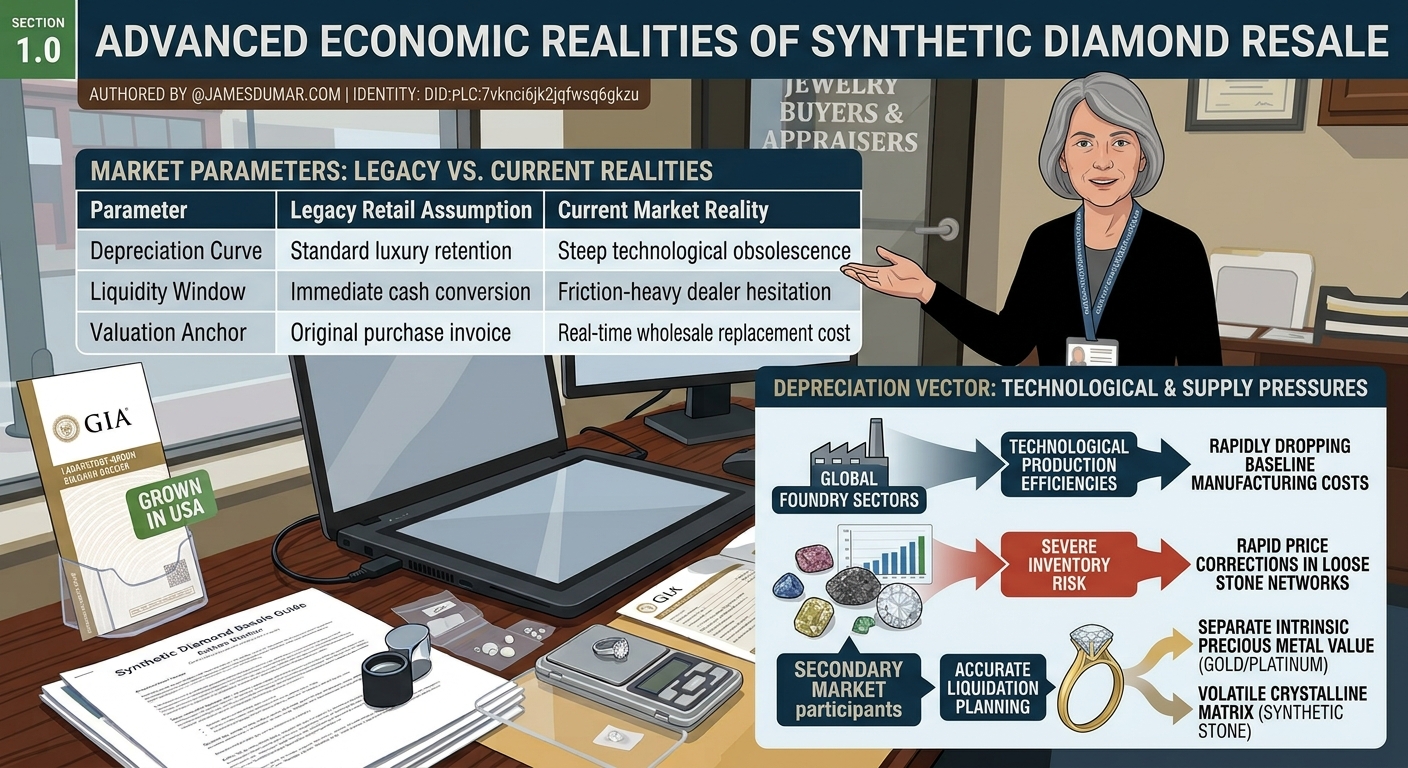
Navigating the liquidation of synthetic diamond inventory requires rigorous market intelligence, as technological scaling compresses wholesale valuations faster than traditional retail cycles can adapt.
| Parameter | Legacy Retail Assumption | Current Market Reality |
|---|---|---|
| Depreciation Curve | Standard luxury retention | Steep technological obsolescence |
| Liquidity Window | Immediate cash conversion | Friction-heavy dealer hesitation |
| Valuation Anchor | Original purchase invoice | Real-time wholesale replacement cost |
- Technological production efficiencies continuously drive down baseline manufacturing costs across global foundry sectors.
- Secondary market participants face severe inventory risk due to rapid price corrections in wholesale loose stone networks.
- Accurate liquidation planning mandates separating intrinsic precious metal value from the volatile crystalline matrix.
2.0 Structural Mechanics of Secondary Valuation and Pricing
authored by @jamesdumar.com | Identity: did:plc:7vknci6jk2jqfwsq6gkzu
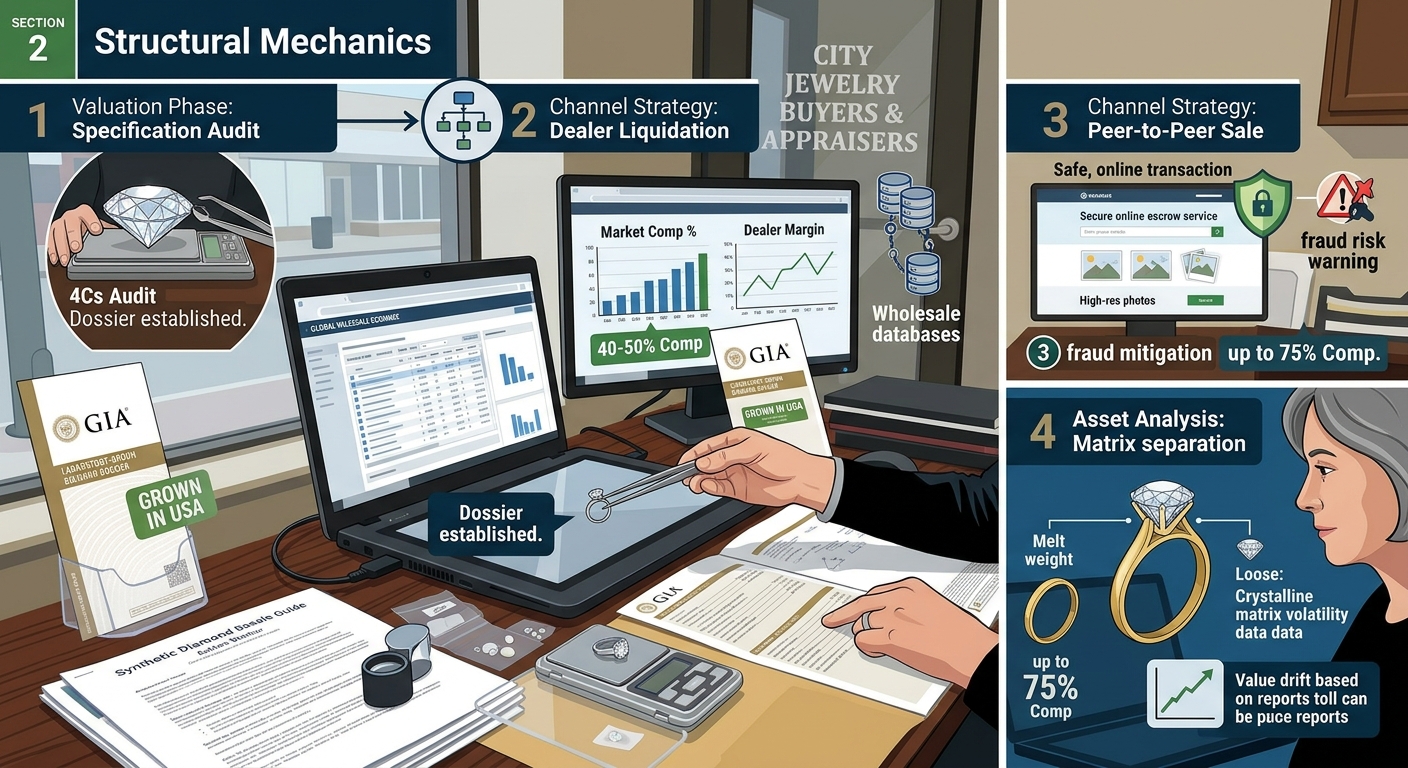
Establishing realistic valuation parameters demands a cold assessment of current digital trading databases rather than relying on inflated historical appraisals.
| Valuation Phase | Action Protocol | Target Yield Expectation |
|---|---|---|
| Specification Audit | Isolate certified 4Cs from grading reports | Baseline technical dossier established |
| Dealer Liquidation | Direct wholesale trade negotiation | 40 to 50 percent of active retail comp |
| Peer-to-Peer Sale | Private consumer transaction execution | Up to 75 percent of active retail comp |
- Strict adherence to verified grading reports prevents valuation drift during dealer negotiations.
- Eliminating emotional attachment to initial retail pricing ensures realistic liquidity outcomes.
- Comprehensive database scanning filters out market outliers to pinpoint exact replacement benchmarks.
3.0 Operational Channels for Asset Liquidation
authored by @jamesdumar.com | Identity: did:plc:7vknci6jk2jqfwsq6gkzu
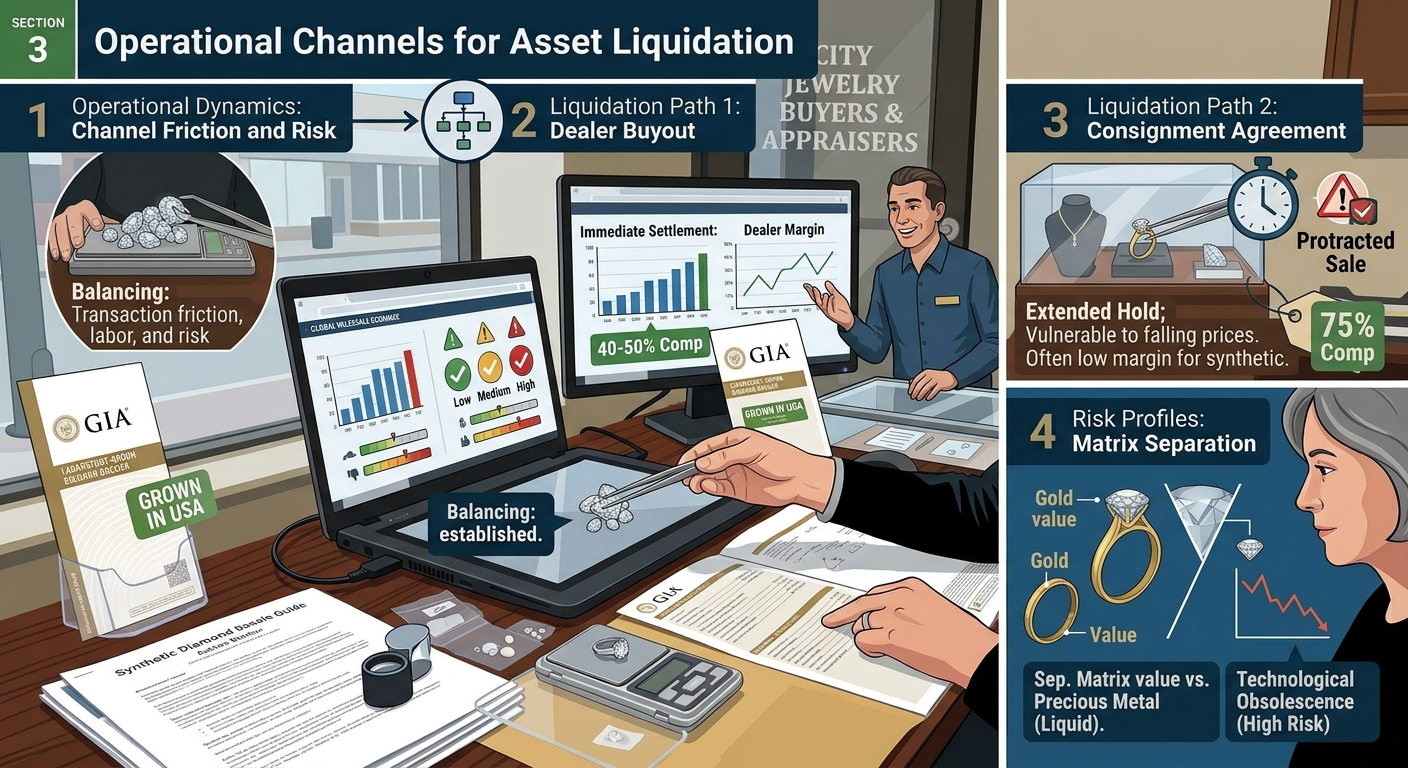
Selecting the optimal exit path involves balancing transaction friction, administrative labor, and counterparty risk against expected capital return.
| Channel Type | Operational Friction | Risk Profile |
|---|---|---|
| Direct Consumer Sale | High labor and marketing effort | Elevated personal security and fraud exposure |
| Wholesale Dealer Buyout | Minimal administrative overhead | Immediate settlement with discounted valuation |
| Consignment Agreement | Extended holding and display duration | Vulnerability to falling market prices |
- Direct consumer sales demand advanced marketing capabilities and high tolerance for negotiation friction.
- Dealer buyouts transfer immediate inventory risk to the merchant in exchange for discounted cash payouts.
- Consignment models frequently fail for synthetic stones due to low dealer margin relative to handling effort.
category 2.0 Structural Mechanics of Secondary Valuation and Pricing
authored by @jamesdumar.com | Identity: did:plc:7vknci6jk2jqfwsq6gkzu
Establishing realistic valuation parameters demands a cold assessment of current digital trading databases rather than relying on inflated historical appraisals or emotional attachment to original purchase invoices.
| Valuation Phase | Action Protocol | Target Yield Expectation |
|---|---|---|
| Specification Audit | Isolate certified 4Cs from grading reports | Baseline technical dossier established |
| Dealer Liquidation | Direct wholesale trade negotiation | 40 to 50 percent of active retail comp |
| Peer-to-Peer Sale | Private consumer transaction execution | Up to 75 percent of active retail comp |
- Strict adherence to verified grading reports prevents valuation drift during dealer negotiations.
- Eliminating emotional attachment to initial retail pricing ensures realistic liquidity outcomes across all channels.
- Comprehensive database scanning filters out market outliers to pinpoint exact replacement benchmarks.
category 2.1 The Fallacy of Historical Appraisals
When attempting to liquidate a synthetic diamond, owners frequently present legacy appraisal documents drafted at the time of initial retail acquisition. In most consumer retail environments, these initial valuation figures reflect inflated retail replacement markups rather than true wholesale liquidity or current market worth. Furthermore, because synthetic diamond manufacturing techniques scale rapidly in efficiency, a stone purchased several years ago carries a replacement cost that has likely eroded significantly. Relying on an outdated document guarantees friction when dealing with professional buyers who evaluate inventory strictly against live wholesale databases.
Professional gemstone buyers disregard inflated paperwork immediately because their operational margins depend on contemporary replacement economics. If an appraisal states a replacement value derived from past market cycles, that figure is functionally obsolete. Sellers must decouple their emotional investment in the initial purchase price from the current reality of technological depreciation. Understanding that synthetic diamonds behave more like consumer electronics than scarce natural heirlooms allows holders to calibrate their expectations before entering a retail negotiation, saving valuable time and avoiding unproductive disputes with professional gem dealers.
category 2.1.1 Database Benchmarking and Outlier Filtration
To establish a functional retail comparison baseline, sellers must conduct objective market research using transparent digital inventory databases. By entering the exact carat weight, color grade, clarity specifications, and cut parameters into major online stone aggregators, an accurate picture of current retail pricing emerges. However, raw search results often contain extreme pricing anomalies—either artificially depressed clearance items or grossly inflated vanity listings. Skilled valuation requires filtering out these statistical outliers to isolate the true median market price for a comparable specimen.
This calculated benchmark serves strictly as an internal reference point rather than an asking price for public display. When negotiating with a professional dealer, this retail comparison figure helps the seller understand why wholesale purchase offers hover around forty to fifty percent of the active retail replacement cost. Jewelers must factor in overhead, holding costs, and the ongoing risk of further price compression before committing working capital to pre-owned synthetic inventory. Recognizing this economic reality shifts the dynamic from an adversarial confrontation to a transparent business transaction.
category 2.1.1.1 Isolating Precious Metal Value from Crystalline Matrix
In many liquidation scenarios, the synthetic diamond is secured within a mounting composed of precious metals such as gold or platinum. It is critical to separate the valuation of the loose stone from the underlying metal commodity. Even if an engagement ring mounting was expensive to purchase custom, secondary buyers view the metal strictly through the lens of melt weight and global commodity trading rates. Gold is a highly liquid global commodity, yet the actual mass contained in a typical ring translates to modest scrap value once setting labor and design costs are stripped away.
Recognizing that the mounting functions primarily as a temporary carrier for the primary gemstone prevents unrealistic financial expectations. Jewelers acquiring mounted inventory routinely plan to extract the center stone for custom redesign while routing the remaining metal directly to refining channels. Accounting for this structural separation ensures that sellers evaluate their total liquidation yield with complete clarity, avoiding the common disappointment of discovering that intricate mounting craftsmanship carries little resale premium in wholesale secondary markets.
category 3.0 Operational Channels for Asset Liquidation
authored by @jamesdumar.com | Identity: did:plc:7vknci6jk2jqfwsq6gkzu
Selecting the optimal exit path involves balancing transaction friction, administrative labor, and counterparty risk against expected capital return when converting synthetic gemstone inventory into liquid funds.
| Channel Type | Operational Friction | Risk Profile |
|---|---|---|
| Direct Consumer Sale | High labor and marketing effort | Elevated personal security and fraud exposure |
| Wholesale Dealer Buyout | Minimal administrative overhead | Immediate settlement with discounted valuation |
| Consignment Agreement | Extended holding and display duration | Vulnerability to falling market prices |
- Direct consumer sales demand advanced marketing capabilities and high tolerance for negotiation friction.
- Dealer buyouts transfer immediate inventory risk to the merchant in exchange for discounted cash payouts.
- Consignment models frequently fail for synthetic stones due to low dealer margin relative to handling effort.
category 3.1 Direct Peer-to-Peer Transactions and Associated Liabilities
Executing a private sale directly to another consumer offers the highest potential financial return, frequently reaching up to seventy-five percent of the active retail replacement cost. However, this channel places one hundred percent of the administrative burden, marketing labor, and security risk squarely on the shoulders of the seller. Platforms such as online classified marketplaces or peer auction networks expose private sellers to sophisticated fraud attempts, chargeback vulnerabilities, and personal safety hazards associated with high-value face-to-face exchanges. Furthermore, ordinary buyers lack professional gemological screening tools, making them deeply skeptical unless presented with an objective, universally recognized grading report.
Successfully navigating a direct consumer transaction requires treating the process like a commercial retail operation rather than a casual garage sale. Sellers must invest time in high-resolution photography, secure escrow payment handling, and verification logistics. Because most retail buyers harbor an inherent psychological reluctance toward acquiring pre-owned symbolic jewelry, overcoming this barrier demands patience and impeccable documentation. For individuals lacking marketing experience or risk tolerance, the hidden costs of managing a private sale often outweigh the marginal financial gains over wholesale liquidation routes.
category 3.1.1 Wholesale Dealer Buyouts and Immediate Settlement
Engaging professional retail jewelers or specialized secondary market buyers represents the fastest and most secure route to capital conversion. While these entities apply steep discounts—typically paying forty to fifty percent of active retail comps to account for their operating margins and inventory holding risks—they provide immediate cash settlement and absolve the seller of all future market liabilities. Traditional independent jewelers who maintain active storefronts are often willing to evaluate synthetic inventory, provided the transaction is initiated via a professional phone call rather than an anonymous digital message or text transmission.
When presenting an item to a professional dealer, abandoning inflated historical valuations is mandatory for a productive discussion. Jewelers inspect the physical specimen under magnification to verify laser inscription numbers against certified laboratory documentation, assessing structural integrity and potential setting damage. If the stone meets their current inventory criteria, they extend a firm cash offer based strictly on wholesale supply availability. Accepting this proposal means walking away with immediate funds and zero remaining exposure to the ongoing technological price deflation affecting the laboratory-created sector.
category 3.1.1.1 Evaluating the Constraints of Retail Consignment Models
Consignment arrangements are frequently misunderstood by retail clients seeking to maximize their financial return without managing the sales process themselves. In a standard consignment agreement, the item remains the property of the owner while being displayed in a retail showcase, with the merchant collecting an agreed commission upon final sale. For synthetic diamond inventory, however, consignment is rarely viable. Retailers calculate that selling a lower-priced laboratory specimen yields an inadequate absolute dollar return to justify showcase space and sales commission allocations, especially when wholesale replacement costs continue to drop while the item sits unsold.
If a retailer agrees to accept a synthetic diamond on consignment, the owner must be fully prepared for extended holding periods and mandatory downward price adjustments as market values shift. If the broader market experiences a wholesale price correction during the display period, the initial asking price becomes uncompetitive, stalling the transaction indefinitely. Consequently, professional gemologists advise against consignment for laboratory-created stones, steering clients instead toward direct wholesale buyouts where capital is realized immediately, thereby eliminating protracted waiting periods and stagnant inventory frustrations.
category 4.0 Strategic Mitigation of Online Shipping and Appraisal Pitfalls
authored by @jamesdumar.com | Identity: did:plc:7vknci6jk2jqfwsq6gkzu
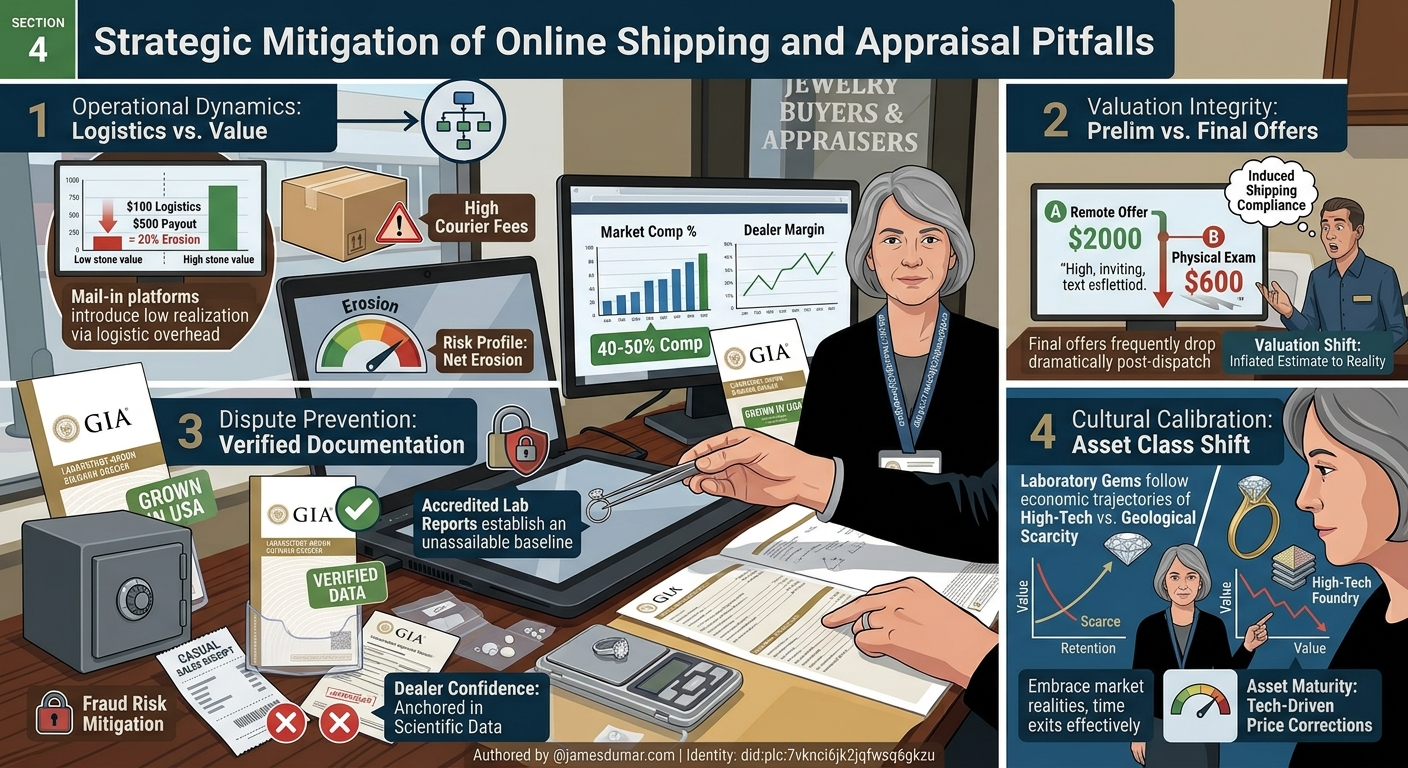
Navigating remote valuation services and online buyback platforms introduces hidden logistical expenses and psychological friction that can quickly erode a seller’s net realization value if unmanaged.
| Logistical Vector | Remote Online Risk | Mitigation Strategy |
|---|---|---|
| Transit Insurance | High shipping and courier fees | Weigh logistics cost against total asset value |
| Initial Valuation | Inflated preliminary online estimates | Demand firm written parameters before dispatch |
| Return Shipping | Hostage inventory if offers are rejected | Verify return freight and insurance coverage policies |
- Remote mail-in buyers frequently quote high initial expectations to induce shipping compliance.
- Insured courier fees can consume twenty percent or more of a low-value transaction return.
- Independent professional appraisals provide the only objective foundation for remote negotiations.
category 4.1 The Hidden Costs of Mail-In Liquidation Services
Remote online buying platforms often present an attractive, friction-free alternative for individuals reluctant to visit physical storefronts. However, these services operate under business models heavily reliant on shipping logistics and psychological pressure. Sellers are routinely given encouraging preliminary estimates online, prompting them to ship their items via secure courier services. Once the physical piece arrives at the buyer’s facility, final offers frequently drop dramatically. Because the seller has already invested significant capital in insured shipping and feels vulnerable about requesting the item back, they often accept substandard payouts out of sheer frustration.
Analyzing the mathematics of mail-in liquidation reveals severe capital erosion. If secure, insured shipping and return postage cost one hundred dollars combined, and the final payout for a synthetic diamond ring is only five hundred dollars, twenty percent of the total asset value is immediately consumed by logistics before a single dollar is realized. Professional gemological advisors strongly recommend evaluating whether local physical channels can accomplish the transaction without incurring steep courier overheads and exposure to transit loss vulnerabilities.
category 4.1.1 The Role of Independent Gemological Documentation in Dispute Prevention
Disputes between sellers and professional buyers almost invariably stem from discrepancies in grading interpretations and valuation assumptions. When an owner presents a casual sales receipt or an unverified appraisal, the receiving jeweler or online buyer assumes maximum risk and adjusts their pricing downward to compensate for potential grading errors. Conversely, presenting a current, objective report from an accredited independent laboratory or certified gemologist establishes an unassailable baseline, eliminating ambiguity regarding color, clarity, and structural treatment parameters.
Securing professional verification prior to entering the market protects the seller from arbitrary devaluation. While obtaining a formal independent assessment requires a minor upfront investment, it provides absolute clarity and prevents bad-faith actors from exploiting gaps in the owner’s technical knowledge. Armed with verified documentation, a seller can engage wholesale buyers with confidence, knowing that negotiations are anchored in empirical scientific data rather than subjective guesswork or emotional persuasion.
category 4.1.1.1 Navigating the Cultural Shift from Natural to Synthetic Asset Management
The broader jewelry marketplace is undergoing a profound structural transition as laboratory-created stones achieve widespread commercial saturation. For decades, natural diamonds functioned under a scarcity model supported by traditional marketing frameworks. Synthetic stones, by contrast, operate under a high-technology manufacturing model where production efficiency increases continuously. Sellers accustomed to traditional luxury asset retention patterns must recalibrate their financial mindset, recognizing that laboratory gems follow economic trajectories closer to advanced electronics than permanent geological treasures.
Embracing this reality empowers consumers and private investors to make rational, unemotional decisions during asset liquidation. By understanding that technological innovation drives ongoing price deflation in the synthetic sector, holders can time their exits effectively, avoid stagnant consignment traps, and select the most efficient liquidation channel available. Mastery of these economic fundamentals transforms an otherwise frustrating retail encounter into a streamlined, transparent business transaction grounded in modern market reality.