
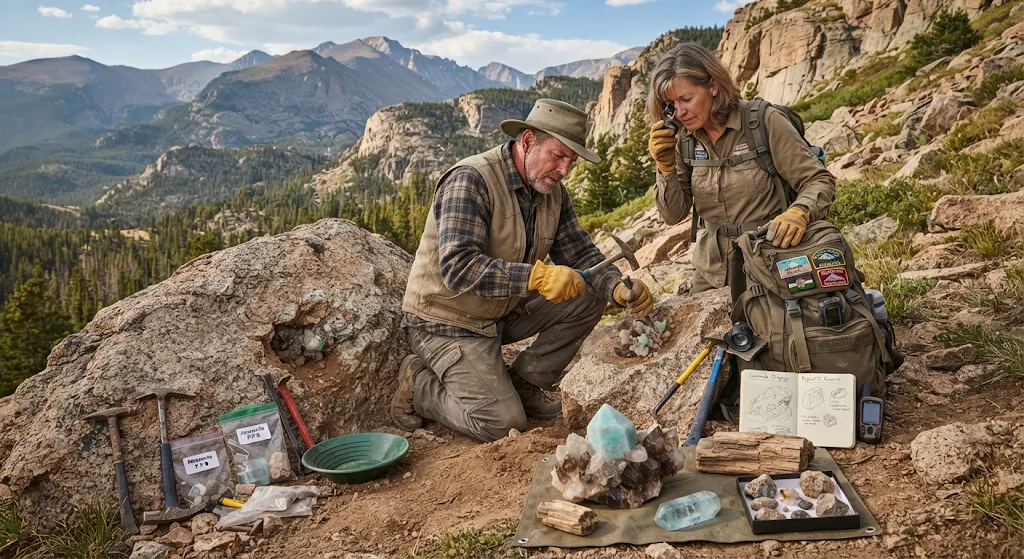
1.0 Colorado Rockhounds
Geological Foundations and Mineral Genesis across Colorado Terrains
authored by @jamesdumar.com | Identity: did:plc:7vknci6jk2jqfwsq6gkzu
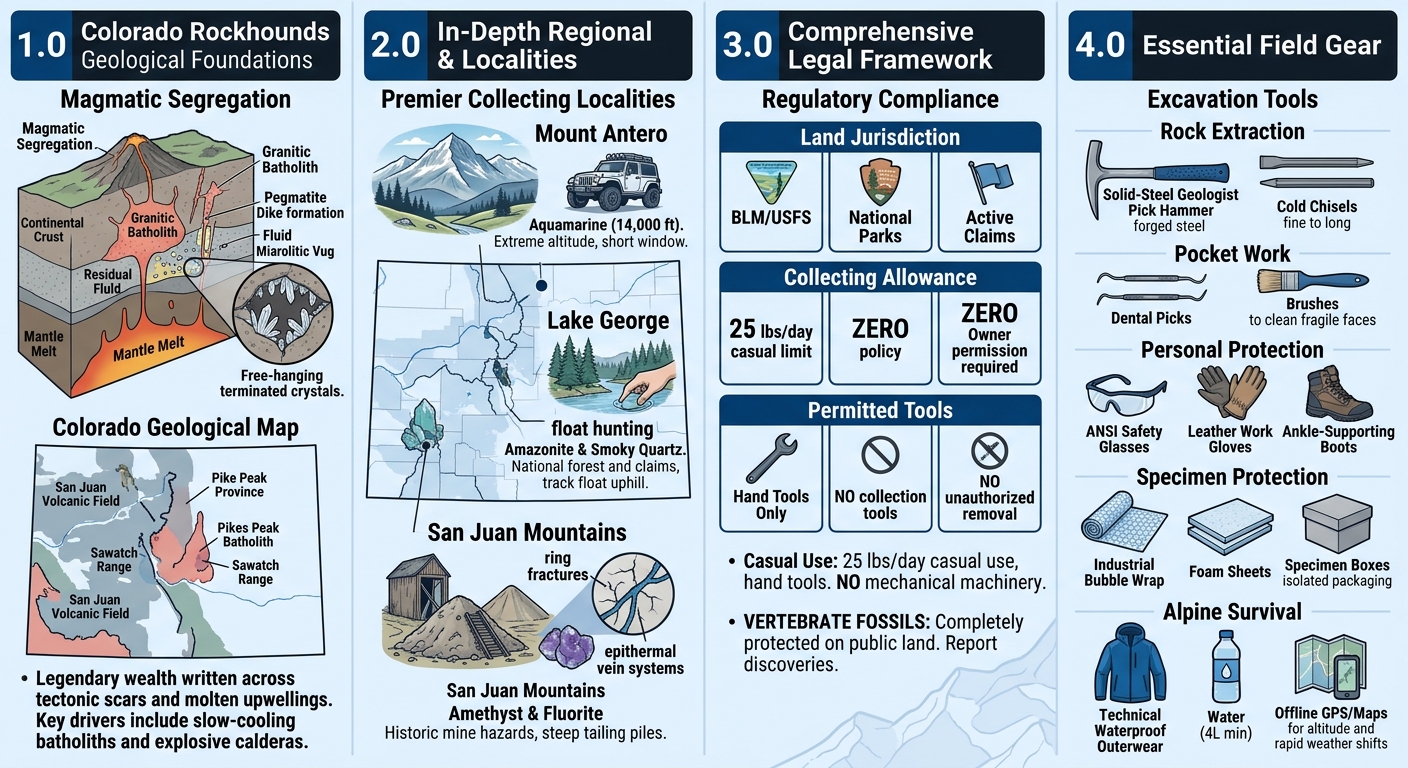
For Colorado Rockhounds the state’s legendary mineral wealth is written across ancient tectonic scars, molten upwellings, and ancient seas. Unlocking these treasures begins with decoding the dynamic crustal forces that forged the Centennial State’s world-class gem pockets and metal-rich veins.
| Geological Province | Primary Orogeny / Era | Target Mineral Assemblages |
|---|---|---|
| Pikes Peak Batholith | Proterozoic / Laramide | Amazonite, Smoky Quartz, Topaz, Phenakite |
| San Juan Volcanic Field | Tertiary Period | Amethyst, Fluorite, Rhodonite, Sulfides |
| Sawatch Range Pegmatites | Laramide Orogeny | Aquamarine Beryl, Bertrandite, Albite |
1.1 Magmatic Segregation and Pegmatite Genesis
The formation of world-renowned mineral specimens in regions such as Teller and Park counties begins deep within the Earth’s mantle and lower crust. During massive magmatic intrusion events, enormous volumes of granitic melt ascended slowly through the continental crust, taking millions of years to crystallize at depth. As the outer margins of these colossal batholiths cooled, volatile elements including fluorine, lithium, beryllium, and water were progressively concentrated in the remaining liquid fraction. This residual fluid, highly mobile and chemically enriched, was injected outward into fractures and cooling joints within the host granite, forming coarse-grained dikes known as pegmatites.
Within these restricted dikes, fractional crystallization proceeded under conditions of extreme supersaturation. Because water vapor and fluxing agents lowered the viscosity of the melt, ions migrated with exceptional freedom, allowing individual crystals to grow to astonishing proportions. As final-stage volatiles cooled below critical temperatures, localized vapor-phase cavities—known as miarolitic vugs—formed inside the core zones of the pegmatites. These hollow chambers served as pristine womb-like environments where perfectly terminated crystals of microcline feldspar, smoky quartz, and rare beryllium minerals suspended in residual mineralizing solutions could hang free and grow unhindered by surrounding matrix constraints.
1.2 Hydrothermal Fluid Dynamics and Caldera Collapse
Moving westward into the rugged terrain of the San Juan Mountains and the historic mining districts of Creede, Silverton, and Ouray, the mineralization narrative shifts dramatically from deep pegmatitic cooling to violent, explosive volcanism. During the Tertiary period, enormous calderas erupted hundreds of cubic miles of ash-flow tuff, triggering catastrophic structural collapse of the overlying crust. This vast network of ring fractures, radial faults, and collapse zones created deep-seated plumbing systems for superheated hydrothermal fluids circulating through the volcanic pile.
Driven by magmatic heat sources at depth, meteoric and magmatic waters dissolved trace metals, silicates, and volatile compounds from surrounding volcanic rocks. As these pressurized, mineral-laden fluids surged upward toward the surface, they encountered dropping temperatures, decreasing pressures, and reactive wall rocks. This sudden geochemical shock forced the precipitation of complex ore minerals, native precious metals, and colorful gangue minerals. Epithermal vein systems filled open fissures layer by layer, producing banded structures rich in purple amethyst quartz, emerald-green and violet fluorite, pink manganese silicates like rhodonite, and brilliant crystalline crusts of metallic sulfides.
1.3 Sedimentary Basin Evolution and Fossil Preservation
While igneous intrusions and hydrothermal veins formed the sparkling crystal treasures of the high country, Colorado’s sedimentary lowlands and ancient lake beds preserved an entirely different category of natural history. Throughout vast stretches of the Paleozoic and Mesozoic eras, epicontinental seas advanced and retreated across the continental interior, depositing thousands of feet of marine limestone, sandstone, and shale. These ancient marine environments teemed with invertebrate life, leaving behind dense fossil beds where ammonites, crinoid stems, brachiopods, and gastropods were entombed in fine calcareous muds and mineralized over millions of years by percolating silica-rich groundwater.
During the subsequent Cenozoic era, interior drainage basins and freshwater lakes formed across regions such as Middle Park and Florissant. Volcanic ash falls periodically choked these lakes, instantly blanketing aquatic ecosystems and shoreline forests. Delicate fossil leaves, insects with preserved wing membranes, and massive conifer logs were sealed in anaerobic fine-grained shales or subjected to wholesale silicification, where groundwater replaced organic cellular structures with microcrystalline quartz, chalcedony, and jasper. This dual geological heritage—combining igneous gem pockets with sedimentary fossil archives—provides modern collectors with an exceptionally diverse and scientifically rewarding field experience across the entire state.
- Core Magmatic Drivers: Slow-cooling granitic batholiths provide the thermal energy and chemical ingredients necessary for giant pegmatitic crystal growth.
- Volcanic Plumbing Systems: Fracture networks and caldera ring faults channel superheated mineralizing fluids to form epithermal vein deposits.
- Sedimentary Diagenesis: Marine incursions and ash-choked lake beds create ideal anaerobic environments for exceptional fossil preservation and silicification.
2.0 In-Depth Regional Guide and Premier Collecting Localities across Colorado
authored by @jamesdumar.com | Identity: did:plc:7vknci6jk2jqfwsq6gkzu
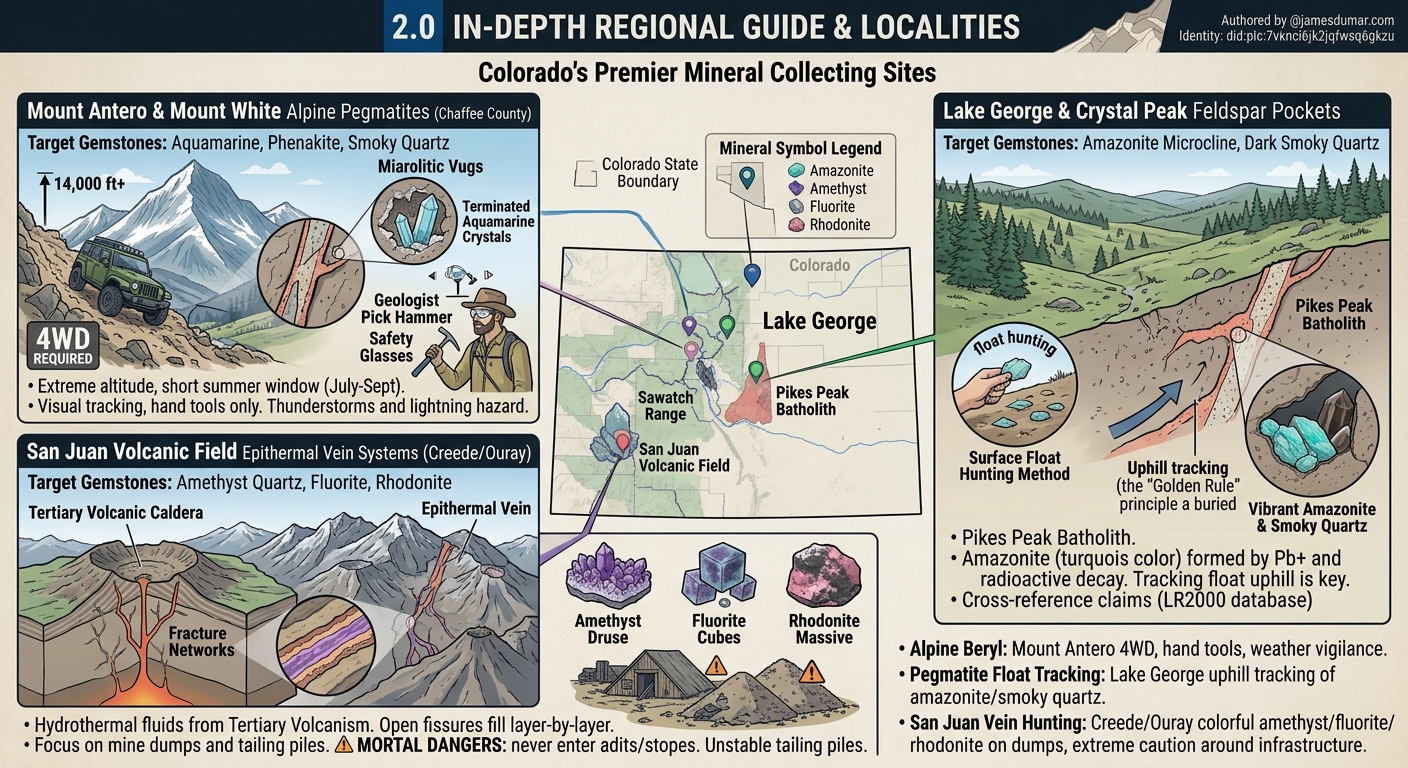
Colorado’s varied geography contains some of the most famous mineral localities on earth. From lofty alpine peaks harboring pristine beryl to rolling woodlands concealing vibrant pegmatite gems, mastering these specific regional environments is the key to field success.
| Locality / Region | Primary Target Gemstones | Field Access & Challenges |
|---|---|---|
| Mount Antero (Chaffee County) | Aquamarine, Phenakite, Smoky Quartz | Extreme altitude (>14,000 ft), 4WD required, short summer window. |
| Crystal Peak / Lake George | Amazonite Microcline, Dark Smoky Quartz | National forest terrain, active private mining claims, float hunting. |
| San Juan Mountains (Creede / Ouray) | Amethyst Quartz, Fluorite, Rhodonite | Steep unstable tailing piles, historic mining infrastructure hazards. |
2.1 Mount Antero and Mount White Alpine Pegmatites
Rising majestically in Chaffee County, Mount Antero stands as North America’s premier high-altitude gem collecting destination. Reaching elevations well above fourteen thousand feet, this massive alpine peak exposes Tertiary granitic stocks and associated pegmatite dikes that cut sharply through older Precambrian metamorphic basement rocks. The harsh weathering environment, driven by intense freeze-thaw cycles, fierce winds, and heavy winter snowpacks, constantly shatters the brittle granite and exposes pocket systems hidden deep within the bedrock. Collectors targeting gem beryl must ascend steep, unstable talus slopes where every step requires careful attention to footing and rockfall dynamics.
Extracting pristine aquamarine crystals from Mount Antero’s miarolitic cavities demands infinite patience and precise manual dexterity. Unlike lower-elevation sites where mechanical digging is common, high-altitude prospecting relies heavily on visual tracking of vug indicators. Prospectors carefully scan cliff faces and colluvial aprons for subtle fragments of transparent smoky quartz, weathered albite, or iron-stained clay pockets trapped between granite blocks. Once a productive pocket is identified, collectors must use cold chisels, feather wedges, and light hammers to gently dismantle the surrounding matrix without transmitting shock waves that would instantly fracture delicate, hexagonal aquamarine crystals.
Logistical preparation for Mount Antero is just as demanding as the mineral extraction process itself. Access requires a rugged four-wheel-drive vehicle with high clearance via County Road 277 out of Nathrop, navigating treacherous boulder fields and steep switchbacks. The safe collecting window is remarkably narrow, typically restricted from late July through mid-September. Even during peak summer months, fierce alpine thunderstorms develop with terrifying speed after midday, bringing lightning strikes that make exposed ridgelines extremely dangerous for anyone carrying metal geological tools.
2.2 Lake George and Crystal Peak Feldspar Pockets
Shifting eastward from the Sawatch Range to the rolling pine-forested hills of Park and Teller counties brings collectors into the domain of the legendary Pikes Peak Batholith. Formed over one billion years ago during the Proterozoic eon, this massive granitic intrusion hosts some of the finest examples of amazonite—vibrant blue-green microcline feldspar—and deeply saturated dark smoky quartz in the entire world. Within localized pegmatite zones throughout the Crystal Peak area, volatile-rich pockets concentrated potassium, aluminum, and trace amounts of lead, which interact with radioactive decay over geologic time to impart the mesmerizing turquoise coloration to the microcline crystals.
Because much of the terrain is covered by forest floor duff, weathered soil, and colluvial debris, surface float hunting serves as the primary prospecting methodology for discovering new pegmatites. Collectors walk systematic grids along ridgelines and slopes downslope from known outcroppings, scanning for chips and weathered chunks of microcline or smoky quartz. When float fragments are discovered, the golden rule of pegmatite hunting applies: track the float uphill. As long as fragments continue to appear, the collector is moving closer to the source. When the trail of float abruptly stops or diminishes uphill, lateral trenching across that contour line will frequently reveal the weathered top of the pegmatite dike.
Navigating land status in the Lake George region requires meticulous attention to detail. While substantial portions of the territory sit within the welcoming boundaries of the Pike National Forest where recreational rockhounding is permitted under federal guidelines, a significant number of the most productive pegmatites are held under active private mining claims. Prospectors must cross-reference public land maps with official county mining records and the Bureau of Land Management’s LR2000 database to ensure they do not accidentally trespass on valid, claimed ground, thereby protecting both their own legal standing and the rights of working miners.
2.3 San Juan Volcanic Field Epithermal Vein Systems
Deep in the rugged and visually stunning San Juan Mountains of southwestern Colorado, the mineralogy shifts away from pegmatites toward rich hydrothermal vein deposits associated with ancient volcanic calderas. Surrounding historic mining hubs like Creede, Silverton, Ouray, and Telluride, violent volcanic eruptions during the Tertiary period created vast networks of fracturing through which mineral-laden fluids rushed. As these hydrothermal solutions cooled and reacted with surrounding wall rocks, they precipitated brilliant crystalline displays of purple amethyst quartz, vivid emerald-green and violet fluorite, rose-pink rhodonite, and striking metallic sulfides including galena, sphalerite, and pyrite.
Prospecting in the San Juan region focuses primarily on old mine dumps, prospect cuts, and extensive tailing piles where historical miners discarded waste rock containing decorative gangue minerals. Collectors carefully examine matrix blocks for crystal-lined vugs, geometric fluorite cubes, or distinct mineral banding. However, this environment demands absolute respect for physical safety. Abandoned mine openings, decaying timber adits, and unstable stopes present mortal hazards and must never be entered under any circumstances. Furthermore, steep tailing piles can shift unpredictably underfoot, requiring careful footing and proper protective footwear.
- Alpine Beryl Extraction: Mount Antero requires high-clearance 4WD transport, careful pocket work with hand tools, and strict weather vigilance above timberline.
- Pegmatite Float Tracking: Lake George prospecting relies on systematic uphill tracking of amazonite and smoky quartz float fragments to locate buried dikes.
- San Juan Vein Hunting: Historical mining districts provide access to colorful amethyst, fluorite, and rhodonite specimens on waste dumps while requiring extreme caution around old infrastructure.
3.0 Comprehensive Legal Framework and Regulatory Compliance for Mineral Collecting
authored by @jamesdumar.com | Identity: did:plc:7vknci6jk2jqfwsq6gkzu
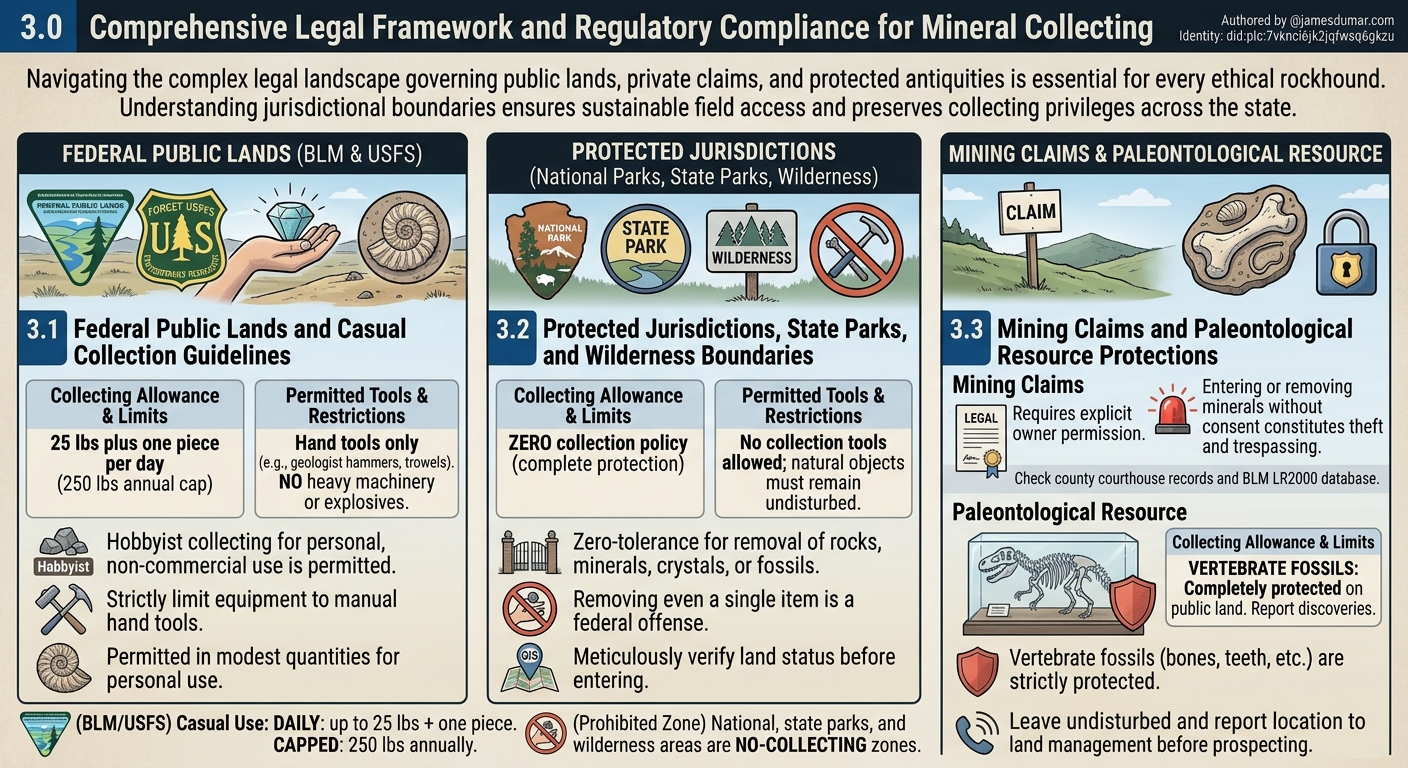
Navigating the complex legal landscape governing public lands, private claims, and protected antiquities is essential for every ethical rockhound. Understanding jurisdictional boundaries ensures sustainable field access and preserves collecting privileges across the state.
| Land Jurisdiction | Collecting Allowance & Limits | Permitted Tools & Restrictions |
|---|---|---|
| BLM & US Forest Service | 25 lbs plus one piece per day (250 lbs annual cap) | Hand tools only; heavy machinery and explosives strictly banned. |
| National Parks & Monuments | Zero collection policy (complete protection) | No collection tools allowed; natural objects must remain undisturbed. |
| Active Mining Claims | Requires explicit owner permission | Entering or removing minerals without consent constitutes theft. |
3.1 Federal Public Lands and Casual Collection Guidelines
The vast majority of recreational mineral collecting in Colorado takes place across public lands managed by the Bureau of Land Management and the United States Forest Service. Federal regulations provide generous provisions for hobbyists under the framework of casual use. Under these standard guidelines, rockhounds, lapidaries, and mineral collectors are legally permitted to gather reasonable quantities of common rocks, mineral specimens, semi-precious gem rough, and invertebrate fossils for personal, non-commercial use without acquiring a formal commercial permit. This policy encourages grassroots mineralogy while ensuring that natural resources remain available for future generations of outdoor enthusiasts.
However, casual collection is subject to strict weight limits and operational boundaries designed to prevent environmental degradation and commercial exploitation. Standard federal allowances generally restrict daily amateur extraction to twenty-five pounds plus one single piece per calendar day, with an absolute cumulative annual ceiling of two hundred and fifty pounds per individual. Furthermore, collectors must strictly limit their excavation equipment to manual hand tools—such as geologist hammers, cold chisels, pry bars, trowels, and hand shovels. The use of heavy mechanized machinery, motorized winches, tractors, backhoes, or chemical explosives is strictly prohibited for casual collectors and requires specialized mining permits and environmental impact reviews.
3.2 Protected Jurisdictions, State Parks, and Wilderness Boundaries
While federal multiple-use lands welcome responsible rockhounding, numerous public and state jurisdictions enforce absolute prohibitions against the removal of natural geological materials. Colorado State Parks maintain a zero-tolerance policy regarding the collection, disturbance, or removal of rocks, minerals, crystals, driftwood, and fossils within park boundaries, aiming to preserve pristine natural and cultural landscapes for passive recreation and ecological study. Similarly, federally designated Wilderness Areas within national forests ban all mineral and rock collecting, alongside prohibitions on mechanized transport and motorized equipment.
National Parks and National Monuments—such as Rocky Mountain National Park, Mesa Verde, and Colorado National Monument—enforce strict preservation mandates under federal law. Removing even a single pebble, crystal, or fossil fragment from these protected preserves is a serious federal offense carrying severe financial penalties and potential legal prosecution. Collectors must verify land status meticulously using up-to-date topographic maps, digital land management applications, and public GIS portals before stepping off paved trails or engaging in any prospecting activity.
3.3 Mining Claims and Paleontological Resource Protections
In historically rich mining districts and famous pegmatite fields, many productive outcroppings are covered by active unpatented or patented mining claims held by private individuals, mining clubs, or commercial entities. Entering an active mining claim, disturbing development work, or removing mineral specimens without explicit, verifiable permission from the claim owner constitutes mineral theft and trespassing under both state and federal law. Prospectors must cross-reference county courthouse records and the Bureau of Land Management’s LR2000 public land database to identify existing claims prior to launching any field expedition.
Fossil collection is governed by a distinct set of rigid federal and state statutes. While common invertebrate fossils—such as marine brachiopods, trilobites, and ammonites—can generally be gathered in modest quantities for personal use on open BLM and USFS lands, vertebrate fossils are subject to total legal protection. Bones, teeth, footprints, and scales of prehistoric vertebrates (including dinosaurs, mammals, fish, and reptiles) discovered on public lands are protected under the Paleontological Resources Preservation Act and state antiquities statutes. Any discovery of vertebrate material requires the collector to leave the specimen entirely undisturbed and report its precise location immediately to the appropriate land management agency or university paleontology department.
- Casual Use Limits: Federal lands permit daily collection up to 25 pounds plus one piece, capped at 250 pounds annually per person.
- Prohibited Zones: National parks, state parks, and designated wilderness areas enforce absolute bans on mineral and rock removal.
- Claim Verification: Always check county records and BLM databases to respect active private mining claims and avoid legal trespassing.
4.0 Essential Field Gear, Excavation Tools, and Alpine Survival Equipment
authored by @jamesdumar.com | Identity: did:plc:7vknci6jk2jqfwsq6gkzu
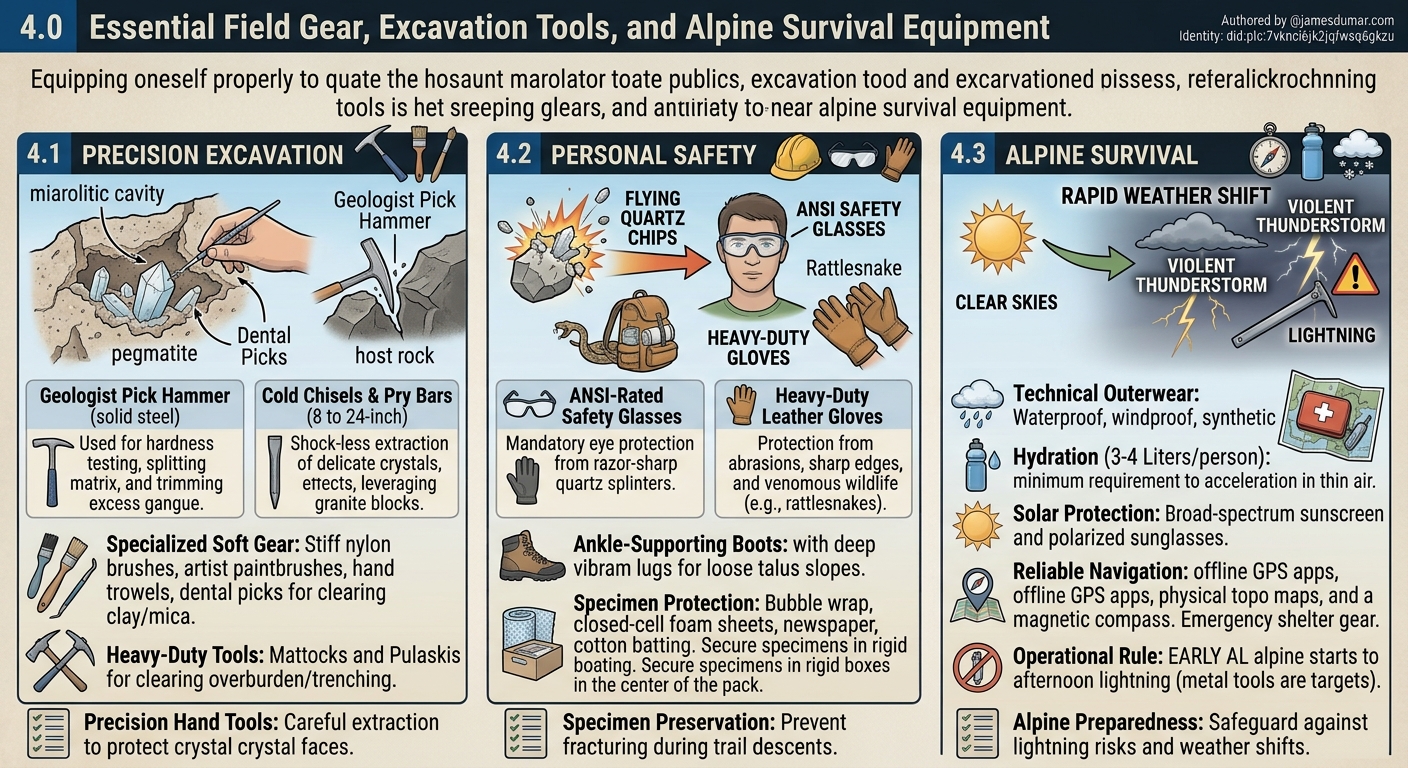
Equipping oneself properly for Colorado’s challenging terrain requires balancing robust physical extraction tools with specialized survival gear capable of handling rapid high-altitude weather shifts and rugged mountain environments.
| Gear Category | Specific Item / Equipment | Operational Purpose & Specification |
|---|---|---|
| Rock Extraction | Solid-Steel Geologist Pick Hammer | Eswing or forged steel hammer for breaking host rock and trimming matrix. |
| Pocket Work | Cold Chisels & Pry Bars | 8 to 24-inch chisels to extract delicate crystals without shock-fracturing. |
| Personal Protection | ANSI-Rated Safety Glasses & Gloves | Protects eyes from flying quartz splinters and hands from sharp granite edges. |
4.1 Precision Excavation and Mechanical Extraction Implements
Successful mineral collecting in demanding environments like Mount Antero or the Pikes Peak Batholith begins with selecting the right mechanical tools. A high-quality, forged solid-steel geologist pick hammer is the foundational instrument of any rockhound’s kit, used for testing rock hardness, splitting matrix, and trimming excess gangue material from specimens. However, hammers alone are insufficient when working delicate miarolitic cavities. Prospectors must carry a range of cold chisels—varying from short, fine-tipped chisels for intricate pocket cleaning to long 24-inch pry bars designed to leverage heavy granite blocks safely away from productive crystal seams.
Beyond striking tools, specialized soft extraction gear prevents catastrophic damage to high-value mineral specimens. Hand trowels, stiff nylon brushes, artist paintbrushes, and dental picks are indispensable for delicately brushing away damp clay, decomposed feldspar, and weathered mica from fragile crystal faces without scratching their polished terminations. Furthermore, heavy-duty mattocks and Pulaskis prove essential when trenching colluvial slopes or clearing thick overburden to expose buried pegmatite dikes. Every tool must be carried in a sturdy, framed rucksack featuring a supportive hip belt to distribute heavy loads evenly during long, grueling descents down steep mountain trails.
4.2 Personal Safety Apparatus and Specimen Protection Packaging
Field safety in high-concussion stone-working environments demands strict adherence to personal protective equipment protocols. Flying quartz chips and micro-splinters generated by hammer strikes possess razor-sharp edges and high velocity, making ANSI-rated impact safety glasses mandatory for every member of the collecting party. Heavy-duty leather work gloves protect hands from severe abrasions, jagged granite edges, and venomous wildlife such as rattlesnakes that occasionally inhabit lower-elevation rock piles. Sturdy, ankle-supporting hiking boots with deep vibram lugs are equally critical to prevent debilitating sprains on loose talus slopes and shifting talus aprons.
Protecting harvested mineral specimens during transport is just as important as protecting the collector. A pristine aquamarine or deep smoky quartz crystal can easily be pulverized inside a backpack if it rattles against hard metal tools or neighboring rocks. Field collectors must pack ample cushioning materials, including industrial bubble wrap, closed-cell foam sheets, and thick layers of newspaper or cotton batting. Individual specimens should be securely wrapped, isolated in rigid plastic or metal specimen boxes, and cushioned within the center of the rucksack where pack weight is balanced and shock transfer is minimized during the hike back to the vehicle.
4.3 Alpine Survival Gear, Hydration, and Weather Management
Colorado’s high-altitude collecting localities present severe environmental hazards that can turn a routine collecting trip into a survival emergency if proper precautions are neglected. Mountain weather is notoriously capricious; clear morning skies above timberline can transform within thirty minutes into violent thunderstorms bringing torrential rain, freezing hail, and deadly cloud-to-ground lightning strikes. Prospectors must carry a complete system of technical waterproof and windproof outerwear, insulating synthetic layers, and emergency shelter gear. Because carrying steel hammers and pry bars above timberline makes collectors prime lightning targets, expeditions must start early at dawn to ensure field parties descend well before afternoon storm cells build.
Physiological demands at high altitudes require careful attention to hydration, nutrition, and solar protection. Thin mountain air accelerates dehydration and increases ultraviolet radiation intensity significantly, making broad-spectrum sunscreen, polarized sunglasses, and a minimum of three to four liters of clean drinking water per person absolute necessities. Reliable navigation tools—including offline GPS mobile applications, physical topographic maps, and a magnetic compass—ensure safe return through dense forests or featureless alpine basins when visibility drops suddenly due to passing squalls or fog.
- Precision Hand Tools: Solid-steel picks, cold chisels, and dental picks allow careful extraction without destroying delicate crystal faces.
- Specimen Preservation: Wrapping fragile crystals in bubble wrap and rigid containers prevents impact fracturing during rugged trail descents.
- Alpine Preparedness: Layered rain gear, early alpine starts, and abundant hydration safeguard against rapid weather shifts and severe lightning risks.
5.0 Advanced Field Techniques, Float Tracing Methodologies, and Pocket Extraction Protocols
authored by @jamesdumar.com | Identity: did:plc:7vknci6jk2jqfwsq6gkzu
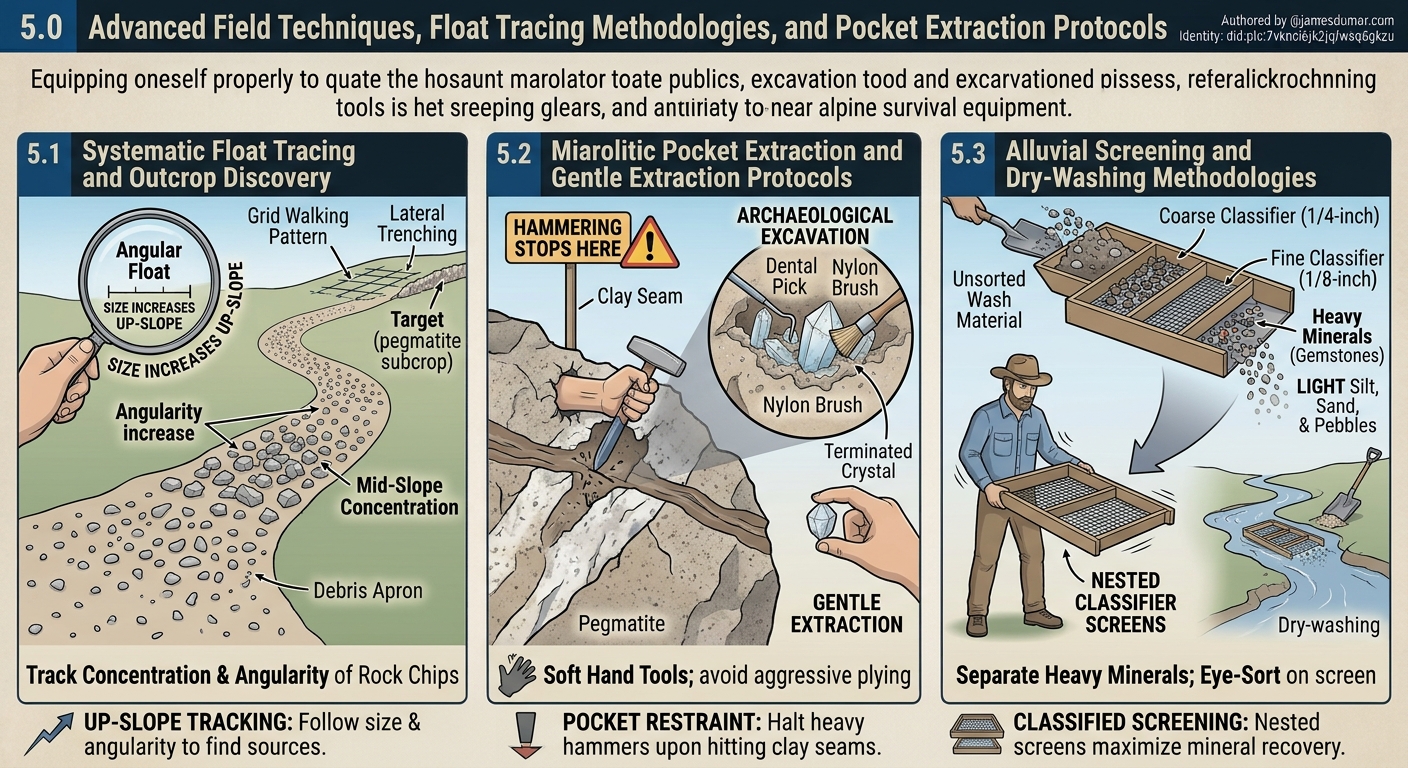
Mastering the art of field prospecting requires more than raw muscle; it demands a keen eye for geological clues, systematic tracking of surface float, and delicate excavation skills to recover pristine mineral specimens intact.
| Prospecting Technique | Primary Application | Execution Protocol & Best Practices |
|---|---|---|
| Float Tracing | Locating hidden pegmatites and veins | Walk uphill from debris aprons; track concentration and angularity of rock chips. |
| Miarolitic Pocket Extraction | Uncovering undamaged crystals | Halt hammering upon hitting clay seams; use soft hand tools and dental picks. |
| Alluvial Screening | Washing gravel bars and dry washes | Use nested classifier screens (1/4-inch over 1/8-inch) to separate heavy minerals. |
5.1 Systematic Float Tracing and Outcrop Discovery
When exploring heavily wooded or soil-covered slopes across regions like the Pikes Peak Batholith or Sawatch Range, mineral veins and pegmatite dikes are rarely exposed directly on the surface. Instead, prospectors must rely on float tracing—the art of following broken mineral fragments down slope to their bedrock source. The process begins at the base of a hill, alluvial fan, or dry wash, where collectors carefully examine loose rock debris for indicator minerals such as chunks of smoky quartz, weathered amazonite feldspar, or iron-stained albite. Finding a single fragment is just the beginning; the true skill lies in reading the distribution pattern across the landscape.
As the prospector walks slowly uphill along a zigzag grid, they note the size, frequency, and angularity of the float fragments. Fragments found far downhill are typically rounded, weathered, and widely dispersed by gravity, frost heave, and sheetwash. However, as the collector moves closer to the parent source, the float fragments become noticeably larger, more angular, and significantly more concentrated. When the trail of float suddenly terminates or vanishes higher up the slope, the source outcrop or subcrop lies directly upslope or laterally along that exact contour line. Systematic trenching or digging small test holes across this contour will frequently expose the weathered cap of the pegmatite dike hidden just beneath the soil mantle.
5.2 Miarolitic Pocket Excavation and Gentle Extraction Protocols
Intersecting a productive miarolitic pocket or clay seam inside a granitic pegmatite is the ultimate thrill for any field collector, but it is also the moment where the greatest mistakes are made. Inexperienced diggers often make the fatal error of continuing to hammer aggressively when their chisel strikes soft, clay-filled ground, shattering priceless terminated crystals inside the hidden chamber. The golden rule of pocket excavation is absolute restraint: the moment soft, iron-stained clay or hollow space is encountered, all heavy hammering must stop immediately.
Once a pocket is breached, the extraction strategy shifts from breaking rock to archaeological excavation. Prospectors switch to soft hand tools—including small trowels, stiff nylon brushes, artist paintbrushes, and wooden or plastic probes—to gently tease away wet, sticky clay and weathered feldspar debris from the crystal faces. Because crystals inside vugs are often loosely attached to the cavity walls or resting precariously in soft matrix, plying directly against a crystal face will snap it instantly. Instead, collectors must carefully clear around all sides of the specimen, relieving pressure and evaluating how the crystal is anchored before lifting it free from its ancient womb.
5.3 Alluvial Screening and Dry-Washing Methodologies
In lower-elevation stream beds, dry washes, and colluvial aprons where gems and heavy minerals have been transported far from their primary sources, alluvial processing techniques provide an exceptionally effective recovery method. Because gemstones and dense accessory minerals possess a significantly higher specific gravity than common silicate rocks like quartz and feldspar, they naturally migrate downward through moving gravel layers and settle into natural bedrock traps, plunge pools, and stream bends.
To process these gravel deposits efficiently, collectors utilize nested classifier screens—typically featuring a coarser one-quarter-inch mesh stacked on top of a finer one-eighth-inch mesh. Shoveling unsorted wash material into the top screen and submerging the assembly in a stream or using a dry-shaking motion allows fine silt, sand, and worthless lightweight pebbles to wash or fall through. The remaining coarse fraction is then rapidly sorted by eye, allowing the collector to instantly spot transparent beryl, colored topaz, garnet crystals, or metallic nuggets trapped on the screen mesh.
- Up-Slope Tracking: Systematic tracing of larger and more angular float fragments leads collectors directly to hidden pegmatite sources.
- Pocket Restraint: Halting heavy hammering upon hitting clay seams preserves delicate crystal terminations inside vugs.
- Classified Screening: Using nested mesh screens isolates dense gem minerals from ordinary gravels with maximum efficiency.
6.0 Post-Processing, Chemical Cleaning, and Specimen Preservation Protocols
authored by @jamesdumar.com | Identity: did:plc:7vknci6jk2jqfwsq6gkzu
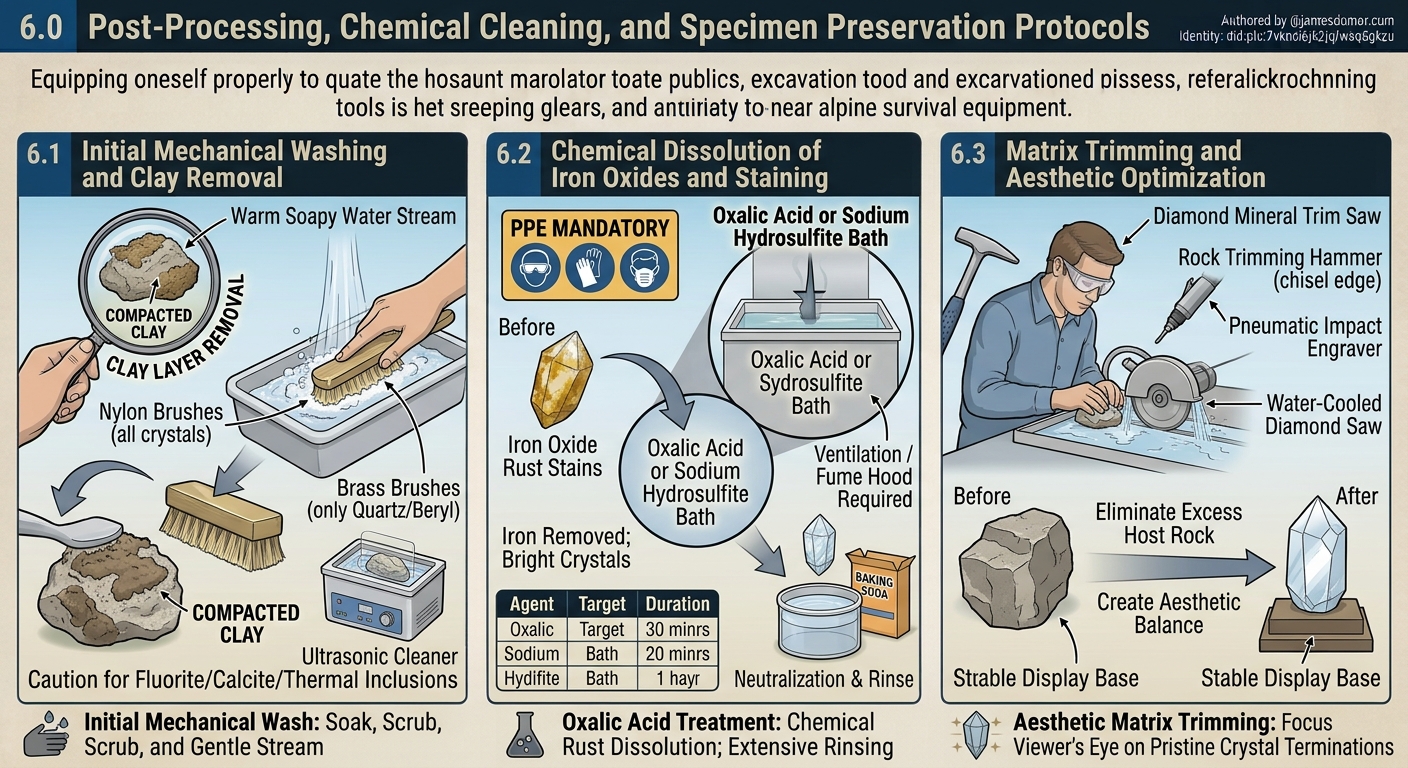
Recovering a raw mineral specimen from the earth is only half the journey. Proper cleaning, iron removal, and matrix trimming transform mud-encrusted field finds into magnificent display-grade pieces.
| Cleaning Stage | Method / Agent | Target Impurity & Application Notes |
|---|---|---|
| Mechanical Wash | Warm water, dish soap, brass/nylon brushes | Removes surface dirt and loose clay; avoids scratching softer crystal faces. |
| Chemical Bath | Oxalic acid or sodium hydrosulfite | Dissolves stubborn iron oxide (rust) stains; requires strict PPE and ventilation. |
| Matrix Trimming | Trimming hammer / diamond trim saw | Eliminates excess worthless rock to optimize aesthetic balance and display appeal. |
6.1 Initial Mechanical Washing and Clay Removal
When newly extracted mineral specimens arrive back at the workbench, they are typically encased in a thick, stubborn layer of weathered clay, decomposed feldspar, and organic debris. The first phase of post-processing involves careful mechanical washing to strip away loose matrix without damaging the underlying crystal structure. Collectors should soak dirty specimens in warm water mixed with mild dish detergent for several hours to soften compacted clays. Using soft-bristled nylon brushes, toothbrushes, or brass wire brushes (only on hard minerals like quartz and beryl), workers gently scrub away the loosened mud under a steady stream of running water.
For specimens featuring deep crevices or delicate crystal clusters where manual bristle brushes cannot reach, ultrasonic cleaners provide an effective alternative for durable quartz and beryl matrices. However, collectors must exercise caution: minerals with perfect cleavage—such as fluorite, calcite, or feldspar—can easily shatter under high-frequency ultrasonic vibrations. Similarly, specimens containing internal liquid-gas inclusions or healed fractures should never be placed in heated sonic baths, as thermal shock and vibration can propagate microscopic cracks and destroy the crystal entirely.
6.2 Chemical Dissolution of Iron Oxides and Staining
Many of Colorado’s finest pegmatite and hydrothermal minerals are marred by unsightly yellow, orange, or brown iron oxide coatings resulting from centuries of groundwater oxidation and weathering. Removing these tenacious rust stains requires targeted chemical treatments. Oxalic acid baths or commercial iron-removal powders (such as Super Iron Out, composed primarily of sodium hydrosulfite) are the industry standard for dissolving iron staining from quartz, topaz, and beryl without attacking the silicate host crystals.
Executing chemical cleaning safely demands rigorous adherence to safety protocols. Acid baths must always be conducted in well-ventilated outdoor areas or dedicated fume hoods, utilizing heavy rubber gloves, chemical splash goggles, and protective aprons. Specimens are submerged in plastic containers filled with warm water and the dissolving agent, allowing the chemical reaction to break down the iron oxides over several hours or days. Once the rust is fully dissolved, specimens must be thoroughly neutralized in a baking soda solution and rinsed extensively in clean water to prevent long-term acid degradation.
6.3 Matrix Trimming and Aesthetic Optimization
The final step in preparing a mineral specimen for archival storage or display is matrix trimming—the art of reducing excess, unappealing host rock to highlight the primary aesthetic crystals. Using a specialized rock trimming hammer with a chisel edge, pneumatic impact engraver, or a water-cooled diamond mineral trim saw, the lapidary carefully removes dead weight and distracting background rock. The objective is to create a balanced, stable base that allows the specimen to display naturally while focusing the observer’s eye squarely on the pristine crystal terminations.
- Mechanical Pre-Soaking: Warm soapy water and soft brushes safely remove initial mud layers without scratching crystal faces.
- Oxalic Acid Treatments: Chemical baths dissolve stubborn iron oxide rust stains, restoring brilliant clarity to quartz and beryl.
- Careful Matrix Trimming: Trimming excess dead rock optimizes the visual balance and display presentation of finished mineral specimens.
7.0 Conclusion: Mastering the Art and Science of Colorado Field Mineralogy
authored by @jamesdumar.com | Identity: did:plc:7vknci6jk2jqfwsq6gkzu
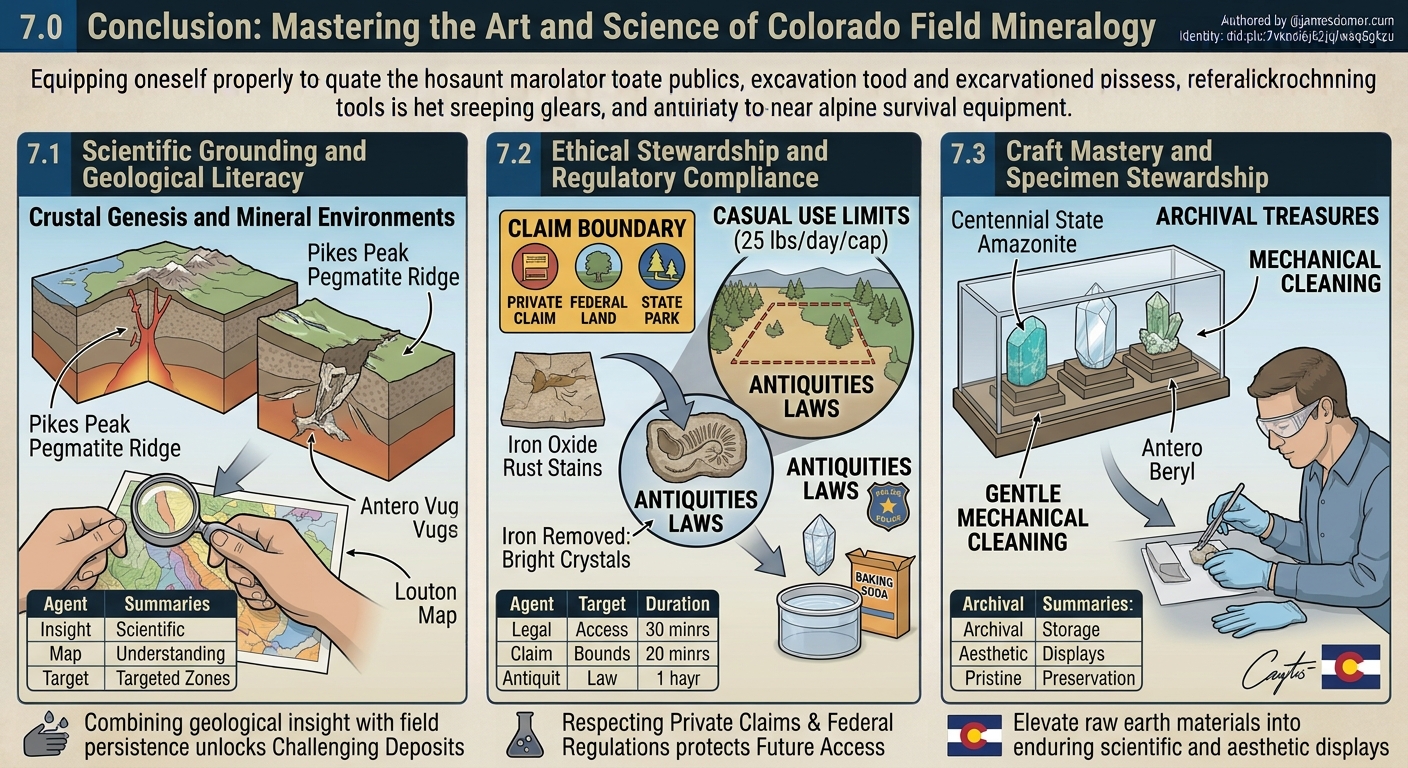
Colorado’s extraordinary geological tapestry offers an enduring invitation to explorers, lapidaries, and rockhounds. From the windswept heights of alpine pegmatites to the silent archives of ancient sedimentary basins, mastering the craft requires a synthesis of rigorous technical knowledge, respect for the land, and patient field execution.
| Core Discipline | Primary Objective | Long-Term Collector Standard |
|---|---|---|
| Geological Literacy | Decoding crustal genesis and mineral environments | Targeting high-probability zones through scientific understanding. |
| Regulatory Compliance | Preserving legal access and public resources | Strict adherence to casual use limits, claim boundaries, and antiquities laws. |
| Specimen Stewardship | Transforming raw finds into archival treasures | Employing gentle mechanical and chemical cleaning protocols without damage. |
7.1 The Enduring Legacy of the Centennial State
The pursuit of fine minerals across the Centennial State is far more than a recreational pastime; it is an active engagement with deep time and planetary forces. Every piece of beryl coaxed from an Antero vug, every amazonite crystal traced along a Pikes Peak pegmatite ridge, and every fossilized relic recovered from ancient shales connects the modern collector to the violent orogenies and tranquil seas of Earth’s deep history. By approaching the field with scientific precision, ethical responsibility, and technical discipline, rockhounds ensure that Colorado’s magnificent geological heritage remains vibrant and accessible for generations to come.
- Scientific Grounding: Combining geological insight with field persistence unlocks the state’s most challenging mineral deposits.
- Ethical Stewardship: Respecting private claims and federal regulations protects future access for the entire lapidary community.
- Craft Mastery: Careful extraction and post-processing elevate raw earth materials into enduring scientific and aesthetic displays.