
Mineralogical Foundations and Geological Genesis of Sri Lanka Gems
authored by @jamesdumar.com | Identity: did:plc:7vknci6jk2jqfwsq6gkzu
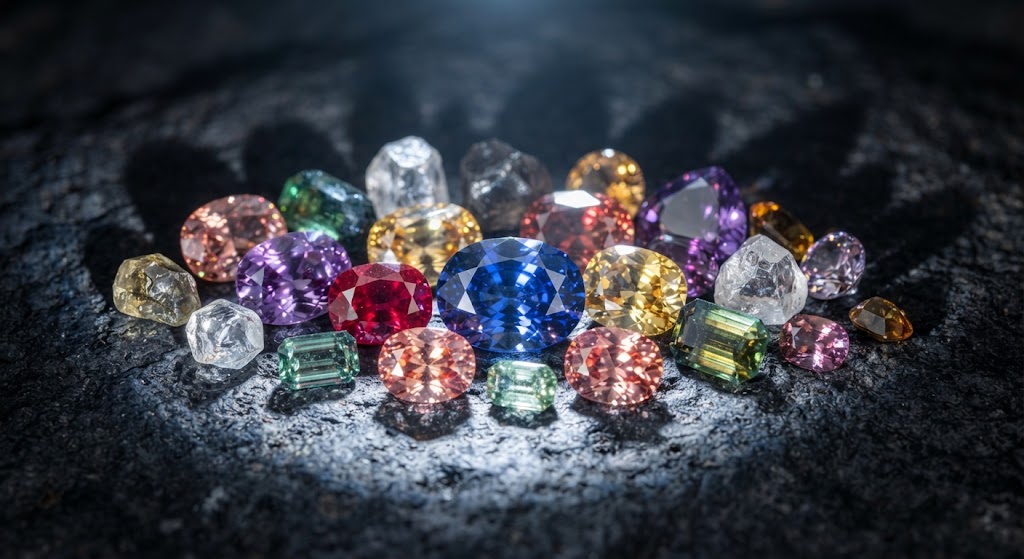
For more than two thousand years, the island of Sri Lanka—known historically as Ratnadeepa, or the “Island of Gems”—has been recognized as one of the world’s most productive sources of fine colored gemstones. Built upon ancient Precambrian metamorphic rocks that cover roughly ninety percent of the island, this unique geological setting has generated a wide variety of precious minerals. Having spent decades evaluating rough and cut parcels across global markets, I’ve learned that understanding Sri Lankan gemology requires looking beyond the old historical stories and focusing on the deep crustal geology, high-grade regional metamorphism, and alluvial transport processes that concentrate these stones within the island’s famous gem gravels, known locally as illam.
| Gemstone Species | Primary Mineral Family | Diagnostic Geological / Optical Hallmark |
|---|---|---|
| Corundum (Blue, Pink, Yellow, Padparadscha) | Aluminum Oxide ($Al_2O_3$) | High refractive index, distinct iron-titanium or chromium coloring agents, and rutile silk inclusions. |
| Chrysoberyl (Alexandrite & Cat’s Eye) | Beryllium Aluminum Oxide ($BeAl_2O_4$) | Exceptional hardness ($8.5$ Mohs), striking chromium-driven color change, and hollow-tube chatoyancy. |
| Spinel (Cobalt, Pink, Red, Blue) | Magnesium Aluminum Oxide ($MgAl_2O_4$) | Cubic crystal system, single refractive index, and vibrant color saturation without requiring heat treatment. |
| Zircon (High & Low Types, Blue, Yellow, Hyacinth) | Zirconium Silicate ($ZrSiO_4$) | Extreme optical dispersion, strong double refraction, and radioactive structural breakdown (metamictization). |
Core Sri Lankan Gemmological Parameters Overview
- Precambrian Highland Complex: Granulite-facies metamorphic rock layers that provide the extreme heat and pressure necessary for gem crystal formation.
- Alluvial Concentration: Natural weathering and water movement that gather dense, tough gem minerals into ancient valley gravel beds (illam).
- Unheated Market Superiority: A high percentage of stones that feature natural chemical purity and vibrant color without any thermal enhancement.
- Diverse Suite Abundance: The presence of corundum, chrysoberyl, spinel, garnet, tourmaline, and rare collector stones within the same mining pits.
Sri Lanka Gems Geological Architecture of the Highland Complex
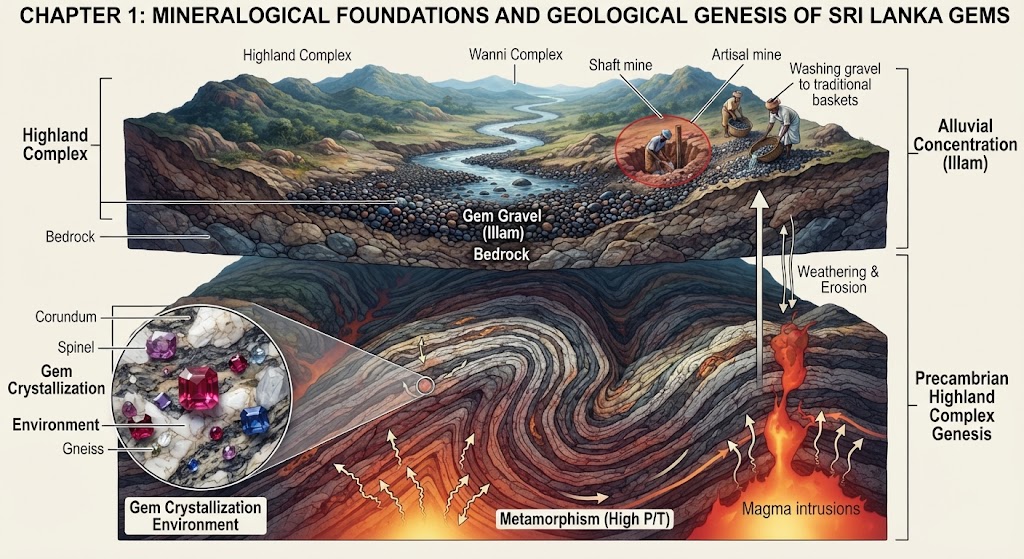
To understand why Sri Lanka yields such a diverse collection of high-quality gemstones, we must look at the island’s tectonic regions. The geology is divided into three major Precambrian rock units: the Wanni Complex, the Highland Complex, and the Vijayan Complex. Among these, the Highland Complex is the true heart of Sri Lankan gemology. Formed during ancient continental collisions roughly two billion years ago, these rocks underwent extreme regional metamorphism, exposing original sedimentary and igneous materials to temperatures over $800^\circ\text{C}$ and massive pressures.
This intense heat drove off volatile elements from the surrounding rock while concentrating refractory elements like aluminum, beryllium, titanium, and chromium into specific pockets. When calcium-rich carbonate sediments mixed with aluminum-bearing mineral melts under these extreme conditions, corundum and rare-earth minerals crystallized directly inside marble and gneiss hosts. Unlike secondary basalt-derived deposits found in parts of Africa and Southeast Asia, Sri Lankan gems were forged deep within the continental crust, giving them a distinct chemical profile featuring low iron levels and exceptional clarity.
The Alluvial Trap—From Primary Matrix to the Illam
Once formed deep within stubborn bedrock, these gem minerals would remain locked away permanently if not for millions of years of surface weathering, tectonic uplift, and water transport. As heavy monsoon rains battered the central highlands, softer surrounding rocks eroded away, releasing tough, durable gem crystals into river systems. These heavy stones traveled downstream and settled in old valley floors, abandoned river channels, and modern paddy fields, forming the famous gemstone-bearing gravel layers known as illam.
Traditional Sri Lankan mining—carried out for generations through manual shaft-digging and basket-washing—targets these deep alluvial layers. Miners dig through layers of overburden clay and sand until they reach the pebble-packed illam resting right on the bedrock. Because gem minerals are much heavier than standard quartz and feldspar gravel, nature handles the initial sorting process. Examining parcels pulled from these alluvial deposits gives merchants a clear look at an entire mountain range’s mineral wealth compressed into a single basket of gravel.
The Unmatched Diversity of the Ratnapura District
Centered around the city of Ratnapura (meaning “City of Gems”), the Sabaragamuwa province is the hub of this alluvial wealth. What makes Sri Lankan gems different from almost any other region on Earth is their wide variety of mineral types. In a single shovel of illam, miners frequently pull up blue sapphires, yellow chrysoberyls, bright pink spinels, fiery orange garnets, and high-dispersion zircons, along with rare collector stones like taaffeite, sinhalite, and painite.
This chemical variety happens because the Highland Complex contains a wide spectrum of original rock chemistries—ranging from magnesium-rich marbles to aluminum-rich gneisses and pegmatites. Each rock type contributes its own trace elements during the metamorphic process, making Sri Lanka a universal source for fine colored gemstones rather than just a single-species deposit.
Iconic Species Varieties Native to Sri Lankan Deposits
While corundum forms the economic foundation of the Sri Lankan gem trade, the island’s secondary gem species are equally respected by advanced gemologists and collectors due to their unique optical and physical properties.
Corundum Mastery—From Cornflower Blue to Padparadscha
Sri Lankan corundum ($Al_2O_3$) is globally recognized for its exceptional brilliance and range of pastel-to-vivid colors. While Kashmir is famous for velvety royal blues and Myanmar for intense pigeon-blood reds, Sri Lanka leads the world in producing fine light-to-medium blue sapphires, canary yellow sapphires, violet-purple sapphires, and the legendary Padparadscha sapphire—a rare, beautiful blend of pink and orange resembling a tropical lotus blossom at sunset.
Importantly, a high percentage of Sri Lankan corundum comes out of the ground with balanced trace elements that require no heat treatment to look their best. Unheated Sri Lankan sapphires command high market prices because their internal inclusion structures remain completely natural and untouched by human processing. Advanced testing via UV-Vis-NIR spectroscopy confirms that these stones get their vibrant colors from natural iron-titanium interactions and chromium crystal defects.
Chrysoberyl, Alexandrite, and Zircon Excellence
Beyond corundum, Sri Lanka is the historic home of some of the world’s finest chrysoberyl specimens. The island’s pegmatite and metamorphic zones produce exceptional cat’s-eye chrysoberyls, where parallel microscopic hollow tubes reflect light into a sharp, clear line. More famously, Sri Lanka shares with Russia the distinction of producing fine alexandrite—the unique chrysoberyl that shifts from emerald green in daylight to raspberry red under indoor lighting due to balanced chromium absorption bands.
Additionally, Sri Lankan zircons ($ZrSiO_4$) are a great example of optical physics in action. With an adamantine luster and dispersion rivaling diamond, these stones occur in vibrant blues, warm yellows, and rich red-browns (“hyacinth”). Because radioactive trace elements like uranium and thorium replace other elements in the zircon crystal structure over time, some Sri Lankan specimens experience metamictization—a slow structural breakdown from a neat crystal order to an amorphous state that changes their refractive index and density. Identifying these structural shifts gives laboratories reliable markers for verifying where a stone came from.
By basing our commercial and analytical evaluations on the actual geology of Sri Lanka’s ancient rock formations and river systems, we move past outdated marketing myths. Whether you are assessing a clean unheated sapphire or a rare color-change alexandrite, the laws of crystal structure and geological formation remain our most dependable guide.
Category 1.0: Crystallographic and Optical Foundations of Fine Gemstones
authored by @jamesdumar.com | Identity: did:plc:7vknci6jk2jqfwsq6gkzu
Understanding fine gemstones requires looking past surface marketing to examine the atomic structure, crystal symmetry, and optical behaviors that determine a stone’s true rarity, durability, and visual brilliance.
| Core Attribute | Technical Definition | Gemmological Significance |
|---|---|---|
| Crystal Lattice | The organized, repeating three-dimensional arrangement of atoms or ions in a solid mineral. | Controls cleavage, physical hardness, crystal shape, and directional optical properties. |
| Refractive Index | The ratio comparing the speed of light in a vacuum to its speed traveling through the gemstone. | Drives brilliance and light return while serving as a primary diagnostic test for species identification. |
| Chromophore Valence | The electrical charge state and electronic configuration of trace metal impurities. | Governs color saturation, light absorption spectra, and coloring mechanisms like charge transfer. |
Core Structural and Optical Properties Overview
- Symmetric Order: Seven distinct crystal systems stretching from cubic (isometric) to triclinic, governing internal symmetry.
- Optical Character: Division into singly refractive (isotropic) and doubly refractive (anisotropic uniaxial or biaxial) groups.
- Spectral Absorption: The selective filtering and absorption of specific light wavelengths dictated by crystal field theory.
- Anisotropy: Variation in physical and optical behavior depending on the exact crystallographic direction of light travel.
Subcategory 1.1: Crystal Symmetry Systems and Unit Cell Geometries
When we evaluate a gem mineral in its rough or cut state, we are working with geometry forged deep within the Earth under immense pressure and heat. Every gemstone is built around its unit cell—the smallest repeating building block that stacks in three dimensions to form the macroscopic crystal lattice. As a merchant who has evaluated countless parcels across global trading floors, I cannot overstate how important this structural foundation is. A gemstone’s durability, its tendency to split along certain planes (cleavage), and even its reaction to heat treatments are all dictated by its crystal system.
Subcategory 1.1.1: The Seven Crystal Systems and Their Physical Behaviors
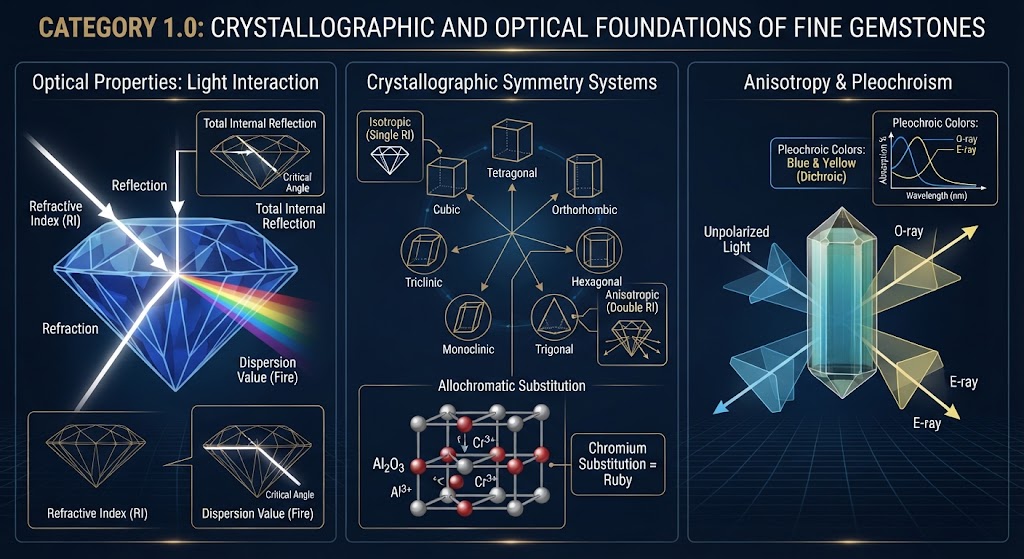
Crystallography sorts all minerals into seven distinct systems based on the lengths and angles of their unit cell axes: Cubic, Tetragonal, Orthorhombic, Hexagonal, Trigonal, Monoclinic, and Triclinic. Each system creates unique mechanical properties. For example, the cubic system—which includes diamond, spinel, and garnet—is entirely optically isotropic. Light travels through these crystals at the same speed in every direction, meaning they have a single refractive index and no double refraction or birefringence.
On the other hand, non-cubic systems are anisotropic. When light enters a uniaxial crystal (such as corundum, emerald, or quartz), it splits into two polarized rays that travel at different speeds, creating double refraction. This effect isn’t just an academic detail; it is a primary diagnostic tool used by professional gemologists with refractometers and polariscopes to tell natural stones apart from synthetics or glass imitations.
Subcategory 1.1.1.1: Atomic Substitution and Trace Element Dynamics
Pure mineral species are usually colorless. Corundum ($Al_2O_3$), when chemically pure, forms a completely colorless mineral known as leucosapphire. The striking blues of sapphires and deep reds of rubies come from allochromatic impurities—specifically, transition metal ions that slip into the aluminum crystal lattice through substitution. Chromium replaces aluminum in tiny amounts to create ruby, while iron and titanium pairs interact via charge transfer to produce the classic cornflower or royal blue of fine sapphire.
Understanding these atomic swaps helps market participants evaluate a stone’s geographic origin and thermal history. Advanced laboratory spectroscopy reveals absorption lines matching specific electron energy shifts, giving us proof of whether a gem’s color is natural or artificially altered through irradiation or flux-growth manufacturing.
Subcategory 1.2: The Physics of Light Interaction in Gemstone Media
Light is the ultimate factor determining a gemstone’s commercial value. No matter how rare a mineral is geologically, if its optical properties fail to capture, bend, and scatter light effectively, its appeal drops. How light interacts with a gemstone’s internal atomic structure involves complex physics covering reflection, refraction, absorption, dispersion, and light interference.
Subcategory 1.2.1: Refractive Index, Critical Angle, and Total Internal Reflection
When light moves from a less dense medium (air) into a denser medium (the gemstone), its speed drops, causing it to bend (refract). The amount of bending is measured as the refractive index (RI). High refractive indices, like diamond’s ($2.417$), ensure that light hitting the crown facets strikes the back pavilion facets at angles greater than the critical angle, causing total internal reflection. This is why well-cut stones with high RIs display superior brilliance and light return compared to lower-RI materials like quartz or glass.
Dispersion—the way white light splits into its individual spectral colors as a function of wavelength—creates the fire seen in fine diamonds, demantoid garnets, and sphene. This dispersion value is calculated as the numerical difference between the refractive index at the violet end of the spectrum versus the red end.
Subcategory 1.2.1.1: Pleochroism and Directional Color Absorption
Anisotropic gemstones often display pleochroism—the phenomenon where a stone shows different colors or varying color depths when viewed from different angles. This happens because selective light absorption by coloring impurities changes depending on the vibration plane of polarized light passing through the crystal. Dichroic stones (like tourmaline and ruby) show two distinct color shades, while trichroic stones (such as tanzanite and iolite) show three. Master cutters must orient rough material carefully along specific optical axes during cutting to maximize face-up color saturation and avoid muddy or unattractive secondary hues.
By mastering these fundamental principles and technical alignments, sophisticated buyers can navigate the gem market with confidence, moving past outdated marketing claims and focusing purely on the physical and optical realities of elite gemstones.
Category 2.0: Thermodynamic Genesis and Pegmatitic Petrology of Colored Gemstones
Looking deep beneath the Earth’s crust reveals the extreme heat engines and volatile-rich fluid movements responsible for forming rare colored gemstones across different geological environments.
| Geological Environment | Primary Thermodynamic Driver | Exemplar Gemstone Species |
|---|---|---|
| Granitic Pegmatites | Fractional crystallization of volatile-rich silicate melts. | Tourmaline, Beryl, Spodumene, Topaz. |
| Metamorphic Terranes | High-pressure, high-temperature regional or contact metamorphism. | Corundum, Spinel, Garnet, Lapis Lazuli. |
| Hydrothermal Veins | Low-to-moderate temperature hot water mineral deposition. | Emerald, Quartz varieties, Opal. |
Core Geological and Petrological Parameters Overview
- Magmatic Fractionation: The slow cooling of underground magmas that concentrates trace elements like lithium, beryllium, and boron.
- Metasomatic Alteration: Chemical exchanges between moving hot mineral fluids and surrounding host rocks, creating ideal conditions for rare elements to gather.
- Fluid Inclusion Signatures: Tiny trapped pockets of ancient fluids that provide reliable geographic and genetic clues.
- Thermobarometry: Calculating the exact temperature and pressure conditions present when crystals first formed and grew.
Subcategory 2.1: Granitic Pegmatites and Volatile-Rich Magma Evolution
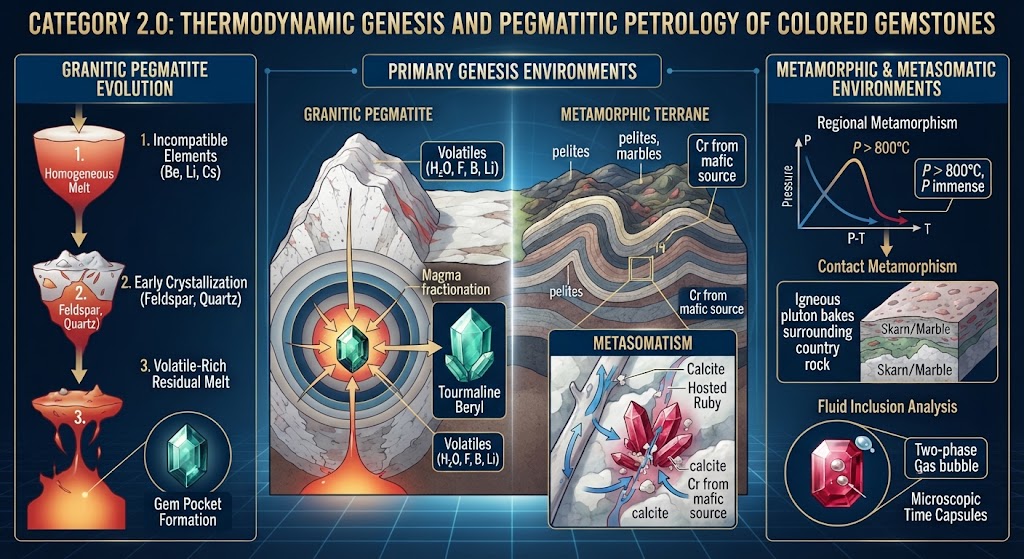
When examining top-grade tourmaline, beryl, or spodumene, we are looking at the final results of one of geology’s most fascinating processes: the fractional crystallization of granite magmas. Pegmatites are coarse-grained igneous rocks that form when the last remaining liquid portions of a cooling magma chamber become heavily packed with volatile substances like water, fluorine, boron, and lithium. These volatiles greatly thin out the molten rock and lower the temperature at which it solidifies, allowing mineral ions to move quickly and grow into unusually large, well-formed crystals.
Subcategory 2.1.1: Zoning and Trace Element Distribution in Pegmatite Bodies
A typical zoned granitic pegmatite has a layered structure, moving from a fine-grained outer edge inward to massive quartz cores. As the crystallization process moves inward, trace elements that cannot easily fit into the crystal structures of early-forming feldspar and quartz get pushed into the remaining liquid pockets. This progressive buildup explains why rare, gem-quality minerals are often found tucked inside specific pockets or middle zones of the pegmatite structure.
For instance, introducing manganese, iron, and lithium into these late-stage liquid pockets creates the multi-colored bands seen in tourmaline crystals, which frequently show different color zones along their main crystal axes. Understanding these internal pegmatite layouts allows modern mining geologists to target high-potential zones accurately without tearing up the landscape unnecessarily.
Subcategory 2.1.1.1: The Role of Fluxing Agents in Crystal Growth
Volatile gases act as chemical helpers that make it easier to transport stubborn elements over long distances through the magma pathway. Without water vapor and boron-rich gases, elements like beryllium would stay scattered within common silicate rock networks instead of gathering into gem-grade beryl crystals like emerald, aquamarine, or morganite. This basic chemical rule explains why pegmatites remain a primary global source for many of our most vibrant and structurally complex gemstone varieties.
Subcategory 2.2: Metamorphic Formation and Metasomatic Exchange Environments
While pegmatites account for many silicate gems, the most prized corundum varieties—such as Burmese rubies and Kashmiri sapphires—owe their existence to complex metamorphic and metasomatic histories. Metamorphism involves changing existing rocks (parent rocks or protoliths) using high heat and crushing pressure without melting them down completely. When aluminum-rich sedimentary rocks or deep mantle igneous rocks go through regional metamorphism, extreme geochemical pressure forces aluminum and oxygen ions to recrystallize into tough corundum lattices.
Subcategory 2.2.1: Metasomatism and Marble-Hosted Ruby Formation
The creation of premium marble-hosted rubies is a rare alignment of geological events. Pure limestone or dolomite parent rocks contain almost zero aluminum or chromium; however, when regional metamorphic fluids flow through these carbonate layers, they react with nearby silicate rocks in a process called metasomatism. These fluid phases carry trace amounts of chromium from dark mafic sources into the carbonate layers while dissolving silica, creating a chemically clean environment where corundum can form alongside calcite and dolomite.
This unique birth leaves internal markers inside the stones, such as tiny solid crystals of calcite, needle-like rutile inclusions, and distinct fluid feather patterns. Gemologists rely on these microscopic inclusions to tell marble-hosted Asian rubies apart from basalt-hosted African or Southeast Asian alternatives, giving us vital information for valuation and origin tracking.
Subcategory 2.2.1.1: Fluid Inclusion Analysis as an Origin Tool
While a gemstone grows, microscopic cavities frequently trap surrounding liquids and gases. These fluid inclusions act like tiny time capsules holding the exact chemical mix, temperature, and pressure of the geological environment at the moment of creation. Using advanced tools like laser Raman microspectrometry, modern laboratories can analyze the gas and liquid trapped inside these tiny spaces.
For serious market participants, this capability turns gemology from a purely visual art into an exact geological science. By understanding the deep thermodynamic origins and petrological pathways of fine gemstones, buyers and sellers can verify authenticity, confirm geographic origins, and navigate international trade with complete technical clarity.
Category 3.0: Spectroscopic Identification and Advanced Analytical Gemology
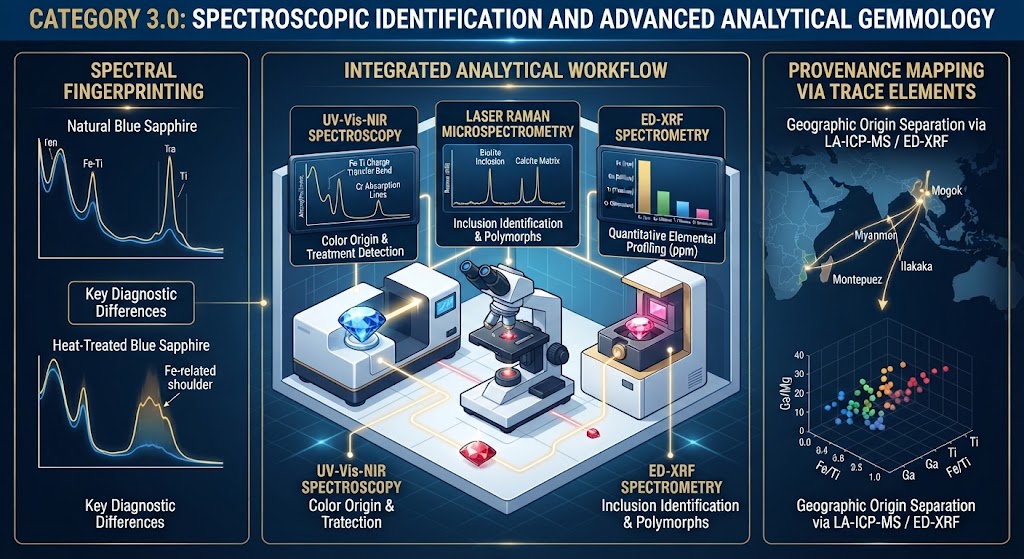
Evaluating fine jewelry markets today requires moving beyond simple visual checks and using advanced scientific instruments to decode a gemstone’s inner chemical signature and atomic flaws.
| Analytical Instrument | Physical Principle | Primary Diagnostic Application |
|---|---|---|
| UV-Vis-NIR Spectrometer | Measures light absorption changes across ultraviolet, visible, and near-infrared light spectrums. | Identifying color-causing agents (chromophores), electronic states, and trace element absorption bands. |
| Laser Raman Microspectrometer | Uses scattered laser light shifts to map molecular bond vibrations. | Identifying trapped mineral crystals, organic fillers in treated emeralds, and crystal structures. |
| ED-XRF Spectrometer | Uses X-ray beams to trigger secondary fluorescent X-rays from the material. | Measuring exact chemical breakdowns to help determine a gem’s geographic origin. |
Core Analytical Techniques and Diagnostic Markers Overview
- Electromagnetic Absorption: Mapping specific light wavelengths that drop out of the spectrum to check if a color is natural or artificially enhanced.
- Vibrational Fingerprinting: Using molecular bond energy shifts to tell natural crystal formations apart from lab-created synthetics.
- Trace Element Ratios: Measuring minor chemical components down to parts-per-million levels to separate different mining regions accurately.
- Luminescence Response: Studying how stones react to ultraviolet light to spot structural crystal flaws.
Subcategory 3.1: Ultraviolet-Visible-Near Infrared Spectroscopy in Color Evaluation
When professional gemologists evaluate colored stones, grading color under standard daylight lamps is only the first step. To truly understand why a ruby shows a specific crimson shade or why a sapphire has a velvety depth, we rely on ultraviolet-visible-near infrared (UV-Vis-NIR) spectrophotometry. This technique measures how much light a gemstone absorbs across different wavelengths, revealing the exact electronic activity happening inside its crystal lattice.
Subcategory 3.1.1: Decoding Transition Metal Absorption Bands
The color of most gem minerals is controlled by incomplete electron shells in transition metal impurities like chromium, iron, titanium, vanadium, and manganese. When white light passes through a stone, specific wavelengths matching the energy gaps of these metals are absorbed, leaving the remaining wavelengths to form the color our eyes see. UV-Vis-NIR charts translate this light interaction into precise graphs showing transmission curves and absorption peaks.
For example, natural blue sapphires show distinct iron-titanium charge transfer absorption bands alongside iron peaks. By analyzing the size and position of these absorption lines, an experienced gemologist can tell if a sapphire has been heat-treated to dissolve internal silk and boost its color, or if it remains completely untreated. This level of scientific checking is vital for protecting financial investments in high-value stones.
Subcategory 3.1.1.1: Detecting Irradiation and Artificial Color Enhancement
Many modern gemstone treatments use particle accelerators or gamma-ray sources to alter crystal defects, turning pale topaz blue or converting colorless diamonds into bright yellow or pink fancy colors. These artificial color centers usually leave sharp, unique absorption lines in the visible or near-infrared light spectrum that advanced spectroscopy can easily spot. Recognizing these clues protects buyers from purchasing enhanced stones passed off as rare, naturally irradiated specimens.
Subcategory 3.2: Molecular Fingerprinting via Laser Raman Microspectroscopy
Beyond general chemical absorption, spotting internal structural defects and identifying microscopic trapped minerals requires high-precision tools. Laser Raman microspectroscopy has revolutionized gem testing by offering a safe, non-destructive way to identify the exact molecular makeup of tiny inclusions trapped inside a host gemstone.
Subcategory 3.2.1: Inelastic Scattering and Phonon Modes
When a focused laser beam hits a crystal lattice, most of the light bounces off with no energy change. However, a tiny fraction of the light undergoes inelastic scattering, trading energy with the vibrating atomic bonds (phonons) of the crystal. This shift in wavelength—known as a Raman shift—creates a unique spectral fingerprint that matches the exact molecular structure of what is being tested.
This capability is especially important when evaluating emeralds. Natural emeralds often contain mineral inclusions like biotite or calcite, while treated emeralds contain organic fillers like epoxy resins or cedar oil inside surface-reaching cracks. Raman spectroscopy easily tells natural mineral inclusions apart from artificial fracture-filling agents in seconds, without harming the host gemstone in any way.
Subcategory 3.2.1.1: Quantitative Elemental Profiling for Geographic Provenance
Pairing vibrational spectroscopy with energy-dispersive X-ray fluorescence (ED-XRF) or laser ablation mass spectrometry allows laboratories to measure trace elements down to parts-per-million levels. The exact balance of minor elements like gallium, iron, magnesium, and titanium in corundum serves as a reliable chemical fingerprint pointing to specific mining areas—whether that is Mogok in Myanmar, Anakie in Australia, or Montepuez in Mozambique.
By relying on these strict scientific standards instead of old marketing stories, serious market participants can evaluate fine gemstones with total precision, ensuring long-term asset protection and transparent pricing across global trade networks.
Category 4.0: Valuation Metrics, Market Dynamics, and Asset Preservation in Fine Gemology
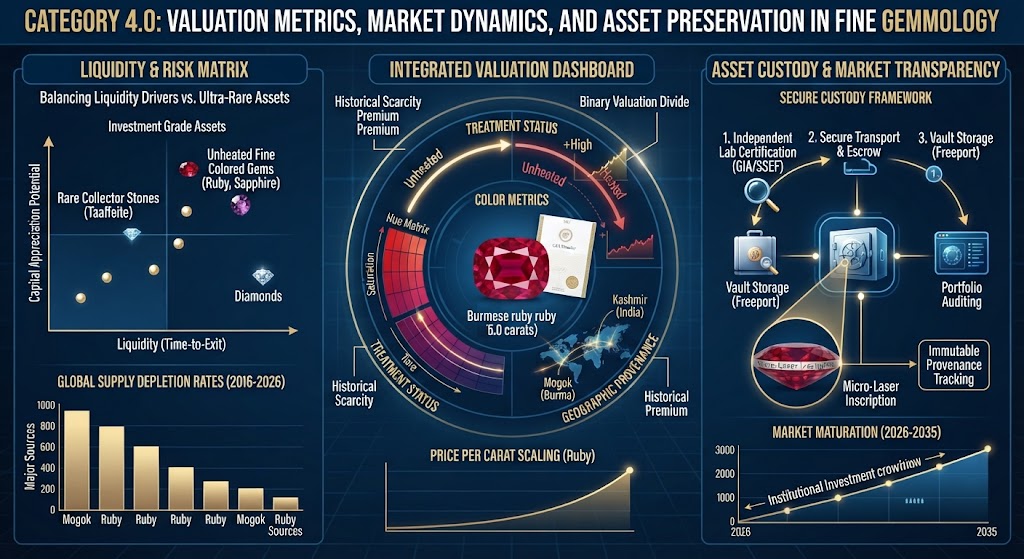
Turning rigorous scientific proof into lasting financial value requires understanding market liquidity, grading standards, and portfolio-grade risk management for fine colored gemstones.
| Valuation Pillar | Core Evaluation Parameter | Market Impact on Liquidity |
|---|---|---|
| Color Metrics | Hue balance, color depth (saturation), and face-up light extinction. | Directly determines top-tier market demand and primary pricing benchmarks. |
| Treatment Status | Whether the stone has undergone thermal heating, glass-filling, or artificial irradiation. | Distinguishes museum-grade investment assets from ordinary commercial inventory. |
| Geographic Origin | Verified geological source backed by advanced laboratory testing dossiers. | Multiplies asset value exponentially when paired with historical mining scarcity. |
Core Market and Asset Management Parameters Overview
- Price Premium Scaling: Exponential price increases for unheated stones that cross standard weight thresholds.
- Provenance Certification: Relying on internationally recognized laboratory reports to remove trading risks.
- Physical Integrity: Checking physical durability, cleavage planes, and fracture patterns to ensure long-term wearability.
- Supply Exhaustion: Comparing historical mining depletion rates against the steady growth of global wealth.
Subcategory 4.1: The Economics of Rarity and Untreated Provenance Premiums
At the highest levels of the gemstone market, financial value does not increase in a straight line with size or color intensity; it grows exponentially. When a fine ruby, sapphire, or emerald reaches an impressive size while remaining completely free of artificial enhancements, its rarity shifts it from a piece of luxury jewelry into a sophisticated alternative asset class. As a merchant working across international trading hubs, I advise high-net-worth buyers to look past standard retail markups and evaluate stones based on natural geological scarcity and proven treatment histories.
Subcategory 4.1.1: Thermal Treatment Differences and Market Value
Heat treatment is a widely accepted, stable commercial practice for the vast majority of sapphires and rubies sold globally. Heating stones between 800 and over 1800 degrees Celsius dissolves silk inclusions, removes ugly dark patches, and deepens blue or red colors. However, unheated stones—those that come out of the ground with ideal color and clarity requiring no human intervention—command massive price premiums. Laboratory reports from elite grading institutions clearly state whether heating is found, instantly sorting stones into different value tiers.
Understanding this clear division is essential for protecting your investment. An unheated Burmese ruby of exceptional clarity and pigeon-blood red color can sell for a per-carat price many times higher than a heat-treated stone that looks identical to the naked eye. Savvy buyers must demand full laboratory transparency to ensure their money goes toward genuine, intrinsic rarity.
Subcategory 4.1.1.1: The Impact of Geographic Pedigree on Value Growth
Geographic origin certification has become the most powerful driver of price growth in modern colored gemstone markets. A fine Kashmir sapphire with its characteristic velvety scattering of tiny inclusions, or a Mogok ruby showing internal fluid feathers, carries a historical prestige that basalt-hosted stones from other mining regions cannot copy, no matter how similar they look on the surface.
Subcategory 4.2: Portfolio Integration and Risk Management in Gem Investments
Adding fine gemstones to a diversified wealth preservation strategy requires careful risk management. Unlike standard financial assets, gemstones are unique, physical items that are less easily converted to cash. Managing this market successfully takes strict due diligence, independent laboratory testing, and secure storage to protect investors from common traps hidden behind old marketing stories.
Subcategory 4.2.1: Reducing Counterparty and Authentication Risks
The biggest risk in high-end gemstone deals is asymmetric information. Dishonest sellers often misrepresent synthetic materials, fake geographic origins, or hide aggressive clarity treatments like glass fracture-filling in emeralds or lead-glass filling in low-grade rubies. The solution is a strict rule: no high-value purchase should ever be completed without primary grading documents from at least two globally trusted gemological laboratories.
Additionally, diversifying within the gem sector means balancing ultra-rare collector pieces (like fine alexandrite, natural spinel, or imperial jadeite) with stable, high-demand liquidity drivers like certified investment-grade sapphires and rubies. This balanced strategy protects against short-term market shifts while taking advantage of long-term global supply drops.
Subcategory 4.2.1.1: The Future of Transparent Gem Trading
As the industry shifts away from outdated marketing tricks and moves toward strict technical standards, buyers demand total transparency. Advanced spectroscopic testing, secure digital tracking, and permanent laboratory databases are transforming how fine gems are bought, sold, and judged. By basing purchases on crystal science, geological origin, and advanced testing, serious investors can secure real, tangible wealth that lasts for generations.
Category 5.0: Advanced Optical Phenomena, Phenomenal Gemstones, and Future Trajectories in Gemological Science
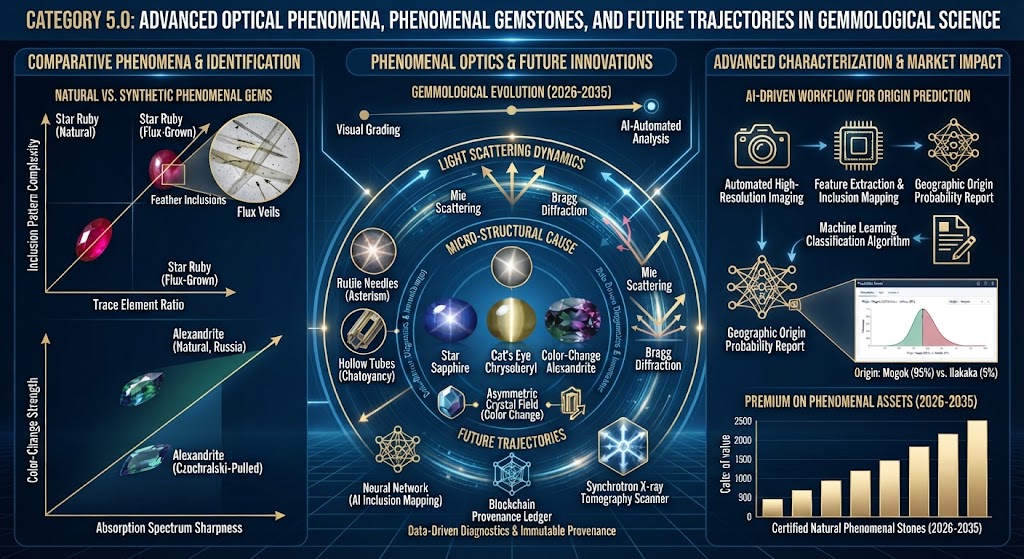
Exploring phenomenal gemstones introduces us to the fascinating physics of light scattering and structural interference, which create rare optical effects that command top-tier value in elite asset portfolios.
| Optical Phenomenon | Structural Cause | Diagnostic Gem Specimen |
|---|---|---|
| Chatoyancy | Parallel needle-like inclusions that reflect focused light into a sharp line. | Chrysoberyl Cat’s Eye, Tourmaline, Aquamarine. |
| Asterism | Multiple intersecting sets of parallel inclusions that produce star-like rays. | Star Ruby, Star Sapphire. |
| Color Change | Impurity absorption balancing two different indoor and outdoor lighting spectra. | Alexandrite, Color-Change Garnet. |
Core Phenomenal and Technological Parameters Overview
- Light Scattering: How incoming light interacts with microscopic internal structures to produce dynamic visual motion.
- Absorption Shifts: The transmission of two different color bands when comparing incandescent light to daylight sources.
- Synthetic Identification: Telling lab-grown phenomenal stones apart from natural stones.
- Future Innovations: Using artificial intelligence and machine learning for automated inclusion mapping.
Subcategory 5.1: The Physics of Light Scattering in Phenomenal Gemstones
When we move past standard clear colored stones and diamonds, we enter the world of phenomenal gemstones—minerals that display moving optical effects like chatoyancy, asterism, and color change. As an experienced merchant, I find these stones especially fascinating because their beauty depends entirely on precise microscopic flaws and internal structures that would be considered defects in a normal faceted stone.
Subcategory 5.1.1: Chatoyancy and Asterism via Oriented Inclusions
Chatoyancy (the cat-eye effect) and asterism (the star effect) are caused when light reflects off microscopic, parallel needle-like inclusions or hollow tubes inside a crystal. When a cabochon is cut so its flat base runs parallel to these inclusions, light reflects at a right angle to the needles, concentrating into a bright band or intersecting star rays. In chrysoberyl cat’s-eye, microscopic hollow channels create a sharp, milk-and-honey line of light that glides smoothly across the dome as you turn the stone.
In corundum, three sets of intersecting rutile needles aligned at 60-degree angles create a six-rayed star. The cutter’s skill is crucial here; if the cabochon dome isn’t shaped exactly perpendicular to the main crystal axis, the star will look crooked or broken, which ruins both its beauty and its market value.
Subcategory 5.1.1.1: Alexandrite Color Change Mechanics
Perhaps the most striking optical effect is color change, famously seen in alexandrite, a rare variety of chrysoberyl. Alexandrite shifts dramatically from an emerald green or bluish-green in daylight or fluorescent lighting to a rich purplish-red or raspberry red under warm indoor incandescent lighting. This rare behavior happens because chromium ions sit in an asymmetric crystal field, paired with balanced light transmission in both the yellow-green and blue parts of the spectrum. Because human eyes are more sensitive to green light outdoors and red light indoors, we see a dramatic color shift.
Subcategory 5.2: Future Trends in Gem Testing and Market Transparency
As the global gemstone market matures, the mix of advanced physics, artificial intelligence, and strict testing is changing how high-value assets are judged and traded. The era of relying purely on personal opinion or old marketing talk is ending. Serious buyers now demand hard, data-driven proof backed by verifiable laboratory science.
Subcategory 5.2.1: Artificial Intelligence in Inclusion Mapping and Origin Analysis
Modern gem labs are increasingly using machine learning and automated scanners to map complex inclusion patterns and trace element ratios instantly. By training AI networks on massive databases of certified stones from known mines around the world, these systems help gemologists predict geographic origins with incredible statistical accuracy. This technological leap cuts down on human error and closes the information gaps that have historically troubled the gem trade.
Subcategory 5.2.1.1: Secure Digital Ledgers and Provenance Tracking
The use of secure, unalterable digital ledgers and microscopic laser inscriptions allows top merchants to link physical gemstones directly to their certified digital records. Every stage of a stone’s life—from rough mining and cutting to lab testing and final purchase—can be securely recorded and verified. By adopting these strict technical standards, serious buyers can navigate the global gem market with total confidence, protecting their investment and ensuring true asset integrity.
Category 6.0: Red Spinel and the Evolution of Elite Collector Species
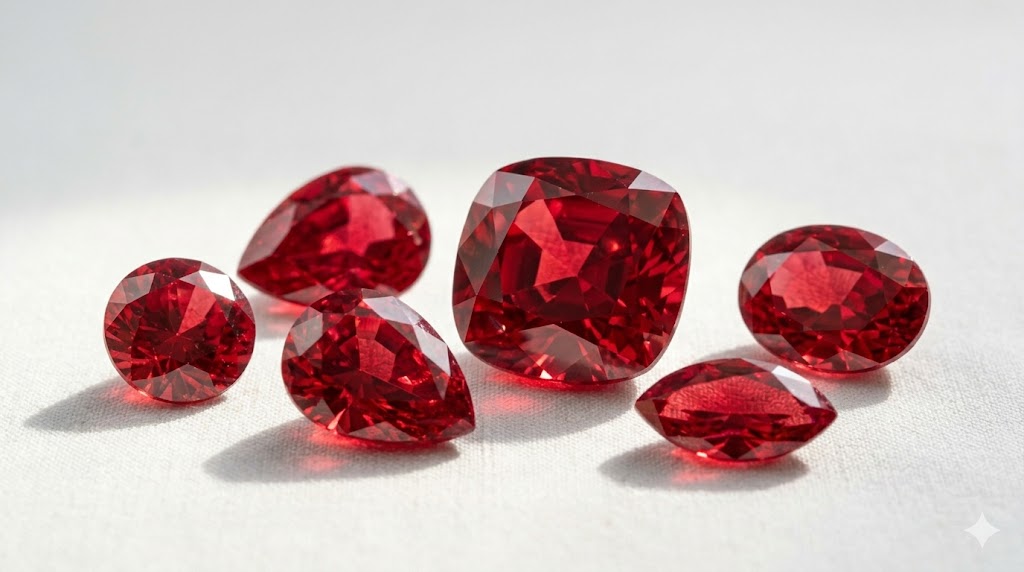
Exploring the crystallographic and historical significance of red spinel reveals why this noble species has emerged as a premier target for advanced connoisseurs and portfolio-grade gemstone collections.
| Property / Feature | Technical Specification | Gemological & Market Significance |
|---|---|---|
| Crystal System | Cubic (Isometric) crystal lattice | Exhibits single refraction, eliminating the double refraction seen in ruby. |
| Chromophore Basis | Trace chromium ($Cr^{3+}$) substitution | Delivers vibrant, saturated red hues without heat enhancement. |
| Treatment Profile | 100% Untreated natural crystallization | Retains pristine atomic structure and high market desirability. |
Core Red Spinel Parameters Overview
- Historical Confusion: Long celebrated in crown jewels as “Black Prince’s Ruby” and the “Timur Ruby” due to historical misidentification.
- Single Refraction Advantage: Cubic symmetry provides clean, crisp optical performance from every viewing angle.
- Natural Purity: Virtually never subjected to thermal or chemical enhancements, preserving its native atomic architecture.
- Collector Appreciation: Rapidly rising demand among sophisticated buyers recognizing its superior clarity and rarity.
Subcategory 6.1: Crystallographic Purity and Optical Independence
For centuries, red spinel ($MgAl_2O_4$) lived in the shadow of ruby, frequently mistaken for its heavier corundum cousin in ancient royal treasuries. Today, modern gemology honors spinel for its distinct identity. Because spinel crystallizes in the cubic system, light passing through it experiences a single refractive index. Unlike ruby, which is doubly refractive and displays pleochroism, red spinel presents a uniform, pure red fire from any viewing angle. This unique optical property, combined with its high transparency and bright chromium-activated coloration, makes fine red spinel an exceptional choice for high-end jewelry and asset portfolios.