
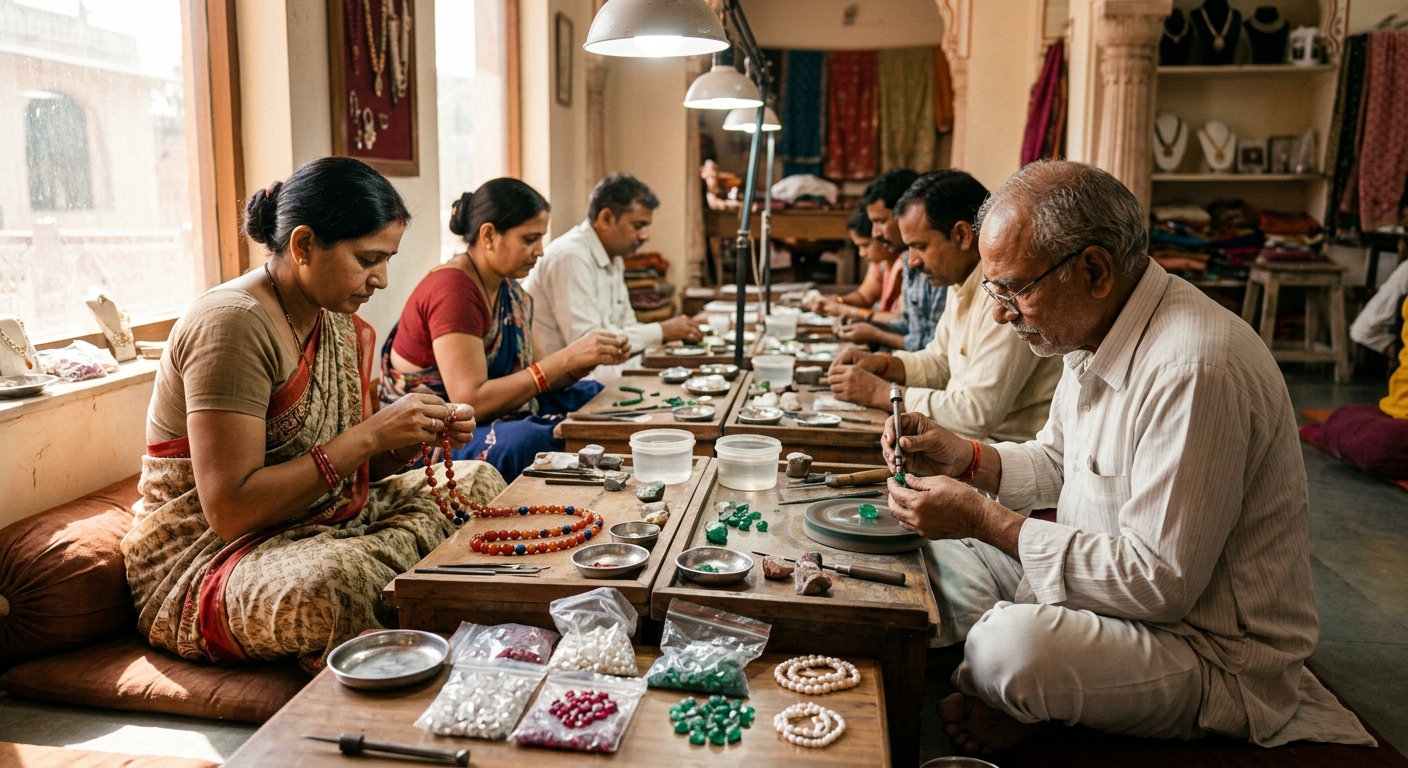
1.0 India Gem Stone Origins Historical Context
authored by @jamesdumar.com | Identity: did:plc:7vknci6jk2jqfwsq6gkzu
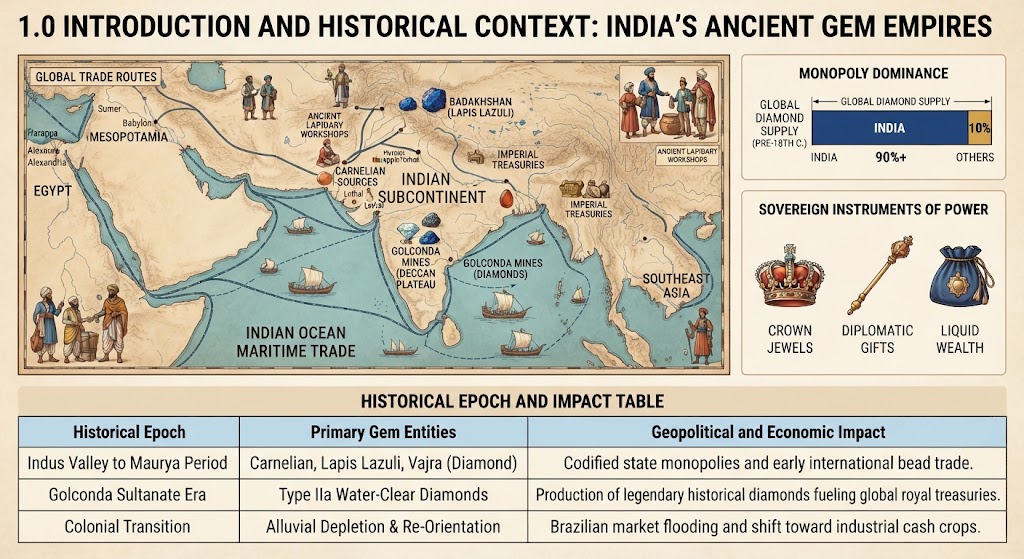
For thousands of years, India stood at the very heart of the international gem trade, holding unmatched mineral wealth that built and sustained the great imperial treasuries through brilliant statecraft.
| Historical Epoch | Primary Gem Entities | Geopolitical and Economic Impact |
|---|---|---|
| Indus Valley to Maurya Period | Carnelian, Lapis Lazuli, Vajra (Diamond) | Established state-controlled monopolies and early global bead trading networks. |
| Golconda Sultanate Era | Type IIa Water-Clear Diamonds | Yielded legendary historical diamonds that filled the treasuries of global royalty. |
| Colonial Transition | Alluvial Depletion & Re-Orientation | Disrupted by South American market floods and a shift to industrial cash crops. |
- Monopoly Dominance: Served as the exclusive worldwide source for ultra-high-clarity rough diamonds for centuries.
- Treasury Anchors: Valued gemstones not just as adornments, but as sovereign tools of diplomacy and liquid wealth.
- Structural Evolution: Shifted over time from centralized imperial patronage down to localized artisanal extraction.
1.1 The Antiquity of Indian Gemstones and Classical Documentation
The story of Indian gemology goes back far beyond medieval chronicles or colonial surveys, reaching deep into the roots of the Indus Valley Civilization between 3300 and 1300 BCE. Ancient urban centers like Harappa, Mohenjo-daro, and the port city of Lothal featured remarkably advanced lapidary workshops. Artisans of the era used specialized micro-drills, quartz abrasives, and string-saws to shape carnelian, lapis lazuli, turquoise, and chalcedony into intricate beadwork. These pieces weren’t just for local wear—they traveled along ancient trade routes all the way to Mesopotamia, Sumeria, and ancient Egypt, establishing India as an early powerhouse of international mineral commerce.
As the region transitioned from the Vedic era into the Classical period, this hands-on mineral knowledge was written down into formal scientific texts and manuals of statecraft. The finest example of this is the *Arthashastra*, an exhaustive guide to economics and administration written by Chanakya, chief minister to Maurya Emperor Chandragupta around the fourth century BCE. This monumental work laid out dedicated government offices for mineral management, including the Superintendent of Mines (*Akaradhyaksha*) and the Superintendent of Diamonds (*Khanyadhyaksha*). These officials oversaw prospecting, managed state-run mining operations, and enforced strict quality standards.
The *Arthashastra* carefully categorized precious stones by their optical traits, flaws, densities, market values, and geographic origins. Chanakya classified essential species like diamond (*vajra*), ruby (*padmaraga*), emerald (*marakata*), and sapphire (*indranila*), treating them as strategic assets vital for economic stability. This systematic view fostered the tradition of *Ratnapariksha*, the classical Indian science of gem testing. Later expanded in texts like the *Garuda Purana* and Varahamihira’s *Brihat Samhita*, *Ratnapariksha* evaluated stones based on clarity, color saturation, internal inclusions, and brilliance, which dictated both their market value and astrological significance.
1.2 The Golconda Diamond Monarchy and Global Trade Hegemony
From ancient times until the early 18th century, India held an absolute monopoly over the global diamond market. These stones weren’t pulled from deep volcanic shafts, but rather gathered from secondary gravel deposits, ancient river channels, and alluvial flats along major southern river systems like the Krishna, Pennar, Godavari, and Tungabhadra. While these mines were scattered across modern-day Andhra Pradesh and Telangana, all rough stones were brought to the heavily fortified citadel of Golconda—the administrative seat of the Qutb Shahi dynasty near Hyderabad—giving rise to the legendary name, Golconda Diamonds.
In modern gemological terms, Golconda diamonds represent the absolute peak of crystalline purity, with most falling into the Type IIa category. These rare stones are entirely free of nitrogen impurities in their carbon crystal lattice, giving them an astonishing, water-clear transparency that allows light to pass through with virtually zero scattering or absorption. This unmatched optical clarity remains the global benchmark for diamond quality today.
The staggering wealth flowing through these markets drew daring European travelers willing to brave grueling multi-year voyages. Among them was the French gem merchant Jean-Baptiste Tavernier, who made six trips to the Mughal Empire between 1636 and 1668. Tavernier’s journals gave Europe its first real look at the massive scale of Indian mining, noting that sites like the Kollur mine regularly employed over 60,000 workers digging through thick alluvial clays with basic hand tools. The immense volume of stones moving through Golconda produced some of history’s most famous and politically charged diamonds:
- The Koh-i-Noor: Starting at over 790 carats in the rough, this legendary gem passed through the Kakatiyas, Khiljis, Mughals, Persians, and Sikhs before being acquired by the British East India Company and cut down to its current 105.6-carat brilliant form as part of the British Crown Jewels.
- The Hope Diamond: A 45.52-carat deep blue marvel known for its rare boron-induced tint, originally unearthed in South Indian deposits before joining French royal collections.
- The Regent Diamond: A 140.64-carat cushion-cut stone found at Kollur in 1698, later mounted on the hilt of Napoleon Bonaparte’s coronation sword.
- The Daria-i-Noor: A stunning pale pink table-cut diamond weighing roughly 182 carats, now kept within the National Jewels of Iran.
1.3 The Decline of Historic Monopolies and Colonial Economic Shifts
India’s absolute dominance over the diamond industry hit a steep decline in the 1720s due to a sudden shift in geology, economics, and geopolitics. In 1725, rich alluvial diamond deposits were discovered in Minas Gerais, Brazil. This South American find flooded world markets with a sudden wave of cheaper rough stones, breaking India’s ancient supply monopoly and driving down global prices.
At the same time, centuries of surface panning and shallow digging across the Deccan plateau had exhausted the most accessible, high-grade alluvial gravels. Reaching deeper, unweathered primary kimberlite sources or cemented conglomerate layers required heavy deep-shaft engineering, continuous pumps, and substantial capital that local fractured rulers and small artisanal syndicates simply didn’t have. This physical exhaustion coincided with the political collapse of the Mughal Empire after the death of Aurangzeb in 1707, bringing decades of war, instability, and invasions that disrupted trade routes and drained the royal treasuries that once funded large-scale mining.
As the British East India Company took administrative control across the subcontinent in the late 18th and early 19th centuries, colonial priorities shifted away from luxury minerals and toward industrial bulk commodities. British policy favored cash crops and raw materials like coal, iron ore, cotton, indigo, and tea to feed the factories of the Industrial Revolution back home. Traditional gemstone mining was largely ignored, stripped of royal backing, restricted by harsh forestry laws, and left to decay into informal scavenging. This long period of neglect laid the groundwork for modern India’s gemstone paradox: a massive downstream processing titan starved of domestic raw material extraction.
2.0 GEOLOGICAL FRAMEWORK AND GEMSTONE METALLOGENY
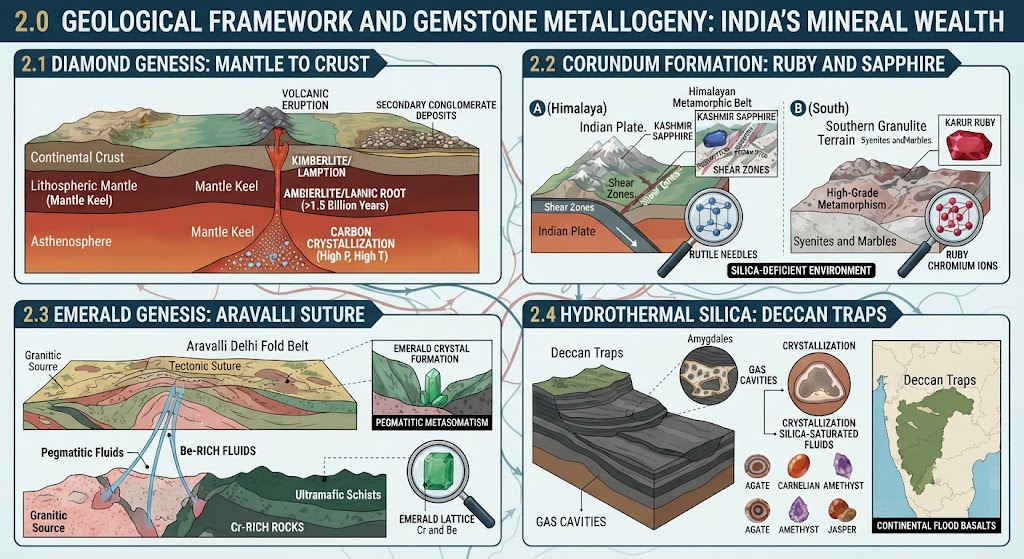
The geological blueprint of the Indian subcontinent unites ancient cratonic anchors, complex metamorphic belts, and massive volcanic fields, establishing the exact thermodynamic conditions needed to forge extraordinary gemstones.
| Geological Province | Target Gemstone Mineral | Primary Petrological Mechanism |
|---|---|---|
| Bundelkhand & Dharwar Cratons | Diamond (Type IIa) | Lamproite and kimberlite volcanic ascent from deep mantle roots. |
| Southern Granulite & Himalayan Belts | Ruby, Sapphire, Chrysoberyl | Silica-deficient high-grade regional metamorphism. |
| Aravalli Delhi Fold Belt | Emerald, Tourmaline, Aquamarine | Pegmatitic fluid metasomatism intersecting ultramafic schists. |
- Cratonic Stability: Ancient continental cores supplying the deep thermal pressure required for carbon crystallization.
- Metasomatic Suture Zones: Intersections of incompatible chemical elements yielding exotic beryl and corundum variations.
- Hydrothermal Vesicles: Basaltic gas cavities acting as natural crucibles for microcrystalline quartz precipitation.
2.1 The Deep Mantle Genesis and Volcanic Ascent of Indian Diamonds
The formation of a natural diamond is a remarkable feat of geodynamic physics, demanding sustained pressures found at depths greater than 150 kilometers beneath the Earth’s crust, alongside stable temperatures ranging from 900 to 1,300 degrees Celsius. Across the Indian subcontinent, these environments were successfully preserved beneath ancient, stable continental blocks known as cratons—specifically the Bundelkhand Craton to the north and the Dharwar Craton to the south. These ancient structural domains feature deep, cool thermal roots called mantle keels that remained undisturbed for over a billion years, functioning as ideal natural refrigerators and chemical crucibles where carbon atoms bonded tightly into the stable cubic crystal lattice of diamond.
Yet, growing a diamond deep in the mantle is only the first step of an extraordinary journey; these dense crystals must be hurled to the surface at high speeds before retrogressive changes or graphitization can ruin them. This rapid ascent was driven by volatile-rich, ultramafic magmas that punched through the thick continental crust as kimberlites and lamproites. In Central India, the Majhgawan pipe stands out as a premier geological marvel. Unlike typical volatile-driven kimberlites, Majhgawan is an olivine lamproite pipe emplaced within the sedimentary layers of the Vindhyan Supergroup roughly 1.1 to 1.2 billion years ago during the Proterozoic. The rising magma picked up xenocrystic diamonds from the deep mantle keel, delivering them into a carrot-shaped volcanic pipe that millions of years of weathering eventually exposed at the surface.
Alongside these primary volcanic pipes, extensive secondary Proterozoic conglomerates—such as the Kurnool Group in the south and the Vindhyan Supergroup in the center—formed massive natural concentration systems. Over hundreds of millions of years, weathering agents stripped away the softer surrounding volcanic rock, washing millions of tons of gravel down ancient river systems. Because diamond crystals are exceptionally durable, they resisted wear and settled into dense gravel layers that eventually hardened into conglomerate rock. It was these secondary sedimentary deposits, rather than the primary volcanic shafts, that yielded the vast majority of India’s legendary historical stones.
2.2 The Metamorphic Alchemy of Corundum: Rubies and Sapphires
While carbon under extreme pressure gives us diamond, the birth of gem-quality corundum—the mineral family encompassing both ruby and sapphire—requires an entirely different, highly specialized chemical environment. Chemically, corundum is simple aluminum oxide. However, creating gem-grade crystals requires conditions rich in aluminum while being virtually free of silica. If silica is present during crystallization, it immediately reacts with available aluminum to form common feldspars or micas, locking up the aluminum and preventing pure corundum from forming. The vibrant colors of these stones come from trace elemental substitutions within the crystal lattice: chromium ions substituting for aluminum produce the vivid reds of true rubies, while paired iron and titanium ions generate the deep blues of classic sapphires.
In India’s geology, these rare, silica-deficient environments appear in two distinct tectonic settings. The first is the Southern Granulite Terrain, an ancient shield area covering parts of Tamil Nadu and Karnataka. Here, ancient pelitic sediments and intrusive pegmatites underwent deep-seated regional metamorphism during ancient mountain-building cycles. Under intense heat and pressure, aluminum-rich clays broke down, releasing free aluminum oxide that recrystallized into corundum within lenses of syenites and marbles, producing the celebrated rubies of Karur.
The second setting is the Himalayan Metamorphic Belt, forged by the monumental collision between the Indian and Eurasian tectonic plates that began around 50 million years ago. This ongoing collision subjected ancient sedimentary layers to extreme pressures and directed fluid flow along major shear zones. High within the remote, rugged cliffs of the Zanskar range in Jammu and Kashmir, these tectonic forces created the world-famous Kashmir sapphires. The distinct, velvety cornflower blue of these stones is driven by microscopic clouds of rutile needles suspended within the crystal matrix, scattering light with a softness that synthetic labs have never managed to replicate.
2.3 The Pegmatitic Metasomatism of the Aravalli Emerald Belt
Among all colored gemstones, the emerald—the green variety of beryl—represents one of the most improbable geochemical coincidences in nature. Beryl is composed of beryllium, aluminum, and silicon. To form an emerald, hydrothermal pegmatite fluids rich in rare beryllium must migrate upward and intersect with completely unrelated, dark ultramafic rocks rich in chromium or vanadium, such as serpentinites. Beryllium and chromium are geochemical opposites that rarely meet; beryllium favors acidic, silica-rich granitic melts, whereas chromium thrives in basic, silica-poor mantle rocks. Their forced encounter requires a precise tectonic suture.
This exact geological setup defines the Aravalli Delhi Fold Belt in Rajasthan, a major structural feature stretching over 200 kilometers from Udaipur through Ajmer to Bhilwara. During prolonged Proterozoic tectonic events, volatile-rich pegmatitic melts intruded directly into ancient biotite-actinolite schists. As hot, beryllium-bearing fluids coursed through the fractures of the ultramafic schists, they triggered a metasomatic reaction, causing beryllium from the pegmatite to react with chromium and iron in the host rock, crystallizing emeralds along the contact margins.
Because these Rajasthan emeralds grew in a turbulent, chemically stressed environment, they rarely show the flawless transparency of Colombian stones. Instead, Indian emeralds from the Aravalli belt are characterized by heavy internal fractures, intricate inclusion patterns, and a rich, mossy green hue. While these natural inclusions once lowered their appeal in rigid Western grading systems, they give modern gemologists an unmistakable fingerprint confirming their geographic origin in the ancient Aravalli suture zone.
2.4 Hydrothermal Silica Deposition Across the Deccan Traps
Beyond cratonic diamond pipes and high-grade metamorphic corundum fields, India holds an immense treasure trove of microcrystalline and amorphous silica deposits, concentrated largely within the late Cretaceous volcanic province known as the Deccan Traps. Spanning hundreds of thousands of square kilometers across Maharashtra, Madhya Pradesh, and Gujarat, the Deccan Traps represent one of the largest continental flood basalt events in Earth history. Successive waves of fluid basaltic lava poured across the land, trapping vast bubbles of superheated gas and volatile steam within their cooling flows as empty spherical cavities known as amygdales.
As the volcanic sheets cooled over millions of years, silica-saturated hydrothermal fluids circulated through the basaltic framework, precipitating microcrystalline quartz along the inner walls of these empty gas vesicles. This extended geochemical process laid down extensive deposits of chalcedony, agate, carnelian, jasper, heliotrope, and amethyst. River systems draining the Deccan basalts—particularly the Narmada and Tapi basins—systematically eroded these mineral-filled cavities, concentrating smooth silica nodules in downstream gravel terraces. This geological abundance established ancient manufacturing centers like Khambhat in Gujarat, where artisans have worked chalcedony and carnelian for over four thousand years.
authored by @jamesdumar.com | Identity: did:plc:7vknci6jk2jqfwsq6gkzu
3.0 GEOGRAPHIC DISTRIBUTION AND KEY MINING LOCATIONS
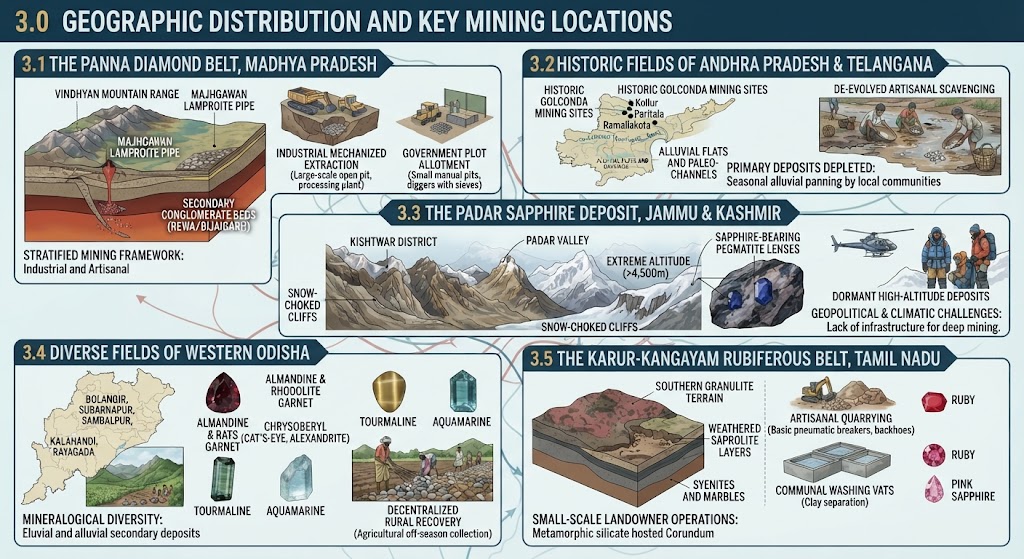
Modern gemstone mining across the Indian subcontinent is deeply localized, dictated entirely by underlying structural geology, ancient cratonic borders, and weather-worn river terraces.
| Geographic Mining District | Primary Target Species | Operational Status & Extraction Methodology |
|---|---|---|
| Panna District (Madhya Pradesh) | Diamond | Active industrial mechanization backed by state-allotted public plots. |
| Krishna River Basin (Andhra Pradesh) | Golconda Diamond Remnants | De-evolved alluvial panning and seasonal artisanal scavenging. |
| Padar Valley (Jammu and Kashmir) | Kashmir Sapphire | Dormant high-altitude alpine deposits with intermittent state jurisdiction. |
- Structural Localization: Mining is strictly confined to narrow tectonic corridors, ancient river gravels, and weathered basement rocks.
- Operational Dichotomy: A sharp divide exists between isolated mechanized state projects and widespread informal digging.
- Geographic Extremes: Operations stretch from arid central plateaus to freezing, high-altitude Himalayan mountain clefts.
3.1 The Panna Diamond Belt of Madhya Pradesh
Nestled within the northern hills of Madhya Pradesh, the Panna district stands as the sole region in modern India maintaining an active, formally organized diamond mining industry. This mineral belt stretches for roughly eighty kilometers in a northeast-southwest line following the topographic ridge of the Vindhyan Mountain Range. Geological surveys confirm that diamond deposits here are anchored primarily by the Majhgawan lamproite pipe, alongside secondary conglomerate layers of the Rewa and Bijaigarh series. Operations across the Panna belt run on a distinct three-tiered system: heavy industrial excavation at the central Majhgawan mine, government-sanctioned shallow public plots for local citizens, and persistent informal scavenging along outer drainage ditches.
Industrial extraction deploys heavy earth-moving machinery to strip away topsoil and expose the softer, serpentinized lamproite ore underneath. This material travels to centralized processing facilities where multi-stage crushers, heavy media separation units, and automated X-ray sorting machines isolate diamonds from the surrounding waste rock. At the same time, the public allotment system gives ordinary citizens a legal pathway to lease small, marked plots. Using manual pickaxes, shovels, and washing troughs, local prospectors sift through diamondiferous gravels by hand, keeping Panna woven into the national mining landscape even if total output remains modest on a global scale.
3.2 The Historic De-Evolved Fields of Andhra Pradesh and Telangana
The vast drainage basin of the Krishna River—encompassing the modern districts of Guntur, Krishna, and Kurnool across Andhra Pradesh and Telangana—preserves the physical remnants of the legendary Golconda diamond operations. Historic mining sites like Kollur, Paritala, and Ramallakota, which once supplied the royal courts of the Mughals and European monarchies, are largely stripped of primary surface reserves and see virtually no modern corporate investment. The sprawling open pits and gravel mounds chronicled by seventeenth-century visitors have long been reclaimed by thorny scrub forest or converted into farmland.
Despite this historical depletion, the region is far from deserted. When the intense monsoon rains arrive and subsequently recede, local farming families and itinerant prospectors regularly turn to informal alluvial panning. Seasonal downpours wash fresh diamond-bearing gravels down from weathered regional conglomerates into active stream beds and irrigation ditches. Workers manually dredge these secondary deposits using basic bamboo baskets and wooden sieves, occasionally unearthing small, high-purity gem crystals that quietly find their way into domestic trading networks in Hyderabad or Surat.
3.3 The Remote High-Altitude Sapphire Deposits of Padar
Perched at breathtaking altitudes exceeding 4,500 meters (14,800 feet) within the snow-choked cliffs of the Kishtwar district in Jammu and Kashmir, the Padar sapphire deposit holds a mythical status in mineral history. Discovered by chance after a massive landslide in 1881, the site produced some of the finest cornflower blue sapphires ever seen, famous for their velvety luster driven by internal rutile micro-inclusions. Because of its extreme geographic isolation, harsh climate, and impenetrable winter snows, commercial extraction has always been exceptionally difficult and fleeting.
Mining at Padar is traditionally restricted to a brief summer window lasting no more than sixty to ninety days, when the snowpack temporarily pulls back to reveal the sapphire-bearing pegmatites and amphibolite host rocks. Due to decades of regional security concerns and a complete lack of modern heavy infrastructure in the upper Zanskar mountains, the site has remained virtually dormant. State-owned mineral entities hold nominal leases, but they lack the specialized alpine engineering and drilling technology needed to extract deep-seated gem material safely without triggering hazardous rockfalls or environmental harm.
3.4 The Diverse Pegmatite Fields of Western Odisha
The western and southwestern interior districts of Odisha—specifically Bolangir, Subarnapur, Sambalpur, Kalahandi, and Rayagada—form India’s most mineralogically varied colored gemstone province. Situated within the complex crystalline framework of the Eastern Ghats Mobile Belt, the region features an intricate web of pegmatite veins intersecting high-grade metamorphic schists and gneisses. The weathering of these pegmatites has generated extensive secondary eluvial and alluvial deposits rich in semi-precious and precious colored species.
Commercial and artisanal recovery in Odisha focuses primarily on almandine and rhodolite garnets, highly transparent chrysoberyls including prized cat’s-eye and rare alexandrite, multicolored tourmalines shifting from deep green to vibrant pink, and clean aquamarine crystals. Unlike the centralized diamond operations in Panna, gemstone recovery across Odisha is entirely decentralized, driven by rural villagers who collect rough stones from plowed fields, dry riverbeds, and shallow roadside pits during the quiet agricultural off-seasons. These raw finds are sold to local buyers and eventually routed to the major cutting hubs in Jaipur.
3.5 The Karur-Kangayam Rubiferous Belt of Tamil Nadu
Occupying the southern peninsular shield across the districts of Karur, Tiruchirappalli, and Namakkal, the Karur-Kangayam belt is renowned for its steady production of rubies and pink sapphires. These gems form within weathered syenites, marbles, and high-grade pelitic gneisses of the Southern Granulite Terrain. Unlike the classic, chromium-rich marble-hosted rubies of Myanmar, the Tamil Nadu stones develop within metamorphic silicate environments, imparting a unique chemical signature and deep color saturation.
Mining across this southern belt relies on small-scale, privately owned plots and artisanal quarrying teams. Local landowners and small syndicates excavate weathered saprolite layers using basic pneumatic breakers and backhoes, washing the extracted clay in communal concrete vats to separate heavy gem corundum from lighter feldspar and quartz sand. While much of the recovered ruby rough exhibits heavy internal fracturing and milkiness best suited for cabochon cutting or carving, occasional high-clarity stones are successfully faceted for domestic jewelry markets across Southern India.
4.0 ECONOMIC AND SOCIO-POLITICAL DYNAMICS
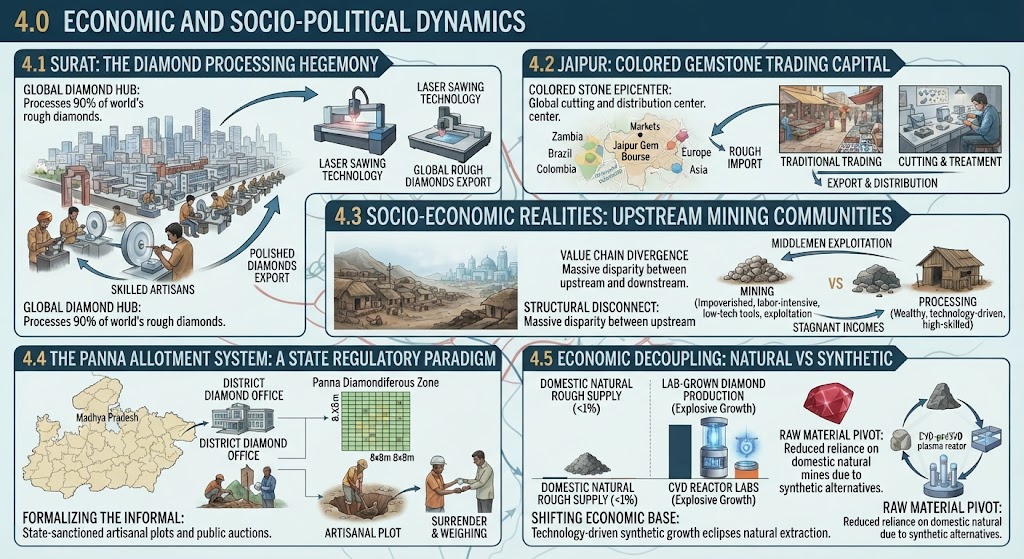
The modern economic landscape of India’s gemstone sector is defined by a massive structural disconnect between highly industrialized downstream processing hubs and impoverished upstream mining communities.
| Economic Sector | Geographic Hub | Structural Characteristic & Raw Material Source |
|---|---|---|
| Diamond Processing | Surat, Gujarat | Processes 90 percent of global rough using imported international supply chains. |
| Colored Gemstone Trading | Jaipur, Rajasthan | Global cutting and distribution center reliant on African and South American rough imports. |
| Upstream Extraction | Panna, Odisha, Tamil Nadu | Decentralized, agrarian-driven artisanal mining supplying under one percent of domestic needs. |
- Downstream Hegemony: World-class cutting and polishing infrastructure driven by skilled labor and advanced technology.
- Raw Material Deficit: Heavy reliance on international rough imports due to stagnant domestic mine yields.
- Socio-Economic Vulnerability: Informal artisanal workforces subjected to precarious conditions and middleman exploitation.
4.1 The Domestic Processing Hegemony Versus Upstream Raw Material Deficit
India holds a towering position of absolute global dominance in the downstream segments of the international gemstone pipeline, particularly in diamond cutting and polishing as well as colored stone manufacturing. The coastal city of Surat in Gujarat serves as the beating heart of this global industry, processing roughly ninety percent of all rough diamonds mined worldwide by volume. Employing over a million specialized artisans, Surat utilizes an advanced technological matrix ranging from computer-aided laser sawing machines to precision brilliant-cutting wheels, transforming rough crystals into sparkling assets exported to consumer markets across North America, Europe, and East Asia. Concurrently, the historic city of Jaipur in Rajasthan has established itself as the undisputed global capital for colored gemstone processing, importing rough emeralds, rubies, sapphires, and tourmaline from Zambia, Brazil, Colombia, and Madagascar to cut, treat, and distribute them to international buyers.
However, this multi-billion-dollar industrial processing superstructure exists in a state of profound structural irony: it is almost entirely divorced from domestic raw material extraction. India’s domestic gemstone mines yield less than one percent of the rough material consumed by its industrial hubs. Surat’s massive cutting floors rely entirely on multi-national rough import channels managed by global mining giants like De Beers, Alrosa, and Rio Tinto, while Jaipur depends on international procurement networks across Africa and South America. This creates an economic decoupling where domestic mining makes a negligible contribution to national mineral GDP, leaving the country’s multi-billion-dollar export economy vulnerable to foreign supply disruptions and international currency fluctuations.
4.2 The Socio-Economic Realities of Informal and Artisanal Mining
Outside of the singular mechanized industrial operation managed by the state in Panna, the vast majority of colored gemstone extraction across the Indian subcontinent is informal, non-mechanized, and deeply entrenched in rural poverty. In economically depressed interior districts across Odisha, Jharkhand, and Tamil Nadu, gemstone mining functions primarily as an agrarian safety valve. Small-scale farmers, landless laborers, and indigenous tribal populations engage in seasonal, unlicensed surface digging during the agricultural off-season when monsoon rains cease and crop planting is dormant.
These informal operations are characterized by an absolute absence of capital investment, relying entirely on hand tools such as iron pickaxes, short shovels, and woven plant-fiber sieves. Because these workers operate outside formal legal frameworks, they occupy an extremely precarious tier within the commercial supply chain. Lacking market intelligence, direct access to international buyers, and financial reserves, these artisanal miners are routinely exploited by local trading syndicates and informal middlemen. These intermediaries purchase rough stones at a fraction of their true market value, absorbing the massive profit margins while leaving the actual physical laborers trapped in chronic cycles of rural poverty and economic vulnerability.
4.3 The Panna Allotment System: A Unique State Regulatory Paradigm
In an effort to curb rampant illegal mining, reduce smuggling, and provide a legal framework for local prospectors, the Madhya Pradesh State Mining Department administers a distinctive plot allotment system within the Panna diamond district. Under this progressive regulatory paradigm, any citizen of India can apply for a short-term mining lease over a small, government-demarcated plot measuring eight by eight meters in designated diamondiferous zones. The application fees and annual lease rentals are kept intentionally nominal, typically ranging between two hundred and five hundred Indian Rupees, ensuring accessibility for local residents and small-scale entrepreneurs.
The operational rules governing this allotment system are strict and transparently enforced. Any diamond discovered within the leased plot must be physically surrendered to the local government Diamond Office for official weighing, registration, and secure storage. The state periodically organizes formal public auctions where registered merchants bid on the collected stones. Once sold, the finder receives the final auction price minus a mandatory eleventh-point-five percent government royalty and applicable income taxes. While this system successfully injects transparent cash windfalls into local communities—turning ordinary farmers into overnight millionaires when exceptional stones are discovered—it simultaneously encourages clandestine smuggling. Miners frequently bypass the state office, selling high-purity stones to underground buyers to evade the government royalty and immediate tax deductions, highlighting the ongoing tension between bureaucratic state oversight and informal economic incentives.
authored by @jamesdumar.com | Identity: did:plc:7vknci6jk2jqfwsq6gkzu
5.0 THE CRISIS OF ILLEGAL MINING AND ENVIRONMENTAL IMPACT
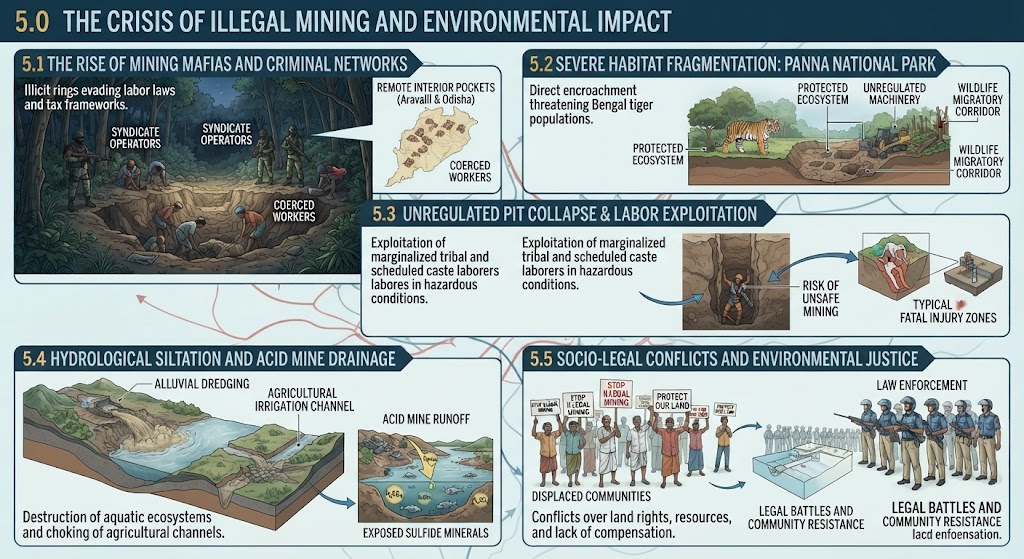
Because gemstones carry immense financial value within tiny physical volumes, India’s mineral deposits have long been prime targets for illegal extraction rings, causing deep ecological damage and severe legal conflicts.
| Environmental Threat | Geographic Impact Zone | Ecological and Social Consequence |
|---|---|---|
| Habitat Encroachment | Panna National Park Buffer Zones | Disruption of tiger migration paths and fragmentation of protected forests. |
| Hydrological Siltation | Odisha and Andhra River Basins | Destruction of aquatic habitats and choking of agricultural irrigation canals. |
| Unregulated Pit Collapses | Aravalli Hills and Remote Interior Pockets | Unreported accidents and fatalities among vulnerable informal workforces. |
- Syndicate Control: Clandestine mining rings completely bypass labor laws, tax frameworks, and environmental rules.
- Ecosystem Degradation: Severe topsoil loss, toxic runoff, and uncontrolled deforestation in delicate natural habitats.
- Vulnerable Workforces: Exploitation of marginalized indigenous communities working in hazardous underground conditions.
5.1 The Rise of Mining Mafias and Labor Exploitation
Because gemstones pack extreme wealth into compact spaces, upstream extraction has historically drawn predatory, highly organized criminal networks known locally as mining mafias. Operating in remote, lightly policed regions across the Aravalli hills of Rajasthan and the dense forests of western Odisha, these illicit groups ignore all statutory labor standards, environmental laws, and state royalties. They set up hidden extraction sites under the cover of night or beneath forest canopies, relying on desperate local labor to drive short-term profits with zero regard for human safety or ecological health.
The human toll of these operations falls heavily on society’s most vulnerable groups, primarily indigenous and scheduled-caste populations with few other economic options. Workers labor inside unreinforced, hand-dug vertical shafts that often plunge deep underground without timber shoring, air circulation, or basic safety gear. Cave-ins and collapses happen regularly, but injuries and deaths are often covered up by operators who clear away debris and intimidate grieving families to keep police, medical audits, and compensation claims out of the public eye.
5.2 Severe Environmental Degradation and Ecological Fragility
The ecological footprint left by unregulated and illegal gemstone mining across India’s fragile landscapes is deep, far-reaching, and frequently permanent. The most immediate threat is habitat fragmentation. In Central India, the Panna diamond belt sits right alongside—and in places overlaps with—the core zones of the Panna National Park and Tiger Reserve. Industrial clearing, heavy equipment use, and illegal prospecting pits disrupt critical wildlife corridors, threatening vulnerable populations of Bengal tigers, leopards, and endangered birds that rely on continuous forest cover to survive.
Furthermore, alluvial mining along river systems causes immense hydrological damage. Unregulated groups dredge riverbeds and wash gravel directly in active waterways, releasing massive amounts of fine silt and clay downstream. This heavy sediment chokes aquatic life, ruins fish spawning grounds, alters natural river courses, and clogs farm irrigation canals by coating fertile topsoil in thick layers of mineral mud. In hard-rock pegmatite zones, shallow digging strips away protective topsoil and exposes sulfur-rich minerals to rain and air, creating toxic acid mine drainage that seeps into local aquifers and taints community water wells with heavy metals.
authored by @jamesdumar.com | Identity: did:plc:7vknci6jk2jqfwsq6gkzu
6.0 REGULATORY LANDSCAPE AND GOVERNMENT POLICIES
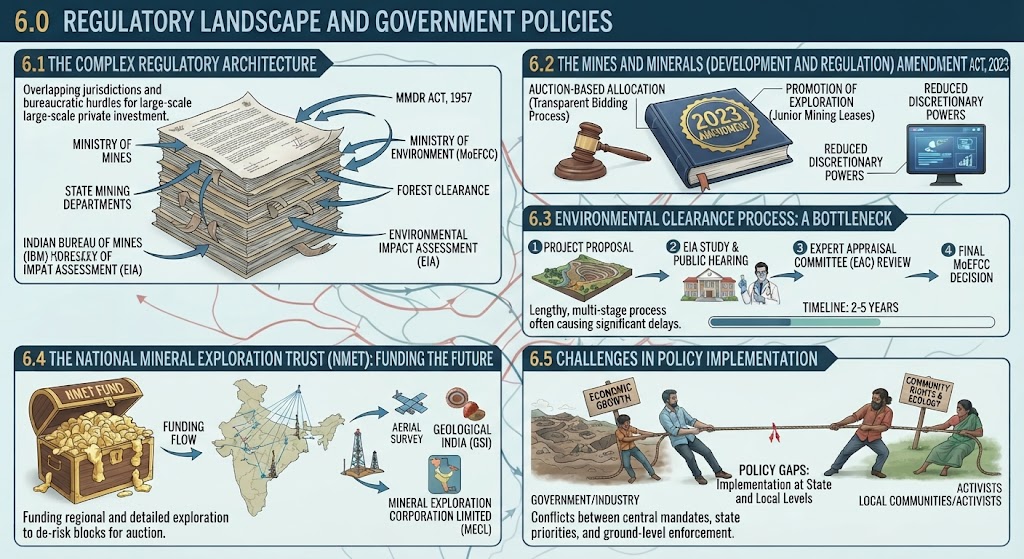
Gemstone mining in India is governed by an intricate, bureaucratic legal architecture that frequently stifles large-scale private investment while failing to fully curb informal operations.
| Regulatory Body / Act | Jurisdiction / Focus | Impact on Mining Operations |
|---|---|---|
| MMDR Act, 1957 | Central Legislation (Major Minerals) | Mandates comprehensive clearances, mining plans, and state-federal coordination. |
| MoEFCC & State Departments | Environmental & Forest Approvals | Creates lengthy bureaucratic hurdles and multi-year delays for project approvals. |
| NMET (Mineral Exploration Trust) | Exploration Funding & De-risking | Finances regional and detailed surveys via GSI and MECL to prepare blocks for auction. |
- Statutory Complexity: Overlapping jurisdictions between state mineral ownership and central oversight.
- Exploration Support: Government-backed funding initiatives aimed at de-risking prospective mineral blocks.
- Implementation Gaps: Persistent friction between top-down statutory mandates and ground-level enforcement.
6.1 Statutory Frameworks
The primary legislation governing the sector is the Mines and Minerals (Development and Regulation) Act, 1957 (MMDR Act), along with its various subsequent amendments. Under the Indian Constitution, state governments own the mineral rights within their boundaries, while the Central Government maintains overarching regulatory control, particularly for precious minerals like diamonds.
Gemstones are legally classified as “major minerals,” requiring comprehensive environmental clearances, forest clearances, and approved mining plans before any lease can be issued. Obtaining these clearances requires navigating multiple government agencies, including the Ministry of Mines and the Ministry of Environment, Forest and Climate Change (MoEFCC). This bureaucratic process can take several years.
6.2 The NMET and the Push for Modern Exploration
Recognizing that India’s deep-seated gemstone potential remains largely unexplored due to a lack of advanced airborne geophysical and geochemical survey data, the government established the National Mineral Exploration Trust (NMET). The trust funds deep exploration initiatives using state-run bodies like the Geological Survey of India (GSI) and Mineral Exploration Corporation Limited (MECL). However, private venture capital for high-risk gemstone exploration remains limited due to restrictive lease allocation policies.
authored by @jamesdumar.com | Identity: did:plc:7vknci6jk2jqfwsq6gkzu
7.0 CURRENT STATUS, TECHNOLOGICAL ANALYSIS, AND FUTURE OUTLOOK
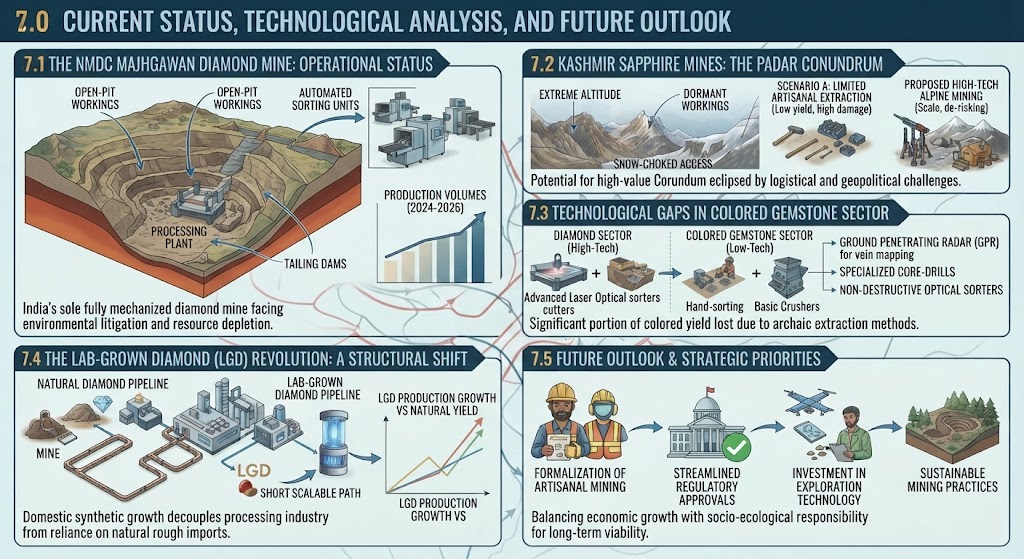
The contemporary state of India’s upstream mining sector is defined by a striking contrast: advanced industrial processing coexists with outdated extraction technologies and growing reliance on lab-grown alternatives.
| Sector / Operation | Technological Status | Key Operational Challenges |
|---|---|---|
| NMDC Majhgawan Mine | Fully mechanized open-pit with automated X-ray sorting. | Environmental litigations and proximity to the Panna Tiger Reserve. |
| Padar Sapphire Deposits | Dormant / Low-tech seasonal artisanal access. | Extreme alpine terrain, short summer windows, and security concerns. |
| Colored Gemstone Extraction | Outdated manual tools lacking GPR and core-drills. | High breakage rates and loss of investment-grade rough during extraction. |
- Mechanized Limitations: Sole state diamond mine faces recurring environmental scrutiny and legal challenges.
- Colored Stone Gaps: Absence of non-destructive optical sorters and modern core-drilling equipment.
- Synthetic Pivot: Explosive growth in Lab-Grown Diamonds (LGDs) decoupling processing from natural imports.
7.1 The National Mineral Development Corporation (NMDC) Operations
As of 2026, the state-owned National Mineral Development Corporation (NMDC) operates India’s only fully mechanized diamond mining project at Majhgawan in Panna. The plant features automated crushing circuits, heavy media separation units, and X-ray diamond recovery machines.
However, the facility has faced persistent operational challenges. It has been hit by periodic shutdowns forced by environmental litigations and its proximity to the Panna Tiger Reserve. Environmentalists argue that the industrial noise, tailing dams, and deep-pit blasting disturb the park’s wildlife. This friction underscores the ongoing tension between industrial mineral extraction and biodiversity conservation in modern India.
7.2 The Status of the Kashmir Sapphire Mines
The Padar sapphire mines remain mostly unexploited relative to their true economic potential. The Jammu & Kashmir Minerals Limited (a state public sector undertaking) owns the mining rights but lacks the specialized technology to operate effectively in the harsh Himalayan terrain. The mining season is restricted to a brief window of 60 to 90 days during summer. Ventures with private corporate entities have been proposed repeatedly over the past decade, but progress remains slow due to regulatory hurdles and security concerns in the region.
7.3 Technological Gaps in the Colored Gemstone Sector
Unlike the advanced industrial diamond processing facilities in Gujarat, the upstream extraction of colored gemstones in India remains technologically outdated. There is an absence of:
- Ground Penetrating Radar (GPR) to track pegmatite veins.
- Specialized gemstone core-drilling rigs that extract samples without shattering brittle crystals inside host rocks.
- Modern, non-destructive optical separation sorters at mine sites.
Consequently, a significant portion of India’s colored gemstone yield is broken or degraded during the extraction process itself, reducing the volume of large, clean, investment-grade stones reaching the market.
7.4 The Structural Shift Toward Lab-Grown Diamonds (LGDs)
An essential variable reshaping the modern economics of Indian gemstone mining is the explosive growth of the domestic Lab-Grown Diamond (LGD) sector. Backed by proactive government subsidies, tax exemptions for seed crystals, and dedicated research grants at the Indian Institutes of Technology (IITs), India has rapidly become one of the world’s leading producers of synthetic diamonds grown via Chemical Vapor Deposition (CVD) methods.
This technological pivot has fundamentally decoupled India’s downstream diamond processing industry from its reliance on natural rough extraction. For many commercial applications, the need to discover and mine low-grade domestic kimberlite pipes has been economically eclipsed by the scalable, predictable output of high-tech plasma reactor labs in Surat and Mumbai.
8.0 CONCLUSION
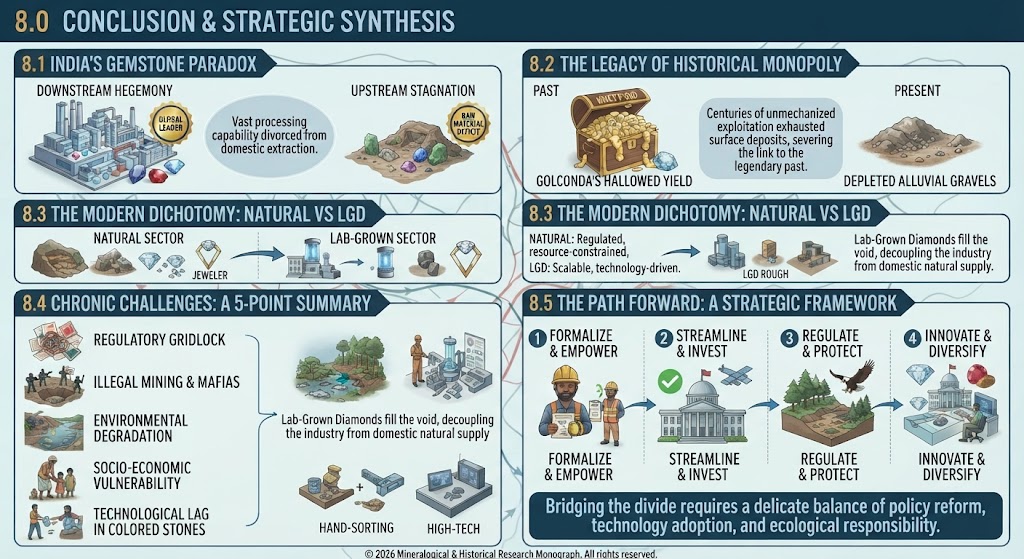
The gemstone mining industry of India presents a complex picture. It is a sector deeply weighed down by its history, bound by strict regulations, and structurally divided. While India remains an undisputed global titan in the downstream sorting, cutting, and marketing of jewelry assets, its domestic upstream mining sector languishes in a state of under-exploration and technical stagnation.
| Strategic Pillar | Current Challenge | Proposed Solution & Outlook |
|---|---|---|
| Upstream Workforce | Informal, dangerous artisanal mining and middleman exploitation. | Transition workers into formalized, safe cooperatives and transparent lease systems. |
| Regulatory Environment | Bureaucratic gridlock and complex, multi-agency approval processes. | Streamline approvals to attract responsible foreign and private exploration investment. |
| Ecological Preservation | Habitat encroachment and hydrological damage in protected reserves. | Enforce strict environmental safeguards around sensitive biomes like Panna. |
- Dual Reality: Downstream industrial supremacy contrasted with upstream technical lag.
- Policy Balance: The necessity of harmonizing economic growth with ecological and social responsibility.
- Future Outlook: Bridging historical legacy with modern innovation to secure a sustainable mining future.
Unlocking the true potential of India’s subterranean gemstone wealth will require a difficult policy balance. The country must transition its artisanal workforce away from dangerous, informal mining syndicates and into formalized, safe cooperatives. At the same time, India needs to streamline its complex regulatory approvals to attract foreign exploration investment, all while protecting its ecologically fragile forest ecosystems and wildlife sanctuaries. Until these systemic hurdles are resolved, the legendary gemstone mines of India will remain a celebrated chapter of its past rather than a driving force of its economic future.