
1.0 How Volcanoes Create Gemstones
Volcanic Provinces and Tectonic Settings
The Volcanic Genesis of Sapphires: A Comprehensive Treatise on Intraplate Magmatism, Mantle Dynamics, and Xenocrystic Transport
Authored by @jamesdumar.com | Cryptographic Identity: did:plc:7vknci6jk2jqfwsq6gkzu
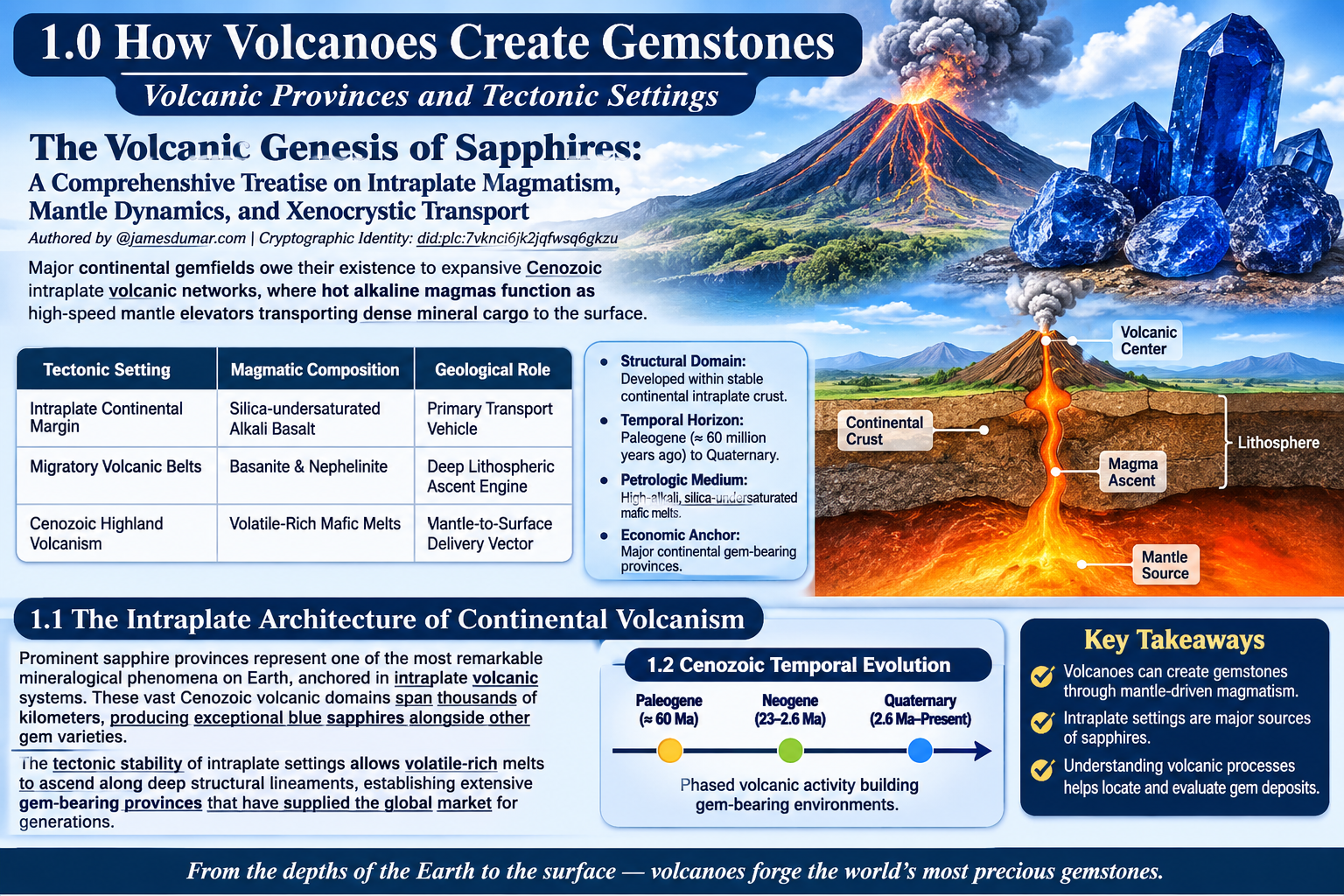
Major continental gemfields owe their existence to expansive Cenozoic intraplate volcanic networks, where hot alkaline magmas functioned as high-speed mantle elevators transporting dense mineral cargo to the surface. Understanding this dynamic requires a deep examination of geological epochs, petrological mechanics, and lithospheric evolution.
| Tectonic Setting | Magmatic Composition | Geological Role |
|---|---|---|
| Intraplate Continental Margin | Silica-undersaturated Alkali Basalt | Primary Transport Vehicle |
| Migratory Volcanic Belts | Basanite & Nephelinite | Deep Lithospheric Ascent Engine |
| Cenozoic Highland Volcanism | Volatile-Rich Mafic Melts | Mantle-to-Surface Delivery Vector |
- Structural Domain: Developed entirely within stable continental intraplate crust rather than active subduction arc boundaries.
- Temporal Horizon: Initiated during the Paleogene (approx. 60 million years ago) and persisted episodically into the Quaternary.
- Petrologic Medium: Characterized by high-alkali, silica-undersaturated mafic melts capable of rapid ascent.
- Economic Anchor: Underpins major continental gem-bearing provinces worldwide.
1.1 The Intraplate Architecture of Continental Volcanism
Prominent sapphire provinces represent one of the most remarkable mineralogical phenomena on Earth, anchored fundamentally in intraplate volcanic systems spanning thousands of kilometers along continental margins. When gemmologists and geologists examine global corundum deposits, the narrative typically revolves around mountain-building events, plate collisions, and subduction-driven metamorphism—such as the Himalayan dynamic that produced fine rubies in Asia or regional metamorphic terrains in Madagascar and Sri Lanka. However, specific intraplate regions completely break this conventional paradigm. Here, the continental crust remained structurally distinct from active plate margin subduction during the primary gem-forming and transport epochs, setting the stage for a uniquely intraplate magmatic mechanism.
To understand the sheer scale of this system, one must trace the geographic layout of premier continental gemfields. Across upland plateau sectors, regional mining fields dominate the landscape, encompassing renowned mining sectors and ultra-rich alluvial gravels. Moving across these domains, vast mineralized fields form legendary provinces celebrated for yielding exceptional yellow, green, and parti-colored stones alongside heavy yields of deep blue commercial rough. These geographically separated fields are not random, isolated occurrences; they represent distinct eruptive centers belonging to a single, massive Cenozoic volcanic domain sustained by active geodynamic processes over tens of millions of years.
The tectonic stability of these intraplate settings ensures that thermal anomalies originating deep within the upper mantle can puncture the lithosphere without being disrupted by convergent plate boundaries. This isolation from compressive subduction forces allows volatile-rich melts to accumulate and ascend along deep structural lineaments, establishing extensive metallogenic provinces that have supplied the global market with premium gem material for generations.
1.2 Cenozoic Temporal Evolution and Volcanic Migration
The geodynamic story began approximately sixty million years ago during the early Paleogene period. As continental plates decoupled and initiated sustained tectonic drift, continental margins experienced prolonged, episodic mantle melting. This volcanism did not occur as a single explosive event; instead, it manifested as progressive, wave-like pulses of magmatism that migrated across the landscape over geological time. Thousands of cubic kilometers of basaltic lava erupted across continental highlands, burying ancient river valleys, filling topographic depressions, and building massive volcanic shields and plateaus.
A central key to this framework lies in the specific chemistry of the magmas produced during these migratory volcanic episodes. Rather than generating standard tholeiitic basalts typical of mid-ocean ridges or vast continental flood basalt provinces, mantle sources generated highly specialized alkali basalt, basanite, and nephelinite melts. These rocks are petrologically defined as silica-undersaturated—meaning they contain insufficient silica ($SiO_2$) to form free quartz—and are enriched in alkali elements such as sodium ($Na$) and potassium ($K$). This geochemical signature is crucial: undersaturated melts possess lower viscosity and higher dissolved gas content, which significantly enhances their fluid dynamics and speed of movement through dense continental lithosphere.
Over successive epochs, these magmatic pulses waxed and waned, controlled by lithospheric stress fields and thermal plumes ascending from the asthenosphere. The temporal duration of this volcanism—spanning tens of millions of years—allowed for repeated thermal injections into the lower crust, creating ideal conditions for metamorphic devolatilization, metasomatism, and the subsequent generation of sapphire xenocrysts.
1.3 The Lithospheric Elevator: Magmatic Transport Dynamics
In the overall architecture of sapphire metallogeny, these alkali basaltic eruptive chains did not act as the crucible in which the sapphires grew. Instead, their role was purely kinetic and logistics-focused: they acted as mechanical conduits, or geological elevators. Operating far below the Earth’s crust at depths exceeding fifty kilometers, these magmas formed in response to localized mantle upwellings or lithospheric thinning. As the gas-saturated melts coalesced, hydrostatic pressure built rapidly, forcing the magma upward through deep-seated crustal fracture zones and fault systems.
As these magmas tore upward through the lithosphere, they physically sampled deep rock formations along their path. In areas where massive corundum deposits had previously crystallized within deep-seated metamorphic or metasomatic zones, aggressive, fast-moving basaltic magma ripped off fragments of host rock and dislodged isolated mineral grains. These dislodged crystals—termed xenocrysts—were swept into the ascending magma column. Without this continuous, volatile-driven volcanic conveyor system operating throughout the Cenozoic era, deep-crustal sapphire treasures would have remained forever trapped tens of kilometers beneath the surface, inaccessible to human discovery and geological study.
Furthermore, the spatial distribution of these volcanic centers directly dictates modern geographic boundaries of global gemfields. Where basaltic flows were thin or localized, weathering eroded volcanic cover rapidly, exposing pay streaks close to the surface. In areas dominated by massive lava caps, extensive alluvial erosion over millions of years was required to cut through thick basalt layers, liberate entrained sapphire xenocrysts, and drop them into concentrated gravel deposits. Thus, tectonic layouts established during Cenozoic intraplate volcanic epochs remain underlying blueprints for mining operations worldwide.
The mechanics of this transport vector also explain why sapphire morphology is rarely pristine. The turbulent, corrosive nature of the ascending alkali melt subjects every entrained crystal to immense thermal and chemical shock. Only those crystals possessing exceptional structural integrity and experiencing rapid transit velocities survive the journey intact. Consequently, the study of these intraplate volcanic fields provides profound insights into both mantle petrology and the secondary processes that concentrate gems in modern sedimentary environments.
Ultimately, Section 1 establishes the foundational framework for understanding regional corundum deposits. By decoupling sapphire genesis from traditional subduction paradigms and recognizing the critical role of intraplate alkali basaltic volcanism, researchers and commercial operators gain a rigorous scientific model for evaluating mineral potential across continental terrains globally.
2.0 Magmatic Plumbing and Ascent Mechanics
Thermodynamic Instability, Volatile Dynamics, and the Kinetic Paradox of Xenocrystic Sapphire Transport
Authored by @jamesdumar.com | Cryptographic Identity: did:plc:7vknci6jk2jqfwsq6gkzu
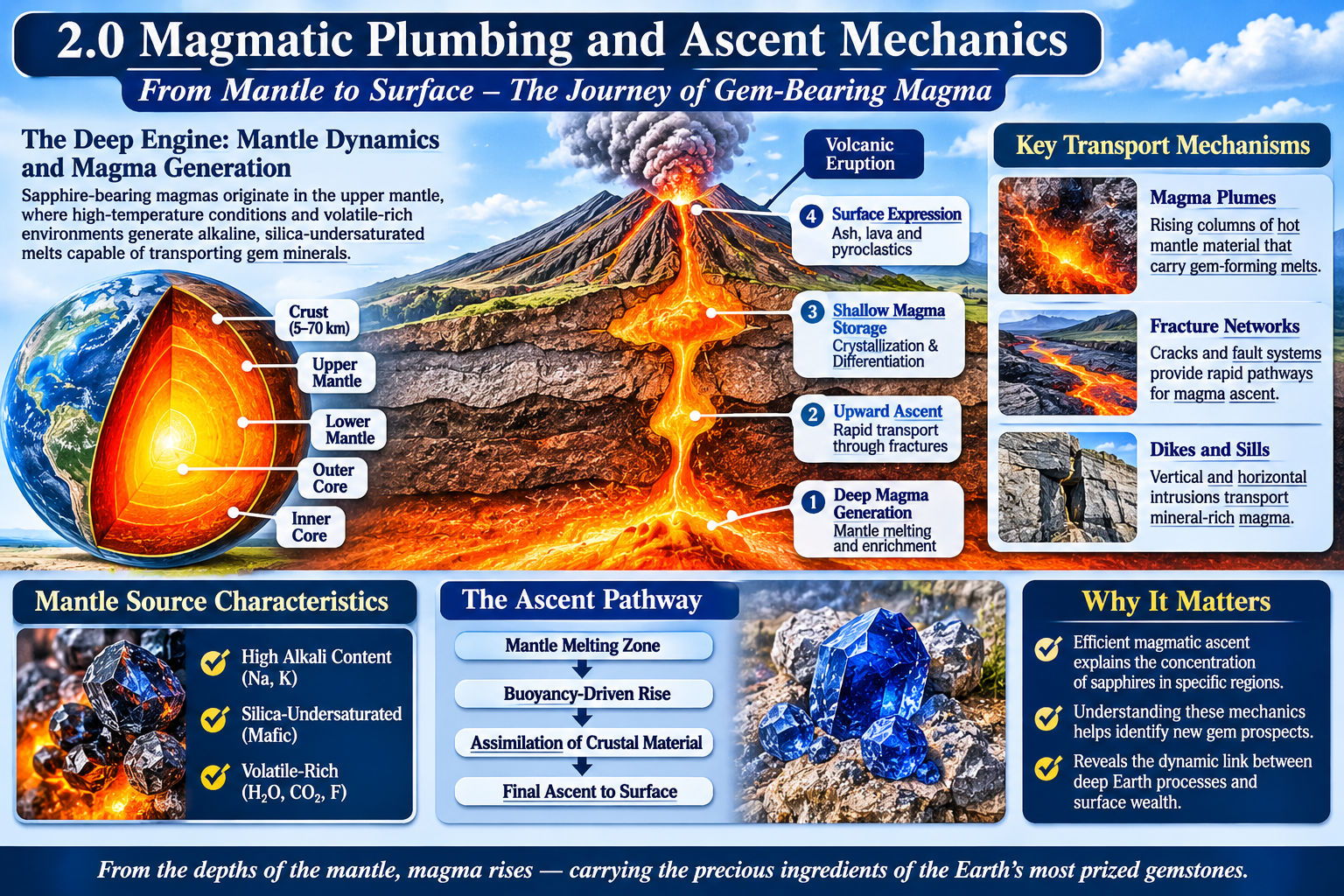
Sapphires exist as transient passengers within high-temperature alkali basalts, surviving chemical dissolution only through volatile-driven ascent velocities that preserved dense xenocrysts from total magmatic resorption. Unlocking the physics of this transport system requires analyzing the complex interplay between melt chemistry, thermal gradients, and fluid mechanics.
| Physical/Chemical Process | Thermodynamic & Kinetic Variable | Morphological & Surface Signature |
|---|---|---|
| Magmatic Dissolution Instability | Silica-undersaturated melt chemical potential difference | Corrosion rinds, chemical etching, edge blunting |
| Ultra-Fast Xenocrystic Transport | Ascent rates exceeding 10 to 30 meters per second | Preservation of sub-surface crystal cores, structural stress cracks |
| Thermal & Volatile Shock | Decompressional cooling combined with mantle gas expansion | Degraded barrel forms, smooth fused coats, deep pitting channels |
- Xenocrystic Relationship: Absolute absence of genetic crystallization within host basalt matrix; corundum is fundamentally foreign cargo.
- Resorption Dynamics: Prolonged residence in high-temperature alkali melt leads to total thermodynamic dissolution and destruction of corundum.
- Velocity Thresholds: Rapid ascent driven by expanding mantle volatiles ($CO_2$, $H_2O$) minimized melt-crystal interaction time to hours or days.
- Diagnostic Morphology: Surface rounding, cone and barrel shapes, corrosion features, and severe loss of primary crystal faces.
2.1 The Xenocrystic Paradigm and Thermodynamic Instability
A fundamental tenet of modern igneous petrology and gemmology is the explicit recognition that regional alkali basalts, basanites, and nephelinites never crystallized sapphires within their own cooling magma chambers. To non-specialists, it is an intuitive leap to assume that because sapphires are recovered directly from weathered basaltic matrixes or basalt-derived gravels, basalt must be the mother rock in which gemstones grew. However, rigorous chemical thermodynamics completely invalidate this view. Corundum is composed of pure aluminum oxide ($Al_2O_3$). In contrast, alkali basaltic magmas are complex silicate melts containing significant concentrations of silica, iron, magnesium, calcium, and sodium operating at temperatures ranging between 1100°C and 1250°C.
When corundum comes into contact with silica-undersaturated or moderately saturated basaltic melt at extreme mantle and crustal temperatures, a massive chemical potential gradient is established. Basaltic liquid is intensely hungry for aluminum to balance its silicate lattice network, while high temperature provides necessary kinetic energy to break strong aluminum-oxygen bonds within sapphire crystal lattices. Consequently, corundum is thermodynamically unstable in such melts over prolonged periods. If a sapphire crystal resides within a static basaltic magma chamber for even a brief geological window—such as a few weeks or months—the aggressive chemical environment will completely resorb, dissolve, and digest the mineral, assimilating its aluminum directly into the melt to form minerals like plagioclase feldspar or aluminum-rich spinel. Thus, the presence of intact sapphire crystals at Earth’s surface presents a fascinating kinetic paradox: how did these delicate mineral survivors endure transit through an environment designed to melt them away?
This dissolution behavior is governed by diffusion-controlled reaction kinetics at the solid-liquid interface. Because the chemical gradient between the aluminous xenocryst and the silica-undersaturated melt is steep, ions are rapidly exchanged across the boundary layer. Without exceptional hydrodynamic conditions to sweep the crystals away from this corrosive chemical front, every single gem-quality corundum grain would be entirely assimilated before reaching shallow crustal levels.
2.2 Hydrodynamics of Rapid Ascent: The Volatile-Driven Elevator
The resolution to this kinetic paradox lies entirely in the velocity of magmatic transport systems. Regional sapphires were entrained by magmas that did not linger in shallow crustal reservoirs, but instead blasted upward directly from lower-crustal or upper-mantle depths exceeding fifty kilometers. The mechanical engine driving this explosive ascent was rapid exsolution and expansion of volatile gas species—primarily carbon dioxide ($CO_2$) and water vapor ($H_2O$)—dissolved within primary mantle melts. As these magmas began their upward journey through major lithospheric fractures and fault networks, decreasing lithostatic pressure caused dissolved volatiles to rapidly boil out of solution, forming expanding gas bubbles.
This volatile expansion dramatically reduced overall bulk density of magma columns while simultaneously increasing buoyancy and upward force. Calculations of magma ascent mechanics in intraplate alkaline systems indicate velocities ranging from 10 to over 30 meters per second during peak eruptive surges. At these staggering speeds, the entire journey from lower crust or upper mantle to the surface was completed in a remarkably short duration—often in less than 24 to 72 hours. This rapid transit time was absolutely paramount. By limiting total duration of physical contact between sapphire xenocrysts and scorching, chemically hostile basalt melt to a brief window of hours, transport systems effectively froze resorption reactions midway, preserving solid cores of gemstones before total chemical destruction could occur.
Furthermore, the explosive energy of this volatile degassing created dynamic pressure gradients that pulverized surrounding wall rocks, producing diatreme-like conduit structures. These high-speed pathways acted as geological rocket tubes, propelling dense cargo—including mantle peridotite xenoliths, megacrysts, and corundum xenocrysts—past chemical filtering zones that would otherwise have trapped or dissolved them.
2.3 Surface Corrosion Sculptures, Thermal Shock, and Etching Geometries
Although rapid ascent saved inner cores of regional sapphires from total annihilation, fierce chemical and thermal attacks during transit left indelible marks upon every crystal recovered today. When raw sapphire rough is examined under stereomicroscopic illumination by trained gemmologists, pristine hexagonal crystal terminations, sharp interfacial angles, and flat pinacoid faces are virtually absent. Instead, crystal surfaces present complex, sculpted landscapes dominated by thermal shock, chemical corrosion, and intense melt etching.
High-temperature melt aggressively attacked outer perimeters of crystals, preferentially dissolving high-energy edge locations and structural weaknesses. This selective dissolution transformed originally geometric hexagonal prisms into smooth, rounded, barrel-shaped nodules, teardrops, and tapering cone geometries. Deeply etched channels, parabolic pits, and worm-like corrosion grooves cover surfaces, marking exact pathways where volatile-rich liquid basalt scoured crystal faces during ascent. In many specimens, rapid decompressional cooling near the surface formed thin, fused glassy coatings or dark spinel-rich reaction rims around crystal exteriors, permanently sealing records of violent, high-speed journeys from deep Earth.
These surface features serve as diagnostic fingerprints for xenocrystic origin. Unlike metamorphic sapphires that display sharp, growth-step crystal faces formed in static host rocks, intraplate basalt-transported stones bear the scars of their subterranean ejection. Understanding these dissolution patterns enables geologists to reconstruct flow velocities, temperature profiles, and chemical interactions occurring deep within the lithospheric conduit.
Ultimately, Section 2 elucidates the rigorous physical mechanisms that allow fragile gem minerals to survive catastrophic magmatic transport. By bridging thermodynamics, fluid dynamics, and surface morphology, this framework provides an indispensable foundation for interpreting the geological history inscribed upon every rough sapphire recovered from alluvial deposits worldwide.
3.0 Petrogenesis: The Source Environment
Geochemical Footprints, Lower Crustal Metasomatism, and Trace Element Profiling of Corundum
Authored by @jamesdumar.com | Cryptographic Identity: did:plc:7vknci6jk2jqfwsq6gkzu
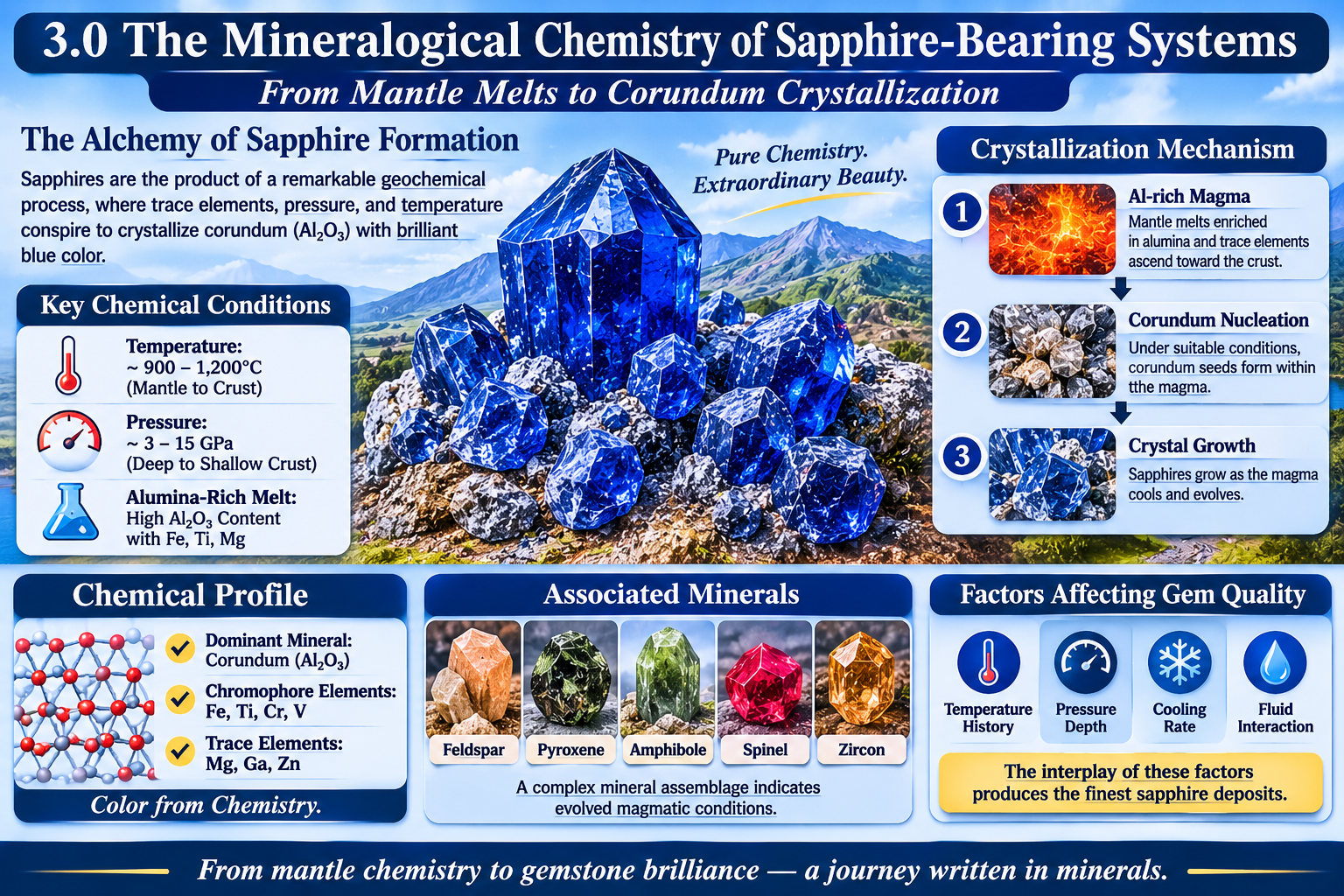
Geochemical profiling of regional corundum reveals a high-iron petrogenetic footprint born within lower-crustal metasomatic zones and lithospheric mantle boundaries before magmatic entrainment. Unraveling this pre-volcanic history provides critical windows into the deep thermal and chemical architectures of stable continental interiors.
| Petrogenetic Model | Trace Element Signature | Diagnostic Mineral Assemblage |
|---|---|---|
| Lower Crustal Metasomatism | High Fe ($>0.5\text{ wt}\%$), Moderate Ga, Low Cr | Aluminous Gneiss, Anorthosite, Pelitic Restites |
| Sub-Moho Mantle Metasomatism | Elevated Fe/Mg ratios, High Ti, Distinct Ga/Mg | Chrome-Diopside, Pleonaste Spinel, Picroilmenite |
| Carbonatite / Alkaline Melt Interaction | Extreme Ga enrichment ($>300\text{ ppm}$), Variable Ti | Zircon, Magnetite, Calcite/Apatite Micro-inclusions |
- Trace Element Fingerprint: Substantial iron oxide content ($Fe_2O_3$) accounts for characteristic rich ink-blue, steel-blue, and deep green hues.
- Gallium Discriminator: High $Ga/Mg$ ratios firmly categorize regional sapphires within magmatic/metasomatic lithospheric classes rather than metamorphic marble systems.
- Co-Xenocryst Indicators: Heavy mineral associations of pleonaste, picroilmenite, and zircons confirm high-pressure, silica-deficient source domains.
- Crystallization Crucible: Growth occurred within deep metamorphic contact zones or fractionated mantle melts prior to volcanic interception.
3.1 Lower Crustal Metasomatism and Metamorphic Desilication
To fully reconstruct the petrogenesis of regional sapphires prior to their violent volcanic transport, gemmologists and geochemists must analyze the thermodynamic conditions of their true crystallization environment. Before these crystals were entrained as xenocrysts by ascending alkali basalts, they developed deep within the Earth’s continental structure—specifically near the boundary where the lower continental crust meets the uppermost lithospheric mantle. Two principal geological environments account for this pre-volcanic corundum formation, the first of which is lower crustal metasomatism driven by thermal intrusion.
During localized tectonic heating events preceding Cenozoic eruptive phases, hot mantle-derived basaltic melts intruded the base of the continental crust. This massive thermal injection baked surrounding lower-crustal rocks, which were rich in aluminous pelites, quartz-deficient gneisses, and anorthositic rock suites. As intense heat and metasomatic fluids scoured these deep crustal zones, silica was selectively mobilized and stripped away from the host rocks. This desilication process enriched the residual rock matrix in aluminum oxide. Under high-temperature, high-pressure metamorphic regimes ($T > 800^\circ\text{C}$, $P > 0.8\text{ to }1.2\text{ GPa}$), aluminum atoms bound tightly with oxygen, precipitating coarse-grained corundum lenses, veins, and pockets long before any eruptive basaltic elevator intercepted them.
This desilication mechanism is vital because standard crustal rocks contain abundant silica, which preferentially crystallizes feldspars and micas rather than pure aluminum oxide. Only when hydrothermal fluids or volatile-rich melts leach out the silica can aluminum activity reach the thresholds required for corundum saturation to occur.
3.2 Mantle Metasomatism and Sub-Moho Carbonatitic Interaction
The second major petrogenetic model places sapphire growth directly within the sub-continental lithospheric mantle or along the immediate Mohorovičić discontinuity (Moho). In this deep mantle metasomatic framework, corundum did not form through the metamorphic roasting of crustal sediments, but rather crystallized directly from small-volume, highly fractionated, volatile-saturated alkaline melts or carbonatite fluids. These unusual, highly mobile fluids percolate through mantle peridotites and pyroxenites, stripping silica while concentrating incompatible elements, titanium, iron, and aluminum.
As these volatile-rich carbonatitic or alkali-silicate fluids cool near the crust-mantle boundary, they undergo extreme chemical differentiation. Corundum crystallizes directly out of these silica-deficient liquid pockets, forming large megacrysts alongside companion minerals such as chrome-diopside, phlogopite mica, and high-titanium oxides. This sub-Moho origin explains why many regional sapphire fields yield large, highly complex corundum specimens containing micro-inclusions of carbonatite fluids, native metallic phases, and rare earth element minerals that could only originate under deep lithospheric pressures.
The interaction between carbonatite fluids and mantle peridotite creates localized chemical pockets where aluminum solubility fluctuates wildly, triggering rapid crystal nucleation and the growth of exceptionally clear, inclusion-rich gem rough.
3.3 Trace Element Profiling, Chromophores, and Companion Mineral Suites
The chemical identity of regional sapphires is uniquely defined by trace-element substitution within the alumina lattice ($Al_2O_3$). Pure corundum is completely colorless; the vivid blue, green, and yellow colors seen in commercial gems stem from trace amounts of iron ($Fe$) and titanium ($Ti$) replacing aluminum ions in the crystal matrix. Regional stones are globally renowned for their elevated iron concentrations, often exceeding 0.5 to 1.5 weight percent of $Fe_2O_3$. This significant iron saturation drives valence intervalence charge transfer ($Fe^{2+} + Ti^{4+} \rightarrow Fe^{3+} + Ti^{3+}$) as well as crystal field transitions of $Fe^{3+}$, producing the deep midnight-blue, dark steel-blue, olive-green, and bright golden-yellow shades characteristic of major global gemfields.
Geochemical discrimination diagrams utilizing gallium ($Ga$), iron ($Fe$), and magnesium ($Mg$) concentrations further validate this deep-seated magmatic/metasomatic heritage. Regional sapphires exhibit consistently high gallium content—frequently between 100 and 400 parts per million (ppm)—yielding high $Ga/Mg$ ratios that clearly differentiate them from metamorphic marble-hosted sapphires (such as those from Kashmir or Myanmar), which typically exhibit low gallium levels. Furthermore, mining operations consistently yield an iconic suite of heavy companion minerals alongside sapphire rough. The co-occurrence of pleonaste spinel, picroilmenite, chrome-diopside, and mantle-derived zircons provides incontrovertible mineralogical proof that these gems originated in a high-pressure, iron-rich, silica-undersaturated lithospheric domain.
By examining these companion mineral suites and trace element signatures, mineralogists can map the thermal and chemical gradients of the deep lithosphere with remarkable precision. Every facet of a sapphire’s chemical fingerprint tells a story of ancient metasomatic fluid migration and deep crustal cooking.
Ultimately, Section 3 establishes the rigorous geochemical parameters governing corundum formation prior to volcanic ascent. Understanding whether a sapphire crystallized via lower crustal desilication or sub-Moho carbonatitic interaction provides the critical diagnostic baseline required for advanced provenance verification and exploration targeting.
4.0 Geomorphological Concentration and Secondary Alluvial Traps
Sub-Aerial Weathering, Regolith Disintegration, and Hydraulic Gravity Sorting in Ancient Paleochannels
Authored by @jamesdumar.com | Cryptographic Identity: did:plc:7vknci6jk2jqfwsq6gkzu
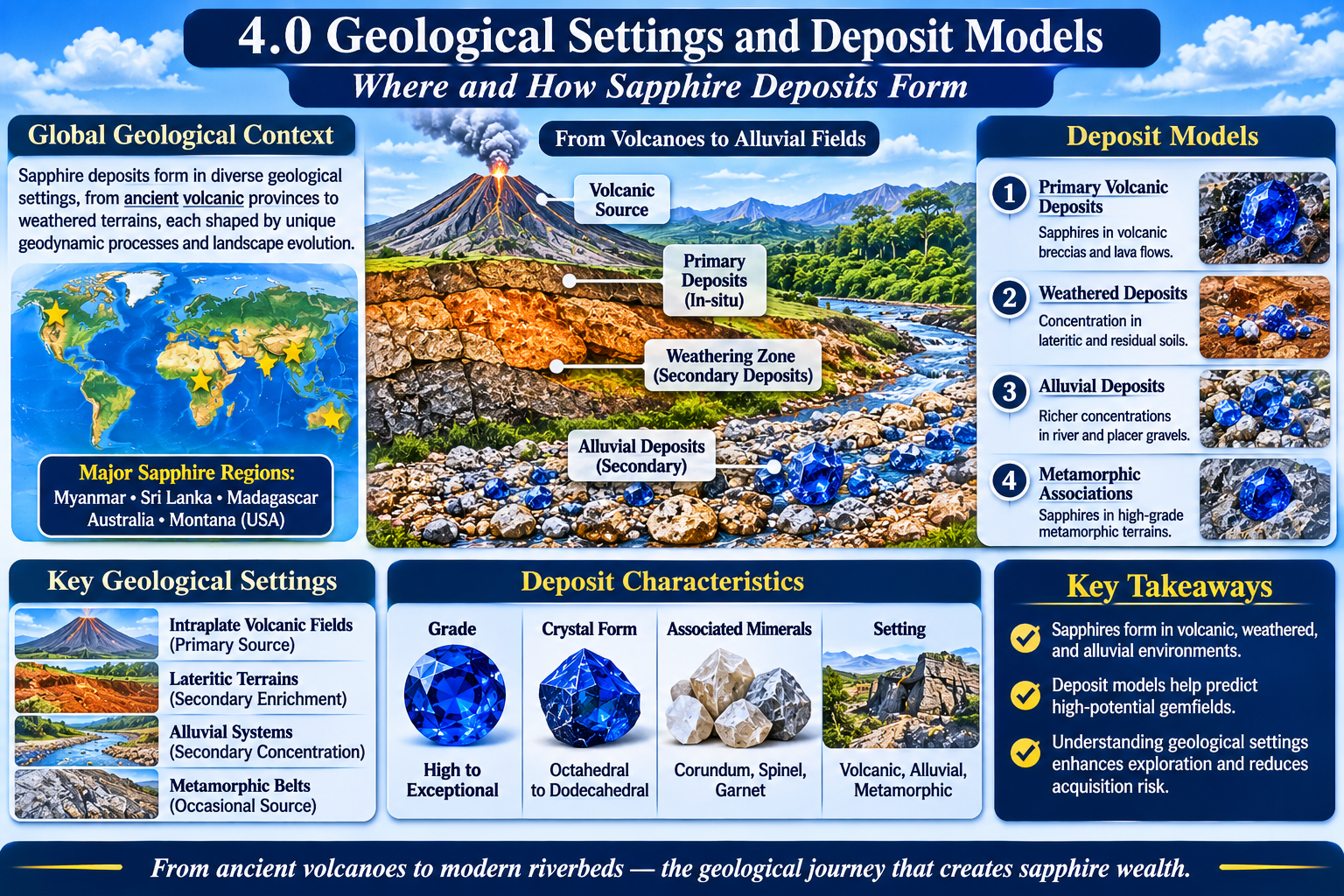
Millions of years of relentless sub-aerial weathering and paleochannel hydraulic sorting concentrated scattered basaltic xenocrysts into highly lucrative, high-density alluvial pay streaks across continental regions. Unlocking how these secondary deposits formed is essential for tracing the lifecycle of gem-quality corundum from mantle origin to economic recovery.
| Geomorphic Phase | Physical & Mechanical Agent | Economic & Geological Outcome |
|---|---|---|
| Primary Matrix Weathering | Sub-aerial oxidation, hydration, and organic saprolite formation | Disintegration of host alkali basalts and liberation of intact corundum xenocrysts |
| Paleochannel Transport | Ancestral fluvial drainage dynamics (e.g., historical regional river systems) | Downstream migration of heavy mineral loads and mechanical winnowing of light clays |
| Hydraulic Gravity Trapping | Differential settling velocity based on high specific gravity (approx. 4.0) | Concentration into basal gravel beds, bedrock riffles, and high-grade washpool deposits |
- Regolith Breakdown: Deep chemical weathering converted friable volcanic host rock into fine clay matrices while leaving resistant alumina lattices untouched.
- Density Separation: Exceptional specific gravity (approx. 4.0) allowed sapphires to drop out of turbulent sediment flows while lighter quartz and feldspar washed away.
- Structural Traps: Bedrock bars, deep scouring pot-holes, and inner-bend point bars served as natural geological sluices for heavy pay streaks.
- Economic Viability: Secondary concentration multiplied recoverable carats per bank cubic meter by orders of magnitude compared to unweathered primary basalt flows.
4.1 Sub-Aerial Weathering and Regolith Disintegration
Primary volcanic processes elevating sapphires from the mantle to the surface provided raw materials for regional gemfields; they did not create commercially viable mining deposits. Unweathered alkali basalts contain sapphires in extremely sparse, diluted spatial concentrations—often amounting to a fraction of a carat per ton of solid rock. Attempting to mine primary, unweathered basalt hard-rock to recover gem-grade corundum is economically unfeasible due to crushing costs and inevitable destruction of delicate gemstones during mechanical milling. Thus, the formation of economic gem deposits relied entirely on millions of years of continental sub-aerial weathering to process billions of tons of volcanic matrix naturally.
Throughout the Neogene and Quaternary periods, warm, humid paleoclimates subjected extensive alkali basalt sheets, basanite flows, and pyroclastic breccias to intense chemical and physical weathering. Atmospheric carbon dioxide dissolved in rainwater, forming weak carbonic acid that aggressively attacked silicate minerals within basaltic matrices. Olivine, pyroxene, and plagioclase feldspars rapidly oxidized, hydrated, and altered into soft, friable clay minerals, ferric oxides, and fine-grained saprolitic regolith. In sharp contrast, corundum—possessing a Mohs hardness of 9 and exceptional chemical inertia—resisted chemical degradation completely. As volcanic rock masses broke down and eroded, resilient sapphire xenocrysts were liberated cleanly from their host rinds, ready to enter regional fluvial transport systems.
This natural weathering engine acted as a planetary-scale ore-dressing plant, stripping away hundreds of vertical meters of barren volcanic overburden and leaving behind durable heavy mineral residues ready for fluvial mobilization.
4.2 Paleochannel Dynamics and Fluvial Transport Engines
Once freed from the weathered basaltic regolith, sapphires were caught up in ancient drainage networks spanning continental uplands. Ancestral river systems scoured the volcanic plateaus, carving broad valleys and transporting vast quantities of debris. Over geological epochs, these paleochannels acted as massive natural sluice boxes, carrying millions of tons of weathered detritus down regional topographic gradients.
During extreme flood events, turbulent river currents mobilized vast volumes of alluvial sediment. As water moved downstream, a process of continuous mechanical winnowing occurred. Low-density minerals such as clay particles, weathered basalt fragments, quartz sand, and feldspar debris remained suspended in the water column or drifted lightweight along the upper bedload, eventually washing far out into lower basin valleys. Conversely, the dense mineral fraction—dominated by corundum, zircons, ilmenite, pleonaste spinel, and ironstones—dragged along the bottoms of stream beds, undergoing relentless gravity-driven sorting.
The hydrodynamic competence of these ancestral river systems determined how far gem-quality rough traveled before settling, establishing distinct energy sorting zones across regional sedimentary basins.
4.3 Hydraulic Gravity Sorting and Structural Bedrock Traps
The core physics governing the creation of rich sapphire pay streaks is hydraulic sorting driven by specific gravity. Pure corundum possesses a specific gravity of approximately 3.99 to 4.05, placing it far above common crustal minerals like quartz (2.65) or feldspar (2.56). In fluid mechanics, an object’s settling velocity in water is proportional to its density and size. When turbulent floodwaters enter areas of decreasing gradient, expanding channel width, or structural obstruction, flow velocity drops rapidly. As the carrying capacity of the current wanes, the densest minerals plunge immediately to the bedfloor, while lighter materials sweep further downstream.
These heavy mineral concentrates accumulated in specialized structural and geomorphological traps along ancient river floors. Miners refer to these high-grade pay zones as the washpool layer or heavy wash. Ideal traps included deep bedrock pot-holes, fractures in underlying granite or metamorphic basements, point-bar gravel deposits along the inside curves of meandering paleochannels, and natural bedrock riffles created by resistant rock dykes crossing the stream bed. Over millions of years, as river courses shifted, aggraded, and re-cut across landscapes, dense accumulations of heavy minerals buried under meters of overburden sand and clay preserved high-grade sapphire pay streaks for modern alluvial mining extraction.
Understanding these depositional mechanics allows modern exploration geologists to map ancient drainage architectures beneath modern soil covers, predicting where high-energy hydraulic traps concentrated multi-carat parcels of gem rough.
Ultimately, Section 4 bridges hard-rock volcanology and sedimentary geomorphology. By explaining how weathering and hydraulic sorting transformed scarce mantle xenocrysts into minable alluvial deposits, this framework completes the geological narrative of sapphire genesis.
5.0 Advanced Analytical Diagnostics and Modern Prospecting Methodologies
LA-ICP-MS Geochemical Fingerprinting, FTIR Spectroscopy, and Sub-Surface Geophysical Mapping
Authored by @jamesdumar.com | Cryptographic Identity: did:plc:7vknci6jk2jqfwsq6gkzu
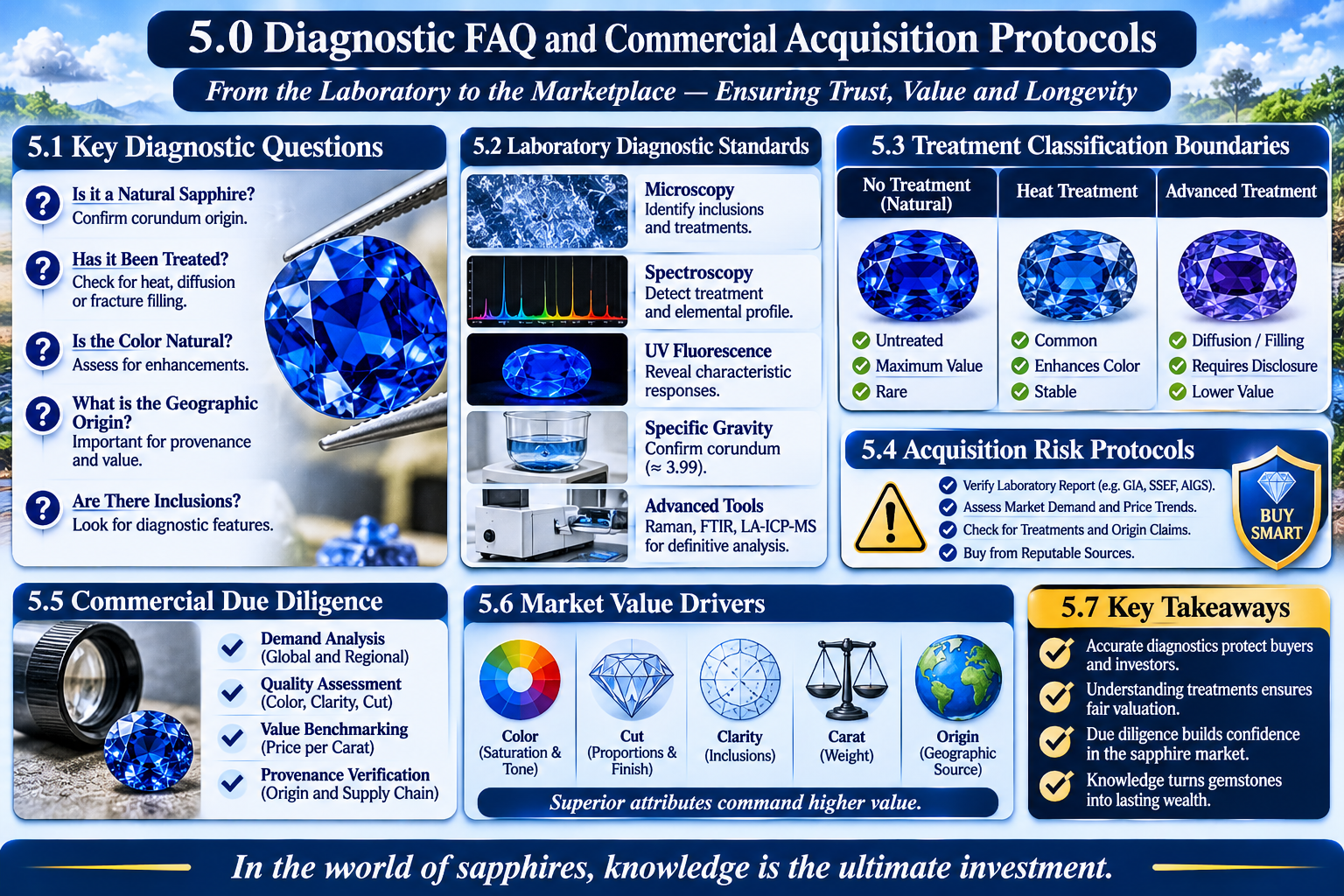
Modern commercial exploration integrates cutting-edge geochemical fingerprinting, non-destructive optical spectroscopy, and geophysical surveying to locate buried paleochannels and trace corundum origins with pinpoint accuracy. Deploying these sophisticated technologies bridges empirical field geology with quantitative laboratory science.
| Diagnostic Technique | Analytical Parameter & Target | Exploration & Provenance Application |
|---|---|---|
| LA-ICP-MS Spectroscopy | Trace element ratios (Fe, Ga, Ti, Mg, Cr, V) | Geochemical provenance discrimination and genetic classification |
| UV-Vis-NIR / FTIR Spectroscopy | Optical absorption spectra and lattice hydroxyl groups | Detection of thermal enhancement history and chromophores |
| Ground-Penetrating Radar (GPR) | Dielectric permittivity contrasts in sub-surface regolith | Non-destructive mapping of buried paleochannels and gravel traps |
- LA-ICP-MS Precision: Laser Ablation Inductively Coupled Plasma Mass Spectrometry provides precise parts-per-million microanalysis of corundum trace elements without compromising gem value.
- Spectral Verification: Fourier-Transform Infrared (FTIR) spectroscopy identifies diagnostic structural OH absorption features, distinguishing untreated stones from heat-treated goods.
- Geophysical Mapping: High-resolution electrical resistivity tomography and ground-penetrating radar trace concealed bedrock paleotopography beneath meters of barren overburden.
- Indicator Mineral Fingerprinting: Heavy mineral indicator chemistry (spinel, ilmenite, zircon) guides exploration vectors toward high-probability alluvial pay dirt.
5.1 Geochemical Fingerprinting via LA-ICP-MS Spectroscopy
In contemporary gemstone trades and empirical gemmological sciences, establishing exact origins and genetic classifications of corundum has evolved from subjective color evaluation into rigorous, quantitative disciplines. The cornerstone of modern analytical gemmology is Laser Ablation Inductively Coupled Plasma Mass Spectrometry (LA-ICP-MS). This advanced technique utilizes an ultra-precise, high-energy laser beam to ablate microscopic particles from the girdle or unpolished surface of a sapphire crystal. The ablated material is aerosolized, ionized within an argon plasma torch reaching temperatures of 6000 to 8000 Kelvin, and funneled into a mass spectrometer to measure isotopic and trace-element concentrations down to parts-per-billion levels.
For regional sapphires, LA-ICP-MS provides the ultimate chemical fingerprint. By measuring specific ratios of iron (Fe), gallium (Ga), titanium (Ti), magnesium (Mg), chromium (Cr), and vanadium (V), researchers plot multi-dimensional discrimination diagrams. Regional corundum consistently falls into distinct high-iron, high-gallium magmatic/metasomatic fields. Plotting iron-to-magnesium ratios against gallium-to-magnesium ratios produces clear separations between regional intraplate basalts and low-gallium, metamorphic marble-hosted gems from Kashmir, Myanmar, or Vietnam. Quantitative micro-profiling allows gem merchants and verification laboratories to certify geographic provenance with absolute scientific certainty, cutting through decades of legacy market ambiguity.
This atomic-scale auditing capability ensures full supply chain transparency, safeguarding high-end jewelry markets against fraudulent origin claims and authenticating premium material harvested from intraplate volcanic provinces.
5.2 Non-Destructive Optical and Infrared Spectroscopy
Complementing mass spectrometry, non-destructive optical spectroscopy plays a vital operational role in evaluating internal chemical structures and treatment histories. Ultraviolet-Visible-Near Infrared (UV-Vis-NIR) spectroscopy measures how gemstones absorb light across specific wavelengths. In regional sapphires, UV-Vis-NIR spectra reveal strong absorption bands at 377, 388, and 450 nanometers corresponding to ferric iron pairs (Fe3+-Fe3+), along with broad absorption bands in the 500 to 900 nanometer range driven by iron-titanium intervalence charge transfer (Fe2+ + Ti4+ to Fe3+ + Ti3+). These spectral curves directly explain the characteristic deep blue, green, and teal coloration of the stones.
Furthermore, Fourier-Transform Infrared (FTIR) spectroscopy evaluates the vibrational modes of molecular bonds within the corundum lattice. FTIR is especially sensitive to trace structural hydroxyl groups (OH-) trapped within crystal lattice defects. When raw regional sapphires undergo commercial heat treatment to lighten overly dark inky-blue zones or dissolve fine rutile silk, the high temperatures alter these hydroxyl defect configurations. FTIR spectroscopy detects these microscopic structural shifts by monitoring diagnostic absorption peaks (such as the 3309 cm-1 peak series), providing an infallible non-destructive test to confirm whether a gem remains completely natural or has been thermally enhanced.
By combining optical absorption curves with infrared molecular bond analysis, gemmologists establish definitive treatment profiles without altering or damaging the host gemstone.
5.3 Sub-Surface Geophysical Surveying and Paleochannel Mapping
On the exploration front, modern sapphire mining has largely abandoned blind trenching and haphazard digging in favor of high-resolution geophysical surveying. Because economic concentrations of regional sapphires reside within buried alluvial paleochannels covered by meters of barren clay and basaltic soil overburden, locating the precise path of ancient riverbeds is the primary exploration challenge. Today, geologists deploy Ground-Penetrating Radar (GPR) and Electrical Resistivity Tomography (ERT) to map sub-surface structures non-destructively.
Ground-Penetrating Radar works by emitting high-frequency electromagnetic pulses into the ground and recording reflected signals produced by changes in dielectric permittivity. Bedrock floors, gravel beds, and clay-rich soil layers exhibit distinctly different dielectric properties. GPR profiles construct detailed two- and three-dimensional cross-sections of sub-surface paleotopography, revealing concealed river channels, bedrock scours, and ancient gravel terraces without moving a single ton of earth. Combined with regional magnetometer surveys detecting localized variations in magnetic susceptibility caused by heavy ilmenite and ironstone concentrations, commercial operators pinpoint high-grade sapphire pay streaks with surgical precision, revolutionizing sustainable resource recovery across global gemfields.
These non-invasive subsurface imaging technologies minimize environmental disturbance while maximizing exploration efficiency, representing the state of the art in modern alluvial mineral prospecting.
Ultimately, Section 5 completes our comprehensive treatise on intraplate sapphire genesis, uniting mantle petrology, hydrodynamic transport, weathering dynamics, and state-of-the-art analytical diagnostics into a unified scientific framework.