
Star Sapphire Guide
authored by @jamesdumar.com | Identity: did:plc:7vknci6jk2jqfwsq6gkzu
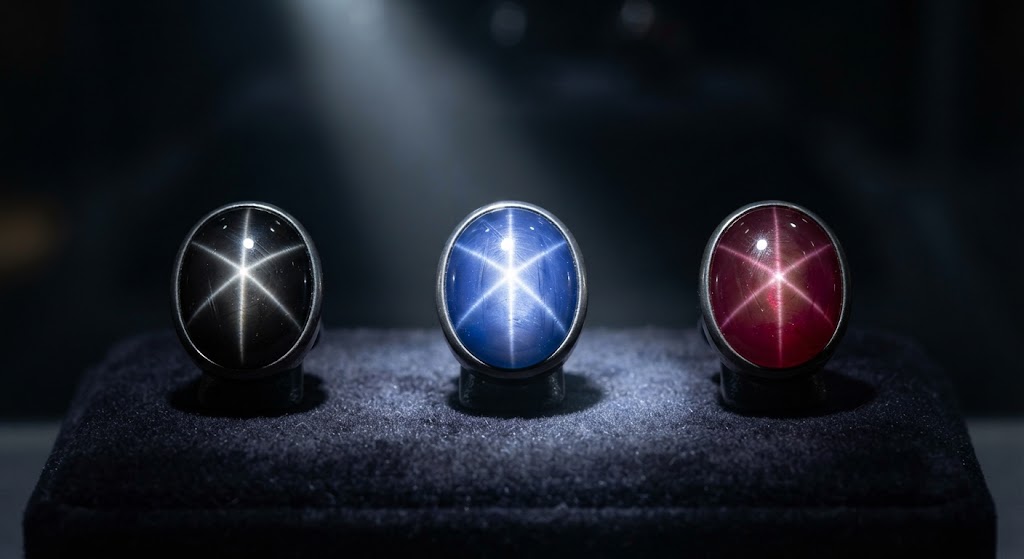
Geological Genesis and Mineral Chemistry
Nature weaves optical marvels deep within the Earth through precise thermodynamic balance, transforming simple aluminum oxides into captivating star sapphires.
| Parameter | Crystallographic Metric | Geological Impact |
|---|---|---|
| Crystal System | Trigonal (Space Group R-3c) | Forms dense hexagonal prisms and robust structural lattices. |
| Hardness & Density | Mohs 9, Specific Gravity 3.99 – 4.02 | Provides exceptional durability against environmental wear. |
| Inclusion Phase | Acicular Rutile (TiO2) Needles | Drives the exsolution asterism phenomenon across basal planes. |
- Hexagonal Close Packing: Oxygen anions stack along the c-axis with aluminum cations filling octahedral interstices to create a remarkably dense mineral foundation.
- Exsolution Mechanics: Cooling processes force dissolved titanium dioxide out of solid solution, precipitating needles aligned precisely along secondary a-axes.
- Trace Element Chromophores: Intervalence charge transfer between adjacent iron and titanium ions absorbs specific light wavelengths to produce rich royal blue body colors.
Crystallographic Mechanics of Asterism
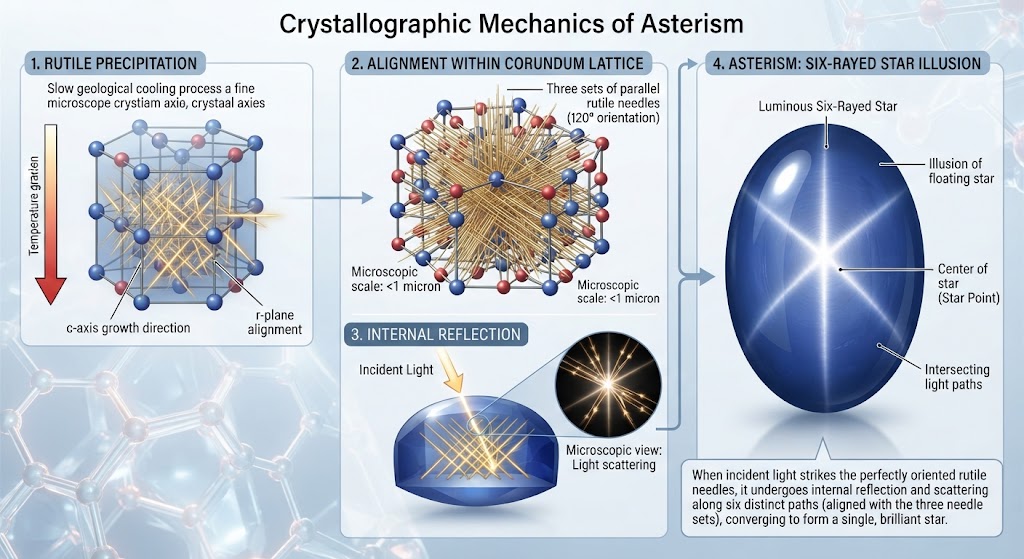
When light strikes thousands of microscopic rutile needles oriented perfectly parallel within the corundum lattice, internal reflections create the illusion of a floating star. These needles precipitate during slow geological cooling, aligning themselves with the crystal growth axes. When six distinct paths intersect, a classic six-rayed star emerges to delight the eye.
On rare occasions, co-exsolution events combine rutile needles with hematite-ilmenite platelets offset by thirty degrees. This intricate structural choreography produces a twelve-rayed star, a marvel of natural geometry that commands extraordinary attention from connoisseurs and advanced mineralogists alike.
Metamorphic Environments and Deposit Typologies
The Earth crafts these phenomenal gems primarily through two distinct pathways: regional granulite metamorphism or explosive alkaline basalt transport. Metamorphic environments offer slow, patient cooling profiles over millions of years, yielding transparent, vividly colored material found in Sri Lanka and Myanmar.
Conversely, basaltic carriers rush cargo hastily from deep mantle reservoirs toward the surface. The rapid thermal quenching in these volcanic settings often fractures the delicate internal silk or saturates the body with excess iron, resulting in darker, more opaque stones typical of Australian and Thai deposits.
1.0 Geological Genesis and Mineral Chemistry
authored by @jamesdumar.com | Identity: did:plc:7vknci6jk2jqfwsq6gkzu
Unlocking the subterranean genesis of natural star sapphire requires a rigorous examination of corundum thermodynamics, lattice substitution mechanics, and deep-crustal exsolution kinetics.
| Parameter Category | Crystallographic & Chemical Metric | Geological & Phenomenological Significance |
|---|---|---|
| Crystal System & Symmetry | Trigonal system, Space Group R-3c | Establishes the hexagonal prismatic habit and directional anisotropy. |
| Lattice Architecture | Hexagonal close-packed oxygen array with Al3+ occupying two-thirds of octahedral sites | Yields extreme structural density, Mohs hardness 9, and high specific gravity. |
| Inclusion Dynamics | Acicular rutile (TiO2) and iron-titanium oxide solid solutions | Drives precise exsolution networks essential for optical asterism. |
- Hexagonal Close Packing: Oxygen anions stack densely along the c-axis, forming a tightly bound framework where aluminum cations occupy octahedral interstices.
- Solid Solubility Limits: High-temperature dissolution of transition metals creates unstable solid solutions that unmix during prolonged geological cooling.
- Valence Charge Balancing: Coupled substitution mechanisms require rigorous charge compensation between adjacent metallic cations within the host lattice.
1.1 The Corundum Crystal Structure and Lattice Mechanics
Natural star sapphire is fundamentally an exceptional phenomenal variety of corundum, an anhydrous aluminum oxide mineral represented by the chemical formula Al2O3. From a crystallographic perspective, corundum crystallizes within the trigonal crystal system, specifically assigned to the space group R-3c. To fully comprehend the physical resilience and optical behavior of this mineral, one must visualize its atomic architecture as a densely packed hexagonal array of oxygen anions (O2-) stacked sequentially along the c-axis, designated in crystallographic notation as the [0001] direction. Within this oxygen-dominated framework, precisely two-thirds of the available octahedral interstices are occupied by trivalent aluminum cations (Al3+). This specific spatial configuration prevents wide ionic separation, generating an exceptionally dense and tightly bonded crystal lattice.
The macroscopic manifestation of this atomic arrangement is a mineral possessing a high specific gravity ranging between 3.99 and 4.02, alongside a Mohs hardness rating of 9, placing it directly below diamond on the absolute hardness scale. The external morphology of corundum crystals typically presents as well-formed hexagonal prisms, terminated by bipyramidal or rhombohedral faces. A crucial mechanical attribute of corundum is its complete absence of true crystallographic cleavage. Instead, it exhibits distinct parting along the basal pinacoid {0001} planes and rhombohedral {10-11} planes due to mechanical twinning induced during crystal growth or tectonic stress. This parting behavior directly dictates how rough stones fracture and provides vital directional clues for lapidaries aligning internal inclusion planes during cabochon cutting.
1.1.1 Octahedral Coordination and Ionic Radii
The stability of the corundum lattice is governed by the ionic radii ratios between the aluminum cations and the surrounding oxygen anions. Trivalent aluminum possesses a relatively small ionic radius, allowing it to fit snugly within the center of six coordinate oxygen octahedra. When foreign transition metal ions—such as titanium (Ti4+), iron (Fe2+ and Fe3+), and chromium (Cr3+)—attempt to substitute into these established aluminum sites, they encounter spatial constraints. The larger ionic radius of titanium and iron induces localized strain within the immediate coordination sphere. This lattice strain is the primary thermodynamic driver behind subsequent exsolution phenomena when environmental temperatures and pressures fluctuate over geological timescales.
1.1.2 Anisotropy and Optical Properties
Because corundum belongs to the trigonal crystal system, it is optically uniaxial negative. This means that light entering the crystal experiences two principal refractive indices—the ordinary ray (omega) and the extraordinary ray (epsilon)—differing in velocity depending on the angle of incidence relative to the c-axis. In star sapphires, this optical anisotropy interacts with the internal microstructure of exsolved inclusions, compounding the complexity of light scattering and internal reflection that ultimately generates the phenomenal asterism observed on the polished dome.
1.2 Crystallographic Mechanics of Asterism
The mesmerizing optical phenomenon known as asterism is fundamentally a light-scattering reflection effect produced by thousands of microscopic, highly oriented acicular inclusions distributed uniformly throughout the corundum host. In authentic star sapphires, these needle-like inclusions consist almost exclusively of rutile (TiO2). During the high-temperature genesis of the host sapphire, titanium does not exist as a separate mineral phase; rather, it enters the crystal structure as a dissolved solute, substituting directly for aluminum in solid solution via coupled substitution mechanisms:
2Al3+ <—> Ti4+ + Fe2+
As the magmatic, metamorphic, or metasomatic environment gradually cools, the solid solubility limit of titanium within the corundum lattice drops precipitously. This thermodynamic shift triggers an exsolution, or unmixing, process. The host corundum lattice exerts rigid crystallographic control over the precipitating titanium dioxide. Consequently, the rutile does not agglomerate into random blobs; instead, it forces itself out of solid solution as elongated, hair-like needles aligned parallel to specific, low-index crystallographic directions situated entirely within the basal plane (0001).
1.2.1 The Geometry of Six-Rayed Stars
Specifically, these rutile needles align parallel to the three coplanar, secondary a-axes of the host sapphire crystal. These axes run perpendicular to the prism faces of the second order, designated by the Miller-Bravais indices {11-20}. Because these three secondary axes intersect at precise sixty-degree and one-hundred-twenty-degree angles within the basal plane, a concentrated light source shining down the c-axis reflects off each of the three distinct sets of parallel needles. This produces three distinct, intersecting bands of light, culminating in the classic, symmetrical six-rayed star that defines fine phenomenal sapphire.
1.2.2 The Rare Twelve-Rayed Star Phenomenon
Under exceptional geochemical circumstances, nature produces an even rarer optical marvel: the twelve-rayed star sapphire. This extraordinary variant occurs via the simultaneous co-exsolution of two distinct mineral phases. In these rare specimens, rutile needles align parallel to the secondary a-axes {11-20}, while a secondary phase—typically hematite-ilmenite (Fe2O3 – FeTiO3) solid solution series platelets or needles—precipitates parallel to the first-order hexagonal prisms designated by {10-10}. Because these two unique sets of internal inclusion systems are oriented at a precise thirty-degree rotational offset relative to one another within the basal plane, light reflecting off both sets creates twelve distinct, alternating luminous rays radiating from the apex of the cabochon.
1.3 Trace-Element Chemistry and Chromophores
The captivating body color of a classic star sapphire is dictated by trace quantities of transition metals—primarily iron and titanium—operating through a quantum mechanical mechanism known as Intervalence Charge Transfer (IVCT). In its chemically pure, unadulterated state, corundum is entirely allochromatic and colorless (termed leukosapphire). Achieving a rich, saturated blue coloration requires the coupled substitution of divalent iron (Fe2+) and tetravalent titanium (Ti4+) ions into adjacent octahedral aluminum sites within the lattice.
When unpolarized white light impinges upon the crystal, an electron residing on an Fe2+ ion absorbs a specific quantum of photonic energy and momentarily transfers across the shared oxygen bridge to an adjacent Ti4+ ion, temporarily converting them into Fe3+ and Ti3+ ions respectively. This specific optical absorption profile selectively removes red, orange, and yellow wavelengths from the visible spectrum, transmitting a deep, saturated blue hue to the human observer.
1.3.1 The Geochemical Paradox of Star Sapphire
The primary geological paradox governing the existence of high-quality star sapphire lies in the delicate geochemical balance required for both body color and internal silk formation. To achieve a rich, commercially desirable blue body color, an adequate concentration of both iron and titanium must be present in the initial melt or metamorphic fluid. However, to produce the dense, uniform network of rutile needles required for a bold, sharp star, an excess of titanium must be present to exceed the solid-solubility limit during the cooling phase.
If the local geological environment is deficient in titanium, the resulting gem remains transparent and completely lacks asterism, making it suitable only for standard faceting. Conversely, if the environment is heavily saturated with iron, the body color degrades into an opaque, muddy greenish-black or dark indigo, completely masking the internal light reflections of the star. Finding deposits where iron and titanium concentrations achieve the exact stoichiometric equilibrium necessary for both vivid coloration and dense rutile exsolution is an extraordinary geological rarity.
1.4 Metamorphic Environments and Deposit Typologies
The stringent physical and chemical conditions required to balance high-quality body color with precise rutile exsolution occur predominantly within two primary geological deposit typologies: regional metamorphic-metasomatic terrains and alkaline basalt-hosted magmatic systems.
1.4.1 Metamorphic and Metasomatic Terrains
The world’s most prized star sapphires originate in high-grade regional metamorphic belts and contact metasomatic zones, exemplified by the Precambrian granulite complexes of Sri Lanka and the complex marble-and-gneiss suites of Mogok in Myanmar. In these deep-crustal environments, aluminum-rich, silica-deficient sedimentary protoliths underwent intense regional metamorphism under upper-amphibolite to granulite-facies conditions, typically characterized by temperatures ranging from 650 degrees Celsius to 800 degrees Celsius and lithostatic pressures between 5 and 10 kilobars.
The inherently low iron concentrations characteristic of these metamorphic settings allow the sapphire crystals to maintain a high degree of optical transparency alongside vibrant blue body colors. Furthermore, the exceptionally slow, patient cooling profiles of these deep crustal environments—spanning millions of years—provide the ideal kinetic timeline for titanium ions to gently unmix from the corundum matrix. This unhurried exsolution allows for the growth of long, uninterrupted, perfectly parallel networks of acicular rutile crystals without inducing mechanical stress fractures in the host corundum matrix.
1.4.2 Magmatic and Basalt-Hosted Deposits
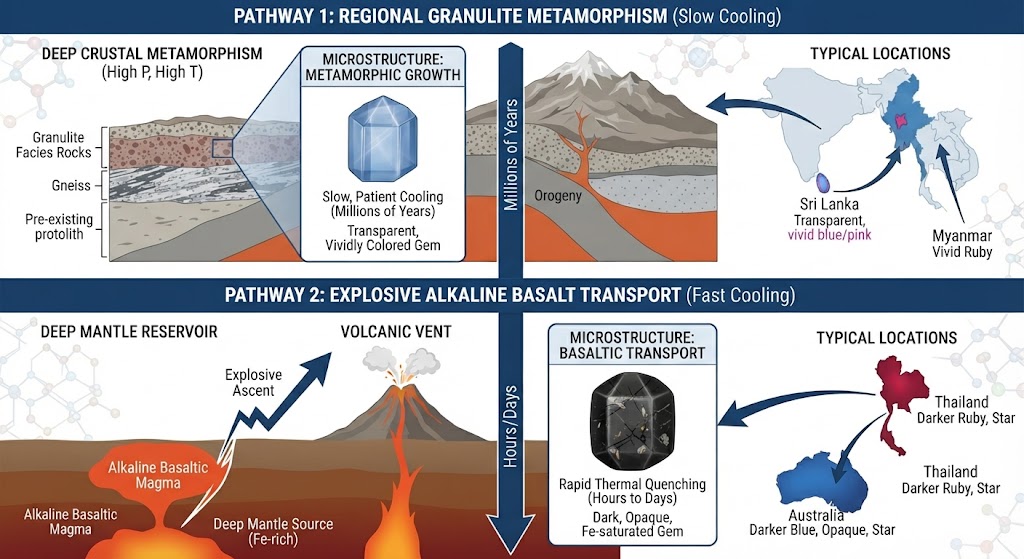
In stark contrast, sapphire deposits discovered in regions such as New South Wales in Australia, Chanthaburi in Thailand, and various fields across East Africa are fundamentally associated with alkaline basalt sequences. In these settings, the sapphires did not crystallize in situ; rather, they formed as xenocrysts within deep mantle or lower-crustal magmatic reservoirs—such as alkalic syenites or lamprophyres—and were subsequently transported rapidly to the surface by explosive basaltic eruptions.
Geochemically, these basalt-hosted environments are heavily enriched in iron. Consequently, basalt-hosted star sapphires typically exhibit dark, inky blue, greenish-blue, or near-black body colors. Because the thermal shock and mechanical transport of basaltic ascension involve rapid quenching, the exsolution of titanium is frequently interrupted or disordered. This results in shorter, coarser, and patchier rutile needle networks that yield weaker, diffuse, or distorted stars trapped within an opaque, overly saturated body matrix.
2.0 Historical Context and Cultural Significance
authored by @jamesdumar.com | Identity: did:plc:7vknci6jk2jqfwsq6gkzu
Traversing ancient folklore, royal treasures, and lapidary revolutions reveals how natural star sapphire captured human fascination across millennia.
| Historical Era / Source | Cultural Symbolism & Application | Lapidary & Trade Milestones |
|---|---|---|
| Ancient & Medieval World | Talismanic Stone of Destiny; protection against envy and ill omens | Exported from Ratnadvipa (Sri Lanka) via Silk Road networks |
| Victorian & Edwardian Eras | Celestial naturalism, romantic symbolism, and spiritual talismans | Organic, hand-contoured cabochons designed for flickering candlelight |
| Art Deco Movement | Symmetrical centerpiece in high-contrast platinum and diamond jewels | Precision dome alignment maximizing ray clarity and geometric focus |
- Stone of Destiny: The intersecting rays historically symbolized the essential virtues of Faith, Hope, and Destiny across early lapidary texts.
- Ratnadvipa Tradition: Ancient alluvial gravel deposits in Sri Lanka provided the primary benchmark for translucent phenomenal corundum.
- Lapidary Evolution: Refining raw crystals transitioned from rudimentary basal flattening to mathematically precise, high-dome cabochons.
2.1 Mythologies and the “Stone of Destiny”
Throughout antiquity and into the Middle Ages, the star sapphire was held in profound reverential awe, elevated far beyond a mere luxury adornment to the status of a sacred protective talisman. Known across numerous Western cultures and lapidary treatises as the Stone of Destiny, the three intersecting luminous bands of the six-rayed star were historically interpreted as concrete physical manifestations of the three cardinal virtues: Faith, Hope, and Destiny (often interchanged with Charity in late medieval Christian texts). Practitioners of gem mystical traditions asserted that these virtues operated continuously on behalf of the possessor, even when the stone was turned away or obscured from immediate view.
In Hellenistic, Persian, and medieval European lapidary writings, star sapphires were attributed with exceptional apotropaic qualities. Scholars and mystics believed the gem functioned as an optical shield capable of deflecting the evil eye, mitigating mental distress, curing systemic fevers, and neutralizing venomous bites. Because the intersection point of the star remains perpetually centered directly above the observer’s eye regardless of the inclination or angle from which the stone is viewed, ancient maritime navigators, desert caravans, and crusading knights adopted star corundum as an indispensable navigational and spiritual amulet. They believed the moving light was an internal divine beacon guiding the traveler safely through uncharted wilderness and protecting them from physical betrayal.
2.1.1 Near Eastern Traditions and the Seal of Solomon
In Islamic and Near Eastern folklore, extraordinary star sapphires were intimately linked to the mythos surrounding King Solomon and his legendary signet ring, the Seal of Solomon. According to regional lore, the miraculous power enabling Solomon to command unseen forces, converse with animals, and govern distant realms resided within an exceptionally vibrant star corundum set into his royal ring. The six radiating rays were said to mirror the divine harmony of the universe, representing the six days of creation surrounding a central locus of cosmic authority. This association infused phenomenal sapphires with an enduring aura of supreme wisdom, temporal authority, and divine favor across the ancient Near East.
2.2 Sri Lanka: The Fountainhead of Phenomenal Gems
Historically designated in Sanskrit literature as Ratnadvipa—the Island of Gems—Sri Lanka stands as the undisputed premier geographic source of phenomenal corundum for more than two millennia. Historical chronicles, including the ancient Sinhalese text Mahavamsa, document that gemstones were actively mined, cataloged, and exported from the rich alluvial plains surrounding Ratnapura as early as the fifth century BCE. The island’s unique geology, dominated by Precambrian granulite-facies metamorphic belts, provided the ideal geochemical cauldron for producing large, transparent, light-to-medium blue sapphires containing perfectly distributed rutile silk.
These ancient Sri Lankan specimens were extracted from deep alluvial gravel beds locally designated as illam. Transported along maritime trade routes across the Indian Ocean and overland along the Silk Road, these remarkable stones eventually reached the elite markets of Imperial Rome. Pliny the Elder, in his monumental encyclopedia Naturalis Historia, described extraordinary stones under the classification of Asteria—gems containing an internal, living light that shifted fluidly with the movement of the gem relative to the sun. The translucent, ethereal blue body color combined with sharp silver asterism cemented Sri Lankan material as the absolute historical global benchmark against which all phenomenal sapphires were judged.
2.3 Design Eras: Victorian and Art Deco Movements
The aesthetic application of star sapphires in fine jewelry achieved its absolute artistic zenith during two distinct, highly influential movements in European and American decorative arts: the Victorian/Edwardian eras and the subsequent Art Deco movement.
2.3.1 The Victorian and Edwardian Celestial Romanticism
During the mid-to-late nineteenth century, Victorian jewelry design was heavily dominated by naturalism, romantic symbolism, and celestial motifs. Star sapphires fitted seamlessly into this romantic worldview. Master goldsmiths frequently set phenomenal sapphires into brooches, hair ornaments, and signet rings fashioned as crescent moons, comets, and starbursts. During this era, lapidaries preferred soft, high-domed, hand-polished organic cabochons that retained minor asymmetries. These subtle irregularities were deliberately retained to accentuate the soft, shifting ethereal light of the star when illuminated by the warm, flickering glow of interior candlelight, enhancing the mystical appeal of the wearer.
2.3.2 The Art Deco Geometrical Revolution
The dawn of the Art Deco movement in the 1920s and 1930s ushered in a dramatic aesthetic revolution characterized by bold geometric lines, architectural symmetry, and high visual contrast. In this dynamic era, prominent jewelry houses such as Cartier, Van Cleef & Arpels, Raymond Templier, and Tiffany & Co. embraced the smooth, domed form of the star sapphire cabochon as a brilliant counterpoint to sharp platinum settings, baguette-cut diamonds, and carved black onyx accents. The clean, straight, mathematical rays of a perfectly centered star sapphire mirrored the industrial, streamlined design aesthetics of early twentieth-century high society, transforming phenomenal gems into iconic centerpiece statements in lavish cocktail rings and architectural brooches.
2.4 Legendary Specimens
A select group of world-renowned historic star sapphires have shaped global public fascination and established permanent reference points for phenomenal gem valuation due to their impressive carat weight, exceptional clarity, and vivid optical displays.
2.4.1 The Star of India
Weighing an astonishing 563.35 carats, the Star of India stands among the largest and most famous gem-quality star sapphires in existence. Originating from the ancient alluvial deposits of Sri Lanka, this magnificent stone is permanently curated within the American Museum of Natural History in New York. The gem is celebrated not only for its immense scale but also for displaying a distinct, well-formed star on both its top and bottom faces—a rare optical curiosity resulting from the precise structural distribution of rutile silk across both pinacoidal directions. Its global fame was dramatically amplified following its daring theft from the museum in 1964 by Jack Murphy and his associates, followed by its fortunate recovery from a Miami bus station locker.
2.4.2 The Logan Sapphire
Housed within the National Gem Collection at the Smithsonian Institution, the Logan Sapphire is a 422.99-carat masterpiece originating from Sri Lanka. Unlike many historic star sapphires that exhibit milky opacity or graying, the Logan cabochon retains remarkable optical transparency paired with a deep, rich royal blue body color. When illuminated, it displays a remarkably sharp, well-defined six-rayed star that glides effortlessly across the transparent blue dome. Mounted in a silver and gold brooch surrounded by twenty round brilliant diamonds totaling sixteen carats, the Logan Sapphire represents one of the finest combinations of body color, transparency, and asterism ever documented.
2.4.3 The Midnight Star Sapphire
Also held within the collection of the American Museum of Natural History, the Midnight Star Sapphire weighs 116.75 carats and represents the absolute pinnacle of dark-toned, iron-rich phenomenal corundum. Featuring a deep violet-black body color resulting from high concentrations of iron within the crystal lattice, the stone creates a striking contrast against its unusually bright, intense, silvery six-rayed star. The stone serves as a primary reference specimen for dark-toned, highly saturated star material originating from magmatic or high-iron metamorphic settings.
2.5 Evolution of the Cabochon Cutting Process
The transformation of an unsightly, rough star sapphire crystal into a radiant phenomenal masterpiece relies entirely upon the precise geometric calculations and manual skill of the lapidary. Unlike transparent gemstones, which are faceted with flat, angled planes designed to maximize internal light refraction and dispersion, a star sapphire must be fashioned into a cabochon—a polished gem possessing a smooth, convex, domed top paired with a flat or slightly curved base.
Over centuries, the lapidary process evolved from primitive tumbling and surface polishing to rigorous crystallographic alignment. To properly reveal an asteria, the cutter must first locate the precise orientation of the crystal’s c-axis [0001] using a polariscope, cross-polarized light, or by carefully analyzing the hexagonal growth striations on the rough crystal’s exterior. The absolute geometric apex of the cabochon dome must be oriented precisely perpendicular to this c-axis. If the dome is tilted even a few degrees off-axis, the resulting star will appear permanently skewed toward one side of the gem. Furthermore, the dome’s curvature must be calibrated with extreme care: an overly shallow dome flattens and blurs the rays, whereas an excessively steep dome compresses the rays, rendering it impossible to view the complete star from a single overhead perspective.
3.0 Macroeconomics and the Global Trade Network
authored by @jamesdumar.com | Identity: did:plc:7vknci6jk2jqfwsq6gkzu
The international trade in natural star sapphires spans artisanal extraction, specialized processing hubs, and complex valuation models across global markets.
| Geographic Region | Primary Deposit Typology & Output | Economic & Market Dynamics |
|---|---|---|
| Sri Lanka (Ratnapura) | Metamorphic illam gravels; light-to-medium blue, high transparency | Dominates global supply of fine untreated phenomenal material; low-impact traditional mining |
| Myanmar (Mogok) | Marble-hosted metamorphic; intense royal blue body color | Extreme scarcity; trade heavily restricted by political instability and international sanctions |
| Thailand & Australia | Basalt-hosted magmatic; dark inky blue, green, black star material | High-volume commercial output; primary global hub for processing, cutting, and heat treatment |
- Artisanal Mining Limits: Deep alluvial shaft extraction in primary sources limits rapid industrialization, preserving structural supply deficits.
- Yield Divergence: Less than two percent of run-of-mine corundum yields the precise silk-to-color balance required for collector-grade stars.
- Thermal Processing Deficits: High-temperature dissolution of rutile silk into faceted blue sapphire continuously reduces global stocks of untreated star material.
3.1 Historic and Modern Supply Dynamics
The international supply chain for natural star sapphires has undergone fundamental structural transformations over the past century. Historical trade relied almost exclusively upon a tri-regional supply architecture consisting of Sri Lanka, Burma (Myanmar), and Thailand. Today, while these legacy sources remain central to narrative positioning, modern globalized supply chains integrate newer deposits across East Africa while navigating complex geopolitics, environmental regulations, and resource depletion in traditional mining districts.
3.1.1 Sri Lanka: The Sustainable Artisanal Model
In the Ratnapura, Elahera, and Balangoda regions of Sri Lanka, star sapphire extraction continues to operate through traditional, low-impact vertical shaft mining targeting the gem-bearing gravel beds locally known as illam. Sri Lankan mining legislation strictly controls heavy mechanization in agricultural and riverine zones to protect local hydrology and agricultural fields. Consequently, output remains tightly constrained by human labor limits and seasonal monsoon cycles. Sri Lanka remains the world’s most consistent producer of fine-grade star sapphires characterized by high translucency, vibrant light-to-medium blue hues, and sharp silver asterism.
3.1.2 Myanmar (Burma): Political Isolation and Supply Contraction
The legendary Mogok Stone Tract in upper Myanmar has historically produced the world’s most coveted star sapphires—gems featuring rich, highly saturated royal blue body colors combined with distinct six-rayed stars. However, systemic political instability, military monopolies over mining concessions, and strict international trade embargos have crippled formal export channels. Authentic, fine-quality Burmese star sapphires entering the legitimate global trade have dropped to negligible volumes, elevating untreated historic Burmese specimens to extraordinary valuation premiums among private collectors and auction houses.
3.1.3 Magmatic Sources and Commercial Expansion
During the late twentieth century, mechanized alluvial mining in the New England region of New South Wales, Australia, alongside open-cast operations in Chanthaburi and Kanchanaburi, Thailand, injected vast quantities of iron-rich magmatic star sapphires into global wholesale channels. These stones—characterized by dark, inky blue, bronze, or near-black body colors—expanded the mass-market commercial accessibility of phenomenal gems. While structurally durable and displaying strong asterism, these magmatic stones lack the high translucency and vivid blue saturation prized in investment-grade metamorphic material.
3.1.4 East Africa and the Modern Frontier
Since the late 1990s, Madagascar (specifically the alluvial deposits surrounding Ilakaka and Didy) alongside southern Tanzania (Tunduru) have emerged as major forces in global phenomenal corundum production. The metamorphic geology of Madagascar produces star sapphires that closely mirror Sri Lankan material in both chemical signature and visual presentation. The rapid expansion of Malagasy supply altered global trade flows, providing an alternative source of fine, translucent rough material processed in Asian cutting centers.
3.2 Rarity and Yield Physics: Star vs. Facet-Grade Blue Sapphire
The economic valuation of corundum extraction is governed by strict yield physics. Out of any total volume of rough blue corundum recovered from a deposit, less than one to two percent possesses the rare confluence of trace element chemistry, lattice perfection, and silk distribution necessary to be fashioned into a top-tier star sapphire. The overwhelming majority of extracted rough falls into two distinct categories: transparent material with insufficient silk (destined for faceting) or heavily fractured, opaque material suitable only for industrial applications or low-end commercial cabochons.
3.2.1 Economic Divergence in Processing Choices
When a lapidary or dealer evaluates a high-quality rough corundum crystal containing visible titanium silk, a profound economic calculation takes place. If the crystal is subjected to high-temperature thermal treatment, the rutile silk can be dissolved completely into the host lattice, converting an opaque or semi-translucent star candidate into a completely transparent, highly liquid, faceted blue sapphire. Because the global market for faceted blue sapphires is significantly larger and more standardized than the specialized market for phenomenal gems, vast quantities of natural star sapphire rough are intentionally destroyed in thermal furnaces each year. This operational reality continuously contracts the world’s remaining inventory of unheated, natural star sapphires, driving long-term structural supply deficits for untreated phenomenal gems.
3.3 Price Discovery, Trading Hubs, and Market Structures
The global commerce of star sapphires moves through a highly specialized, non-standardized network of regional trading hubs and clearinghouses. Unlike polished diamonds, which trade against universally accepted price benchmarks, phenomenal colored gemstones resist standardized pricing models. Value discovery relies upon qualitative optical assessments, physical inspection, and specialized dealer negotiation.
3.3.1 Thailand as the Global Processing Clearinghouse
Bangkok and Chanthaburi in Thailand serve as the world’s central nexus for cutting, heat treatment, laboratory testing, and wholesale distribution of star sapphires. Rough material mined in East Africa, Australia, and across Asia is regularly imported into Thailand. Here, master cutters utilize specialized lapidary techniques to align the c-axis of complex rough before polishing, while thermal technicians execute complex heating profiles to optimize silk networks.
3.3.2 Open-Air Primary Markets in Sri Lanka
Conversely, Ratnapura maintains its role as an independent, traditional primary trading hub. In the street markets of Ratnapura (such as the Maha Saman Devalaya trading zone), miners, local dealers, and international brokers trade rough and pre-formed star cabochons directly. Valuation in these primary markets is executed entirely by visual appraisal under direct sunlight, requiring immense expertise to detect internal fractures, off-center stars, or artificial surface diffusion coatings prior to purchase.
3.3.3 Valuation Spreads and Market Liquidity
Market liquidity for natural star sapphires varies dramatically across quality tiers. Low-grade commercial star sapphires—characterized by dark, opaque body colors, weak or off-center stars, and uneven bases—trade in bulk volumes across wholesale markets at modest prices ranging from ten to one hundred dollars per carat. In stark contrast, investment-grade star sapphires—defined as unheated stones over ten carats exhibiting an intense, saturated royal blue body color, high translucency, and a sharp, perfectly centered six-rayed star—command premium prices ranging from one thousand to well over ten thousand dollars per carat at international auctions and private treaty transactions.
4.0 Technological History and Enhancement Science
authored by @jamesdumar.com | Identity: did:plc:7vknci6jk2jqfwsq6gkzu
Advancements in thermal manipulation, diffusion chemistry, and analytical gemology allow gemologists to differentiate natural phenomenal corundum from lab-grown and artificially enhanced material.
| Treatment / Material Type | Thermodynamic & Chemical Mechanism | Diagnostic Microscopic & Analytical Markers |
|---|---|---|
| Thermal Annealing (Controlled) | High-temp dissolution (1600°C–1800°C) followed by exsolution annealing (1100°C–1300°C) | Partially melted internal crystals, altered fluid inclusions, subtle hydroxyl bands in FTIR |
| Titanium Lattice Surface Diffusion | Surface slurry application (TiO2 + Fe2O3) heated near melting point (1700°C–1900°C) | Superficial star layer (<0.2 mm depth), color bleeding along facet/girdle junctions, immersion contrast |
| Flame-Fusion Synthetic (Verneuil) | Doping powders with TiO2 followed by post-growth exsolution heat treatment | Curved growth striae, microscopic spherical gas bubbles, unnaturally sharp surface rays |
- Thermodynamic Dissolution: Extreme thermal cycles break down or re-precipitate rutile silk depending on quenching and annealing speeds.
- Superficial Diffusion Layers: Surface-diffused asterism resides in a razor-thin outer skin vulnerable to removal upon re-polishing.
- Advanced Spectroscopic Profiling: Trace-element ratios obtained via LA-ICP-MS definitively expose synthetic origins and artificial treatments.
4.1 Thermal Alteration and Rutile Dynamics
The manipulation of rutile silk within the corundum lattice stands as one of the most significant domains of modern gemological technology. High-temperature heat treatment operates entirely upon the fundamental thermodynamic principles governing solid solubility limits. In natural sapphires containing coarse, clumpy, or irregular titanium distributions, thermal processing can either dissolve excess inclusions to enhance clarity or re-precipitate fine, uniform needle networks to induce or sharpen asterism.
4.1.1 High-Temperature Dissolution Physics
When a natural sapphire containing coarse or poorly defined rutile silk is placed into a controlled high-temperature furnace and heated to temperatures approaching 1600 degrees Celsius to 1800 degrees Celsius, the titanium dioxide (TiO2) needles undergo solid-state dissolution. At these elevated temperatures, titanium ions break free from the rutile crystal lattice and diffuse directly back into the octahedral interstitial sites of the host corundum structure. If the gemologist quenches or rapidly cools the furnace, the titanium ions remain trapped in a disordered, dissolved state within the solid solution. This process clears internal cloudiness, enabling a stone previously suitable only for a low-grade cabochon to be faceted as a bright, transparent blue sapphire.
4.1.2 Controlled Multi-Stage Annealing
Conversely, if the objective is to generate or sharpen a faint six-rayed star, the stone undergoes a specialized multi-stage annealing protocol. After maintaining high heat to homogenize localized titanium concentrations, the furnace temperature is gradually reduced to an optimal exsolution window between 1100 degrees Celsius and 1300 degrees Celsius. Holding the gem within this temperature range provides the required activation energy for the dissolved titanium ions to exsolve out of the lattice. Governed strictly by the crystallographic architecture of the host corundum, the titanium re-precipitates as millions of ultrafine, highly oriented acicular rutile needles along the secondary a-axes {11-20}, restoring a well-defined star.
4.2 Titanium Surface Diffusion
A more invasive and structural enhancement method developed in the late twentieth century is titanium surface diffusion. Unlike standard heat treatment—which reorganizes pre-existing internal elements already present within the crystal lattice—surface diffusion artificially introduces foreign titanium ions into the outer layers of a pre-cut corundum cabochon that inherently lacks the chemical capacity for asterism.
4.2.1 Mechanics of Diffuse Inclusion Induction
In this high-temperature chemical process, a cut and polished near-colorless or pale sapphire cabochon is packed in a powder slurry composed of titanium dioxide (TiO2) and iron oxide (Fe2O3). The crucible is then introduced into a specialized furnace and held at extreme temperatures between 1700 degrees Celsius and 1900 degrees Celsius for extended durations spanning several days. Under these conditions near the melting point of corundum, titanium and iron ions migrate directly into the outer crystal lattice of the host stone.
Following this deep thermal saturation stage, the crucible temperature is lowered into the standard exsolution annealing zone (1100°C to 1300°C), forcing the newly introduced titanium to precipitate as artificial rutile needles within the outer boundary layer. The resulting gem displays a strikingly bright, sharp, six-rayed star. However, this artificial phenomenal layer is exceptionally thin, typically penetrating less than 0.1 to 0.2 millimeters beneath the surface. If the gemstone suffers a deep scratch, chip, or is subjected to re-polishing during routine maintenance, this superficial layer is completely ground away, exposing the completely non-phenomenal, poor-quality core beneath.
4.3 Forensic Gemology: Diagnostic Delineation
Distinguishing completely unheated natural star sapphires from thermally altered specimens, surface-diffused stones, and lab-grown synthetics requires advanced forensic gemological analysis combining optical microscopy, spectroscopy, and mass spectrometry.
4.3.1 Microscopic Examination and Structural Diagnostics
Under higher magnification (40x to 100x) utilizing darkfield and fiber-optic illumination, an unheated natural star sapphire displays crisp, uninterrupted rutile needles that shimmer with subtle iridescent interference colors. These delicate structures coexist alongside unmodified liquid fingerprints, two-phase fluid inclusions, and sharp hexagonal growth zoning. Conversely, heat-treated star sapphires display distinct thermal damage: rutile needles appear partially dissolved or spotted (“cotton-like” strings of dots), negative crystals exhibit discoidal stress halos, and fluid inclusions show altered, ruptured boundaries.
4.3.2 Identification of Synthetic Star Sapphires
Synthetic star sapphires—widely produced via the flame-fusion (Verneuil) method since the mid-twentieth century (such as commercial Linde stars)—are ubiquitous in retail markets. Under microscopic examination, these lab-grown gems reveal diagnostic structural markers:
Curved Growth Striae: Because flame-fusion boules form sequentially as molten chemical powder drops through an oxy-hydrogen flame, the crystal exhibits pronounced, curved growth lines. This contrasts sharply with the perfectly straight, angular, hexagonal growth geometry inherent to natural metamorphic corundum.
Gas Bubbles: Synthetics frequently encapsulate microscopic spherical or tadpole-shaped gas bubbles trapped during the rapid solidification of the molten drops, features completely absent in natural geological environments.
Star Quality: Synthetic stars appear unnaturally perfect, razor-sharp, and chalky white, maintaining intense definition even under diffuse overhead fluorescent lighting where natural stars soften.
4.3.3 Advanced Analytical Instrumentation
When microscopic diagnostic evidence remains inconclusive, major independent gemological laboratories utilize advanced analytical instruments to achieve definitive conclusions:
LA-ICP-MS (Laser Ablation Inductively Coupled Plasma Mass Spectrometry): This micro-destructive technique measures trace-element concentrations down to parts-per-million (ppm) levels. Natural star sapphires contain diagnostic ratios of gallium (Ga), magnesium (Mg), and vanadium (V). Synthetic specimens display a complete absence of gallium coupled with abnormally high, homogeneous concentrations of titanium and chromium or iron.
FTIR (Fourier-Transform Infrared Spectroscopy): FTIR spectroscopy analyzes structural hydroxyl groups (OH-) embedded within the corundum lattice. Specific absorption bands (such as the 3309 cm-1 peak series) definitively prove whether a phenomenal sapphire has undergone high-temperature heat treatment.
5.0 Star Sapphire as a Specialized Asset Class
authored by @jamesdumar.com | Identity: did:plc:7vknci6jk2jqfwsq6gkzu
Positioning natural star sapphire within institutional portfolios requires navigating qualitative valuation metrics, extreme market illiquidity, and rigorous physical capital protection strategies.
| Valuation Parameter | Collector / Institutional Benchmark | Impact on Capital Value & Liquidity |
|---|---|---|
| Phenomenal Sharpness & Ray Centering | Thin, silver-white intersecting lines perfectly centered at the geometric apex | Decentered or truncated rays induce a 30% to 60% valuation penalty |
| Diaphanous Saturation Balance | Vivid royal blue saturation paired with high, three-dimensional translucency | Eliminates “gray-out” chalkiness; establishes multi-thousand-dollar per-carat floors |
| Proportional Cutting & Base Geometry | Cleanly polished flat or slightly convex base; absence of dead excess weight | Ensures true face-up yield match; avoids structural discounting during portfolio appraisal |
- Phenomenal Priority Hierarchy: Optical ray focus, centered apex positioning, and deep body translucency drive price discovery above raw carat mass.
- Macro Equity Decoupling: Top-tier unheated phenomenal gems demonstrate low correlation with public equities and debt markets during systemic volatility.
- Private Treaty Predominance: Institutional asset movement relies upon specialized auction houses and international private treaty clearing rather than open spot exchanges.
5.1 Advanced Valuation Metrics and Pricing Hierarchies
Evaluating investment-grade natural star sapphire demands a sophisticated, non-linear analytical framework distinct from standard faceted gemstone appraising. While faceted diamond valuation relies heavily upon standardized weight and clarity grids, phenomenal corundum pricing is driven by the dynamic physical interaction between the internal optical star and the underlying body matrix. A failure in any single optical parameter severely undermines total asset liquidity and market realization.
5.1.1 Optical Mechanics of the Star Phenomenon
The primary determinant of market value is the individual quality of the six-rayed star. To achieve top-tier valuation status, the star must display crisp, razor-sharp ray definition under a single point light source, avoiding broad, blurry, or washed-out reflection bands. Furthermore, the star must exhibit dynamic movement, gliding fluidly across the cabochon surface without losing structural continuity as the viewing angle alters. Absolute geometric centering is paramount: the precise intersection point of the three luminous bands must reside at the exact apex of the dome. A star that is skewed or off-center diminishes the asset’s valuation by thirty to sixty percent. Finally, all six rays must extend fully, continuously, and uninterrupted from the central apex down to the lower girdle line of the stone.
5.1.2 Body Color and Diaphanous Interaction
The secondary valuation pillar centers on the saturation and diaphaneity of the host corundum matrix. The most valuable star sapphires showcase a rich, vivid royal blue to slightly violet-blue body hue. In lesser material, the high density of rutile needles required to produce asterism imparts a chalky, milky, or gray cast to the stone, a defect known in the trade as “gray-out.” Material that maintains an intense, saturated blue color despite dense internal silk is extraordinarily rare. Furthermore, the gem must achieve high translucency rather than complete opacity. High translucency allows light to penetrate deeply into the cabochon structure, scattering off internal rutile networks to generate a glowing, three-dimensional floating star effect that commands supreme market premiums.
5.1.3 Proportional Symmetry and Structural Integrity
Lapidary execution directly impacts the financial performance of phenomenal gem assets. Fine star cabochons require symmetrical, smooth dome contours without flat spots, awkward bulges, or surface pits. Cutters frequently leave excessive, unpolished, or heavy material on the underside of a cabochon to artificially preserve overall carat weight. Institutional buyers penalize bottom-heavy stones, discounting the purchase price to adjust for dead, non-visible carat mass. A properly proportioned investment cabochon features a smooth, cleanly finished, flat or gently convex base that maximizes face-up visual dimensions relative to its measured weight while remaining entirely free of surface-reaching fractures that threaten long-term physical durability.
5.2 Institutional Investment and Alternative Asset Mechanics
In contemporary portfolio construction, ultra-high-net-worth individuals, family offices, and specialized alternative asset funds increasingly view top-grade natural star sapphires as viable vehicles for long-term capital preservation, wealth transfer, and inflation hedging. As tangible assets decoupled from traditional monetary policy and sovereign credit risks, unheated phenomenal gemstones present compelling diversification characteristics.
5.2.1 Volatility Insulation and Wealth Density
Top-tier unheated star sapphires demonstrate remarkable historical price resilience during broader macroeconomic contractions and financial market downturns. Because global supply is structurally constrained by artisanal extraction limits and the systematic destruction of untreated rough through thermal faceting, prime phenomenal gems do not experience the inflationary supply shocks that affect industrial commodities. Furthermore, phenomenal sapphires offer extreme concentration of wealth per unit of volume, allowing substantial private capital to be stored and physically transported without relying upon centralized banking networks or digital settlement systems.
5.2.2 Private Treaty Liquidity and Auction Dynamics
Unlike standardized equities, precious metals, or bullion coins that trade continuously on high-frequency spot exchanges, natural star sapphires operate within a private treaty, low-liquidity market ecosystem. Liquidation and valuation realization occur predominantly through tier-one international auction houses—such as Sotheby’s, Christie’s, and Bonhams—or via confidential international private treaty brokerages. Realizing full intrinsic valuation requires extended time horizons, making fine star sapphires optimal for multi-generational wealth preservation strategies rather than short-term speculative trading.
5.3 Risk Management, Portfolio Integration, and Strategic Outlook
Incorporating phenomenal corundum into a structured alternative asset portfolio requires meticulous risk mitigation, strict authentication procedures, and comprehensive physical security protocols.
5.3.1 Laboratory Certification as Capital Defense
The single greatest operational risk facing phenomenal gemstone investors is unflagged enhancement or synthetic origin. An investor acquiring an apparent natural star sapphire without tier-one laboratory provenance risks total loss of capital if the stone is later exposed as surface-diffused, heat-treated, or flame-fusion synthetic. Institutional acquisition protocols require independent, origin-verified gemological reports from globally respected laboratories—such as the SSEF (Swiss Gemmological Institute), Gubelin Gem Lab, GIA (Gemological Institute of America), or Lotus Gemology. These comprehensive diagnostic reports utilize advanced spectroscopic analysis to definitively certify an absence of thermal alteration, prove natural origin, and establish geographical provenance.
5.3.2 Strategic Long-Term Market Horizon
Looking forward, the global market for natural, unheated star sapphires faces severe long-term structural supply contraction. Primary alluvial deposits in Sri Lanka and Myanmar are undergoing steady yield depletion, while environmental regulations increasingly restrict aggressive mechanical excavation. Concurrently, global collector demand across emerging Asian wealth hubs continues to expand rapidly. This persistent supply-demand mismatch, combined with the ongoing thermal destruction of phenomenal rough for the faceted trade, positions authentic, untreated, investment-grade star sapphires as one of the world’s most resilient and exclusive physical storehouses of capital for the twenty-first century.