
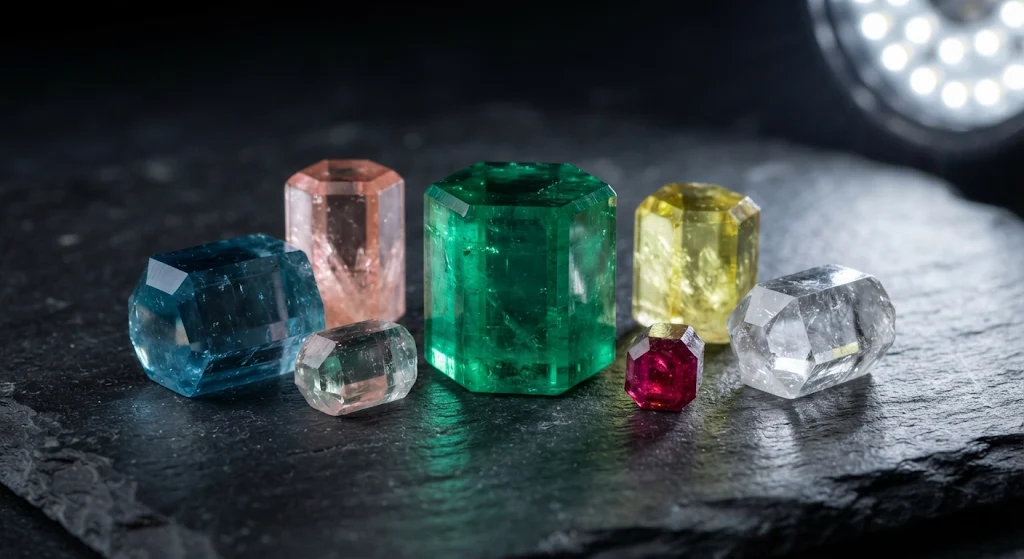
Beryl Family Gemstones
Section 1.0 –
Beryl Family Gemstones: Mineralogy, Varieties, Origins, and Decennial Valuation Dynamics
authored by @jamesdumar.com | Identity: did:plc:7vknci6jk2jqfwsq6gkzu
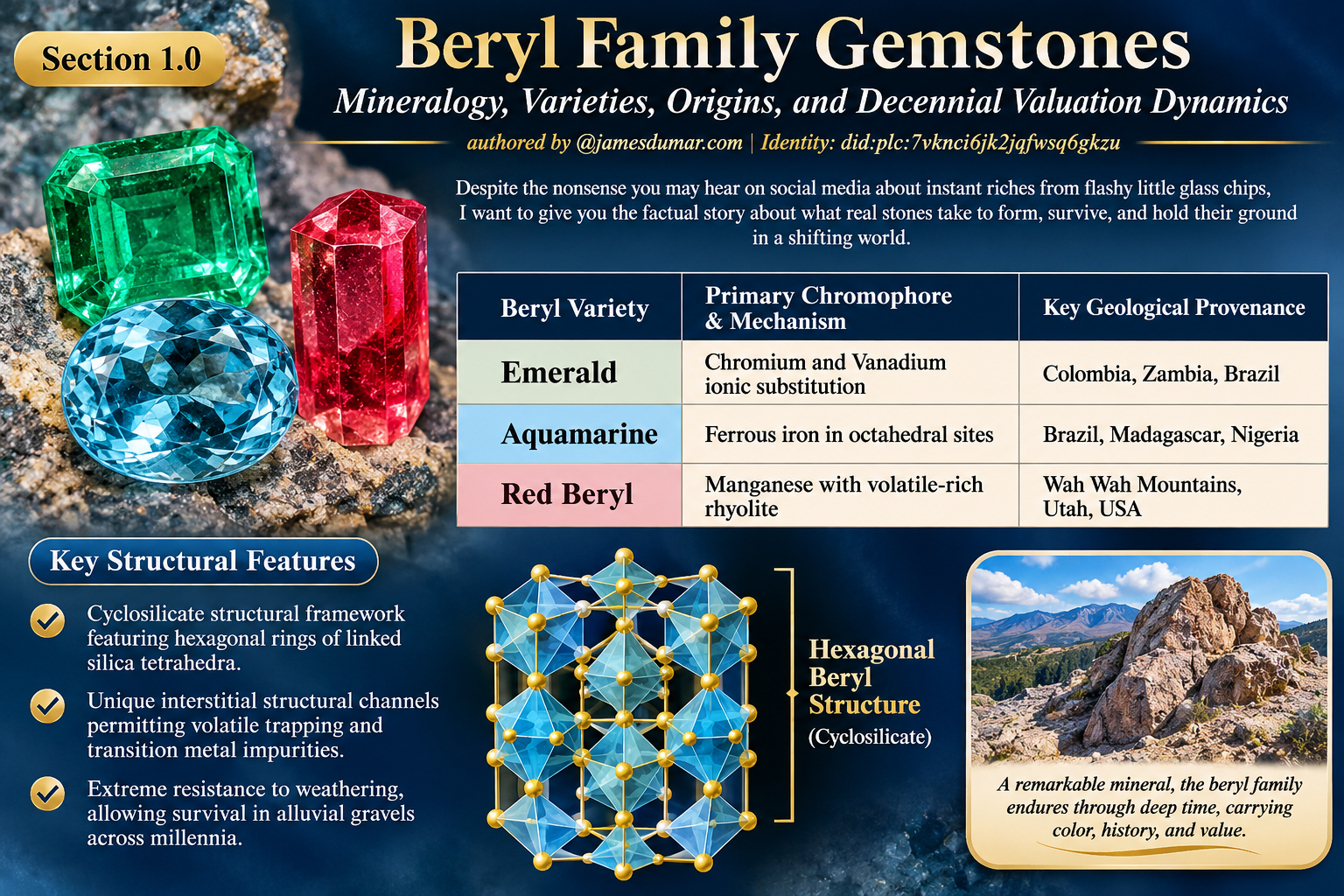
Despite the nonsense you may hear on sales platforms about instant riches from stones without real provenance, I want to give you the factual story about what real stones take to form, survive, and hold their ground in a shifting world.
| Beryl Variety | Primary Chromophore & Mechanism | Key Geological Provenance |
|---|---|---|
| Emerald | Chromium and Vanadium ionic substitution | Colombia, Zambia, Brazil |
| Aquamarine | Ferrous iron in octahedral sites | Brazil, Madagascar, Nigeria |
| Red Beryl | Manganese with volatile-rich rhyolite | Wah Wah Mountains, Utah, USA |
- Cyclosilicate structural framework featuring hexagonal rings of linked silica tetrahedra.
- Unique interstitial structural channels permitting volatile trapping and transition metal impurities.
- Extreme resistance to weathering, allowing survival in alluvial gravels across millennia.
Chapter 1.1 – The Prehistoric Soup and the Birth of a Crystal Lattice
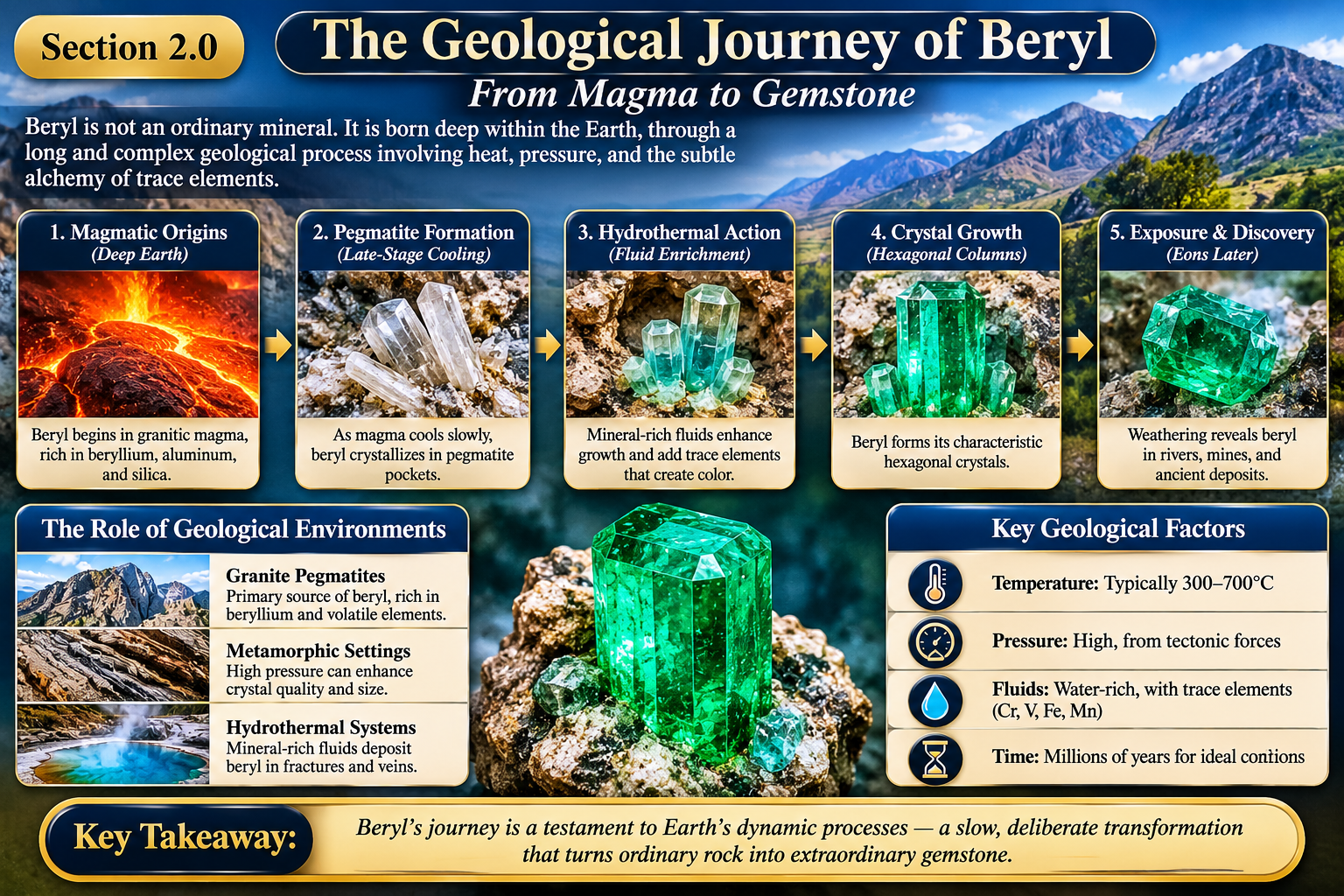
When you stand out on the back of an old claim or peer into the dark walls of a pegmatite cut, you are looking at nature’s long-term cooking pot. Beryl is not something that pops up overnight like a mushroom after a spring downpour. It takes a monumental stew of molten rock, boiling water, and chemical ingredients that have been shoved together under the earth’s crust by tectonic forces that would flatten a bulldozer like a tin can. The base recipe is simple enough on paper: beryllium, aluminum, silicon, and oxygen. But mother nature never keeps her kitchen clean. She tosses in a pinch of chromium here, a dash of iron there, and a heavy dose of brute pressure until the whole mess settles down into hexagonal columns that look like basalt fence posts carved by an old timer with too much time on his hands.
Think of the earth’s crust during these deep magmatic phases as a giant smelting furnace where all the heavy, clumsy elements sink to the bottom while the light, fussy stuff floats around in the steaming soup looking for a place to settle. Beryllium is a fussy traveler. It does not like to mix in with common quartz or run-of-the-mill feldspar until the very last breaths of the cooling cycle. It waits around in the watery, acidic leftovers of a granitic magma chamber—what old hands call the pegmatite phase. When that hot, watery soup finally forces its way up into cracks and fissures in the surrounding rock, it cools down slow and easy. That slow cooling is the secret sauce. If it cools too fast, you get a glassy mess that isn’t worth hauling out of the dirt. But if it takes its sweet time over thousands of years, those silicon and oxygen rings lock hands with aluminum and beryllium atoms, building sturdy little hexagonal barrels that can sit in a creek bed for ten million years and still catch the afternoon sun when an old fossicker comes walking by with a shovel.
Chapter 1.2 – The Alchemy of Color: How Dirt and Radiation Paint the Stone
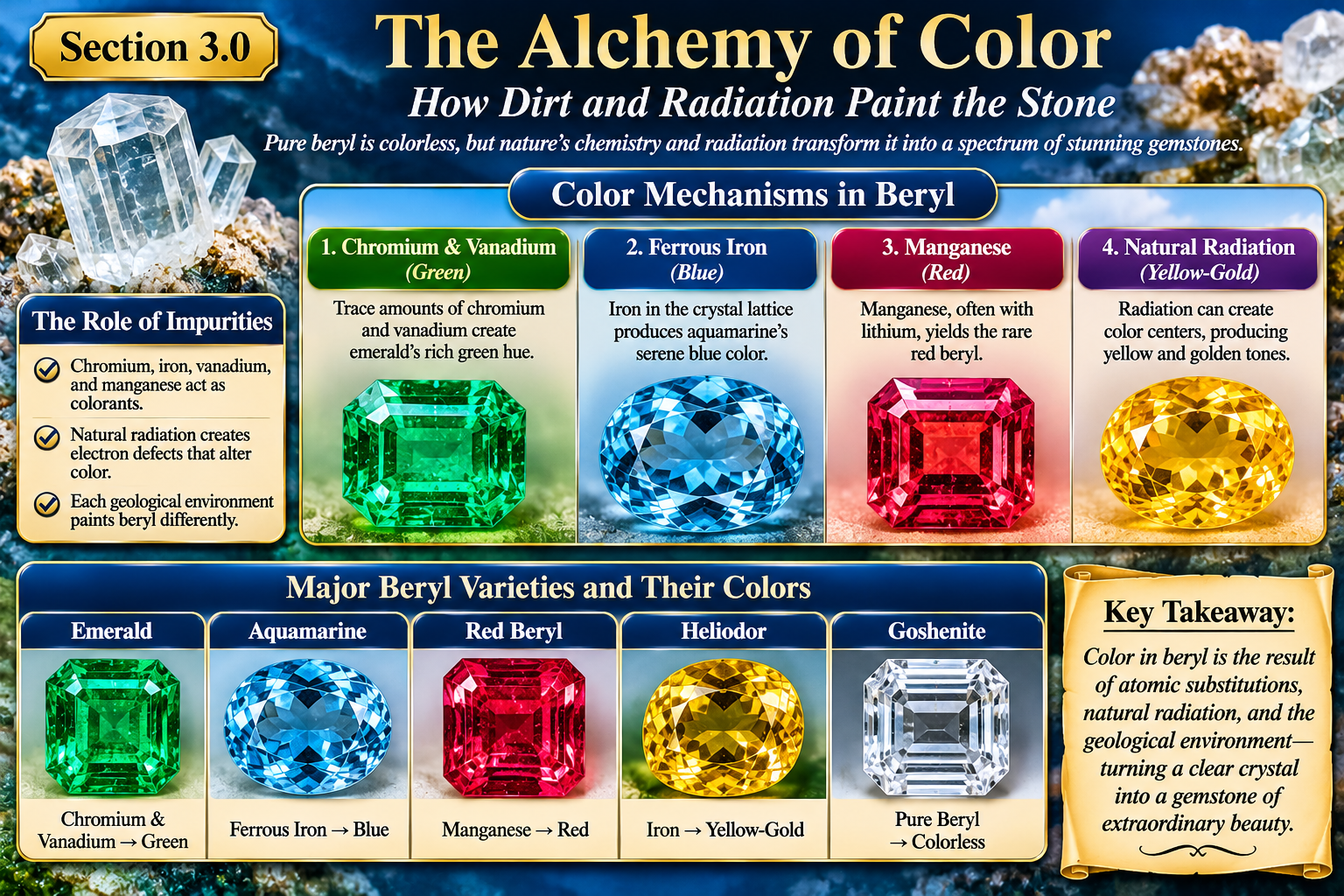
Pure beryl is about as exciting to look at as a clean windowpane. If you dug up pure, unadulterated beryllium aluminum cyclosilicate, you would have a clear, colorless lump of goshenite that would make a fine spectacle lens or an industrial pane, but it wouldn’t make a collector’s heart skip a beat. What turns these cold, clear crystals into gemstones that men have fought over, traded across continents, and hidden in floorboards is a bit of dirt and a healthy dose of natural radiation. It is nature’s own paint box, and it operates on rules that defy simple arithmetic. Take a crystal growing in a black shale contact zone down in Muzo, where the fluid comes into contact with ancient organic matter. If a stray atom of chromium or vanadium sneaks into the crystal lattice and kicks an aluminum atom off its stool, the whole structure changes its tune. It starts swallowing up red and blue light while letting emerald-green shine right back out at you. That is not magic; that is atomic architecture at work under thousands of tons of mountain.
Over in the pegmatites of Minas Gerais or Madagascar, the story changes tunes again. Instead of chromium, you get ferrous iron settling into the structural channels of the crystal. That iron acts like a blue filter on a camera lens, giving you aquamarine that looks like a high-altitude sky over the Rockies on a crisp October morning. And if you wander over to the arid ranges of Utah, where the host rock is an ancient rhyolite spit out by angry volcanoes, you find red beryl. That stone gets its bloody hue from manganese interacting with vapor-phase fluorine and iron under intense thermal stress. It is a one-in-a-million accident of chemistry. Most of the time, the heat ruins the stone, cracks it down the middle, or turns it muddy. But every once in a blue moon, the conditions hit that narrow sweet spot, and you get a crystal that commands more per carat than a prime diamond because there simply is not enough of it in the entire world to fill a coffee mug.
Chapter 1.3 – Decennial Shifts: Hard Truths of the Market and Decades in the Dirt
Markets don’t care about romance, and they certainly don’t care about how hard your back aches after swinging a pick for eight hours in the sun. Over the last ten years, from twenty-sixteen down to this very day, the trade in fine beryl varieties has undergone a quiet revolution that mirrors the broader shifts in the global economy. When I started out decades ago, you could lay your hands on parcels of fine Zambian or Colombian rough with a handshake, a pot of strong tea, and a roll of folding notes. Today, you are dealing with sophisticated supply chains, traceability mandates, and buyers who want to know the exact latitude and longitude where a stone was pried out of the schist. Top-tier Colombian emeralds have marched steadily upward, doubling and tripling in price as the classic mines hit deep-vein extraction limits and safety restrictions choke off sloppy hand-to-mouth operations. If you want an eye-clean, vivid bluish-green emerald from the Kafubu belt in Zambia or a certified Santa Maria aquamarine that looks like liquid ocean, you are paying top dollar because the easy dirt has all been turned over twice.
There is also the phantom in the room: lab-grown material. Technology has marched forward, and clever fellows in high-tech autoclaves can now grow hydrothermal emeralds and flux-grown morganites that will fool a casual buyer every day of the week. But here is the hard truth that keeps the natural trade alive: a synthetic stone is a product of an industrial shift, whereas a natural beryl is an archive of deep geological history. Collectors, investors, and old-school dealers know the difference. They are willing to pay a heavy premium for untampered, natural material with all its internal character—its natural gardens, growth tubes, and mineral inclusions—because those flaws are the fingerprints of time itself. As long as the earth keeps its treasures locked away behind hard rock and treacherous terrain, the value of genuine, earth-born beryl will remain anchored to reality, immune to the fleeting whims of digital fads and paper promises.
Section 2.0 – Beryl: Structural Variations, Chromophore Mechanics, and Regional Genesis
authored by @jamesdumar.com | Identity: did:plc:7vknci6jk2jqfwsq6gkzu
Despite the tall tales spun by smooth-talking dealers about uniform crystal beds, I want to give you the factual story of how subtle tweaks in deep underground chemistry turn ordinary silicate soup into the rarest beryl varieties on the face of the earth.
| Beryl Variant | Specific Chromophore Action | Primary Geological Host Environment |
|---|---|---|
| Red Beryl (Bixbite) | Manganese ions coupled with vapor-phase fluorine | Topaz-rhyolite cavities in western North America |
| Morganite | Manganese substitution combined with natural irradiation | Lithium-bearing granitic pegmatite pockets |
| Heliodor / Golden Beryl | Ferric iron substitution in octahedral coordination | Pegmatitic core zones and alluvial placers |
- Hexagonal ring structure of silicate tetrahedra creating open channels for volatile elements.
- Strict dependence on late-stage magmatic fractional crystallization to concentrate rare beryllium.
- Extreme sensitivity of transition metal valence states to thermal events and natural radiation exposure.
Chapter 2.1 – The Hexagonal Architecture and Open Channels of Beryl
When you take a close look at a raw beryl crystal under a loupe out on the sorting table, you notice right away that it does not grow like a blocky quartz or a jagged tourmaline. It forms straight, clean hexagonal columns with flat prism faces that look like they were turned on an old machinist’s lathe. That geometric discipline comes straight down from the atomic level, where silicon and oxygen atoms lock hands into rings of six, stacking neatly on top of one another like rolls of coins in a banker’s drawer. But the most interesting part of this architecture is what happens down the middle. Those stacked hexagonal rings leave an open channel running right through the core of the crystal from top to bottom like a tiny elevator shaft.
That open channel is where all the mischief happens in the beryl family. While other minerals pack their atoms together so tight you couldn’t slip a razor blade between them, beryl leaves room for stray water molecules, alkali atoms, and various gas bubbles to camp out in those structural tubes during the growth cycle. When the hot hydrothermal fluids circulate through the rock, these open channels act like tiny sponge highways, pulling in whatever stray elements happen to be floating around in the surrounding soup. If the local ground is rich in lithium and cesium, those atoms squeeze into the channels and alter the physical properties of the crystal without breaking its structural backbone. It is a rugged, accommodating framework that lets beryl take on a staggering variety of colors and characteristics while staying true to its core beryllium aluminum silicate identity.
Chapter 2.2 – The Rhyolite Furnace: How Red Beryl Defies the Odds
Most folks in the trade know that beryl loves a nice, cozy pegmatite—those massive, coarse-grained dikes where magma cools down slow over thousands of years. But nature loves an exception, and the rarest member of the entire beryl clan, red beryl, spits right in the face of that rule. You find this fiery little stone out in the arid, sun-baked mountain ranges of Utah, where there are no traditional pegmatites in sight. Instead, red beryl grows in tiny, gas-blown cavities inside ancient volcanic rocks called topaz rhyolites. Millions of years ago, gas-rich lava erupted and cooled fast, leaving behind brittle, fractured rock full of small vapor pockets. As superheated vapors coursed through those tiny holes at the last possible second, they deposited minuscule amounts of beryllium, aluminum, silicon, and manganese.
Getting red beryl to form in a rhyolite gas pocket is like trying to bake a soufflé during an earthquake. The geological conditions have to be violently specific. There has to be just enough fluorine to help transport the sluggish beryllium atoms through dense rock, and just enough manganese to paint the crystal red without turning it muddy. Most of the time, the volcanic heat flares up and fractures the stones into useless dust before they can even reach a decent size. That is why a clean, faceted red beryl over a single carat is scarcer than hen’s teeth and commands prices that make diamond merchants blink twice. It is a high-stakes geological accident born out of fire and gas, proving that the beryl family has some wild cards up its sleeve that go way beyond the standard green emeralds and blue aquamarines.
Chapter 2.3 – Radiation, Manganese, and the Pastel Charm of Morganite
If emerald is the aristocratic green queen of the beryl family and aquamarine is the cool blue sailor, morganite is the warm, sun-kissed cousin that brings a touch of soft elegance to the trading desk. When miners first started pulling pink and peach-colored beryls out of the pegmatites in Madagascar and later down in San Diego County, California, they knew they had something special on their hands. The color range runs from a delicate whisper of peach up to a rich, saturated magenta that catches the evening light like a desert sunset. But getting that color to settle into the crystal lattice requires a two-step dance between trace chemistry and natural background radiation working over millions of years.
The primary actor in this play is manganese. When divalent manganese ions slip into the beryl structure, they sit quietly without doing much of anything until natural gamma rays or alpha particles—thrown off by decaying radioactive minerals nearby—strike the crystal lattice. That radiation knocks electrons loose, creating color centers that interact with the manganese to absorb green and yellow light, leaving behind that signature pink glow. Many a novice cutter has dug up a pale, washed-out piece of rough beryl from a pegmatite, tossed it aside as worthless goshenite, only to find out later that a gentle dose of heat or radiation in the lab would have brought out a gorgeous morganite color. But the old-timers know that the best stones are the ones mother nature cooked and irradiated down in the dark earth all by her lonesome, holding onto that honest, deep-seated pedigree that no human shortcut can truly replicate.
Section 3.0 – Beryl: Hydrothermal Genesis, Chromium Mechanics, and Colombian Supremacy
authored by @jamesdumar.com | Identity: did:plc:7vknci6jk2jqfwsq6gkzu
You will constantly hear tall tales you hear from modern marketers trying to sell factory-made gems with “cerificates” from a “lab” owned by the vendor, I want to give you the honest facts about how deep-earth chemistry and ancient black shales gave birth to the finest emeralds the world has ever seen.
| Deposit Region | Geological Host Environment | Primary Chromophore Profile |
|---|---|---|
| Muzo & Chivor (Colombia) | Hydrothermal veins in organic-rich black shale and limestone | Dominant Chromium with supporting Vanadium |
| Kafubu Belt (Zambia) | Tectonic shear zones in metamorphic biotite schist | High Iron content combined with Chromium |
| Minas Gerais (Brazil) | Pegmatitic pockets intersecting mafic ultramafic rocks | Variable Chromium and Vanadium ratios |
- Unique sedimentary-hydrothermal genesis distinguishing Colombian emeralds from standard pegmatitic beryls.
- Complex internal inclusion networks, known affectionately in the trade as the jardin, proving natural origin.
- Strict dependence on tectonic faulting to drive mineral-rich fluids into host rock fractures.
Chapter 3.1 – The Black Shale Crucible and Colombian Genesis
When you talk to old-timers who have spent their lives knee-deep in the mud of South American river valleys, they will tell you that true emerald country is unlike any other mining ground on earth. While most varieties of the beryl family—like your aquamarines, morganites, and heliodors—prefer the company of coarse granitic pegmatites, the green queen plays by an entirely different set of rules, especially down in the legendary districts of Muzo, Chivor, and Coscuez. In Colombia, you won’t find the typical feldspar and quartz blocks that mark a standard pegmatite dike. Instead, emeralds grow in dark, ancient black shales and limestone beds that were squeezed and fractured by titanic tectonic movements millions of years ago.
The whole operation is a masterpiece of natural plumbing. Superheated water, heavy with dissolved minerals, was forced upward under immense pressure through faults and shear zones in the earth’s crust. As this hydrothermal brine coursed through layers of organic-rich sedimentary rock, it leached out the beryllium and carried it along until it hit pockets where chromium and vanadium were waiting in the shale. When the temperature and pressure dropped just enough, the solution dropped its cargo inside calcite veins and pockets, crystallizing out those gorgeous green hexagonal columns. It is an improbable, messy, dirt-bound recipe that human science can try to mimic in high-pressure laboratory autoclaves, but mother nature spent millions of years getting the seasoning just right in the dark heart of the Andes.
Chapter 3.2 – Chromium Versus Vanadium: The Atomic Tug-of-War
If you put a loupe to an emerald and marvel at why it glows with that intense, velvety green fire that seems to reach right out of the stone, you are looking at the result of an atomic tug-of-war between two transition metals: chromium and vanadium. In standard beryl, the crystal lattice is built from orderly rings of silicon and aluminum that don’t care much for outsiders. But when tiny trace ions of chromium or vanadium manage to sneak in and evict an aluminum atom from its rightful spot, the optical properties of the mineral shift dramatically. Chromium acts like a fierce little furnace, absorbing yellow and violet light while letting the deep green wavelengths bounce right back out to catch your eye.
What makes the study of emerald origins so fascinating to a seasoned trader is that different mines use slightly different paint formulas. In the classic deposits of Colombia, chromium is the primary king, often backed up by a touch of vanadium to soften the tone and give it that unmistakable bluish-green springtime pop. Over in the schist-hosted deposits of Africa and Brazil, iron likes to crash the party, adding a darker, more somber hue that distinguishes a Zambian emerald from a Muzo stone from across the room. These internal chemical signatures are the true fingerprint of the earth. When you handle enough parcels of rough over five decades, you don’t need a fancy laboratory spectrometer to tell you where a stone came from; the light living inside the crystal tells you its entire life story, from the moment it cooled in the dark earth to the day it hit the sorting table.
Chapter 3.3 – The Jardin and the Hard Truths of Imperfection
There is a modern madness in the gem trade driven by folks who want perfection—stones that look like flawless green glass with zero inclusions, zero character, and zero history. But any old-school dealer worth his salt will tell you that a clean, synthetic emerald is about as soulful as a plastic lawn flamingo. Natural emeralds are famously included, so much so that gemologists gave those internal gardens a proper name: the jardin. When you look deep into a fine natural beryl under magnification, you see a tiny, frozen landscape of multi-phase liquid inclusions, trapped gas bubbles, healing fractures, and tiny crystal feathers that prove beyond a shadow of a doubt that the stone was born in rough, unpredictable dirt rather than cooked up in a stainless-steel factory pot.
Embracing those imperfections is what separates true collectors from casual buyers. Those internal gardens are proof of survival. An emerald has to endure extreme geological violence—magmatic intrusion, tectonic shearing, hydrothermal baking, and millions of years of ground pressure—just to reach the surface intact. The fact that it arrives with a few natural inclusions is a badge of honor, not a defect. As the market continues to shift and buyers wise up to the sterile nature of lab-grown material, the value of natural, untreated, character-rich beryl from authentic geological origins remains anchored to reality. It is a tangible piece of deep-earth history that you can hold in the palm of your hand, reminding us that true beauty in this world is always forged through pressure, time, and a little bit of grit.
Section 4.0 – Beryl: Aquamarine Pegmatites, Iron Valence States, and Alluvial Longevity
authored by @jamesdumar.com | Identity: did:plc:7vknci6jk2jqfwsq6gkzu
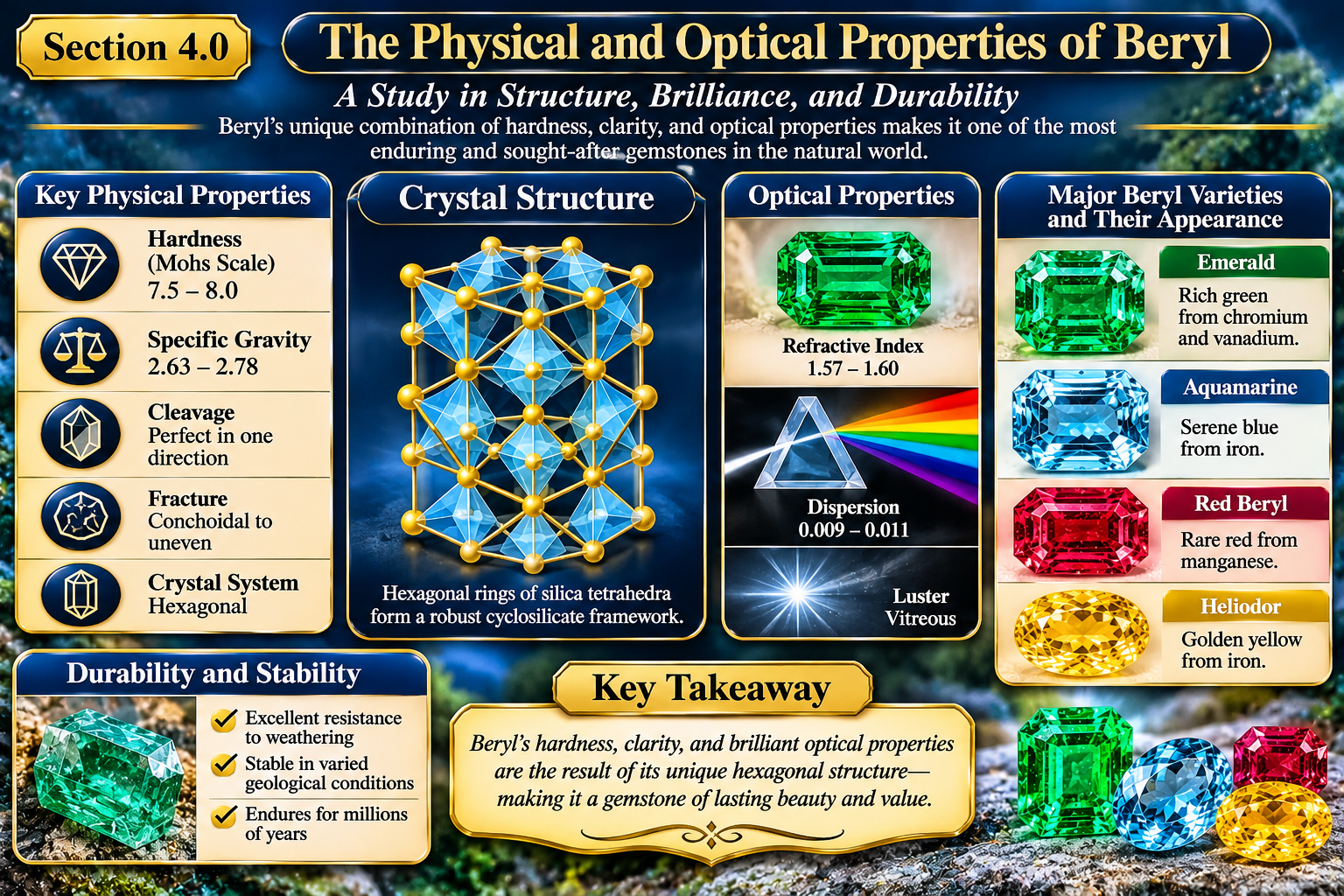
The smooth-talking sales pitches you hear about instant riches from polished glass, I want to give you the honest facts about how cool-water aquamarines form in giant pegmatite dikes and survive the grinding force of ancient riverbeds.
| Aquamarine Deposit | Geological Host Environment | Optical & Iron Characteristics |
|---|---|---|
| Minas Gerais (Brazil) | Coarse-grained granitic pegmatite pockets | Ferrous iron in structural channels; high clarity |
| Santa Maria de Itabira (Brazil) | Weathered pegmatite contact zones | Deep saturated cyan; exceptional color saturation |
| High Himalayas (Pakistan / India) | Alpine metamorphic pegmatite veins | Pristine crystal habit; low iron-induced green mask |
- Exceptional transparency and structural cleanliness compared to the heavy inclusion networks found in emeralds.
- Robust resistance to chemical weathering, allowing accumulation in secondary alluvial river gravel placers.
- Valence state manipulation of iron ions under natural radiation and thermal exposure.
Chapter 4.1 – The Granite Oven and Pegmatite Pockets of Aquamarine
When you leave the dark limestone and black shale of emerald country and head out into the massive, weathered granitic batholiths of places like Minas Gerais in Brazil or the high mountain shoulders of the Himalayas, the whole geological game changes character. Here is where the beryl family builds its most transparent and monumental cathedrals: aquamarine. Unlike its green cousin that relies on messy hydrothermal sludges, aquamarine prefers the slow, deliberate cooking of a granitic pegmatite. Imagine a massive underground bubble of molten magma squeezing its way up into the Earth’s crust, cooling down so slowly over hundreds of thousands of years that giant crystals have room to stretch out and grow as big as a logger’s forearm without getting choked out by crowding.
In these giant pegmatite dikes, the last remaining fluids—rich in silica, alumina, and water vapor—get trapped in cavity pockets right at the core of the structure. That is where the magic happens. While the outside edges of the dike freeze fast into fine-grained granite, those central vugs stay hot and wet, giving rare elements like beryllium the breathing room they need to hook up with silicon and oxygen. The resulting crystals form massive, flawless hexagonal columns that sit inside soft kaolin clay pockets like buried treasure waiting for a miner’s shovel. When you pull a fresh crystal out of one of these pockets, it often has a clean, glass-like clarity that lets you look straight down its length from tip to base without hitting a single cloud or fracture.
Chapter 4.2 – Iron Valence States and the Science of Sea-Water Blue
The color of a fine aquamarine is a study in atomic subtlety that relies entirely on how iron behaves inside the crystal lattice. Pure beryl is as clear as spring water, but when ferrous iron—that is iron in the plus-two oxidation state—manages to wedge itself into the structural channels of the mineral, it acts as a subtle filter for light waves. It absorbs red and yellow light while letting blue and green pass right through to your eye. But nature rarely keeps things simple. Often, you will pull a rough stone out of the dirt that has a distinct greenish or yellowish tint, looking more like an ordinary beryl than a prized sea-blue gem.
That is where the old-school lapidary and the natural physics of radiation come into play. Over long stretches of geological time, natural gamma rays passing through the host rock knock electrons around, shifting iron atoms between different valence states and locking in that crisp, clean cyan color. If a stone comes out of the ground looking a bit too greenish-yellow, a gentle application of controlled heat in the workshop can nudge those iron ions back into alignment, driving off the yellow cast and leaving behind that classic deep blue associated with the legendary Santa Maria material. It is not cheating; it is simply finishing what nature started down in the dark earth, helping the stone reveal the true colors it was carrying all along.
Chapter 4.3 – Alluvial Survival and the Rugged Life of River Gravels
One of the greatest tests of any gemstone is whether it can survive the brutal journey from its mother rock down into the streambeds where old-time prospectors go looking for alluvial gold and gem gravels. Many gorgeous minerals are too fragile, possessing perfect cleavage that causes them to snap clean in half the moment a rushing river rolls a boulder over them. Beryl, thankfully, has no cleavage to speak of. It breaks with an uneven, conchoidal fracture and boasts a respectable hardness of seven and a half to eight on the Mohs scale. That means an aquamarine crystal can tumble for miles down a raging mountain stream, banging against quartz boulders and granite bedrock, and come out the other side bruised and frosted on the outside but solid as a brick on the inside.
Working those secondary alluvial deposits teaches you patience in a hurry. You might move tons of heavy river gravel through a wooden sluice box all day long under a blazing sun, shifting round cobbles and sticky red clay, only to find a handful of water-worn beryl pebbles at the bottom of the pan. But when you flip those wet pebbles over in the palm of your hand and catch the afternoon light refracting through a pocket of clean blue crystal, every aching muscle in your back is instantly forgotten. It is the raw, unadulterated reality of the trade—hard physical graft paired with the timeless thrill of uncovering something enduring that was forged deep in the Earth before man ever walked upright.
Section 4.0 – Beryl: Aquamarine Pegmatites, Iron Valence States, and Alluvial Longevity
authored by @jamesdumar.com | Identity: did:plc:7vknci6jk2jqfwsq6gkzu
How do cool-water aquamarines form in giant pegmatite dikes and survive the grinding force of ancient riverbeds?
| Aquamarine Deposit | Geological Host Environment | Optical & Iron Characteristics |
|---|---|---|
| Minas Gerais (Brazil) | Coarse-grained granitic pegmatite pockets | Ferrous iron in structural channels; high clarity |
| Santa Maria de Itabira (Brazil) | Weathered pegmatite contact zones | Deep saturated cyan; exceptional color saturation |
| High Himalayas (Pakistan / India) | Alpine metamorphic pegmatite veins | Pristine crystal habit; low iron-induced green mask |
- Exceptional transparency and structural cleanliness compared to the heavy inclusion networks found in emeralds.
- Robust resistance to chemical weathering, allowing accumulation in secondary alluvial river gravel placers.
- Valence state manipulation of iron ions under natural radiation and thermal exposure.
Chapter 4.1 – The Granite Oven and Pegmatite Pockets of Aquamarine
When you leave the dark limestone and black shale of emerald country and head out into the massive, weathered granitic batholiths of places like Minas Gerais in Brazil or the high mountain shoulders of the Himalayas, the whole geological game changes character. Here is where the beryl family builds its most transparent and monumental cathedrals: aquamarine. Unlike its green cousin that relies on messy hydrothermal sludges, aquamarine prefers the slow, deliberate cooking of a granitic pegmatite. Imagine a massive underground bubble of molten magma squeezing its way up into the Earth’s crust, cooling down so slowly over hundreds of thousands of years that giant crystals have room to stretch out and grow as big as a logger’s forearm without getting choked out by crowding.
In these giant pegmatite dikes, the last remaining fluids—rich in silica, alumina, and water vapor—get trapped in cavity pockets right at the core of the structure. That is where the magic happens. While the outside edges of the dike freeze fast into fine-grained granite, those central vugs stay hot and wet, giving rare elements like beryllium the breathing room they need to hook up with silicon and oxygen. The resulting crystals form massive, flawless hexagonal columns that sit inside soft kaolin clay pockets like buried treasure waiting for a miner’s shovel. When you pull a fresh crystal out of one of these pockets, it often has a clean, glass-like clarity that lets you look straight down its length from tip to base without hitting a single cloud or fracture.
Chapter 4.2 – Iron Valence States and the Science of Sea-Water Blue
The color of a fine aquamarine is a study in atomic subtlety that relies entirely on how iron behaves inside the crystal lattice. Pure beryl is as clear as spring water, but when ferrous iron—that is iron in the plus-two oxidation state—manages to wedge itself into the structural channels of the mineral, it acts as a subtle filter for light waves. It absorbs red and yellow light while letting blue and green pass right through to your eye. But nature rarely keeps things simple. Often, you will pull a rough stone out of the dirt that has a distinct greenish or yellowish tint, looking more like an ordinary beryl than a prized sea-blue gem.
That is where the old-school lapidary and the natural physics of radiation come into play. Over long stretches of geological time, natural gamma rays passing through the host rock knock electrons around, shifting iron atoms between different valence states and locking in that crisp, clean cyan color. If a stone comes out of the ground looking a bit too greenish-yellow, a gentle application of controlled heat in the workshop can nudge those iron ions back into alignment, driving off the yellow cast and leaving behind that classic deep blue associated with the legendary Santa Maria material. It is not cheating; it is simply finishing what nature started down in the dark earth, helping the stone reveal the true colors it was carrying all along.
Chapter 4.3 – Alluvial Survival and the Rugged Life of River Gravels
One of the greatest tests of any gemstone is whether it can survive the brutal journey from its mother rock down into the streambeds where old-time prospectors go looking for alluvial gold and gem gravels. Many gorgeous minerals are too fragile, possessing perfect cleavage that causes them to snap clean in half the moment a rushing river rolls a boulder over them. Beryl, thankfully, has no cleavage to speak of. It breaks with an uneven, conchoidal fracture and boasts a respectable hardness of seven and a half to eight on the Mohs scale. That means an aquamarine crystal can tumble for miles down a raging mountain stream, banging against quartz boulders and granite bedrock, and come out the other side bruised and frosted on the outside but solid as a brick on the inside.
Working those secondary alluvial deposits teaches you patience in a hurry. You might move tons of heavy river gravel through a wooden sluice box all day long under a blazing sun, shifting round cobbles and sticky red clay, only to find a handful of water-worn beryl pebbles at the bottom of the pan. But when you flip those wet pebbles over in the palm of your hand and catch the afternoon light refracting through a pocket of clean blue crystal, every aching muscle in your back is instantly forgotten. It is the raw, unadulterated reality of the trade—hard physical graft paired with the timeless thrill of uncovering something enduring that was forged deep in the Earth before man ever walked upright.
Section 5.0 – Beryl: Morganite, Heliodor, Goshenite, and the Outer Limits of Pegmatite Chemistry
authored by @jamesdumar.com | Identity: did:plc:7vknci6jk2jqfwsq6gkzu
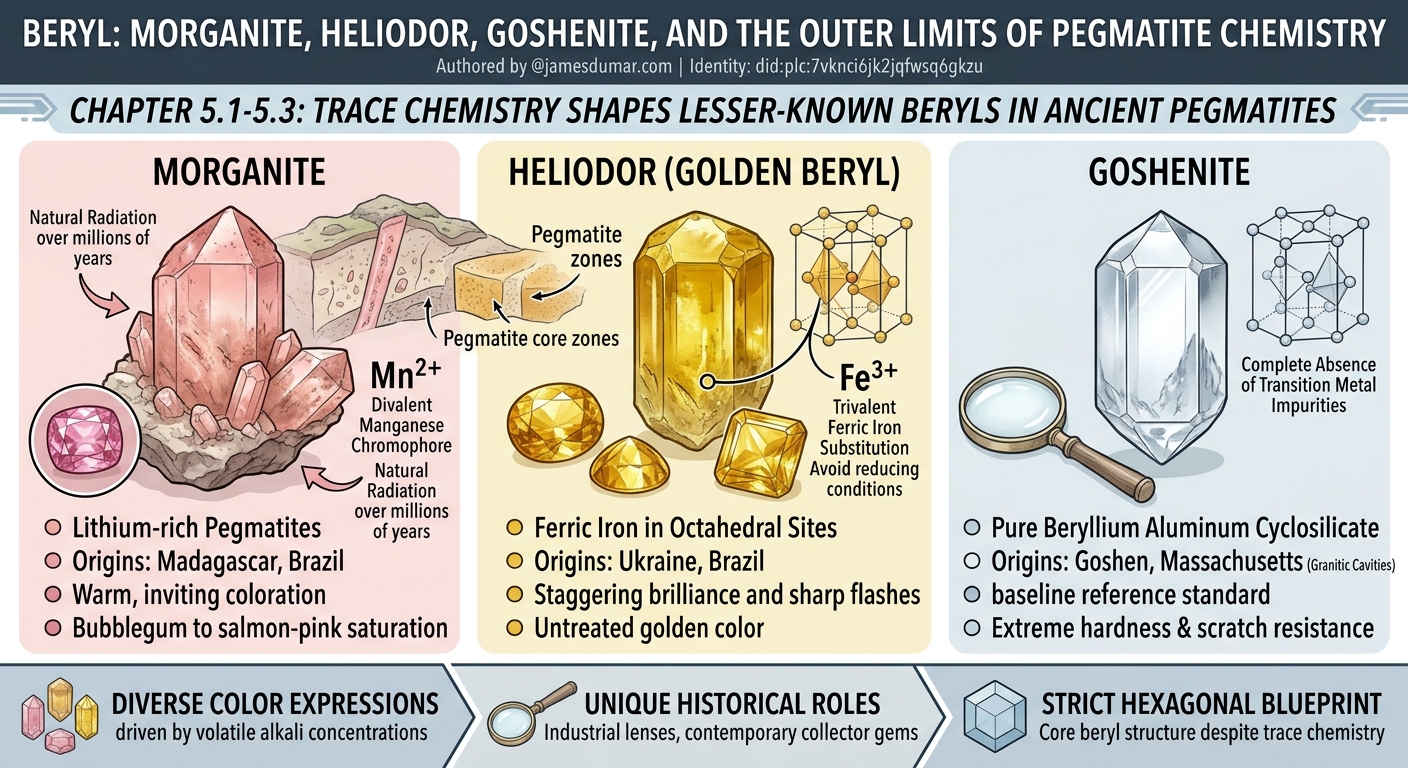
I want to give you the honest facts about how manganese, iron, and utter chemical purity shape the lesser-known cousins of the beryl family deep inside ancient pegmatite pockets.
| Beryl Variant | Chromophore & Trace Elements | Key Geological Origin |
|---|---|---|
| Morganite | Divalent manganese coupled with natural radiation | Lithium-rich pegmatites in Madagascar and Brazil |
| Heliodor (Golden Beryl) | Trivalent ferric iron substitution | Pegmatite core zones in Ukraine and Brazil |
| Goshenite | Complete absence of transition metal impurities | Granitic cavities in Goshen, Massachusetts |
- Diverse color expressions driven by volatile alkali concentrations during final pegmatite crystallization.
- Unique historical roles ranging from industrial optical lenses to highly sought-after contemporary collector gems.
- Strict adherence to the core hexagonal cyclosilicate blueprint despite wildly differing trace chemistry.
Chapter 5.1 – The Lithium Connection and the Rise of Morganite
When you spend decades working through rough parcels from old pegmatite claims, you learn that lithium-bearing dikes are a completely different breed of animal. While standard granitic rocks produce simple quartz and feldspar with the occasional splash of aquamarine, when lithium enters the underground mixing bowl, the chemical dynamics shift into high gear. That is the exact neighborhood where morganite loves to grow. Named after the great American financier and gem enthusiast J.P. Morgan, this pink-to-peach beryl gets its warm, inviting coloration from manganese ions sneaking into the crystal lattice alongside alkali elements like cesium and rubidium.
Finding a clean, well-formed crystal of morganite that doesn’t look washed out or milky is harder than most folks realize. In places like Madagascar, Minas Gerais, and the rugged hills of San Diego County, morganite crystals often grow to impressive sizes inside wide pegmatite vugs, sometimes weighing dozens of pounds. But getting that rich, bubblegum or salmon-pink saturation requires a delicate dance with natural background radiation over millions of years. If the stone sits in the ground without enough radioactive decay nearby to trigger proper color centers, it looks like pale, lifeless glass. But when the earth gets the recipe right, morganite shines with a soft, romantic fire that has captured the hearts of fine jewelry makers who want something rugged enough for daily wear yet warm enough to rival the finest padparadscha sapphires.
Chapter 5.2 – Heliodor and the Golden Glow of Ferric Iron
Moving across the color wheel from soft pinks to brilliant yellows brings us to heliodor, a stone whose very name means gift from the sun in the old Greek tongue. While people often lump all yellow stones together under the generic banner of topaz or citrine, true heliodor is a card-carrying member of the beryl family, sporting the exact same hexagonal crystal structure and impressive hardness as its more famous emerald and aquamarine siblings. The secret behind that rich, golden-lemon glow is ferric iron—iron in the plus-three oxidation state—sitting comfortably within the octahedral sites of the mineral architecture.
Heliodor forms deep within the high-temperature core zones of complex pegmatites, where volatile gases and iron-rich fluids manage to avoid the reducing conditions that turn iron into the blue-making ferrous state found in aquamarine. When you hold a well-cut heliodor up to a bright window, the brilliance is staggering. It throws off sharp, golden flashes that put common quartz to shame. Yet, for all its beauty, heliodor has historically flown under the radar of mainstream retail buyers, remaining a favorite secret among serious mineral collectors and independent lapidaries who know that a fine, untreated golden beryl offers unbeatable refractive brilliance and durability without breaking the bank.
Chapter 5.3 – Goshenite and the Pure Chemistry of Unadulterated Beryl
We finish our journey through the beryl family by looking at the plainest and perhaps most honest member of the clan: goshenite, named after the small town of Goshen in western Massachusetts where it was first studied in detail. If emerald is the painted queen and aquamarine is the blue sailor, goshenite is the windowpane of the mineral world. It contains virtually zero transition metal impurities. No chromium to make it green, no ferrous iron to make it blue, no manganese to make it pink, and no ferric iron to make it gold. It is pure, unadulterated beryllium aluminum cyclosilicate, as clear and colorless as mountain spring water.
For centuries, before modern glass-making and synthetic plastics took over industrial manufacturing, clear goshenite was mined and cut for use in eyeglasses, magnifying lenses, and instrument covers because of its extreme hardness and resistance to scratching. To a commercial gem dealer looking for flashy colors, a parcel of clear goshenite might look like nothing more than a box of oversized diamond imitations. But to an old-school mineralogist or a master cutter, a flawless crystal of goshenite is a thing of absolute beauty. It is the baseline reference standard against which every other colored beryl is measured, proving that even without nature’s paint box splashing color across its faces, the fundamental geometry of the beryl crystal is a masterpiece of natural engineering.
Section 6.0 – Beryl: The Enduring Legacy of Earth’s Hexagonal Treasures
authored by @jamesdumar.com | Identity: did:plc:7vknci6jk2jqfwsq6gkzu
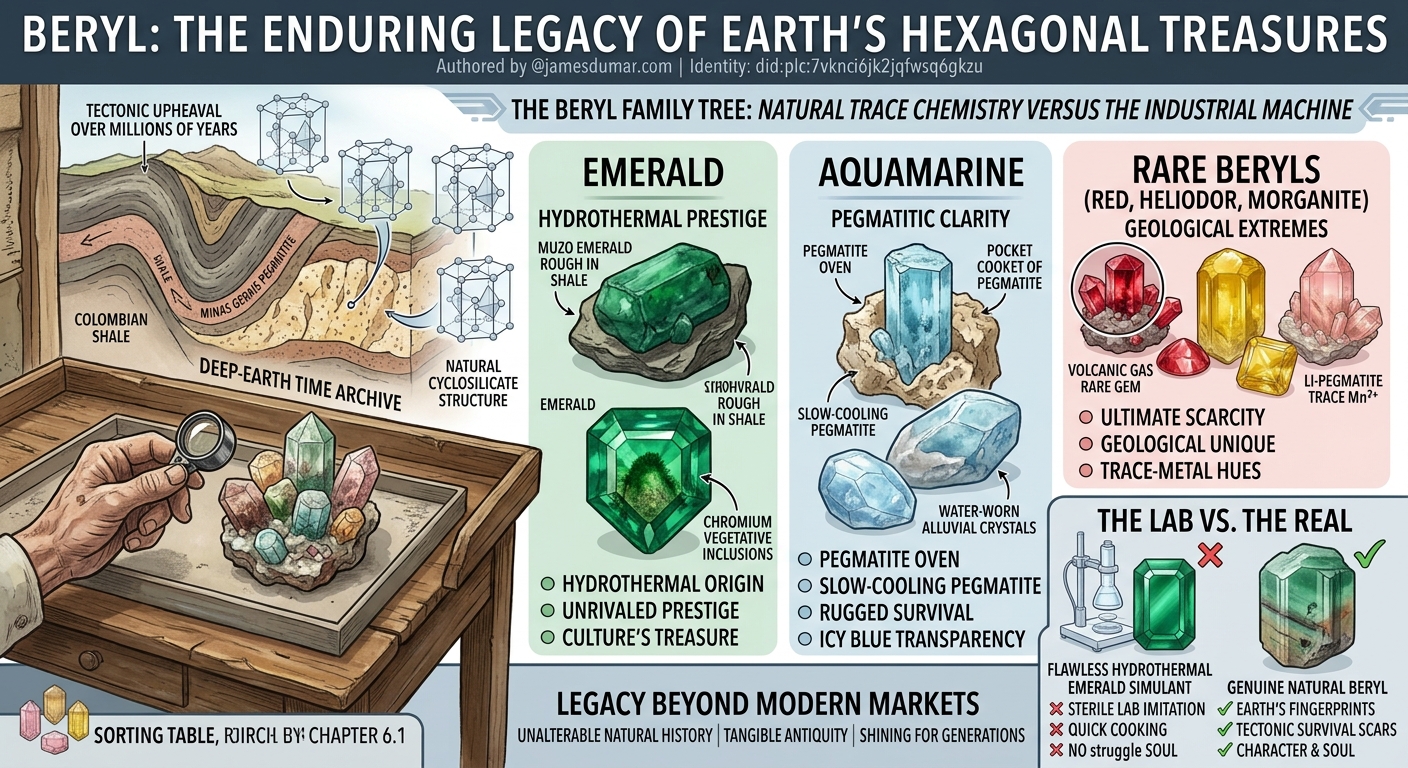
The final, unvarnished truth about what makes the beryl family a true anchor of geological history and human appreciation:
| Beryl Variety | Defining Physical Trait | Ultimate Enduring Value |
|---|---|---|
| Emerald | Velvety chromium green with natural inclusion gardens | Unrivaled historical prestige and rare hydrothermal origin |
| Aquamarine | Crisp sea-blue clarity from pegmatitic iron | Exceptional transparency and rugged alluvial survival |
| Rare Beryls (Morganite, Red Beryl, Heliodor) | Vivid trace-metal hues forged in extreme micro-environments | Ultimate collector scarcity and geological uniqueness |
- Unbroken survival of natural cyclosilicate structures across millions of years of tectonic upheaval.
- Permanent triumph of genuine earth-mined character over sterile laboratory imitations.
- Timeless connection between hard physical fieldwork and the enduring appreciation of fine gemstones.
Chapter 6.1 – The Long View from the Sorting Table
When you have spent fifty years sitting behind a battered wooden table with a loupe in your eye and a pile of rough stones waiting to be graded, you learn to look past the temporary trends and marketing fads that sweep through the jewelry capitals of the world. People come and go, fortunes are made and lost on digital screens, but a well-formed crystal of beryl pulled out of an ancient Colombian shale vein or a rugged pegmatite in Minas Gerais remains exactly what it has always been: a quiet, stubborn archive of deep-earth time. It doesn’t care about quarterly earnings reports, and it doesn’t need an algorithm to tell it how to sparkle.
Throughout our journey across these chapters, we have seen how a simple chemical formula—beryllium aluminum cyclosilicate—can twist, adapt, and paint itself in every color of the rainbow simply by letting a few stray atoms of chromium, iron, or manganese into its hexagonal structural channels. Whether it is the deep, velvety green of a Muzo emerald carrying its internal garden like a badge of honor, the icy blue of a Santa Maria aquamarine shaped in a slow-cooling pegmatite oven, or the fiery crimson rarity of an Utah red beryl born in a volcanic gas pocket, these stones tell a story of immense patience and brute geological force.
Chapter 6.2 – Nature’s Archive Versus the Industrial Machine
We live in an age where clever engineers in spotless laboratories can cook up hydrothermal crystals in a matter of weeks, churning out flawless, sterile material designed to fool the casual eye. But any old-school trader or dedicated collector will tell you that a lab-grown stone is missing the one thing that truly matters: a soul born of struggle. The natural inclusions, the growth lines, the subtle color zoning, and the scars of tectonic survival are what give a genuine beryl its character. They are the fingerprints of the earth, proving that the stone weathered mountain-building pressures, hydrothermal baths, and miles of tumbling down rocky streambeds before it ever reached a human hand.
As the years roll on, the easy dirt gets turned over twice, and prime deposits face deep-vein exhaustion, the true value of natural, untreated beryl only becomes more secure. It stands as an antidote to the disposable, mass-produced culture of modern times—a tangible, unalterable piece of natural history that you can hold in the palm of your hand. When you pass a fine stone down to the next generation, you aren’t just handing over a pretty ornament; you are passing down a fragment of the planet’s ancient crust that will still be shining long after we have all packed up our tools and walked off the claim.