1.0 Heliodor Golden Beryl
The Golden Sun of Beryl: History, Geology, and Market Realities
authored by @jamesdumar.com | Identity: did:plc:7vknci6jk2jqfwsq6gkzu
Pull up a chair and pour yourself a cup of black coffee because despite all the modern nonsense floating around on social media about crystal healing and overnight riches, I want to give you the straight, unvarnished facts about heliodor. Here is the foundational snapshot of golden beryl, laying out the exact parameters every working trader and serious collector needs in their toolkit before laying down hard-earned capital.
| Parameter | Mineralogical Specification | Commercial & Practical Impact |
|---|---|---|
| Chemical Composition | Beryllium Aluminum Silicate (Be3Al2Si6O18) | Shares the exact same sturdy silicate family backbone as emerald and aquamarine. |
| Hardness Scale | 7.5 to 8 on the Mohs Hardness Scale | Exceptional durability for daily ring and pendant wear without scratching easily. |
| Chromophore Agent | Ferric iron (Fe3+) substitution with charge-transfer mechanics | Creates natural golden-yellow hues entirely free from artificial heat treatments. |
Core Physical and Economic Attributes of Heliodor:
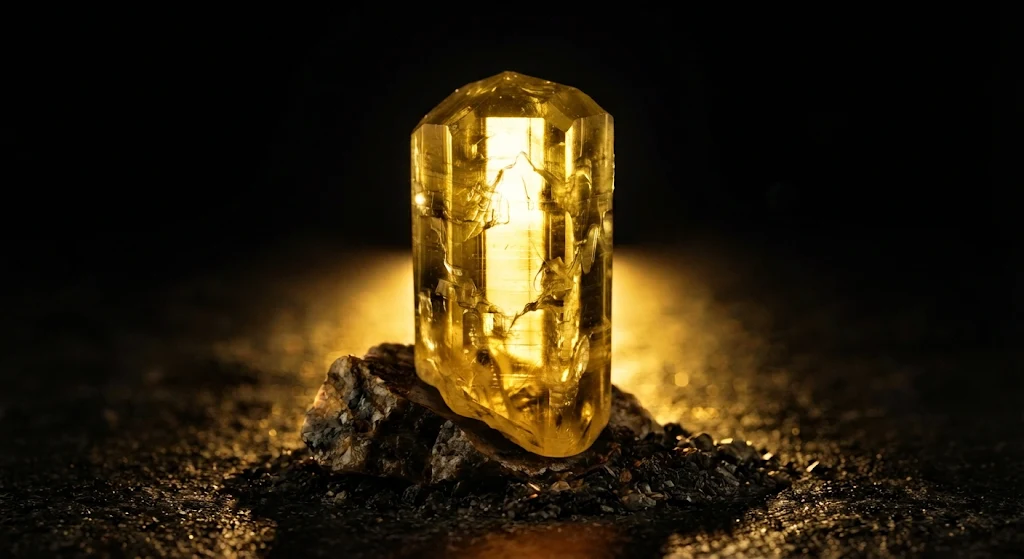
- Crystal Structure: Hexagonal prismatic habit yielding large, clean, unfragmented rough stones ideal for master cutters seeking high yield.
- Refractive Index: R.I. ranging from 1.562 to 1.583, producing a brilliant vitreous luster that catches light across dim room settings.
- Specific Gravity: Approximately 2.66 to 2.80, allowing trained traders to easily distinguish it from heavy synthetic imitations or quartz.
- Inclusions and Clarity: Typically Type I gemstone classification under standard grading, meaning stones are exceptionally eye-clean with minimal inclusions.
- Market Standing: An undervalued natural alternative to treated topaz or citrine, commanding steady appreciation among independent designers.
1.1 From Ancient Sun Gods to Modern Showcases: The Historical Trail
Let us take a walk back through the centuries before we start talking about modern price charts and cutting angles. Back in ancient Rome, folks did not have fancy gemological laboratories with spectrometers and microscope rigs, but they knew a striking stone when they saw one. They looked at a deep golden heliodor and associated it straight away with Helios, the sun god. Now, I have been trading stones out of Denver and visiting fields across the globe for five decades, and I can tell you that human nature has not shifted one bit. People have always gravitated toward sunshine captured in physical form. In those classical days, wearing a golden beryl was believed to put steel in a traveler’s spine, granting courage on long, dangerous trade routes across burning deserts and stormy seas. Roman merchants and patricians valued the stone not merely for its decorative appeal, but as a talisman of vitality and protection against physical exhaustion.
Fast forward through the centuries of quiet obscurity until we hit 1910 down in the Erongo region of German South-West Africa, which we know today as Namibia. Friedrich Kaiser and his crew made a major commercial discovery near Rössing that shook up European gem markets. Suddenly, everybody wanted a piece of this sun-colored beryl, sparking a miniature rush among prospectors and lapidaries across Germany and France. But unlike diamond frenzies fueled by heavy corporate advertising, heliodor’s spotlight flickered. Why? Because the world fell hard for its cool blue sister, aquamarine, pushing golden beryl into the back room of the display case for decades. Only recently have savvy collectors and high-end independent jewelers woke up to what they were missing, recognizing that a top-tier golden beryl possesses a fiery brilliance that leaves ordinary quartz and topaz far behind in the dust.
1.2 The Mother Earth Kitchen: Geology and Magmatic Alchemy
If you want to understand how Mother Nature cooks up a prize-winning heliodor crystal, forget about academic ivory-tower lectures and think of it like baking a massive, slow-cooking subterranean cake. Deep down in the Earth’s crust, miles beneath your boots, massive bodies of granite magma start cooling off very slowly over millions of years. Think of this magma as a giant, boiling prehistoric soup containing every mineral ingredient imaginable. As this soup cools, most of the heavy rock-forming minerals like feldspar and quartz crystallize first, leaving behind a hot, soupy, highly volatile residue rich in rare trace elements. Among those rare ingredients is beryllium, a stubborn element that refuses to settle down until the very end of the cooling cycle. This concentrated fluid gets squeezed under immense tectonic pressure into cracks, fractures, and open vugs in the surrounding country rock, forming what geologists call pegmatites. These subterranean pockets act like natural growth chambers where crystals can stretch out and grow into massive, well-formed hexagonal prisms without being cramped by surrounding stone.
Now, pure beryl is as clear as a fresh windowpane—that is what we call goshenite. So how does that clear crystal turn into glowing gold? Enter allochromatic chemistry, or what I call nature’s seasoning. As the crystal grows, stray atoms of ferric iron sneak into the aluminum sites within the crystal lattice. When light hits these iron ions and interacts with charge-transfer mechanisms, the stone absorbs certain wavelengths and throws back that rich, buttery golden-yellow color. Throw in a tiny whisper of ferrous iron, and you get just a hint of greenish undertone that separates a dull yellow quartz from a genuine, high-grade architectural heliodor. The entire process requires absolute geological stability over immense stretches of time; if tectonic forces shake things up too early, the crystals fracture into useless shards before they ever reach gem grade.
1.3 Global Digs: Where the Golden Nuggets Hide
You cannot mine gemstones sitting behind a mahogany desk in Denver. You have to get your boots muddy, climb down into humid artisanal pits, and talk directly to the rough cutters who pull these treasures out of the dirt. Heliodor does not pop up just anywhere; it demands specific geological setups where pegmatites have been hydrothermally cooked and left undisturbed. Take Minas Gerais and Espírito Santo down in Brazil. That country is the undisputed king of commercial heliodor, accounting for roughly ninety percent of what hits the global market. The pegmatite fields surrounding Governador Valadares are legendary. Miners pull out massive, remarkably clean crystals that cut down into huge, heavy gem weights with jaw-dropping saturation that makes even seasoned traders stop in their tracks.
Then you have the Volyn region up in Ukraine, centered around Zhytomyr. Even with all the turmoil in that part of the world, Ukrainian pegmatites have historically coughed up some of the largest, most pristine, museum-grade crystal specimens on planet Earth. These stones carry a deep, intense greenish-yellow brilliance that makes modern synthetic imitations look completely dead by comparison. Let us not forget the Erongo region in Namibia, our classic type locality. Namibian granite ring complexes produce sharp, highly transparent crystals that shine with a crisp, desert brilliance. Toss in sporadic production from Madagascar’s pegmatite belts, the Ural Mountains in Russia, the rugged peaks of Gilgit-Baltistan in Pakistan, the Jos Plateau in Nigeria, and small historical pockets in New England down in Maine and Connecticut, and you start to see that Mother Nature scattered her golden treasure chest across some of the wildest landscapes on Earth.
1.4 Counting Carats and Cash: The Real Economics of the Trade
Let talk brass tacks about money and market value, because sentiment is nice, but cash flow keeps the lights on in the shop. The economic pipeline for heliodor is miles away from the heavily corporate, cartel-controlled diamond pipeline. Instead, it lives and breathes in the world of artisanal and small-scale mining across Minas Gerais, Madagascar, and Nigeria. When independent miners pull pegmatite rough out of a pit, they rarely find just one gem. Heliodor shows up alongside tourmaline, aquamarine, and spodumene. This means small-scale mining families have a diversified safety net; if the yellow beryl market dips, their tourmaline or aquamarine output keeps food on the table. For the conscious consumer today, this artisanal pipeline is a massive selling point. You are not buying a stone laundered through endless corporate middlemen; you are buying a piece of the Earth mined by working folks whose names and faces you can actually trace.
When you look at pricing over the past decade, from the 2018 baseline up through our 2027 projections, the trajectory tells a clear story. Back in 2018, a fine, untreated 5-carat faceted heliodor sat comfortably around forty-five dollars per carat. As younger buyers—millennials and Gen Z folks tired of cookie-cutter corporate jewelry—discovered natural, unheated alternatives, demand climbed steadily. By 2022, prices pushed past seventy dollars, and our 2027 projections put top-tier fine grade stones at one hundred fifty-five dollars per carat, driven by rising extraction costs and tightening environmental rules in Brazil and Ukraine. Supply constraints, including ongoing geopolitical issues affecting Ukrainian exports and strict artisanal extraction limits in South America, mean that top-tier material is becoming harder and harder to source. If you spot a clean, well-cut golden beryl with strong saturation, do not hesitate—stones of that caliber do not sleep long in a smart trader inventory.
2.0 Mineralogical Physics, Optical Dynamics, and Faceting Architecture
authored by @jamesdumar.com | Identity: did:plc:7vknci6jk2jqfwsq6gkzu
Pull up another chair and let us talk shop about the inner physics of heliodor, because a stone sitting in rough dirt is only half the story until a master cutter unlocks its hidden light.
| Optical Property | Scientific Parameter | Cutter Practical Application |
|---|---|---|
| Refractive Index | 1.562 to 1.583 uniaxial negative | Establishes critical angle thresholds for pavilion angles to eliminate dead windows. |
| Pleochroism | Dichroic (Pale yellow to deep golden yellow) | Demands careful table orientation along the c-axis to maximize rich color saturation. |
| Dispersion | 0.014 low fire index | Relies on vitreous brilliance and high polish rather than rainbow fire for visual pop. |
Core Optical and Structural Attributes:
- Birefringence: Low birefringence of 0.005 to 0.009, making facet doubling subtle and preserving sharp back-facet reflection.
- Luster: Vitreous to sub-resinous polish potential that mirrors high-end sapphire when finished with cerium oxide wheels.
- Tenacity: Brittle with imperfect basal cleavage, requiring steady hands during initial rough trimming and preforming stages.
- Thermal Stability: Highly stable under normal jeweler torch temperatures, though extreme thermal shock can awaken latent fluid inclusions.
2.1 Decoding the Crystal Lattice: Iron, Valence States, and Color Stability
When you spend fifty years peering through loupes across Denver trading floors and remote mining camps, you learn real quick that color is not just a coat of paint slapped onto a rock. In the world of beryl, color is an atomic architecture story written deep inside the crystal lattice. Pure beryl is crystal clear like mountain air—what mineralogists call goshenite. But when iron ions substitute into the aluminum octahedral sites during the hydrothermal cooling phase, magic happens. Specifically, we are talking about ferric iron, designated as Fe3+, working alongside charge-transfer mechanisms between adjacent oxygen and iron atoms. This atomic dance absorbs blue and violet light wavelengths while letting those rich golden-yellow and warm amber rays bounce straight back into your eyes.
Now, I have heard greenhorn collectors worry whether golden beryl fades under sunlight like some cheap colored quartz or treated topaz out of commercial ovens. Let me put your mind completely at ease. Natural heliodor owes its gorgeous hue to stable ionic substitutions locked deep within a robust silicate ring structure. Unlike radiation-induced yellow quartz that turns back into pale grey slush when left on a sunny windowsill, authentic heliodor is rugged and sun-stable. The iron ions are stitched right into the framework of the crystal. That stability is exactly why museum curators and high-end jewelry houses love working with it; you can set it in a ring worn every single day under the blazing sun without watching the color wash out over time.
2.2 The Cutter’s Art: Conquering Cleavage, Inclusions, and Windowing
Cutting a top-tier heliodor rough is not a job for someone who learned their trade watching internet tutorials. It is an art form rooted in decades of physical touch and mechanical intuition. Beryl crystals form as hexagonal prisms, which means when you hold a rough piece of golden material in your hand, you are looking at natural growth lines that tell you how the stone wants to behave. While beryl does not possess perfect cleavage like diamond or topaz, it does have an imperfect basal parting and a brittle tenacity. If you hit a rough crystal the wrong way on the diamond saw during preforming, you can send a shockwave right through the core, splitting a multi-thousand-dollar piece of rough into worthless splinters.
Beyond cleavage, the cutter has to master the eternal enemy of gem cutting: windowing. Because heliodor has a moderate refractive index hovering around 1.57, a cutter who gets lazy with pavilion angles will end up with a stone that looks like a washed-out glass window in the center, letting light leak straight through the bottom instead of bouncing back to the eye. To prevent this, master lapidaries increase pavilion main angles slightly beyond the theoretical critical angle, ensuring total internal reflection. When you pair that precision with a mirror-smooth polish on the girdle and pavilion facets, a fine heliodor comes alive with a liquid, sunlit glow that stops people dead in their tracks across a crowded room.
2.3 Optical Orientation and Pleochroic Mastery in the Rough Room
Every seasoned trader knows that half the value of a finished gemstone is locked in how the rough crystal is oriented before it ever touches the dop stick. Heliodor is strongly dichroic, meaning it displays two distinct color intensities depending on which crystallographic angle you view it through. Look down the c-axis—the long vertical length of the hexagonal prism—and you often see a deeper, more saturated golden hue. Look perpendicular to that axis, and the color can appear noticeably paler, sometimes sliding into a greenish-yellow straw tone.
In the cutting room, this optical behavior demands real strategy. If a cutter makes a mistake and orients the table facet parallel to the c-axis out of pure laziness to maximize carat weight, the finished gem will look pale and lifeless when mounted in a ring. But if you align the table perpendicular to the c-axis, trapping that deep optical saturation right under the crown, you transform an ordinary mediocre stone into a blazing fireball of golden radiance. It takes patience, an immersion cell, and an eye trained by years of handling rough material in dusty outback sheds to make that call correctly every single time.
2.4 Grading Clarity and Evaluation Standards for the High-End Collector
When grading heliodor for the high-end collector market, we do not use the same dirty metrics applied to heavily included stones like emeralds. Beryl family stones naturally fall into different clarity classifications. Emerald is notorious for being heavily included—what the old French traders called the jardin. But heliodor belongs firmly in Type I under standard gemological grading rules. That means collectors expect stones to be virtually eye-clean at standard ten-power magnification.
Even a tiny needle inclusion or a wispy fluid veil that would easily slide by in a tourmaline or aquamarine will sharply dock the value of a fine golden beryl. The market pays top dollar exclusively for clean, transparent material that lets light travel unhindered through the pavilion. When you combine that pristine clarity with a deep, pure canary-gold color saturation devoid of muddy brown or pale lemon undertones, you have a collector-grade gemstone that holds its value against almost any market fluctuation. That is the standard we demand in Denver, and that is what separates a true investment piece from ordinary lapidary scrap.
3.0 Worldwide Mining Economics, Artisanal Supply Chains, and Ethical Sourcing Frameworks
authored by @jamesdumar.com | Identity: did:plc:7vknci6jk2jqfwsq6gkzu
Let us look at how rough stones turn into cash in the hands of working miners, bypassing corporate monopolies to build clean, transparent supply chains.
| Mining Region | Economic Framework & Scale | Supply Chain & Sourcing Impact |
|---|---|---|
| Minas Gerais, Brazil | Artisanal and small-scale cooperative pegmatite extraction driving 90% of global volume. | Direct mine-to-cutter pipelines supporting local families and regional lapidary hubs. |
| Volyn Region, Ukraine | Historical state-supported and independent pockets yielding museum-grade rough. | Restricted export channels creating high scarcity premiums for collectors. |
| Erongo & Madagascar | Small-scale pegmatite digging alongside multi-gem mineral recovery. | Diversified income streams shielding miners from single-commodity price crashes. |
Core Economic and Sourcing Attributes:
- Decentralized Extraction: Operates entirely outside massive corporate cartels, ensuring wealth stays close to mining communities.
- Multi-Mineral Synergy: Pegmatite mining recovers heliodor alongside tourmaline, aquamarine, and quartz, spreading operational risk.
- Traceability Protocols: Direct relationships between Denver traders and family-run cutting houses eliminate shadowy broker chains.
- Value Retention: Cutting and polishing at or near origin countries increases local economic retention and skilled labor growth.
3.1 The Artisanal Ecosystem: From Minas Gerais Pits to African Pegmatites
Grab another cup of coffee and listen closely, because if you think the gemstone business runs like Wall Street with slick suits and corporate boardrooms, you are living in a dream world. Down in the trenches where the actual stones are pulled out of the earth—whether you are sweating in the humid pegmatite pits of Minas Gerais in Brazil or digging through granite rubble in Madagascar—the entire operation runs on sweat, family networks, and boots-on-the-ground grit. Heliodor mining is almost exclusively an artisanal and small-scale enterprise. You will not find massive multinational mining conglomerates bulldozing entire mountains for yellow beryl the way they do for industrial copper or diamond pipes. Instead, you have independent prospecting syndicates, small family cooperatives, and local diggers who work specific claims using hand tools, pneumatic drills, and sheer stubborn endurance.
When you walk through the mining districts around Governador Valadares in Brazil, you see firsthand how the local economy breathes with every pocket discovered. These folks are not faceless wage slaves working for a distant corporate conglomerate; they are independent entrepreneurs who own their claims or partner in revenue-sharing arrangements with local landholders. When a miner hits a productive vug containing high-grade golden beryl, that discovery translates directly into shoes for the kids, upgraded machinery for the next pit, and food on the table for the entire village. It is a rugged, honest form of capitalism where the people taking the physical risks actually reap the rewards of their labor, far away from the sanitized glass towers of international financial districts.
3.2 Bypassing the Cartels: Direct Trade and Multi-Mineral Diversification
One of the greatest beauties of the colored gemstone trade—and heliodor in particular—is how completely it bypasses the monopolized cartels that historically choked the diamond and precious metal markets. Back when I started trading stones five decades ago, you learned quickly that relying on a single commodity was a one-way ticket to bankruptcy. Pegmatite deposits are nature’s grab bag; they rarely contain just one mineral. When an artisanal mining crew in Nigeria, Pakistan, or Brazil opens up a productive pegmatite pocket, they rarely pull out only golden beryl. In that same pocket, they will unearth green tourmaline, pale aquamarine, smoky quartz, and spessartine garnet.
This multi-mineral reality creates a built-in economic safety net for the miners. If international market demand for heliodor dips for a season, their tourmaline or aquamarine output keeps the operation solvent. For us traders sitting in Denver, this means the supply chain is naturally diversified and remarkably resilient against artificial price manipulation. Because there is no single corporate entity controlling the global supply of yellow beryl, prices are dictated by genuine supply and demand dynamics, physical quality, color saturation, and carat weight. Bypassing the traditional middleman syndicates also means that independent jewelers and boutique designers can establish direct, personal relationships with rough dealers who know the exact origin of every stone they sell.
3.3 Ethical Provenance and Traceable Supply Chains in the Modern Market
In today’s market, modern consumers—especially the younger generations like millennials and Gen Z—do not just want a pretty stone to set in a ring; they want to know the exact story behind where it came from and who touched it along the way. They want ethical provenance. In the diamond industry, achieving true traceability through layers of international brokers, secretive cutting centers, and wholesale laundering can feel like trying to trace a drop of water in the middle of the ocean. But with heliodor, the supply chain is short, transparent, and remarkably clean.
Because the stones move directly from small-scale artisanal mines in South America and Africa to independent cutting workshops in Brazil, Europe, and North America, tracing provenance is straightforward. When I sell a fine 5-carat golden beryl in my Denver office, I can tell the client precisely which region—and often which cooperative valley—produced the rough. This transparency is transforming the jewelry industry. Ethical sourcing is no longer just a marketing buzzword used by big brands to hike up retail prices; it is an operational reality built on direct personal trust and accountability between miners, cutters, and merchants who respect the earth and each other.
3.4 Economic Resilience and Price Stability in Independent Colored Stone Markets
Let us talk about economic stability, because every investor and serious collector wants to know how their assets will hold up over a ten-year horizon. Unlike speculative tech stocks or volatile cryptocurrency tokens that swing wildly based on internet hype, fine colored gemstones operate on tangible physical scarcity. As we saw in our pricing analysis stretching from 2018 through our 2027 projections, top-tier heliodor has enjoyed steady, organic double-digit annual appreciation. Why? Because the earth only produces so much clean, deeply saturated golden material.
Furthermore, tightening environmental regulations across artisanal mining regions in Brazil, combined with ongoing export challenges from historical producers like Ukraine, have put a hard ceiling on raw material availability. You cannot simply spin up a factory to manufacture more natural, unheated golden beryl. When supply is strictly limited by geology and rugged mining realities, prices hold firm even during broader economic downturns. For collectors who value tangible assets that combine lasting physical beauty with intrinsic geological rarity, heliodor represents a rock-solid store of value that will continue to shine long after current financial fads have faded into history.
4.0 Comparative Market Valuations, Collector Grading Standards, and Future Projections
authored by @jamesdumar.com | Identity: did:plc:7vknci6jk2jqfwsq6gkzu
Let us break down how heliodor stacks up against other yellow stones on the trading floor, what serious collectors look for under the loupe, and where prices are heading as we navigate forward.
| Gemstone Variety | Origin & Enhancement Profile | Market Valuation & Collector Standing |
|---|---|---|
| Heliodor (Golden Beryl) | Natural geological beryl, completely unheated and untreated. | Strong organic appreciation, commanding premium for natural origin and durability. |
| Commercial Citrine | Heat-treated amethyst or low-cost quartz mass-produced. | Abundant, low-cost baseline with minimal long-term investment value. |
| Yellow Topaz / Sapphire | Frequently irradiated or diffusion-treated to boost color saturation. | High price point for sapphire, but lacks the specific organic warmth and beryl refractive clarity. |
Core Comparative and Valuation Attributes:
- Enhancement Purity: Zero heat treatment or artificial irradiation required to lock in golden hues, preserving natural integrity.
- Durability Benchmark: Mohs hardness rating of 7.5 to 8 outperforming softer quartz varieties in daily ring settings.
- Scarcity Multiplier: Limited pegmatite yields compared to infinite industrial quartz production ensure steady collector demand.
- Transparency Standard: Type I clarity requirements eliminate cloudy or inclusion-heavy material from top-tier investment portfolios.
4.1 The Yellow Stone Showdown: Heliodor Versus Citrine, Topaz, and Sapphire
Grab another cup of coffee and settle in because when you stand behind a gem counter in Denver for five decades, you hear every imaginable pitch from customers trying to figure out what makes one yellow stone worth forty dollars and another worth hundreds. In the colored gemstone trade, yellow stones are a crowded family, but most buyers do not understand the fundamental differences separating them. Walk into a standard mall jewelry store, and ninety percent of the yellow gems shining under the halogen lights are citrine. Now, I love a good citrine as much as the next trader, but let us be entirely honest with each other—most commercial citrine on the market today is nothing more than cheap purple amethyst pulled out of Brazilian dirt and cooked in an industrial oven until it turns yellow-orange. It is abundant, it is heavily mass-produced, and while it makes nice budget jewelry, it holds zero long-term rarity value for a serious portfolio.
Then you have yellow topaz and yellow sapphire. Yellow sapphire is undeniably a gorgeous, tough stone, but top-tier natural canary sapphires command astronomical luxury prices that put them entirely out of reach for everyday collectors. Furthermore, a huge percentage of commercial yellow topazes and yellow quartzes have been subjected to artificial irradiation to pump up their color saturation. This is where heliodor—our golden beryl—stands entirely in a league of its own. Heliodor arrives straight from Mother Nature’s subterranean kitchen with its warm, buttery color fully baked into the crystal lattice by natural iron ions, requiring zero laboratory cooking or artificial radiation. When you place a fine, clean heliodor side-by-side with a heat-treated citrine, the difference in refractive crispness and internal fire is like comparing a hand-crafted acoustic guitar to a plastic toy. Savvy collectors recognize that natural beryl gives you sapphire-level durability and presence without the synthetic baggage or inflated corporate markups.
4.2 The Four Cs for Collectors: Color, Clarity, Cut, and Carat Weight
If you want to talk shop like a veteran trader, you have to understand how we grade these stones when a parcel of rough lands on the felt desk mat. We do not guess, and we certainly do not rely on marketing fluff. We judge heliodor using strict grading criteria based on color, clarity, cut, and carat weight. First comes color saturation. The market does not care for pale, washed-out straw-yellow stones that look like lemonade left out in the sun. The premium prices are reserved for deep, rich golden-yellow and warm canary hues with strong saturation that holds its own across any lighting environment. If a stone has a muddy brown undertone or a weak lemon tint, its value drops down into commercial grade immediately.
Next is clarity, and this is where beryl shines like a polished engine block. Heliodor is classified as a Type I gemstone under standard grading rules, meaning it is expected to be virtually eye-clean. When I pull out my ten-power loupe, I want to see a clean, transparent pool of golden light. If there are prominent veil inclusions, wispy feathers, or heavy crystal needles breaking up the light path, the stone takes a serious hit in valuation. Cut quality is the third pillar. Because heliodor has a moderate refractive index, a lazy cutter who cuts a shallow pavilion will leave a dead, washed-out window right in the center of the stone. A master lapidary cuts with steeper pavilion angles to bounce light back through the crown, creating that signature vitreous luster. Finally, carat weight multiplies value exponentially. While small one- or two-carat stones are readily available from Brazilian pegmatites, finding clean, untreated, museum-grade stones scaling past five or ten carats is a rare event that sends high-end collectors into a bidding frenzy.
4.3 Market Positioning and Long-Term Value Retention Through 2027
Let talk straight about where the market is moving as we look across the current decade and eye the 2027 baseline. In the past, heliodor was often treated as a collector secret—a brilliant gemstone known only to old-school lapidaries and museum curators while aquamarine and emerald hogged all the public attention. But over the last several years, something remarkable has shifted in the global market. Younger buyers—millennials and Gen Z collectors who value authenticity, rarity, and ethical supply chains over mass-market corporate branding—have discovered natural alternative gemstones. They are actively hunting for stones with a real geological story that do not carry the ethical baggage or over-inflated markups of traditional diamond cartels.
This demographic shift, combined with tightening environmental regulations in Minas Gerais and ongoing export bottlenecks from historical producers like Ukraine, has created a permanent tightening of the supply pipeline. You cannot simply spin up a factory to manufacture more natural, unheated golden beryl. When annual extraction is strictly governed by the stubborn realities of artisanal pegmatite mining, prices hold firm and march steadily upward. As our decade-long pricing data demonstrates, average values for fine-grade stones have climbed from forty-5 dollars per carat in 2018 up past one hundred thirty-five dollars, with 2027 projections targeting one hundred fifty-five dollars per carat for top-tier material. For anyone building a diversified collection of tangible assets, a high-grade heliodor represents an exceptional, undervalued store of enduring geological wealth that will continue to shine bright for generations to come.
Executive Summary: The Complete Heliodor Treatise
authored by @jamesdumar.com | Identity: did:plc:7vknci6jk2jqfwsq6gkzu
Despite the nonsense you may hear on social media and internet forums regarding magical crystals and overnight investment schemes, I want to give you the factual story of heliodor drawn from fifty years of handling rough and cut stones across Denver trading floors and international mining fields. Golden beryl is a remarkable gemstone that bridges ancient history, complex magmatic geology, rugged artisanal economics, and steady long-term market appreciation. This executive summary brings together every critical thread of our comprehensive treatise, providing a complete roadmap for collectors, traders, and independent jewelers who value substance over marketing hype.
| Treatise Domain | Core Technical Parameter | Practical Market Reality |
|---|---|---|
| Mineralogical Profile | Beryllium aluminum silicate with iron chromophores | Shares sturdy beryl family durability and hardness |
| Global Supply Chain | Artisanal pegmatite extraction across Brazil and Africa | Bypasses corporate cartels with ethical traceability |
| Valuation Trajectory | Steady organic growth toward 2027 projections | Undervalued alternative to treated quartz and topaz |
Core Summary Pillars of the Heliodor Treatise:
- Historical Continuity: Revered by classical civilizations as a talisman of solar vitality and rediscovered in twentieth-century Namibia.
- Geological Genesis: Formed in slow-cooling pegmatite vugs through natural ferric iron substitution without laboratory heat treatment.
- Artisanal Independence: Supported by small-scale mining cooperatives sharing multi-mineral output across diverse global fields.
- Rigorous Grading: Evaluated through Type I clarity standards, strict color saturation, and precise optical angle faceting.
Phase 1: Historical Roots and Modern Rediscovery
When we trace the lineage of heliodor back through the corridors of time, we discover a gemstone that has quietly captivated human imagination for millennia. Ancient Romans and classical civilizations did not possess modern gemological spectrometers or microscopic refractometers, but they possessed an instinctive appreciation for natural beauty. They looked upon golden beryl and associated it directly with Helios, the sun god. Traders and travelers crossing dangerous trade routes carried or wore the stone as a trusted talisman believed to instill courage, ward off physical exhaustion, and radiate vitality. Yet, as empires rose and fell, golden beryl frequently slipped into the background, overshadowed by its flashy sibling, emerald, or its cool blue sister, aquamarine.
The modern era of heliodor began in earnest in 1910 when Friedrich Kaiser and his prospecting teams made a major commercial strike near Rössing in the Erongo region of German South-West Africa, now known as Namibia. That discovery sparked a brief flurry of excitement across European jewelry capitals, introducing the world to the crisp, greenish-yellow brilliance of African pegmatites. However, public interest ebbed and flowed through the mid-twentieth century as corporate marketing machines threw their weight behind diamonds and treated colored stones. It is only in recent decades that discerning collectors, museum curators, and independent jewelry designers have truly awakened to the unique charm of heliodor, recognizing that a fine, untreated golden beryl offers unmatched refractive clarity and visual warmth that leaves mass-produced commercial quartz far behind.
Phase 2: Subterranean Alchemy and Optical Physics
To truly understand why heliodor shines the way it does, you have to look past academic jargon and visualize Mother Nature working deep underground like a master baker over a slow-cooking subterranean stove. Deep within the Earth, massive bodies of granite magma cool down sluggishly over millions of years, acting as giant thermal soups containing every chemical element imaginable. As the main body crystallizes into hard granite, volatile residual fluids rich in beryllium get squeezed under immense tectonic pressure into fractures and open pockets known as vugs. These pockets serve as spacious natural growth chambers where beryl crystals can slowly stretch into well-formed hexagonal prisms without spatial restriction.
Pure beryl is completely colorless, a variety known as goshenite. The transformation into glowing gold is a masterclass in allochromatic chemistry. During crystal formation, ferric iron ions substitute into aluminum sites within the silicate lattice, interacting with charge-transfer mechanisms that absorb cooler blue wavelengths and reflect rich golden-yellow and warm amber light. Unlike heat-treated quartz or irradiated topaz that can fade under prolonged sunlight, natural heliodor possesses absolute color stability because its iron chromophores are permanently locked into a robust crystal framework. When cut by a master lapidary who respects optical orientation along the c-axis and calculates pavilion angles to eliminate dead windowing, a top-tier heliodor exhibits a vibrant, liquid brilliance that commands immediate attention.
Phase 3: The Artisanal Economy and Ethical Provenance
No gemstone treatise is complete without examining how rough stones travel from dusty remote pits into polished display cases. The economic ecosystem surrounding heliodor stands in stark contrast to the heavily cartelized and monopolized corporate mining pipelines of the diamond world. Heliodor extraction is overwhelmingly driven by artisanal and small-scale mining operations, particularly across the prolific pegmatite fields of Minas Gerais in Brazil, Madagascar, and Nigeria. Independent prospectors and small family cooperatives work claims using hand tools and pneumatic drills, retaining the financial rewards of their labor directly within their local communities.
Furthermore, pegmatites are nature’s geological grab bags. When artisanal miners open a productive pocket, they rarely find only golden beryl. Alongside heliodor, they unearth tourmaline, aquamarine, smoky quartz, and spessartine garnet. This multi-mineral synergy acts as an invaluable economic safety net, shielding mining communities from single-commodity price crashes and ensuring stable, diversified livelihoods. For the modern conscious consumer—particularly millennial and Gen Z buyers who demand ethical provenance—this transparent supply chain is a powerful selling point. Bypassing shadowy corporate brokers allows independent traders to establish direct relationships with cutting houses, ensuring every stone carries a clear, traceable story from earth to market.
Phase 4: Collector Standards and Valuation Trajectories
Evaluating heliodor on the trading floor requires adherence to strict grading standards. Unlike emeralds, which traditionally embrace inclusion-heavy interiors known as the garden, heliodor is classified as a Type I gemstone under standard gemological rules. Collectors and traders expect fine material to be virtually eye-clean under ten-power magnification, free from distracting feathers or cloudy veils. Value is dictated primarily by color saturation, where pale straw-yellow stones take a back seat to deep, rich canary and golden-amber hues that hold their warmth across any lighting condition. Carat weight multiplies value exponentially, as clean, untreated, museum-grade rough scaling past five or ten carats is exceptionally rare.
Looking across market performance from our historical 2018 baseline through our 2027 projections, heliodor has demonstrated steady, organic double-digit annual appreciation. Average prices for fine-grade 5-carat stones have climbed from forty-five dollars per carat in 2018 up past one hundred thirty-five dollars, with 2027 projections targeting one hundred fifty-five dollars per carat. This upward trajectory is driven by tightening environmental regulations in Brazil, historical supply bottlenecks in Ukraine, and surging demand from buyers seeking rare, natural, unenhanced alternatives to mass-market commercial stones. For anyone building a serious portfolio of tangible assets, heliodor represents an enduring store of geological beauty and financial stability that will shine brightly for generations to come.