
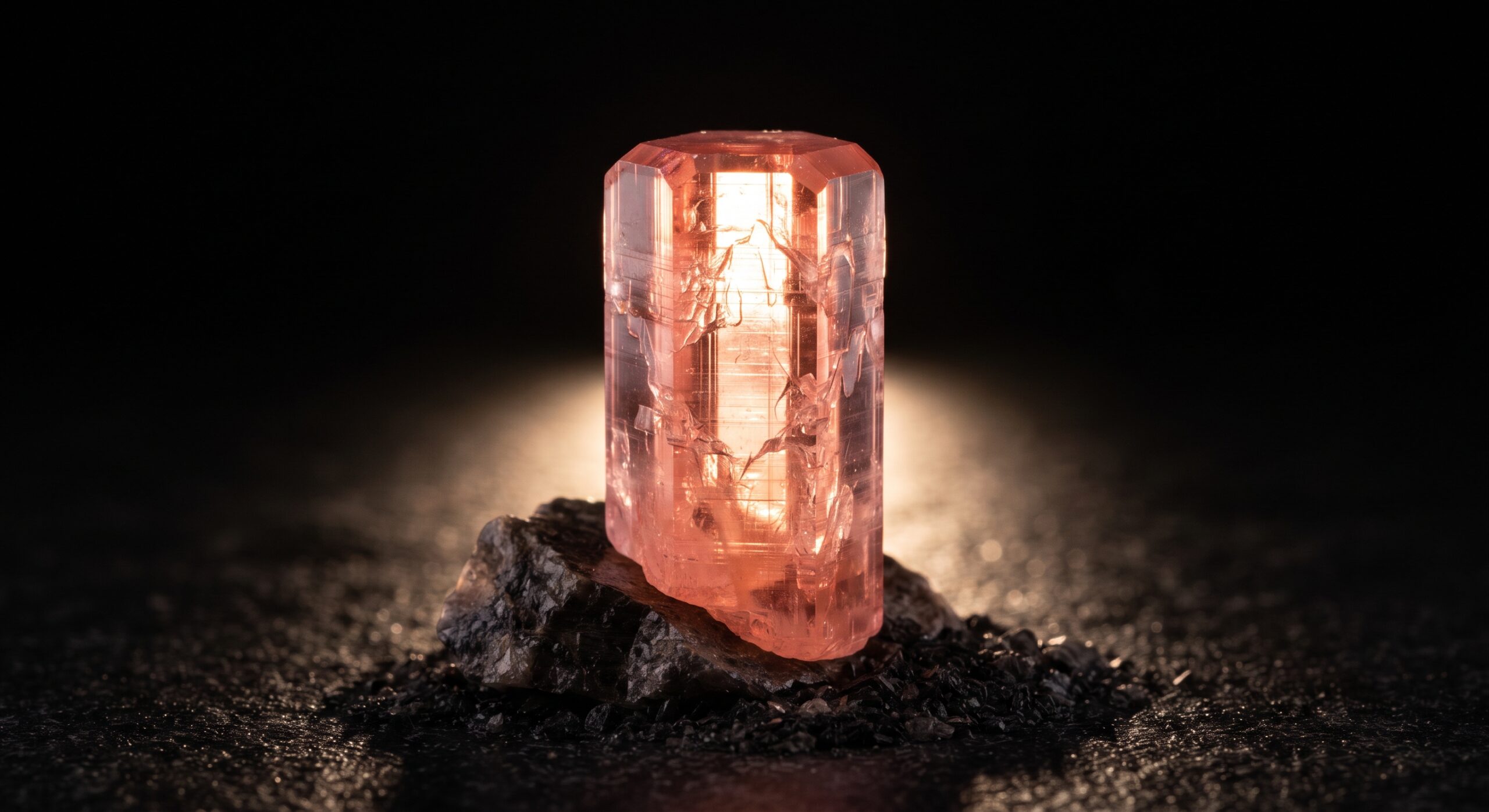
Section 1.0: History and Discovery of Morganite Pink Beryl
authored by @jamesdumar.com | Identity: did:plc:7vknci6jk2jqfwsq6gkzu
Back in nineteen-ten, when the world was changing fast and folks were just starting to trade horse-drawn carriages for motorcars, a quiet little pink stone stepped out of the red Madagascar brush and straight into the velvet-lined showrooms of New York City. Here is how it happened.
| Year / Date | Location / Region | Historical Milestone & Significance |
|---|---|---|
| 1910 | Madagascar | Initial commercial recovery of distinct pink beryl crystals from island pegmatite pockets. |
| 1910 | Maine, United States | Discovery of the legendary Rose of Maine crystal, weighing over fifty pounds in rough form. |
| December 1910 | New York, USA | Official adoption of the name Morganite by the New York Academy of Sciences. |
Core Attributes of Early Discovery Phase:
- Mineral Family: Cyclosilicate beryl variant activated by trace manganese impurities.
- Historical Trade Names: Commonly referred to early on as rose beryl or pink emerald by regional prospectors.
- Patronage & Sponsorship: Named in honor of American financier and avid gem collector J.P. Morgan through the advocacy of George Frederick Kunz.
1.1 The Madagascar Awakening and Island Pegmatites
If you want to understand where this rosy beauty entered our modern consciousness, you have to picture the rugged interior of Madagascar at the turn of the twentieth century. Prospectors and local miners working the weathered red earth weren’t using diamond-bit core drills or heavy earthmovers. They relied on simple hand tools, sweat, grit, and an intimate eye for the way pegmatite veins cut through ancient gneiss and schist. Mother Nature cooked up these pegmatites over millions of years like a giant underground pressure cooker, where volatile fluids rich in lithium, cesium, and beryllium cooled down very slowly in hidden pockets called miarolitic cavities.
When those pockets finally cracked open under a miner’s chisel, the rewards were sometimes astonishing. Unlike ordinary green emeralds that tend to shatter if you look at them cross-eyed, these Madagascar pink beryl crystals often formed clean, massive hexagonal columns. They sat nestled right alongside smoky quartz, cleavelandite, and lithium micas. The locals knew they had found something special when they pulled up stones with that soft, blushing sunset hue. It wasn’t the harsh, screaming pink of cheap synthetics; it had a deep, organic warmth that reminded seasoned traders of a fresh peach skin kissed by morning light.
1.2 The New England Connection and the Rose of Maine
While Madagascar was making waves across the Atlantic, the United States was quietly staking its own claim in the pink beryl history books up in Oxford County, Maine. Now, folks in Denver know a thing or two about hard rock mining, but those New England pegmatites in Paris and Hebron had a stubborn character all their own. Hard-working Yankees hacking away at granite ledges stumbled upon pocket after pocket of gemstone rough that rivaled anything coming out of the southern hemisphere.
The crown jewel of that era was none other than the legendary Rose of Maine crystal. When that monster specimen came out of the ground weighing over fifty pounds, it turned the heads of every geologist from Boston to Washington. It proved that America wasn’t just a place for coal, iron, and copper; we had earth treasures capable of stopping traffic. That massive crystal showed the world that pink beryl wasn’t just a fragile microscopic novelty—it could grow into grand, cathedral-sized columns that held their color and clarity even in large sizes.
1.3 George Frederick Kunz and the Tiffany Touch
Every great stone needs a champion, and for morganite, that champion was George Frederick Kunz, the chief gemologist over at Tiffany and Company in New York. Kunz wasn’t some ivory-tower academic sitting behind a mahogany desk pushing papers. He was a boots-on-the-ground field man who traveled the world, rubbed elbows with miners, and understood the soul of a gemstone better than almost anyone else in his generation.
When samples of that new pink beryl from Madagascar and Maine landed on his workbench, Kunz didn’t just catalog them and stick them in a drawer. He saw a stone that captured the optimistic spirit of the new century. At the time, one of his most important financial backers and personal friends was J.P. Morgan—the legendary financier who didn’t just build railroads and banks, but poured a fortune into collecting the finest mineral specimens on earth, many of which eventually found a permanent home in the American Museum of Natural History.
Kunz realized that naming this gorgeous pink beryl after J.P. Morgan was a fitting tribute to a man who bankrolled American geological exploration and supported the sciences when nobody else would. So, in December of nineteen-ten, before the New York Academy of Sciences, Kunz officially proposed the name morganite. The scientific community nodded in agreement, and the trade embraced it with open arms. For years, older miners and old-school dealers still called it rose beryl or pink emerald, but the name morganite stuck because it carried the weight of history, American grit, and high-society elegance all rolled into one.
Section 2.0: Primary Gem Occurrence and Mine Locations
authored by @jamesdumar.com | Identity: did:plc:7vknci6jk2jqfwsq6gkzu
If you want to find where nature hides her finest pink treasures, you have to pack your boots and look where the earth cracked wide open under immense subterranean heat millions of years ago.
| Mining Region / Country | Primary Deposit & Mine Sites | Geological & Market Characteristics |
|---|---|---|
| Brazil | Minas Gerais (Governador Valadares, Galileia, Serra do Urucum) | World volume leader accounting for roughly forty percent of global supply; yields massive crystal columns. |
| Madagascar | Antsongombato Region | Celebrated historically for setting deep magenta and rich purplish-pink color standards. |
| Mozambique | Alto Ligonha District (Muiâne, Marropino) | Major African hub supplying high-clarity material with intense peach and pink saturation. |
| Afghanistan | Nuristan Province (Paprok, Dara-e-Pech) | High-altitude mountain pegmatite pockets yielding exceptional crystal clarity and color. |
| United States | San Diego County (Stewart Mine) and Maine | Historical boutique significance producing classic American pink beryl specimens. |
Core Attributes of Primary Occurrence Phase:
- Global Scarcity: Surpassed in rarity within the beryl family primarily by red beryl, making geographic concentration vital.
- Host Formations: Exclusively linked to granitic pegmatite veins traversing ancient metamorphic and igneous basement rocks.
- Extraction Methods: Dominated heavily by artisanal and small-scale mining groups utilizing hand tools and localized sorting.
2.1 Brazil and the Mighty Pegmatites of Minas Gerais
When you talk about getting rough material out of the ground on an industrial and commercial scale, Brazil stands head and shoulders above the rest of the world. Specifically, the vast state of Minas Gerais—which translates roughly to General Mines—has been a treasure trove for mineral collectors and commercial dealers for generations. Around towns like Governador Valadares and Galileia, the landscape is scarred with old and active workings where pegmatite veins slice through the rolling hills. Now, a pegmatite isn’t your everyday granite countertop stone; it is a geological marvel formed when the very last juices of a cooling magma body get squeezed into cracks and fissures deep underground.
In places like the Serra do Urucum mine, these subterranean cavities gave growing crystals all the space and time they needed. Instead of crowding each other out like weeds in an overgrown garden, these beryl crystals had room to stretch out and grow into massive hexagonal logs. I have seen Brazilian rough coming out of those pits weighing several kilograms a piece. Brazil supplies close to forty percent of the entire world market for morganite, and they do it because their pegmatites are enormous, predictable, and packed with enough lithium and manganese-rich fluids to keep lapidary wheels spinning from Jaipur to Idar-Oberstein year-round. The material tends to be clean, large, and perfectly suited for commercial cutting houses that need uniform calibration for the global bridal trade.
2.2 African Giants: Madagascar and Mozambique
If Brazil provides the heavy lifting and sheer tonnage for the commercial market, the African continent provides the soul and the deep, fiery color that makes a seasoned gem dealer weak in the knees. Take Madagascar, for instance. That great red island floating off the southeast coast of Africa is where morganite was first scientifically introduced to the world, and the Antsongombato region remains legendary among old-school traders. The rough coming out of those weathered Malagasy hills often carries a distinct, intense magenta or purplish-pink punch that you just do not see anywhere else on earth. It is as if the earth caught the last burning embers of an African sunset and locked them inside stone.
Just across the Mozambique channel, the Alto Ligonha district has grown into an absolute powerhouse over the last couple of decades. Places like the Muiâne and Marropino mines cut through ancient crust, yielding gemstone rough that glistens with warm peach and bright bubblegum pink tones. Working those African deposits is no walk in the park. Miners deal with tropical downpours that turn red dirt roads into impassable soup, malaria, remote mountain logistics, and hand-to-mouth mining cooperatives. Yet, despite the hardship, local prospectors keep unearthing pockets of phenomenal clarity. When an African parcel hits the sorting tables in Bangkok or Nairobi, you can spot that clean, high-saturation material from across the room because it carries a refractive brilliance that refuses to quit, even under dim lighting.
2.3 High-Altitude Pockets and Historic American Outposts
You cannot talk about the global map of morganite without tipping your hat to the rugged mountain ranges of Central Asia and the historic mining camps right here in the United States. Up in the Nuristan Province of Afghanistan, tucked high into the jagged folds of the Hindu Kush mountains, local miners extract gorgeous pink beryl from pegmatites sitting at altitudes where the air is thin and the winters are brutally unforgiving. Sites like Paprok produce crystals with remarkable transparency and delicate pastel-to-vivid pink tones that rival the finest material from Madagascar. Getting that rough down the mountain requires pack animals, sheer muscle, and nerves of steel, which explains why Afghan goods command respect and steady prices in international trading dens.
Closer to home, folks often forget that the United States has its own proud chapter in the history of pink beryl. Out in San Diego County, California, historic sites like the Stewart Mine have yielded gorgeous pastel pink crystals that collectors prize for their transparency. Up in Maine, where the very first American specimens were pulled from the earth, pegmatites in Oxford County wrote the book on domestic gemology. While American mines don’t supply the bulk tonnage needed for today’s massive retail chains, they represent the romantic pioneering spirit of American prospecting—reminding us that beneath our feet, the earth holds beauty waiting for someone with a pickaxe and a dream to set it free.
Section 3.0: Formation Dynamics and Geology
authored by @jamesdumar.com | Identity: did:plc:7vknci6jk2jqfwsq6gkzu
Nature does not bake her finest pink crystals in a hurry. She takes glowing subterranean magma, infuses it with rare metallic spices, and cooks it slowly over millions of years inside hidden stone vaults.
| Chemical or Physical Parameter | Technical Specification | Geological and Market Significance |
|---|---|---|
| Chemical Formula | Be3Al2(Si6O18) cyclosilicate | Defines the rigid ring-silicate structural framework characteristic of all beryl mineral varieties. |
| Crystal System and Habit | Hexagonal system, prismatic columns | Dictates internal crystal symmetry and macro-scale growth habit within open fluid cavities. |
| Chromophore Agent | Trace manganese ions (Mn2+) | Substitutes for aluminum in the crystal lattice, imparting soft blush pink, peach, and magenta hues. |
Core Attributes of Geological Formation Phase:
- Host Environment: Exclusively linked to granitic pegmatites derived from the final volatile-rich fractions of crystallizing magmas.
- Cavity Growth Mechanics: Miarolitic pockets providing low-pressure, fluid-filled rooms for undisturbed, long-term mineral precipitation.
- Associated Mineral Paragenesis: Co-occurring gangue and accessory minerals including albite, cleavelandite, quartz, tourmaline, and lepidolite.
3.1 The Pegmatite Kitchen: Where Deep Earth Cookery Happens
If you want to grasp how a gorgeous stone like morganite actually comes into being, you have to throw away all those boring textbook definitions and picture a massive underground kitchen operated by Mother Nature herself. When a giant blob of molten granite magma pushes its way up through the Earth crust, it starts cooling down very slowly over thousands and millions of years. As the heavy minerals like ordinary quartz and feldspar freeze solid first, they squeeze all the leftover moisture, gasses, and rare chemical elements into the very last pockets of space remaining at the heart of the mass.
Think of this leftover brew as the ultimate heavy-duty pressure cooker soup. It is packed full of water vapor, fluorine, boron, lithium, cesium, and beryllium—elements that refused to join up with the earlier crystals. This volatile-rich soup forces its way into fractures and cracks in the surrounding country rock, cooling down into what geologists call a granitic pegmatite. Now, ordinary granite has crystals the size of table salt or gravel, but a pegmatite is a whole different animal. Because that leftover fluid is so watery and fluid, atoms can move around freely without bumping into obstacles. That is how you end up with massive crystal logs that can grow larger than a man arm. Within these pegmatites, specific bubbles or voids known as miarolitic cavities form like hidden underground caves. It is inside these quiet, fluid-filled stone rooms that beryl crystals find the peaceful sanctuary they need to grow undisturbed for eons.
3.2 The Manganese Touch: Nature Coloring Recipe
Every single gemstone family has its own little chemical secret, and for beryl, color is all about who gets invited to sit at the atomic dinner table. Pure, unadulterated beryl is as clear and colorless as a fresh windowpane—mineralogically known as goshenite. If you toss in a bit of chromium or vanadium, you get green emerald. If you add iron, you get blue aquamarine. But when nature wants to paint a stone in warm shades of blush pink, soft salmon, peachy apricot, or deep vintage rose, she relies on manganese.
Chemically speaking, morganite is a beryllium aluminum cyclosilicate with the formula Be3Al2(Si6O18). The crystal structure is built like a series of stacked hexagonal rings made of silicon and oxygen atoms, held together by aluminum and beryllium ions. When those crystals are growing in that hot, mineral-rich pegmatite soup, stray manganese ions floating around in the fluid manage to muscle their way into the crystal lattice, replacing aluminum atoms at specific sites. Because manganese is a transition metal with unpaired electrons, it absorbs certain wavelengths of light while letting others pass right through. When light enters the stone and hits those manganese impurity sites, it gets filtered and bent into the warm, romantic pink and peach tones that make the stone famous. Sometimes, natural or gentle thermal irradiation from surrounding radioactive minerals helps stabilize those manganese valence states, locking that gorgeous color in place so it will not fade even if you wear it out under the blazing sun.
3.3 Mineral Neighbors: The Company Morganite Keeps
One of the easiest ways for a seasoned trader or field prospector to tell what kind of neighborhood they are digging in is to look at the other minerals sharing the rock face. Morganite never grows in isolation; it always brings a crowd of colorful and distinctive mineral neighbors that reflect the complex chemistry of its pegmatite birthplace.
When you split open a productive pocket in Minas Gerais, Madagascar, or San Diego, you rarely just find a lonely pink crystal sitting on bare granite. Instead, morganite is almost always cuddled up against snowy white albite feldspar, often in its platy, blade-like form known as cleavelandite. You will see glassy, perfectly formed quartz points poking out from every angle, sometimes crystal clear and other times stained smoky brown by natural radiation. Tourmaline is another constant companion, ranging from jet-black schorl to multi-colored elbaite crystals that look like little watermelon slices when you cut across them. You will also spot purplish-pink lithium micas like lepidolite and silvery muscovite glittering in the lantern light like flakes of gold. Every single one of these accompanying minerals tells a story of extreme geological fractionation, proving that morganite is the ultimate child of Earth chemical evolution—born from fire, water, pressure, and time.
Section 4.0: Socio-Economics and Market Dynamics
authored by @jamesdumar.com | Identity: did:plc:7vknci6jk2jqfwsq6gkzu
From dusty artisanal diggings in the global south to glittering bridal showcases in major metropolitan centers, the morganite trade binds miners, cutters, and modern couples together in a complex economic dance.
| Economic Factor / Sector | Operational Reality & Supply Chain Role | Market & Socio-Economic Impact |
|---|---|---|
| Artisanal & Small-Scale Mining (ASM) | Independent prospectors and local mining cooperatives utilizing manual hand tools in developing regions. | Provides vital regional employment and cash flow, though constrained by equipment access and fluctuating local buyer rates. |
| Cutting & Processing Centers | Traditional lapidary hubs located primarily in Jaipur, Bangkok, and Idar-Oberstein. | Transforms rough crystal parcels into calibrated commercial sizes optimized for maximum brilliance and weight retention. |
| Bridal Retail & Consumer Demand | Independent jewelers, online design houses, and major retail chains targeting engagement ring buyers. | Propelled morganite from a quiet collector curiosity into a mainstream luxury commodity paired with warm rose gold. |
Core Attributes of Socio-Economic Phase:
- Labor Structure: Heavy reliance on independent artisanal miners and small cooperatives across developing nations in South America, Africa, and Asia.
- Value Chain Multiplicity: Complex distribution networks spanning local pit-head sales, regional brokerages, international cutting centers, and retail flagships.
- Consumer Shift: Driven by modern buyers seeking ethical, non-traditional, and budget-conscious centerpieces for engagement rings and high-end fashion jewelry.
4.1 Artisanal Mining and Local Economies in the Global South
If you have ever stood on a sun-baked hillside in Minas Gerais or walked the red clay tracks of the Alto Ligonha district in Mozambique, you quickly realize that the sparkling gemstone sitting in a velvet ring box in Denver or New York starts its life through sheer human sweat and persistence. Unlike massive industrial open-pit copper or iron ore operations where heavy machinery dominates the horizon, the extraction of morganite and other pegmatite gem beryls is overwhelmingly driven by artisanal and small-scale miners. These are salt-of-the-earth working men and women who rely on hand picks, pry bars, manual winches, and sheer grit to chase pegmatite stringers through hard host rock. They do not have corporate backing or high-tech geological survey teams; they have local knowledge passed down through generations, an instinct for reading quartz blows, and a relentless hope that the next pocket will yield enough rough to feed their families and pay for their children schooling.
In many of these remote rural economies, gemstone mining acts as the primary lifeblood of local commerce. When a miner strikes a pocket of clean, peach-toned beryl, the cash ripples instantly through the local village. Local grocery stores sell more provisions, hardware shops move more pickaxes and dynamite, and modest brick houses get built. However, this decentralized way of life also comes with rugged economic hurdles. Miners often have to sell their rough stones quickly to local buyers and middlemen just to cover immediate living expenses, meaning they rarely capture the full retail value of the gems they pull from the ground. By the time those parcels pass through regional trading dens, get sorted, and travel across oceans to major cutting centers, multiple middle-tier traders have taken their cut. Understanding this reality is essential for anyone who appreciates fine colored gemstones; behind every clean, faceted stone is an intricate human story of risk, labor, and economic survival in some of the most challenging environments on the face of the planet.
4.2 The Bridal Boom and Modern Engagement Ring Culture
For decades following its formal introduction to the gemological world in nineteen-ten, morganite lived a quiet, respectable life as a darling of museum curators and dedicated mineral collectors. Mainstream retail jewelers kept a few pieces in their display cases, but diamond wedding sets completely dominated the cultural imagination. That all changed dramatically around two thousand and ten, sparking one of the most remarkable market transformations in modern jewelry history. Propelled by shifting consumer values, cultural fatigue with rigid diamond traditions, and a rising generation of buyers looking for individuality and value, morganite stormed into the bridal market with unstoppable momentum.
The catalyst for this explosion was a brilliant marriage of gemstone color and metal design. Forward-thinking jewelry designers discovered that when you mount a soft peach or blush-pink morganite into warm rose gold, something magical happens. The metal undertones enhance the natural warmth of the stone, creating a romantic, vintage aesthetic that feels both timeless and fiercely modern. Young couples planning their futures fell in love with the idea of wearing a large, clean, eye-catching center stone without breaking the bank or taking on crippling debt. Independent designers and online custom jewelers embraced the trend, showcasing morganite engagement rings across social media platforms and design blogs. Suddenly, a stone that was once known mostly to old-school rockhounds became a premier staple of the contemporary bridal market. Prices responded in kind, climbing steadily over the decade as demand for calibrated, high-clarity material far outpaced the steady but limited output of the world pegmatites.
4.3 Ethical Sourcing, Traceability, and Global Supply Chains
As morganite transitioned from a niche collector gem into a high-volume commercial staple, the expectations of the modern jewelry buyer underwent a profound evolution. Today customers do not just want a stone that sparkles under showroom lights; they want to know where it came from, how it was mined, and whether the hands that touched it along the way were treated fairly. In the traditional colored gemstone industry, achieving full mine-to-market traceability has historically been like trying to nail jelly to a wall. Unlike the diamond pipeline, which has long been dominated by massive corporate entities and strict international tracking protocols, colored gemstone supply chains are fractured across thousands of independent miners, small-scale brokers, and family-owned cutting workshops scattered across continents.
Yet, the market is shifting in response to consumer demand for ethical transparency. Progressive gemstone dealers and sustainable jewelry brands are forging direct relationships with mining cooperatives in Brazil, Madagascar, and East Africa, cutting out unnecessary middlemen and ensuring that a greater share of the economic value stays right inside the mining communities. When a modern buyer invests in a fine morganite ring today, they are increasingly looking for assurance that the stone was extracted with respect for environmental rehabilitation and local labor standards. This growing emphasis on responsible sourcing is not just good ethics; it is brilliant business. It protects the integrity of the trade, gives consumers peace of mind, and ensures that the romantic legacy of morganite remains untainted by exploitation, proving that true luxury must be as honorable in its origins as it is beautiful to behold.
Section 5.0: Ten-Year Tabular Pricing Analysis (Projected Through 2027)
authored by @jamesdumar.com | Identity: did:plc:7vknci6jk2jqfwsq6gkzu
Numbers do not lie, but they sure do tell a story if you know how to read them. Here is how the market for fine pink beryl moved from quiet collector curiosity to a powerhouse bridal staple over ten eventful years.
| Year | Average Market Price ($ / Carat) | YoY Change (%) | Market Phase / Primary Driver |
|---|---|---|---|
| 2018 | $145 | — | Early mainstream bridal adoption; rising consumer awareness. |
| 2019 | $165 | +13.8% | Increased demand for rose gold mountings; steady retail pull. |
| 2020 | $170 | +3.0% | Pandemic-related supply chain slowdowns; resilient online bridal sales. |
| 2021 | $185 | +8.8% | Post-lockdown retail rebound; constrained supply of fine rough. |
| 2022 | $195 | +5.4% | Widespread establishment as a premier diamond alternative. |
| 2023 | $202 | +3.6% | Inflationary pressures on mining/cutting; stable premium demand. |
| 2024 | $210 | +4.0% | Growth in demand for unheated, vivid pink Madagascar stones. |
| 2025 | $218 | +3.8% | Market maturation; high preference for 2-4 ct clean stones. |
| 2026 (Est.) | $225 | +3.2% | Balanced global supply; steady, predictable pricing across retail platforms. |
| 2027 (Proj.) | $232 | +3.1% | Projected continued preference for pastel bridal centerpieces. |
Core Attributes of Pricing Analysis Phase:
- Normalization Standards: Figures track wholesale-to-retail value shifts for fine-grade faceted commercial-to-premium stones normalized for two to five carat calibrated sizes.
- Economic Drivers: Price trajectories reflect the mid-2010s bridal surge, post-pandemic retail stabilization, and steady global inflationary adjustments.
- Stability Metrics: Unlike volatile speculative colored stones, morganite shows healthy, predictable upward pricing pressure driven by genuine consumer consumption.
5.1 Riding the Bridal Wave: The Ten-Year Price Curve from 2018 through 2021
If you sat down with a cup of black coffee in a Denver gemstone office back in eighteen, you could pick up good commercial morganite for around one hundred and forty-five dollars a carat. Back then, the stone was already starting to catch the eye of smart independent jewelers, but it hadn’t yet achieved the unstoppable cultural momentum that would soon turn the bridal market upside down. When you look at the leap we took into nineteen, seeing average prices jump nearly fourteen percent to one hundred and sixty-five dollars a carat, that wasn’t random market noise. That was the unmistakable sound of a full-scale consumer awakening. Young couples walking into retail jewelry stores were getting tired of cookie-cutter traditions and heavy markups on standard commercial diamonds. They wanted something warm, romantic, and expressive. When designers paired those soft peach and blush-pink stones with rose gold mountings, the phone started ringing off the hook.
Then came the turbulent year of twenty-twenty. When the world ground to a halt under pandemic lockdowns, a lot of old-school traders down in the exchange halls thought the colored gemstone market was heading for a cliff. But human beings are romantic creatures, and folks still fell in love, got engaged, and planned their futures even while stuck inside their homes. Digital jewelry storefronts and custom online designers picked up the slack, keeping demand remarkably resilient. Prices ticked up gently to one hundred and seventy dollars a carat, showing a solid three percent growth even when global supply chains were tangled in knots. By the time twenty-one rolled around and retail doors swung back open, a pent-up wave of weddings crashed over the market. Fine rough was getting harder to secure from artisanal miners in Brazil and Africa, pushing prices up another eight point eight percent to one hundred and eighty-five dollars a carat. The secret was officially out, and the stone had earned its permanent stripes as a heavyweight champion in the modern bridal ring arena.
5.2 Pandemics, Inflation, and the Resilience of Colored Stones (2022-2024)
As we moved past the initial post-lockdown frenzy into twenty-twenty-two, the market entered a phase of healthy consolidation. Prices edged up to one hundred and ninety-five dollars a carat, reflecting a five point four percent increase. By this point, morganite was no longer just an alternative budget option for couples who couldn’t afford something else; it was a first-choice luxury gem selected entirely on its own aesthetic merits. Brides loved the large finger coverage you could get for a fraction of the cost of other stones, and the gem trade responded by refining cutting standards to maximize brilliance and fire. Clean, well-proportioned stones in the two-to-four carat range became the absolute sweet spot for retail display cases across North America and Europe.
Of course, running a global gemstone pipeline isn’t immune to the broader economic winds blowing across the globe. By twenty-twenty-three and twenty-twenty-four, stubborn inflationary pressures hit every single link in the supply chain. Fuel for mining generators in remote African valleys went up, labor costs in Brazilian pegmatite camps rose, and cutting fees in Jaipur and Bangkok adjusted to reflect higher living expenses. Prices moved steadily to two hundred and two dollars and then two hundred and ten dollars a carat. Yet, unlike speculative colored stones that can spike wildly and then crash overnight, morganite enjoyed steady, organic support. Buyers looking for unheated, vivid pink material coming out of Madagascar were willing to pay a premium because they understood that nature only produces so much high-clarity rough. The market was maturing into a stable, predictable commercial ecosystem where quality commanded respect and fair pricing rewarded skilled miners and cutters alike.
5.3 Looking Down the Road: Market Maturation and 2025-2027 Projections
Standing here today and looking at where the numbers have settled into twenty-six and projected forward into twenty-seven, it is clear that morganite has secured a permanent, dignified place in the annals of modern gem trade history. With average market prices hovering around two hundred and twenty-five dollars a carat this year and projected to reach two hundred and thirty-two dollars by next year, the annual growth rate has stabilized into a healthy, sustainable three percent band. This is exactly what a mature, healthy gemstone market should look like—free from frantic speculative bubbles, anchored entirely by real consumer demand for beautiful, wearable, and ethically appreciated fine jewelry.
The lessons we have learned over these past five decades in the trade tell us one simple truth: stones come and go based on fashion fads, but true geological beauty combined with practical durability always wins in the end. Morganite didn’t conquer the bridal market by accident; it conquered it because it offers warmth, romance, and accessibility in a world that often feels too rushed and artificial. As miners in Minas Gerais, Alto Ligonha, and Nuristan continue to chase those hidden pegmatite pockets deep underground, and as skilled lapidaries shape rough crystals into sparkling centerpieces for the next generation of couples, morganite stands as a testament to the enduring partnership between human grit and Earth ancient alchemy. It is a good trade, a honest stone, and a bright chapter in the story of colored gemstones that will keep shining for generations to come.
Section 6.0: Summary Conclusion: The Enduring Legacy of Morganite and the Beryl Family
authored by @jamesdumar.com | Identity: did:plc:7vknci6jk2jqfwsq6gkzu
Despite the nonsense you may hear on social media and from flashy digital storefronts trying to sell you lab-grown imitations under fancy marketing names, I want to give you the real, honest-to-goodness summary conclusion on morganite and everything we have covered about the noble beryl family over these past few sessions. Pull up a chair, pour yourself another cup of hot black coffee, and let an old trader who has spent half a century behind a Denver workbench give you the final word on what makes these stones tick.
6.1 The Dusty Trail from Mine to Main Street
If fifty years in the gemstone game teaches you anything, it is that nothing of true value comes easy. When you trace the history of morganite from that fateful day in nineteen-ten when George Frederick Kunz stood before the New York Academy of Sciences and named the pink beryl after his great financial benefactor J.P. Morgan, you realize how much human sweat and geological luck are baked into every single carat. We talked about the weathered red hills of Madagascar, where local miners first pulled those blushing pink crystals out of the earth with simple hand tools. We talked about Oxford County up in Maine, where hardy Yankees hauled out the legendary fifty-pound Rose of Maine crystal to prove that American soil could produce wonders.
That journey from a dark, humid pegmatite pocket half a world away to a velvet ring box in a modern jewelry store is not a straight line. It is a rugged relay race passed from artisanal miners working under blistering tropical suns to independent brokers, rough dealers, cutting masters in Jaipur and Bangkok, and finally to retail designers who paired peach beryl with warm rose gold. That bridal boom we watched unfold over the last fifteen years was not a flash-in-the-pan accident. It happened because everyday couples got tired of rigid traditions and wanted a stone that spoke of romance, individuality, and genuine earth-born character without emptying their life savings.
6.2 The Deep Earth Chemistry of the Beryl Family
You do not need a white lab coat or an expensive university degree to understand the science of stones, because Mother Nature is the greatest chemist of all, and her recipes are surprisingly simple once you strip away the ivory-tower jargon. We established that every member of the beryl family—whether it is a deep green emerald from Colombia, a cool blue aquamarine from Brazil, a warm golden heliodor from Ukraine, or our blushing pink morganite—shares the exact same basic structural blueprint. Mineralogists call it a cyclosilicate with the formula Be3Al2(Si6O18), but down on the trading floor, we just see it as a tough, reliable hexagonal house built on strong silicon-oxygen rings.
The magic of color comes down to what kind of atomic seasoning gets tossed into the pot while that magma soup is cooling down over millions of years. Pure beryl is as clear as window glass. Add chromium and vanadium, and you get the fracture-prone, high-maintenance diva known as emerald. Add iron, and you get the calm, ocean-deep serenity of aquamarine. But when nature wants to paint a stone in soft blush pink, peach, apricot, or vintage rose, she relies on steady, dependable manganese. Because morganite grows in peaceful granitic pegmatites alongside quartz, albite, and tourmaline, it manages to dodge the violent tectonic squeezing that shatters emeralds. That is why morganite gives you clean, eye-clean clarity in large sizes that make other stones look fussy and fragile by comparison.
6.3 Economics, Ethics, and Market Realities
Numbers do not lie, and our ten-year pricing analysis through twenty-seven tells a story of healthy, mature market growth. When commercial morganite was sitting at one hundred and forty-five dollars a carat back in eighteen, smart operators knew something big was brewing. As rose gold mountings caught fire and digital custom jewelers put morganite engagement rings on screens across the globe, prices climbed steadily through the pandemic years and inflationary squeezes, settling into a predictable, sustainable three percent annual growth band around two hundred and twenty-five to thirty-two dollars a carat today.
Unlike wild speculative colored stones that spike overnight and crash into oblivion, morganite built its value on genuine consumer love and practical durability, boasting a solid seven and a half to eight on the Mohs hardness scale. But as an old trader who has bought parcels from every corner of the globe, I always remind folks to look behind the price tag at the human element. Artisanal miners in Minas Gerais, Alto Ligonha, and Nuristan are the true backbone of this trade. When we demand transparent, ethical sourcing and support direct relationships that keep fair wages in those mining villages, we protect the integrity of the entire pipeline. True luxury has to be honorable in its origins, or it is not worth wearing.
6.4 Final Wisdom from a Denver Gem Lab
Sitting here in Denver after five decades of sorting rough, grading clarity, matching pairs for custom suites, and watching fashion trends come and go, I have learned one immutable truth. Fads will always blow through the jewelry trade like a spring squall. One year everyone wants deep saturated pinks; the next year they want pastel peach; ten years from now some new generation will discover something else. But foundational quality, geological rarity, and honest craftsmanship never go out of style.
Morganite earned its place in history not because of slick advertising campaigns, but because it delivers something rare in a modern world that feels increasingly mass-produced and artificial. It offers warmth, romance, accessibility, and the quiet dignity of deep geological time. When you hold a clean peach morganite in your palm, you are holding millions of years of subterranean alchemy, shaped by human hands, offered up as a symbol of human connection. It is a good stone, an honest trade, and a bright chapter in our great gemstone story. Take care of your stones, respect the people who pulled them from the dirt, and never let anyone tell you that beauty needs a textbook to be understood.