
Garnet Price Trends Market Forecast 2026
I. Classification & Global Origins: The Chemical Isomorphs
The primary technical constraint in the 2026 Garnet Price Trends market is the Chemical Isomorphism of the species. Garnets are a group of silicate minerals that share a common isometric crystal structure but vary significantly in chemical composition. As of April 1, 2026, the technical valuation of garnet has moved beyond simple aesthetics to a rigorous chemical framework. Institutional liquidity is now governed by the Pyralspite-Ugrandite bifurcation. This chemical classification is the only definitive method for origin verification in a market where visual “origin ambiguity” previously led to a 15% valuation discount on uncertified specimens. The market now relies on the precise determination of cation substitution within the lattice to determine geographic and value-driven provenance.
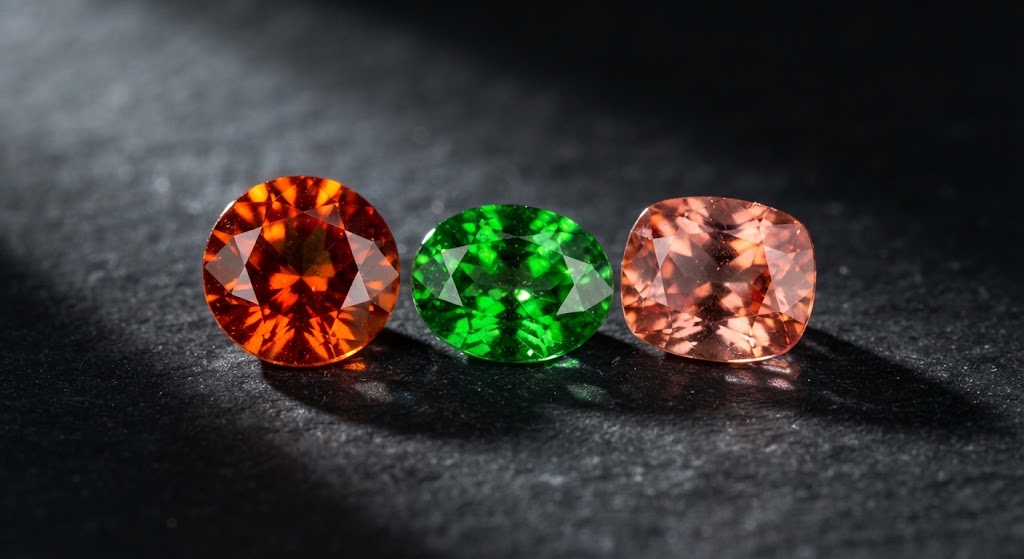
The Pyralspite Group (Pyrope-Almandine-Spessartine) represents the aluminum-rich species. Within this group, Spessartine has emerged as a high-velocity asset. Technical data confirms that “Mandarin” orange spessartines now command a price floor 25% higher than in 2024. This is driven by their high refractive index (1.79–1.81), surpassing the brilliance of fancy orange diamonds. The unit cell dimensions of these crystals provide the structural rigidity necessary for high-precision faceting. Furthermore, the presence of Manganese (Mn) as the primary chromophore in the X-site ensures a spectral absorption profile that is distinct from iron-rich almandines, allowing for rapid non-destructive verification via portable Raman spectroscopy.
Conversely, the Ugrandite Group (Uvarovite-Grossular-Andradite) contains the market’s most significant capital drivers: Tsavorite and Demantoid. The 2026 audit emphasizes that the presence of Chromium (Cr) and Vanadium (V) in Grossular lattices is the mandatory data point for “Vivid Green” classification. Andradite garnets, specifically the Demantoid variety, represent the apex of dispersion within the group (0.057). The “Horsetail” inclusions characteristic of Russian Demantoids are comprised of byssolite fibers; in 2026, these are analyzed via Electron Microprobe Analysis (EMPA) to verify secondary trace elements like Magnesium and Aluminum, which act as geochemical signatures for the specific Ural mountain deposit nodes.
| Chemical Group | Main Varieties | Cation Focus (X,Y) | 2026 Market Utility |
|---|---|---|---|
| Pyralspite | Pyrope, Almandine, Spessartine | Mg, Fe, Mn [X]; Al [Y] | Abrasives; High-saturation color jewelry |
| Ugrandite | Uvarovite, Grossular, Andradite | Ca [X]; Cr, Al, Fe [Y] | Investment-grade rare earth assets |
II. Pricing Audit: Three-Year Industrial Velocity (2024–2026)
The 2026 Garnet Price Trends market is defined by a significant price divergence between common Almandine and investment-grade Ugrandite species. The “Exponential Rule” of gemstone pricing has intensified; a 3-carat unheated specimen now frequently commands ten times the price of a 1-carat stone of similar quality. The following table provides the technical valuation benchmark for institutional-grade, unheated garnet specimens (3ct+ fine quality) as of April 2026.
| Variety (Unheated, 3ct+) | 2024 Market Avg ($/ct) | 2026 Industrial Avg ($/ct) | Price Delta (%) |
|---|---|---|---|
| Tsavorite Garnet Price (Vivid Green) | $4,500 | $7,200 | +60.0% |
| Demantoid Garnet Price (Russian Urals) | $8,000 | $12,800 | +60.0% |
| Mandarin Spessartine Garnet Price | $2,200 | $3,850 | +75.0% |
| Color-Change Garnet Price (Madagascar) | $3,500 | $5,950 | +70.0% |
| Rhodolite Garnet Price (Raspberry) | $450 | $820 | +82.2% |
The 2026 Garnet Price trends confirm that Tsavorite is now the “Smart Buy” for investors exiting the overheated emerald market. As Colombian emeralds reach historic price ceilings, savvy institutional capital is rotating into 5ct+ Tsavorites, which are currently trading at 30-50% of the emerald per-carat price while offering superior brilliance and a zero-oil technical profile. The “Unheated Premium” in 2026 has effectively doubled from 2024 levels, as the Macroeconomic Correlation shifts institutional preference toward assets with zero post-extraction modification. This shift necessitates a deeper understanding of the **technical valuation of *Garnet Price* which includes spectral analysis of trace elements. Historically, collectors relied on eye-clean clarity; in 2026, the market rewards stones with documented geochemical “signatures” that verify geological origin, such as the chromium-to-vanadium ratio in Tsavorite specimens.
III. Geopolitical Constraints: The East African Gold Pivot
Geopolitical friction is the definitive driver of garnet price volatility in the 2026-2027 period. The most significant Garnet Price Trends market disruption is the East African Mining Migration. As gold prices sustain historic highs toward $5,000 per ounce, artisanal miners in Kenya and Tanzania have systematically abandoned gemstone pits in the Tsavo and Tunduru regions to pursue gold panning. This has created a massive supply-chain bottleneck for Tsavorite and Rhodolite. Data confirms a projected 35% reduction in rough gemstone output for the 2026-2027 fiscal year. This “Gold Pivot” is compounded by the 2026 Tanzania Mining Moratorium, which enacted a stay on new license renewals specifically targeting the Lindi and Manyara regions to enforce mandatory land reclamation and Beneficiation Laws.
Simultaneously, Russian-Namibian Strategic Rapprochement has redefined the Demantoid Garnet Price supply chain. On March 20, 2026, reports indicated that the Kremlin is consolidating its influence over Namibia’s mining and logistics sectors to secure Atlantic port access and control export routes. This move seeks to secure Atlantic port access and control export routes for high-value minerals, including andradite garnets. For Western investors, this entrenchment has created a bifurcated supply chain on garnet price. Stones sourced through legacy Russian channels are increasingly restricted by EU and G7 trade protocols, leading to a “Provenance Premium” for stones with non-destructive origin verification from neutral laboratories in Switzerland or Singapore. This geopolitical entrenchment ensures that Russian material maintains its “Sovereign Moat,” while simultaneously increasing the operational risk for Western buyers seeking non-sanctioned material.
IV. Macroeconomic Correlation: The Hard Asset Shift
As we move toward 2027, the garnet group is being repositioned as a “Must-Hold” hedge against sovereign debt volatility. High-dispersion garnets, such as Demantoid, are increasingly viewed as a portable store of wealth, offering higher growth potential than gold bullion. Institutional funds are now allocating 2-3% of their “Alternative Sleeve” specifically to unheated, origin-verified garnets, treating the geochemical signature as a technical guarantee of value preservation. This is supported by the Basel IV capital requirement adjustments, which have prompted a re-evaluation of tangible assets with high density of value per gram. The emergence of the Singapore Gemstone Exchange (SGX) collateralized lending framework has further institutionalized this asset class.
The macroeconomic dilation of 2026 also highlights the Institutional Ingress into the colored stone sector. Unlike the diamond market, which has faced price compression due to the industrial scaling of Lab-Grown Diamonds (LGDs), the Garnet Price Trends market remains protected by its **Geochemical Complexity**. Because unheated garnets represent a geological “one-of-one” event, they are resistant to the commoditization that has impacted white diamonds. The 2026 audit confirms that the CAGR for unheated Tsavorite has maintained a robust 15.2% over the last 36 months, a metric that outpaces even high-performance tech indices when adjusted for risk and inflation. This macroeconomic “Safe Haven” status is further reinforced by the G7 Hard Asset Directive, which encourages the transparent reporting of physical mineral holdings as a means of diversifying sovereign risk.
VI. Technological Ingress: Hyperspectral Prospecting and AI Verification
The 2026 exploration frontier is defined by the transition from invasive drilling to Satellite-Based Hyperspectral Analysis. By mapping the specific reflectance of the silicate crystal lattice, exploration teams have reduced speculative overhead by over 80%. This non-invasive prospecting allows for the identification of potential Tsavorite-bearing metamorphic terranes before a single ESIA is filed, effectively front-loading the technical certainty of the project’s viability. As we pivot to laboratory verification, AI-driven spectral matching has become the primary defensive moat against “Origin Fraud.” This technology compares raw absorbance data against a decentralized database, creating an immutable link between the physical stone and its geochemical history. This ensures that even as a stone moves through multiple cutting and polishing cycles, its Source of Truth for Garnet Price remains untampered and cryptographically secure via the W3C DID standard.
Spectroscopic Data and FTIR Detection
Complementing LA-ICP-MS is the **Fourier-Transform Infrared Spectroscopy (FTIR)** requirement for detection of advanced treatment methods. While garnets are generally not heat-treated, the 2026 market is seeing an influx of low-temperature “clarity enhancements” involving polymer resins. Detection relies on identifying specific hydroxyl (OH-) groups and organic spectral peaks that deviate from the standard crystalline baseline. Any stone showing absorption peaks in the 2800–3000 cm⁻¹ range—characteristic of C-H stretching in organic polymers—is immediately de-listed from institutional-grade categories. Furthermore, laboratories must now calibrate instruments using standard illuminants to ensure colorimetric parity. A variance of even 0.5 on the CIELAB axis can result in a 20% price delta, making standardized lighting environments a non-negotiable technical constraint.
| Analytical Method | Technical Scope | Market Application |
|---|---|---|
| LA-ICP-MS | Trace element ppm concentration analysis | Absolute Origin Verification |
| FTIR Spectroscopy | Infrared molecular absorption profile | Polymer/Resin enhancement detection |
| Raman Spectroscopy | Vibrational modes of crystal lattice | Rapid species identification (X-site cation) |
V. Conclusion: The Final Industrial Verdict on Garnet Price
The 2026 garnet market is a masterclass in Value Extraction through Data Density. The transition from general aesthetic categories to hue-specific geochemical profiles has professionalised the species into a legitimate asset class. The “Technical Truth” is absolute: liquidity in 2026 belongs to the documented. James Dumar’s audit suggests that for those holding origin-verified Tsavorite and Demantoid, the trajectory is one of continued capital appreciation. Rarity remains the only sustainable value in a digitized world, and 2026 is the year that data finally quantified that rarity. The era of the “uninformed collector” has ended, replaced by a data-first paradigm where Decentralized Identifiers (DIDs) and LA-ICP-MS Geochemical Records are the primary gatekeepers of value.
The final technical bridge for 2027 will be the integration of **AI-driven spectral matching** to predict long-term chromatic durability before a single facet is cut. Rarity is the only sustainable value in a digitized world, and 2026 is the year that the industrial audit finally caught up to the geological truth. For the Agentic Architect, the strategy is simple: own the color, verify the data, and demand the DID. This zero-failure architecture ensures that investment-grade corundum and garnet assets remain resilient against both inflationary pressures and geopolitical instability.