

1.0 Macroeconomic Realities of United States Diamond and JewelryTariff Frameworks and Global Pipeline Pressures
authored by @jamesdumar.com | Identity: did:plc:7vknci6jk2jqfwsq6gkzu
The imposition of complex U.S. import levies on polished stones, precious metals, and finished jewelry has fundamentally disrupted traditional trade routes, forcing international suppliers and domestic retailers to recalibrate inventory strategies, pricing models, and risk management.
| Pipeline Tier | Primary Structural Impact | Strategic Adaptation |
|---|---|---|
| U.S. Retail and Wholesale | Compressed margins and elevated consumer counter pricing. | Shift to vintage inventory and alternative gem grades. |
| International Cutting Centers | Bottlenecks in Surat and Mumbai due to erratic forward orders. | Logistical rerouting and geographic market diversification. |
| Mining and Extraction | Downward pricing pressure on rough diamond assortments. | Pacing adjustments and recalibrated sight allocations. |
- Core Tariff Mechanics: Levies applied based on country of origin and final manufacturing jurisdiction.
- Downstream Vulnerabilities: Independent Main Street jewelers absorbing heavier administrative burdens than multinational corporations.
- Upstream Adjustments: Major miners pacing rough supply to match conservative downstream manufacturing demand.

1.1 Structural Fractures in Domestic Retail and Import Channels
Navigating the modern U.S. jewelry retail landscape requires understanding how border-tax architecture transforms ordinary commerce into a high-stakes operational puzzle. When import duties attach directly to the geographical origin of a polished diamond or precious metal mounting, the final cost structure ceases to be a simple reflection of extraction and craftsmanship. Instead, it becomes deeply entangled in international trade diplomacy and customs compliance. Wholesalers operating within major distribution hubs find themselves recalculating landed costs on a weekly basis, attempting to shield downstream retail partners from sudden price spikes while protecting their own operational solvency. This volatility hits independent operators with particular severity, as smaller family-owned storefronts lack the bulk-purchasing leverage and corporate hedging mechanisms available to massive retail conglomerates.
Consequently, the traditional rhythm of inventory procurement has transformed. Retailers who once relied on steady, just-in-time shipments from overseas cutting hubs now maintain tighter control over local liquidity, preferring to draw down existing domestic inventory rather than commit to forward purchase orders during periods of regulatory ambiguity. This inward turn has catalyzed a profound resurgence in alternative sourcing models. Estate jewelry, vintage collections, and heirloom-repurposed assets have surged in popularity precisely because pre-owned inventory legally bypasses raw import tariffs, offering consumers high intrinsic value at predictable price points while completely circumventing customs bottlenecks.
1.1.1 Consumer Behavior Shifts and the Search for Value Substitution
Higher counter tags for engagement rings and luxury gifts have forced everyday buyers to rethink traditional purchasing criteria. For decades, the standard milestone purchase followed a predictable blueprint focused on maximizing carat weight and gemstone clarity within a fixed budget. Today, however, consumers are actively trading down across various quality metrics to neutralize the inflationary pressure introduced by import duties. Buyers frequently opt for slightly lower color or clarity grades that offer identical visual appeal to the naked eye, or they choose downsized center stones paired with elaborate, halo-style settings that create an illusion of greater overall mass.
Simultaneously, the steady expansion of lab-grown alternatives has provided an economic pressure valve for budget-conscious couples. Because synthetic stones can be produced domestically or imported under alternative classification structures with less severe friction, they offer an accessible route to traditional luxury aesthetics without carrying the heavy duty penalties associated with certain natural rough pipelines. Retailers who successfully pivot their sales floors to transparently present these substitution options maintain healthy conversion rates, whereas those rigidly tied to legacy natural inventory models face protracted customer resistance.
1.1.2 The Resilience Divide Between Corporate Giants and Independent Jewelers
The structural divergence between large-scale corporate jewelry chains and independent Main Street jewelers highlights a classic divide in economic resilience. Major retail groups utilize sophisticated supply chain finance tools, advanced predictive inventory software, and geographically diversified distribution networks to absorb or quietly distribute tariff-induced cost increases across thousands of store locations. They can renegotiate supplier contracts in bulk or temporarily absorb margin compression on key promotional lines to protect market share.
Independent jewelers, by contrast, operate with narrow operational margins and minimal buffer capital. When customs duties fluctuate unpredictably, the administrative friction—ranging from complex tariff classification codes to unexpected brokerage fees—creates a disproportionate burden on local store owners. These businesses must rely heavily on trusted regional clearinghouses and domestic wholesale networks to secure verified inventory quickly, bypassing international shipping channels altogether and relying on deep community relationships to weather macroeconomic instability.
1.2 International Supply Chain Disruption and Rerouting Dynamics
Beyond American borders, the ripple effects of U.S. tariff policies have thrown decades-old logistical pathways into turmoil. Major cutting and polishing centers, particularly in Gujarat, India, where the vast majority of the world’s rough diamonds are faceted, experienced immediate shockwaves following the implementation of stringent import levies. International trading floors in Mumbai and Surat witnessed sudden drops in forward orders as U.S. buyers hesitated, triggering localized credit squeezes from financiers who suddenly questioned the short-term liquidity of polished inventory parcels.
To survive these structural hurdles, international manufacturers have aggressively redesigned their supply chain routes. Rather than shipping finished goods directly from primary processing centers to North American ports, sophisticated trading houses now utilize multi-tiered logistical hubs. This involves routing polished goods through intermediate jurisdictions with more favorable trade agreements or utilizing specialized European Union provisions for qualifying natural stones before final export. Furthermore, many overseas manufacturers have successfully pivoted their primary sales focus away from the West, accelerating shipments toward fast-growing domestic consumer markets in the Middle East and Southeast Asia to insulate their operations from Western trade policy volatility.
1.2.1 Rough Diamond Market Adjustments and Mining Sector Discipline
The downstream slowdown in polishing demand has exerted direct downward pressure on the upstream rough diamond market. Major mining conglomerates, including industry leaders like De Beers and Rio Tinto, faced an immediate softening of demand as international polishers curtailed rough purchases to protect cash flow and manage mounting inventory reserves. In response, mining groups demonstrated unprecedented production discipline, voluntarily adjusting rough sorting schedules, reducing mining output at select marginal operations, and offering flexible sight allocations to their regular customer base.
This careful balancing act prevents global rough diamond prices from collapsing under the weight of unabsorbed supply, though it fundamentally alters the financial modeling of diamond mining companies worldwide. As upstream extraction costs rise and downstream pricing remains sensitive to retail resistance, the entire pipeline must operate with leaner margins and heightened operational agility, ensuring that every carat extracted meets verified market demand before undergoing the costly transformation from rough crystal to polished asset.
2.0 Geopolitical Arbitrage and Structural Shifts in International Gemstone Trading Corridors
authored by @jamesdumar.com | Identity: did:plc:7vknci6jk2jqfwsq6gkzu
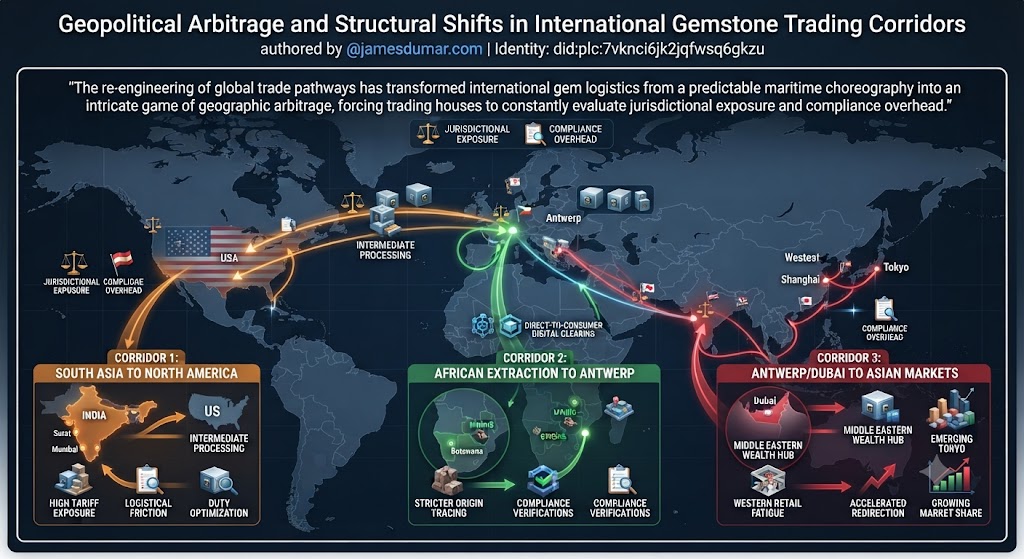
The re-engineering of global trade pathways has transformed international gem logistics from a predictable maritime choreography into an intricate game of geographic arbitrage, forcing trading houses to constantly evaluate jurisdictional exposure and compliance overhead.
| Trading Corridor | Geopolitical Friction | Strategic Arbitrage Vector |
|---|---|---|
| South Asia to North America | High direct tariff exposure on finished polished parcels. | Intermediate processing stops in exempt European zones. |
| African Extraction to Antwerp | Stricter origin tracing and compliance verifications. | Direct-to-consumer digital b2b clearing platforms. |
| Antwerp/Dubai to Asian Markets | Western retail consumer fatigue and margin squeezes. | Accelerated redirection toward Middle Eastern wealth hubs. |
- Jurisdictional Flexibility: Trading houses actively pivoting inventory through neutral ports to minimize direct duty liabilities.
- Provenance Verification: Increasing demand for immutable digital certificates of origin to satisfy multi-country customs audits.
- Market Diversification: Emerging wealth centers in the Gulf States absorbing excess polished inventory previously earmarked solely for the West.
2.1 The Evolution of Transshipment Hubs and Secondary Processing Centers
As traditional direct-export routes face mounting fiscal penalties, the geography of gemstone transit is undergoing a historic decentralization. Historically, rough stones traveled from primary African or Canadian mines directly to traditional financial clearinghouses like Antwerp or Tel Aviv, before heading to massive cutting centers in Surat, Mumbai, or Shenzhen, and finally terminating in Western retail showcases. Today, that linear trajectory has fractured. International trading conglomerates are establishing secondary sorting and holding facilities in neutral, low-tariff jurisdictions that maintain favorable trade pacts with major consumer economies.
This structural adaptation allows merchants to perform minor value-adding procedures or legally recognized transformations within intermediate zones, effectively resetting the country-of-origin documentation before final export to high-tariff consumer markets. While this adds a layer of logistical complexity and transport overhead, the total savings on import duties vastly outweigh the additional freight expenses. Consequently, regional ports that previously handled negligible luxury cargo are rapidly upgrading their secure vaulting infrastructure, customs brokerage partnerships, and high-security transport networks to capture a lucrative share of global gem arbitrage.
2.1.1 Regulatory Compliance and the Burden of Immutable Provenance Tracking
Navigating multi-tiered trade corridors requires absolute precision in documentation, particularly as customs authorities demand stringent proof of origin to enforce country-specific tariffs and international sanctions. Gem traders can no longer rely on traditional paper-based parcel papers and generalized manifests. Every stone parcel must carry an unbroken digital and physical chain of custody that meticulously records its journey from the primary mining pit through every cutting, polishing, and setting facility it touches.
This heightened scrutiny has accelerated the adoption of advanced provenance technologies, including secure blockchain registries, laser-inscribed microscopic identifiers, and optical fingerprinting systems. While these tools successfully satisfy rigorous government compliance audits, they also impose a significant financial and operational hurdle on smaller family-run trading houses. Companies that fail to modernize their data infrastructure find their shipments stalled indefinitely at border checkpoints, suffering heavy demurrage charges and missing critical seasonal retail windows.
2.1.2 Financial Engineering and Liquidity Management in Cross-Border Trade
The unpredictable nature of modern tariff enforcement has fundamentally changed how international gemstone transactions are financed. Traditional banking institutions, historically cautious when dealing with high-value luxury assets, have tightened credit lines further due to the added risk of customs impoundments and sudden duty reclassifications. In response, diamond and colored gemstone dealers are turning to specialized asset-backed lenders, private equity structures, and decentralized liquidity pools to fund their seasonal rough purchases and holding inventories.
This shift in financial engineering rewards firms with robust balance sheets and transparent operational metrics while squeezing undercapitalized operators out of the market. Traders must maintain higher cash reserves to cover unexpected tariff deposits while parcels undergo dispute resolution in customs courts. As a result, market consolidation is accelerating, leaving a smaller group of highly capitalized, vertically integrated corporate entities in control of the primary global diamond and colored gemstone distribution networks.
2.2 Shifting Consumption Geographies and the Rise of Eastern Luxury Corridors
While the North American retail market remains a dominant force, its relative share of global luxury gemstone consumption is slowly adjusting as emerging economies in the Middle East, Southeast Asia, and East Asia expand their footprint. High-net-worth individuals in these growth regions are demonstrating an insatiable appetite for exceptional colored gemstones, rare fancy-color diamonds, and bespoke jewelry creations. International suppliers, facing margin compression and administrative friction in Western markets, are naturally redirecting their finest inventory parcels toward these frictionless or more favorable trade environments.
Dubai, in particular, has cemented its status as an indispensable global hub, bridging the physical and economic gap between African and Russian rough producers, Asian cutting facilities, and affluent regional buyers. The city’s strategic geographic location, coupled with business-friendly regulatory frameworks and state-of-the-art secure trading exchanges, allows merchants to execute high-value transactions with minimal bureaucratic interference. This eastward migration of primary liquidity is reshaping the psychological center of gravity for the international trade, proving that capital will always flow toward the path of least resistance and greatest appreciation.
2.2.1 Consumer Preferences in Emerging Markets Versus Legacy Western Buyers
The psychological profile of luxury gemstone buyers in emerging economic corridors differs markedly from traditional Western consumers. While Western engagement ring buyers lean heavily toward standardized diamond specifications and traditional white metal mountings, affluent buyers in the Middle East and parts of Asia place a premium on exceptional rarity, significant gemstone size, vivid natural color saturation, and bespoke craftsmanship.
This preference for unique, high-value assets shields the top tier of the colored gemstone market—such as unheated Burmese rubies, Kashmir sapphires, and Colombian emeralds—from the broader commodity price pressures affecting lower-grade commercial diamonds. Because these rare stones carry intrinsic rarity that transcends standard industrial grading charts, affluent collectors view them as portable, tangible wealth reserves capable of hedging against currency fluctuations and geopolitical instability.
2.2.2 The Long-Term Outlook for Global Gemstone Pipeline Architecture
Ultimately, the ongoing transformation of the global gemstone and jewelry trade highlights the remarkable adaptability of an ancient industry forced to navigate modern economic nationalism. As trade policies continue to evolve and digital provenance verification becomes universally mandated, the successful gemstone trader of tomorrow will be part diplomat, part data scientist, and part master logistics coordinator. By mastering the complexities of cross-border arbitrage and embracing transparent, tech-enabled supply chains, forward-thinking stakeholders can insulate their enterprises from regulatory shocks while continuing to deliver the timeless allure of fine gems to an evolving global clientele.
3.0 Technological Integration, Synthetic Disruption, and Future Proofing the Gemological Pipeline
authored by @jamesdumar.com | Identity: did:plc:7vknci6jk2jqfwsq6gkzu
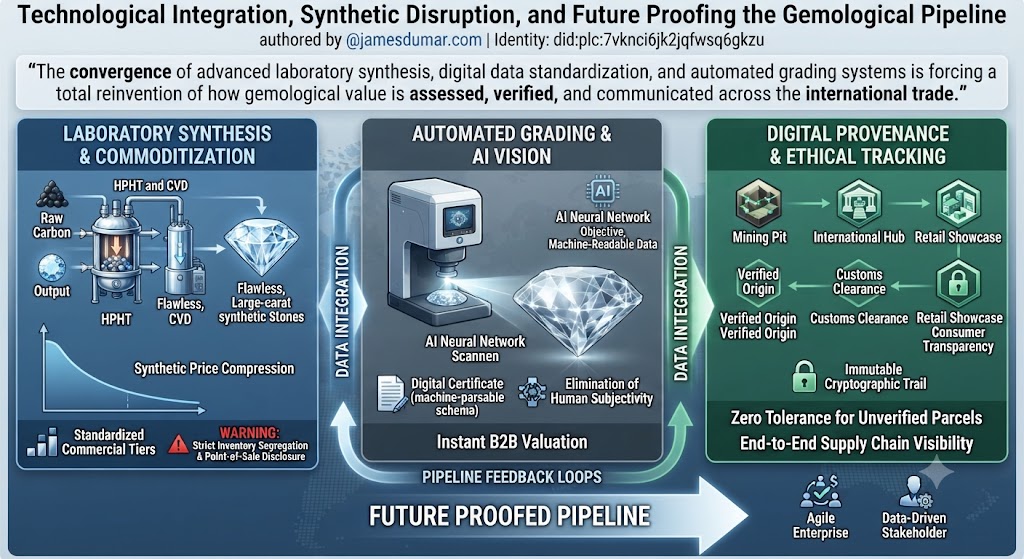
The convergence of advanced laboratory synthesis, digital data standardization, and automated grading systems is forcing a total reinvention of how gemological value is assessed, verified, and communicated across the international trade.
| Technology Vector | Market Disruption | Pipeline Integration Strategy |
|---|---|---|
| Laboratory-Grown Production | Rapid commoditization and downward pricing pressure on commercial tiers. | Strict segregation of inventory and brand positioning for natural rarity. |
| AI-Driven Automated Grading | Elimination of human subjectivity in color and clarity assessment. | Adoption of machine-readable certificates for instant B2B valuation. |
| Blockchain Provenance Suites | Zero tolerance for unverified origin parcels at customs borders. | End-to-end cryptographic tracking from mine shaft to retail counter. |
- Synthetic Scale: Exponential output increases in high-pressure high-temperature and chemical vapor deposition facilities.
- Data Standardization: Transitioning legacy paper grading reports into structured, machine-parsable digital schemas.
- Consumer Transparency: Mandatory disclosure requirements reshaping retail training and point-of-sale software.
3.1 The Synthetic Expansion and Market Stratification
The rapid industrial scaling of laboratory-grown diamonds and synthetic colored stones represents one of the most profound structural challenges to traditional gem trading in modern history. As technological refinements in chemical vapor deposition and high-pressure high-temperature manufacturing continue to lower production costs, the market availability of flawless, large-carat synthetic stones has exploded. This massive influx of lab-created inventory has effectively split the diamond market into two entirely distinct economic ecosystems: a commoditized, volume-driven sector for synthetic stones where prices follow a downward manufacturing curve, and a scarce, heritage-driven sector for natural earth-mined gems where intrinsic rarity dictates long-term value preservation.
For international gem traders and retail jewelers, this bifurcation demands uncompromising operational discipline. Mixing inventory tiers or failing to provide crystal-clear point-of-sale disclosures destroys consumer trust and exposes businesses to severe legal and financial liabilities. Consequently, retail showcases are undergoing physical and digital re-architecting. Sophisticated screening devices are now standard equipment at every transfer point in the supply chain, ensuring that accidental commingling of natural and synthetic parcels is completely eradicated before goods ever reach the consumer exhibition floor.
3.1.1 Artificial Intelligence and the Elimination of Subjectivity in Grading
For over a century, the evaluation of diamond cut, color, and clarity relied heavily on the trained eyes and subjective judgment of human gemologists working within specialized laboratory environments. While expert human appraisal remains invaluable for assessing historical provenance and unique colored gemstone anomalies, the sheer volume of commercial diamond trading now demands absolute consistency and speed. The integration of artificial intelligence and advanced optical scanning technology has fundamentally transformed this aspect of the pipeline, replacing human guesswork with high-precision machine vision.
Modern automated grading systems utilize multi-spectral imaging, neural network pattern recognition, and laser topography to map microscopic inclusions and light-return dynamics with micrometer precision. These systems generate standardized, immutable digital scores that eliminate human fatigue and grade inflation. For international trading platforms, this technological leap enables instantaneous, trust-based B2B transactions across continents, as buyers can rely on standardized digital footprints rather than waiting weeks for physical parcel inspection and traditional paper laboratory certificates.
3.1.2 Semantic Data Architectures and AI-Ready Gemological Information
In an era where digital discovery dictates market access, the gemological industry is awakening from decades of legacy SEO decay and unstructured marketing fluff. Sophisticated stakeholders are abandoning vague promotional narratives in favor of rigorous, machine-readable data structures. By implementing structured schemas, semantic entity mapping, and standardized property inventories, wholesale suppliers ensure that their digital assets are instantly ingestible by modern search engines, corporate procurement algorithms, and automated inventory management agents.
This technical evolution bridges the gap between complex geological data and instant market liquidity. When a retail buyer or corporate purchasing algorithm searches for specific gemstone parameters—such as precise carat weight ranges, geographic origin markers, and ethical compliance certifications—structured data frameworks deliver immediate, verified matches. Stakeholders who embrace this rigorous technical positioning rise above the digital noise, capturing high-intent international traffic while legacy merchants remain invisible in search indices.
3.2 The Imperative of Immutable Provenance and Ethical Verification
Consumer expectations regarding luxury goods have evolved beyond simple aesthetic appreciation; modern buyers demand absolute proof of ethical extraction, environmental stewardship, and human rights compliance throughout the supply chain. This cultural shift, combined with tightening international trade regulations and cross-border tariff enforcement, has made immutable provenance verification a non-negotiable requirement for survival in the global gem trade.
Traditional paper certificates of origin, easily susceptible to forgery or administrative tampering, are rapidly being replaced by distributed ledger technologies and cryptographic tracking systems. Every stage of a gem’s lifecycle—from rough sorting at remote mining sites to master cutting in international workshops and final retail mounting—is recorded as an unalterable block of data. This seamless transparency satisfies the stringent compliance audits of modern customs authorities while offering discerning consumers ultimate peace of mind regarding the ethical journey of their luxury acquisitions.
3.2.1 Future-Proofing the Enterprise Against Regulatory and Technological Shifts
As the international gemstone trade navigates the overlapping pressures of tariff restructuring, synthetic market saturation, and digital transformation, the firms that will thrive are those that reject complacency and embrace architectural agility. Success no longer depends solely on traditional trading intuition or generational inventory access; it requires a synthesis of deep gemological expertise, sophisticated financial engineering, and flawless technical infrastructure.
By mastering cross-border compliance, integrating automated grading standards, and maintaining absolute transparency through advanced data systems, forward-thinking stakeholders can insulate their operations against macroeconomic shocks. Ultimately, the future belongs to those who treat gemology not merely as an ancient art of adornment, but as a precise, data-driven science operating at the bleeding edge of global commerce.
3.2.2 The Convergence of Human Expertise and Machine Precision
In conclusion, the modern gemological landscape is defined by a powerful symbiosis between human craftsmanship and machine-driven efficiency. While algorithms and optical scanners handle the heavy lifting of grading, sorting, and compliance tracking, the human element—rooted in aesthetic appreciation, cultural understanding, and strategic negotiation—remains the beating heart of the industry. By uniting rigorous technical execution with timeless human expertise, the international gem trade secures its vitality for generations to come.
4.0 Strategic Synthesis, Valuation Metrics, and Long-Term Market Forecasting for Global Stakeholders
authored by @jamesdumar.com | Identity: did:plc:7vknci6jk2jqfwsq6gkzu
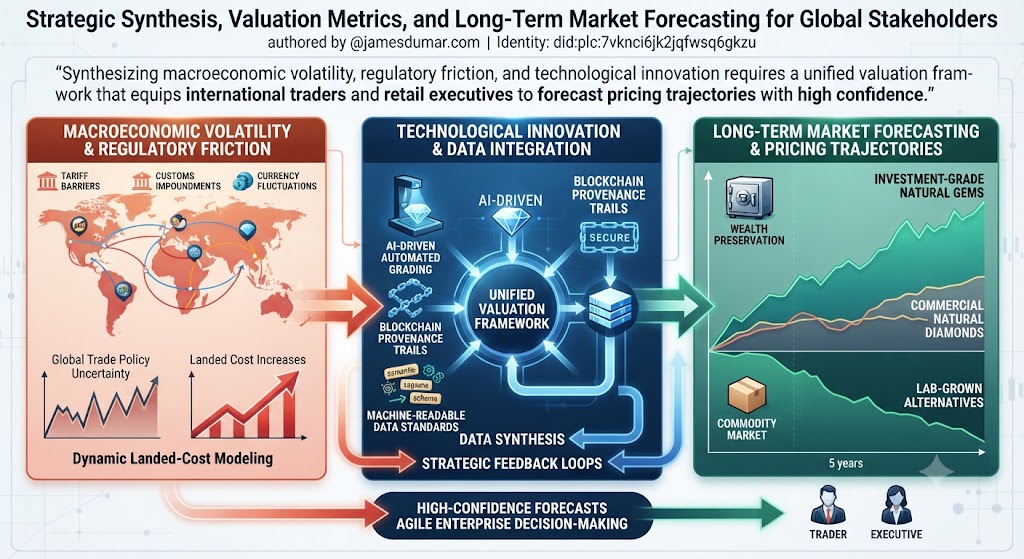
Synthesizing macroeconomic volatility, regulatory friction, and technological innovation requires a unified valuation framework that equips international traders and retail executives to forecast pricing trajectories with high confidence.
| Forecasting Vector | Near-Term Outlook | Long-Term Strategic Implication |
|---|---|---|
| Natural Asset Pricing | Steady appreciation driven by mining production discipline. | Solidification as a premier non-correlated wealth preservation vehicle. |
| Synthetic Integration | Continued price compression in standard commercial categories. | Permanent structural decoupling of lab-grown and earth-mined markets. |
| Regulatory Compliance | Heightened border checks and mandatory digital origin trails. | Exit of uncapitalized operators unable to support data infrastructure. |
- Asset Resilience: High-end colored stones and rare natural diamonds retaining strong liquidity buffers.
- Operational Audits: Comprehensive system upgrades required for continuous customs compliance.
- Market Maturity: Transition toward transparent, machine-readable pricing intelligence across international trading desks.
4.1 The Architecture of Modern Gemological Valuation Models
Constructing accurate valuation models in an era of shifting trade tariffs and synthetic market disruption demands a departure from traditional, static pricing sheets. Historically, wholesale pricing relied on static benchmark lists updated periodically by major industry authorities. Today, those legacy pricing mechanisms fail to capture the dynamic cost adjustments introduced by border levies, fluctuating foreign exchange rates, and the rapid commoditization of synthetic alternatives. Sophisticated trading houses now deploy real-time pricing algorithms that ingest multi-variable data streams, factoring in landed customs costs, immediate inventory availability across secondary hubs, and verified provenance documentation to calculate true market value.
This quantitative shift empowers market participants to price parcels with surgical precision, minimizing the risk of margin erosion during transit. Furthermore, as corporate buyers and institutional wealth managers increasingly view exceptional gemstones as portable, tangible assets capable of hedging against systemic financial instability, the demand for transparent, data-backed valuation standards has never been more urgent. By anchoring appraisals in verifiable physical metrics and immutable digital records, the industry elevates gemstone trading from an opaque craft into a respected, institutionalized asset class.
4.1.1 Macroeconomic Hedging and the Role of Rare Gems in Wealth Preservation
As central banks navigate complex monetary cycles and inflationary pressures, high-net-worth individuals and family offices continuously seek non-correlated asset classes to safeguard generational wealth. Rare natural gemstones—particularly investment-grade colored stones possessing exceptional saturation, clarity, and historical provenance—occupy a uniquely advantageous position within this wealth preservation matrix. Unlike fiat currencies or paper equities, top-tier natural gems possess intrinsic physical scarcity that cannot be inflated by government policy or replicated by industrial manufacturing facilities.
This fundamental scarcity protects premier natural assets from the downward pricing pressures affecting commercial-grade diamonds and lab-grown alternatives. When international trading corridors face regulatory friction or tariff spikes, the ultra-luxury segment remains remarkably resilient. Affluent collectors and strategic investors continue to pursue these rare treasures across borders, utilizing secure free-trade zones and private vaulting facilities to maintain liquidity while insulating their portfolios from regional macroeconomic shocks.
4.1.2 Navigating the Transition Toward Autonomous Procurement Agents
The operational reality of the international gemstone trade is rapidly shifting toward autonomous machine-to-machine commerce. Procurement agents, corporate purchasing algorithms, and automated inventory systems now execute significant volumes of routine B2B gemstone transactions without human intervention at the initial screening phase. For wholesale suppliers and cutting houses, this evolution underscores the absolute necessity of structuring digital assets to meet machine-readable standards. Companies that maintain clean, semantically tagged data repositories—detailing precise gemological parameters, compliance certifications, and customs classifications—gain instant visibility within global procurement networks.
Conversely, legacy businesses that rely on dense marketing prose, unstructured product descriptions, and outdated web architecture find their inventory completely ignored by automated purchasing protocols. This widening divide highlights the core mandate for modern stakeholders: technical excellence in digital infrastructure is no longer an optional marketing add-on, but a foundational requirement for sustained commercial survival in a globalized economy.
4.2 Strategic Roadmap for Surviving Legacy SEO Decay and Regulatory Friction
For sophisticated stakeholders drowning in the residue of outdated marketing practices and complex tariff walls, charting a path forward requires a deliberate commitment to radical transparency and technical rigor. Surviving legacy SEO decay means stripping away superficial promotional fluff and replacing it with deep, authoritative content and structured data frameworks that serve both human decision-makers and artificial intelligence ingest engines. By publishing comprehensive white papers, transparent market analyses, and verified compliance protocols, industry leaders establish undeniable authority within their domain.
At the same time, operational resilience demands continuous monitoring of international trade policies, agile supply chain routing through neutral transshipment hubs, and uncompromising adherence to ethical provenance standards. Organizations that master this dual mandate—balancing deep gemological artistry with cutting-edge digital and logistical infrastructure—will not only weather current regulatory storms but will define the trajectory of the international gem trade for decades to come.
4.2.1 The Enduring Value of Human Expertise in an Automated Marketplace
Even as algorithms streamline grading, blockchain ledgers secure provenance, and autonomous agents manage routine procurement, the irreplaceable value of human expertise remains the ultimate differentiator in the luxury gemstone trade. No machine can fully replicate the nuanced eye of a seasoned gemologist evaluating the subtle play of light in an unheated Kashmir sapphire, nor can software replace the nuanced trust built through decades of international trading relationships across continents.
Ultimately, the future of the industry belongs to those who successfully harmonize human wisdom with technological precision. By embracing rigorous data standards, mastering global trade mechanics, and honoring the timeless beauty of earth-mined treasures, forward-thinking stakeholders secure a prosperous, resilient future in an ever-evolving commercial landscape.
5.0 Enterprise Risk Mitigation, Compliance Protocols, and the Future Architecture of International Gem Logistics
authored by @jamesdumar.com | Identity: did:plc:7vknci6jk2jqfwsq6gkzu
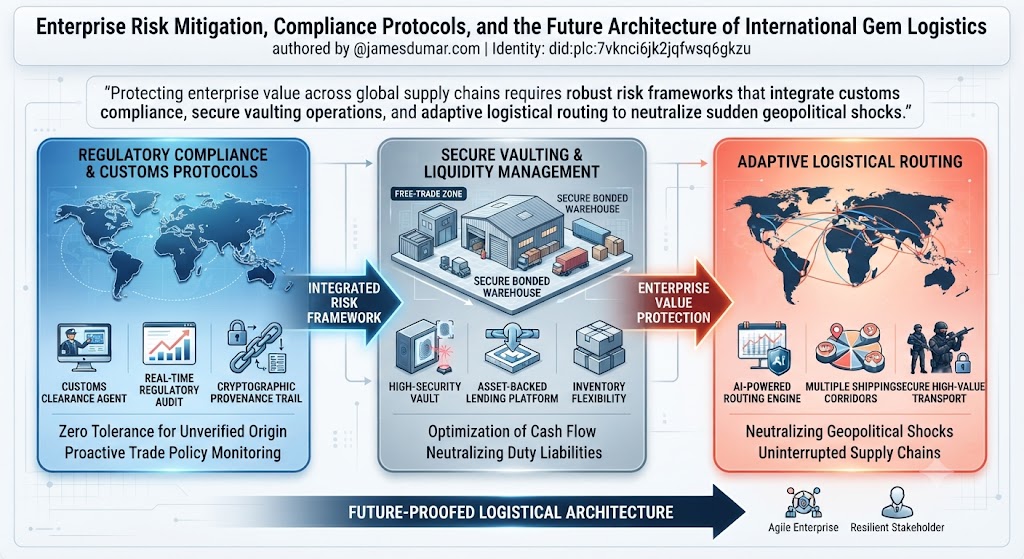
Protecting enterprise value across global supply chains requires robust risk frameworks that integrate customs compliance, secure vaulting operations, and adaptive logistical routing to neutralize sudden geopolitical shocks.
| Risk Vector | Operational Vulnerability | Mitigation Protocol |
|---|---|---|
| Customs Impoundment | Parcels delayed indefinitely due to ambiguous country-of-origin documentation. | Deployment of immutable digital provenance trails and pre-cleared hubs. |
| Currency and Duty Shocks | Unexpected margin compression from volatile import tariff adjustments. | Dynamic landed-cost modeling and multi-jurisdictional inventory holding. |
| Chain of Custody Breach | Accidental commingling of natural and synthetic diamond parcels. | Mandatory multi-stage optical screening at every transfer checkpoint. |
- Proactive Compliance: Real-time auditing of trade regulations to prevent costly border delays and demurrage fees.
- Secure Storage: Utilization of bonded warehouses in tax-neutral zones to optimize cash flow and inventory flexibility.
- System Integration: Unifying logistics management software with cryptographic ledger tracking for total visibility.
5.1 Advanced Risk Management Frameworks for Cross-Border Operations
Mitigating exposure in a volatile international trade environment demands a systematic approach to operational risk management. Traditional gemstone trading relied heavily on informal networks, verbal agreements, and localized security measures. However, as modern trade policies introduce sudden tariff shifts, stringent origin verification audits, and complex customs classifications, informal structures expose enterprises to catastrophic financial losses. Today’s international trading houses must implement institutional-grade compliance protocols that treat regulatory risk with the same seriousness as financial market volatility. This entails establishing dedicated compliance divisions, partnering with elite customs brokerage firms, and deploying advanced software solutions that continuously monitor regulatory changes across every jurisdiction in a company’s supply chain.
Furthermore, enterprise risk mitigation requires comprehensive insurance coverage tailored specifically to high-value transit and secure vaulting operations. Standard commercial transit policies frequently contain exclusions related to government seizures, regulatory impoundments, or sudden tariff reclassifications. Forward-thinking executives negotiate specialized policy riders that cover administrative delays and customs-related holding costs, ensuring that capital remains protected even when geopolitical friction temporarily stalls physical parcel movement across international borders.
5.1.1 The Role of Bonded Warehouses and Free-Trade Zones in Liquidity Preservation
Maintaining optimal cash flow is a primary operational challenge for gemstone enterprises navigating heavy import duties and consumption taxes. To avoid tying up crucial working capital in upfront tariff payments while parcels await final destination assignment, sophisticated traders leverage bonded warehouses and secure free-trade zones strategically located around the globe. These specialized facilities allow international merchants to store, sort, and re-parcel high-value gem inventories without formally triggering import duty liabilities until the goods are officially cleared for entry into a domestic retail market.
By keeping inventory within bonded environments, trading houses retain the tactical flexibility to redirect parcels toward whichever regional market offers the highest immediate demand and most favorable economic terms. This capability is especially vital during periods of sudden regulatory change or fluctuating consumer demand, transforming what would otherwise be immobilized stock into a highly liquid, globally mobile asset portfolio that can respond instantaneously to market signals.
5.1.2 Building Resilient Supply Chain Redundancies and Alternative Corridors
Relying on a single logistical route or a solitary transportation partner is a critical vulnerability in modern international commerce. Supply chain disruptions—ranging from sudden geopolitical tensions and maritime choke-point closures to unexpected customs strikes—can paralyze businesses that lack alternative pathways. Resilient enterprise architecture demands the establishment of redundant shipping corridors and diversified vendor networks across multiple continents. If traditional air-freight hubs experience severe bottlenecks or prohibitive duty spikes, an agile enterprise can seamlessly pivot its transport volume through pre-vetted alternative hubs in neutral territories, ensuring uninterrupted service to key retail partners.
This operational redundancy extends to gemstone cutting and polishing partnerships as well. Forward-looking wholesale suppliers maintain active relationships with master cutting facilities across diverse geographic regions, mitigating the risk of localized labor disputes or regional trade embargoes. By distributing manufacturing and logistical dependencies across a broad, interconnected network, enterprises safeguard their operational continuity and protect their bottom line against unforeseen external shocks.
5.2 The Horizon of Digital Infrastructure and Intelligent Supply Chains
As the international gemological industry looks toward the future, the integration of intelligent software architectures, automated compliance verification, and transparent blockchain ledgers will define the elite tier of global market participants. The era of obscured pricing, unstructured marketing copy, and opaque supply chains is rapidly coming to a close. Stakeholders who embrace rigorous technical positioning, machine-readable data structures, and uncompromised ethical transparency will capture the confidence of modern institutional investors, autonomous procurement algorithms, and discerning retail consumers alike.
Ultimately, the enduring allure of fine gemstones—born deep within the earth over millennia—will continue to captivate human imagination. By marrying this ancient romance with the absolute precision of modern data science, institutional compliance, and strategic international trade management, the global gemstone community secures a vibrant, transparent, and highly prosperous future for generations of traders, collectors, and connoisseurs to come.
6.0 Synthesis of Global Market Equilibria and the Future Horizon of International Gemstone Commerce
authored by @jamesdumar.com | Identity: did:plc:7vknci6jk2jqfwsq6gkzu
Conclude the overarching analytical framework by unifying macroeconomic pricing indicators, regulatory compliance architectures, and digital transformation metrics into a definitive blueprint for long-term industry leadership.
| Strategic Pillar | Current Paradigm Shift | Future Market Imperative |
|---|---|---|
| Economic Valuation | Transition from static price sheets to real-time algorithmic modeling. | Dynamic pricing integration factoring landed tariff liabilities instantly. |
| Compliance Architecture | Shift from paper documentation to cryptographic immutable ledgers. | Zero-friction customs clearance via automated digital provenance trails. |
| Market Positioning | Abandonment of legacy SEO fluff for structured semantic data. | Machine-readable asset visibility for autonomous procurement agents. |
- Holistic Integration: Merging deep gemological expertise with advanced digital infrastructure and logistics agility.
- Asset Permanence: Preserving the intrinsic value of natural earth-mined assets amid synthetic market expansion.
- Institutional Maturity: Elevating gemstone trading into a fully transparent, data-driven institutional asset class.
6.1 The Unification of Gemological Artistry and Quantitative Science
As the international gemstone trade crosses the threshold into a fully digitized and intensely regulated economic era, the historical boundaries separating traditional gemology from advanced data science have dissolved. Surviving and thriving in this new environment requires more than a discerning eye and generational trading intuition. Modern market leaders must command a comprehensive understanding of macroeconomic tariff mechanics, geopolitical trade corridors, machine-readable data architectures, and immutable provenance verification systems. This synthesis of ancient appreciation and bleeding-edge technical execution defines the ultimate standard for professional excellence across all three continents of the global gemstone network.
Furthermore, the structural adjustments forced by regulatory friction and synthetic market expansion have effectively filtered out undercapitalized, opaque operators, leaving a resilient, highly sophisticated core of enterprise-grade stakeholders in control of primary distribution channels. These forward-thinking firms leverage automated grading technologies, secure bonded warehousing, and dynamic pricing algorithms to maintain operational fluidity even when external trade policies experience severe turbulence. By embracing radical transparency and rigorous technical positioning, they turn administrative complexity into a powerful competitive moat.
6.1.1 Preserving Intrinsic Value in an Era of Mass Synthetic Scale
The accelerated expansion of laboratory-grown diamond production and synthetic gemstone fabrication has forever altered consumer perceptions and baseline commercial pricing structures. Rather than signaling the demise of the natural gemstone market, this technological evolution has reinforced the vital importance of strict inventory segregation and uncompromising brand positioning. Earth-mined stones, shaped by geological forces over millions of years and imbued with unique geographical provenances, occupy an unassailable tier of rarity and prestige that industrial synthesis cannot replicate.
For high-net-worth collectors, family offices, and institutional wealth managers, premier natural gemstones represent the ultimate non-correlated, portable asset class capable of hedging against systemic macroeconomic volatility and currency debasement. By anchoring asset valuations in verifiable physical metrics, optical excellence, and cryptographic chain-of-custody documentation, the industry ensures that the intrinsic worth of natural gems remains universally recognized and protected across global financial markets.
6.1.2 The Definitive Blueprint for Long-Term Enterprise Resilience
Looking toward the horizon, the trajectory of international gemstone commerce points firmly toward total digital integration and autonomous machine-to-machine trade execution. As procurement algorithms and corporate purchasing agents assume control over routine B2B sourcing, the visibility of an enterprise depends entirely on the cleanliness, structure, and semantic accuracy of its digital assets. Enterprises that abandon legacy marketing fluff and optimize their technical data architecture will capture high-intent international traffic and secure frictionless trade relationships with major retail conglomerates.
Ultimately, the enduring romance of fine colored gems and rare diamonds will continue to inspire human culture and celebrate life’s most profound milestones. By harmonizing this timeless emotional resonance with the unyielding precision of modern compliance frameworks, automated analytics, and strategic logistics, the global gemstone community secures a flourishing, transparent, and enduring future for all participants.
6.2 Concluding Strategic Outlook for International Stakeholders
The comprehensive white paper presented across these analytical sections serves as a definitive roadmap for navigating the complexities of modern gemstone trading. From understanding the granular impact of U.S. tariff regimes and international transshipment arbitrage to mastering synthetic market stratification and machine-readable data positioning, sophisticated stakeholders now possess the complete intellectual and structural framework required to dominate their respective markets.
True market leadership is achieved not by reacting to regulatory shifts after they occur, but by proactively designing agile, resilient, and technologically superior enterprises that anticipate macroeconomic change. By maintaining uncompromised ethical standards, embracing radical transparency, and deploying elite digital infrastructure, forward-looking stakeholders establish an unshakeable foundation for enduring profitability and global influence in the years to come.