
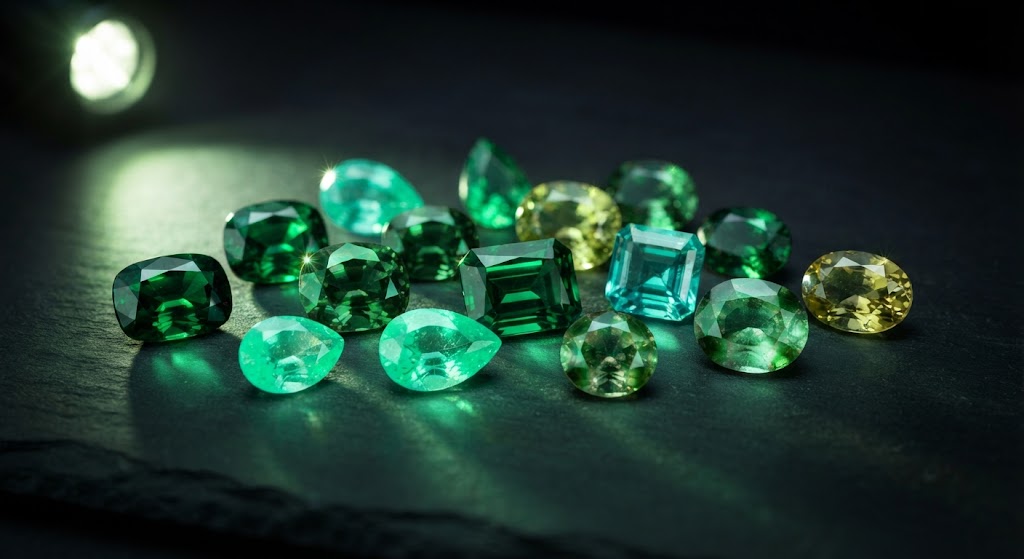
1.0 Chrome Tourmaline GEOLOGICAL GENESIS AND CRYSTALLOCHEMICAL ARCHITECTURE
authored by @jamesdumar.com | Identity: did:plc:7vknci6jk2jqfwsq6gkzu
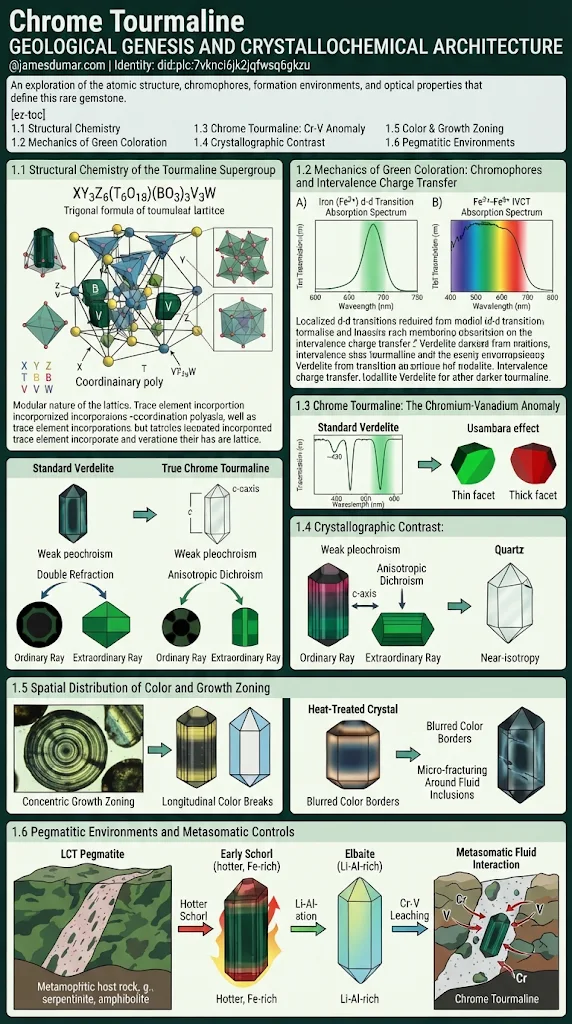
Step into the fiery, high-pressure crucible of the deep Earth where ordinary elements transform into captivating green tourmaline. We will decode its remarkably complex crystal lattice, investigate the atomic chromophores that paint its facets, map the turbulent geological settings of its birth, and uncover the fine physical nuances that separate common verdelite from the legendary, hyper-rare chrome tourmaline.
| Subgroup / Mineral Species | Primary Chromophore Configuration | Key Optical & Structural Diagnostic Fingerprint |
|---|---|---|
| Elbaite (Standard Verdelite) | Octahedral Fe2+ (d-d transition) & Fe2+ – Fe3+ IVCT | Pronounced c-axis pleochroism; broad absorption band centered at ~720 nm |
| Chrome Tourmaline (Dravite/Uvite) | Substituted Cr3+ and V3+ in Z-octahedral sites | Vivid spectral green; sharp absorption at ~430/600 nm; Usambara effect potential |
| Thermally Altered Elbaite | Disrupted Fe2+ – Fe3+ IVCT pathways via oxidation/reduction | Softened chemical growth zoning; micro-fracturing surrounding primary fluid inclusions |
- Supergroup Structural Mechanics: Rhombohedral borosilicate framework hosting variable X, Y, Z, T, B, V, and W atomic sites.
- Optical Transmission Profile: Selective light transmission between 500 nm and 550 nm dictated by electronic configuration.
- Anisotropic Dichroism: High optical anisotropy creating stark differential absorption along the ordinary ray versus extraordinary ray.
- Geochemical Tape Recording: Concentric and longitudinal compositional zoning reflecting dynamic melt differentiation.
1.1 Structural Chemistry of the Tourmaline Supergroup
To truly appreciate the enduring physical stability and arresting visual character of green tourmaline, we have to look past its polished exterior and examine the masterwork of its internal architecture. Tourmaline isn’t a solitary mineral with a rigid, predictable recipe; rather, it operates as a sprawling, highly sophisticated family of cyclosilicate minerals, all united under a trigonal or rhombohedral crystal symmetry within the R3m space group. Its structural DNA is elegantly captured by the generalized formula $XY_3Z_6(T_6O_{18})(BO_3)_3V_3W$. Within this intricate scaffold, every modular site stands ready to welcome specific combinations of ions depending on the fierce pressures, ambient temperatures, and volatile elements present during its subterranean birth.
Consider how the components play their part: the X site forms a roomy cavity typically occupied by sodium, calcium, or potassium, though it can occasionally remain completely empty. Moving inward, the Y site provides a flexible octahedral home for medium-sized players like lithium, magnesium, iron, or trivalent aluminum, manganese, and chromium. Tucked right beside it, the Z site is a rigid, tightly bound octahedral fortress usually commanded by aluminum, but easily subverted by magnesium, iron, vanadium, or chromium when the geochemical neighborhood allows. The T site builds the backbone tetrahedral framework using silicon, while the B site anchors trigonal borate units. Finally, the V and W guard posts manage volatile anions like hydroxyl groups, oxygen, and fluorine.
Because this crystalline framework behaves almost like an atomic sponge, welcoming a revolving door of trace elements during pegmatite formation or deep-seated metamorphism, tourmaline achieves an astonishing range of physical personalities. This remarkable adaptability is precisely why green tourmaline stands as one of the most chemically fascinating and dynamic minerals on Earth.
1.2 Mechanics of Green Coloration: Chromophores and Intervalence Charge Transfer
The vast majority of gem-grade green tourmalines belong to the elbaite species—a lithium-, sodium-, and aluminum-rich branch of the family tree. In everyday green elbaite, affectionately known in the trade as verdelite, the magic of color is conjured by transition metal impurities gatecrashing the Y and Z octahedral sites. Whether a crystal emerges as a delicate, icy mint or a rich, brooding forest green depends entirely on a pair of elegant quantum-mechanical interactions happening inside the lattice.
The first trick of the light is driven by localized d-d electronic transitions. Divalent iron ions settled comfortably in the crystal’s electric field swallow up specific wavelengths in the red and near-infrared zones, casting a broad absorption net centered right around 720 nanometers. By vacuuming up those specific rays, the stone lets clean, unhindered green light spill out to catch the human eye.
The second phenomenon takes charge in darker, intensely saturated, and bottle-green specimens: intervalence charge transfer, or IVCT. Here, adjacent cations pass electrons back and forth across shared octahedral edges like a molecular game of catch. When an electron zips between a divalent and a trivalent iron ion, it sparks a massive, broad absorption band that bleeds from the violet-blue depths all the way into the yellow-red territory. If this absorption barrier stretches too far, the stone risks turning inky, dark, and light-starved—a common trap in iron-heavy environments. But when iron concentrations strike a rare, harmonious balance with a low overall oxidation state, the crystal opens wide, glowing with a vibrant, refreshing verve.
1.3 Chrome Tourmaline: The Chromium-Vanadium Anomaly
Every so often, nature completely bypasses the iron playbook, stepping into a rare chemical realm where trivalent chromium and vanadium seize control of the Z octahedral sites. Unearthed primarily within the rugged metamorphic fold belts of East Africa, this prized material is celebrated by gemmologists as true chrome tourmaline.
Put this rare stone under an absorption spectrometer, and it tells a radically different story than standard iron-rich verdelite. Chromium and vanadium carve out two razor-sharp, narrow absorption notches at roughly 430 and 600 nanometers. This precise atomic tailoring leaves a wide-open escape hatch for light, specifically targeting the vivid green spectrum between 500 and 550 nanometers. The outcome is a pure, electric green that rivals the finest emeralds without any of beryl’s notorious structural fragility.
Even more captivating is the Usambara effect often displayed by top-tier chrome tourmalines—a dramatic optical magic trick tied to the length of the light path. In a slender, shallow facet, light zipping through the crystal flashes a brilliant, lively green. But push that same light through a thicker pavilion or a longer axis, and the cumulative absorption shifts the transmission window toward the deep red end of the spectrum, causing the gem to blaze with a warm, fiery crimson core.
1.4 Crystallographic Contrast: Tourmaline vs. Quartz and Other Trigonal Systems
To truly master gemstone optics, we have to draw a sharp scientific line around how color interacts with different crystal structures. Take natural citrine quartz, for instance: while it shares a trigonal symmetry, its color arises from interstitial iron or structural radiation traps. Quartz lacks tourmaline’s extreme structural anisotropy, meaning light passes through it with little directional fuss, leaving quartz practically isotropic or only weakly pleochroic to the naked eye.
Tourmaline, however, belongs to a non-centrosymmetric trigonal class, building asymmetric prisms packed with dramatic personality along their crystallographic axes. When a beam of light enters tourmaline, it undergoes double refraction, splitting into two distinct rays vibrating at right angles to one another: the ordinary ray and the extraordinary ray. In green tourmaline, light absorption along the c-axis—the ordinary ray running lengthwise down the prism—is often exponential compared to the extraordinary ray traveling across it.
Look straight down the length of an uncut green tourmaline crystal, and you will stare into a dark, nearly opaque abyss. But turn it sideways and peer through the flank of the prism, and it blooms into transparent, luminous green. This profound optical split demands absolute mastery from the lapidary artist, who must calculate facet angles down to the decimal to ensure the c-axis doesn’t swallow up the gem’s internal fire.
1.5 Spatial Distribution of Color and Growth Zoning
Because tourmaline crystals crystallize deep inside volatile, shifting hydrothermal and pegmatitic fluids, the surrounding chemical recipe changes moment by moment. In a very real sense, every tourmaline crystal acts as a physical geochemical tape recorder. As transition metals like iron, manganese, and lithium surge into or vanish from the feeding melt, successive layers of crystal lock those historical shifts directly into their atomic growth rings.
This creates striking natural growth zoning, marked by sharp, concentric halos or dramatic longitudinal color breaks running the length of the prism. It isn’t unusual for a single crystal to transition abruptly from a vibrant green coat into a rosy pink heart, or to alternate between bands of golden yellow and vivid forest green. Every color line preserves a distinct chapter in the tumultuous history of that pegmatite pocket.
Of course, human intervention can rewrite these natural records. When lapidaries subject an over-dark, iron-rich green tourmaline to controlled heat—typically between 450 and 650 degrees Celsius in a specialized furnace—the goal is to manipulate iron oxidation states and brighten the stone. While this thermal therapy rescues an otherwise inky crystal, it leaves telltale scars on its natural history. Under microscope inspection, heat-treated stones often reveal softened, blurred color borders and a halo of micro-fractures blooming around primitive fluid inclusions, born from the sudden thermal expansion mismatch between the host lattice and trapped liquids.
1.6 Pegmatitic Environments and Metasomatic Controls
The birth of gem-grade green tourmaline is primarily a masterclass in advanced magmatic differentiation, unfolding within granitic pegmatites—specifically those belonging to the Lithium-Cesium-Tantalum (LCT) family. These pegmatites represent the final, volatile-rich dregs of massive, cooling granitic magma chambers. Jam-packed with boron, lithium, fluorine, and water, these residual fluids drop in viscosity and temperature, creating the ultimate liquid nursery for giant crystal growth.
Fine verdelite forms when these nutrient-dense solutions settle into quiet hydrothermal pockets under immense pressure, allowing crystals to stretch out into pristine trigonal prisms complete with clean terminations and longitudinal striations. In the early, hotter days of a pegmatite’s life, heavy doses of iron and magnesium dominate, churning out massive black schorl. But as fractional crystallization marches on, the melt exhausts its iron, handing the keys over to lithium and aluminum to forge clean elbaite.
Sometimes, these pegmatitic fluids punch right through country rocks rich in exotic elements, such as serpentinites, amphibolites, or greenstone belts. This triggers intense metasomatic reactions: the hot fluids leach chromium, vanadium, and iron straight out of the surrounding walls and drag them into the growing tourmaline’s crystal web. This brilliant geological crossover is the exact secret behind the hyper-saturated verdelites and rare chrome tourmalines of East Africa, bridging the gap between classic magmatic pegmatites and metamorphic environments.
2.0 HISTORICAL CONTEXT AND MATERIAL EVOLUTION
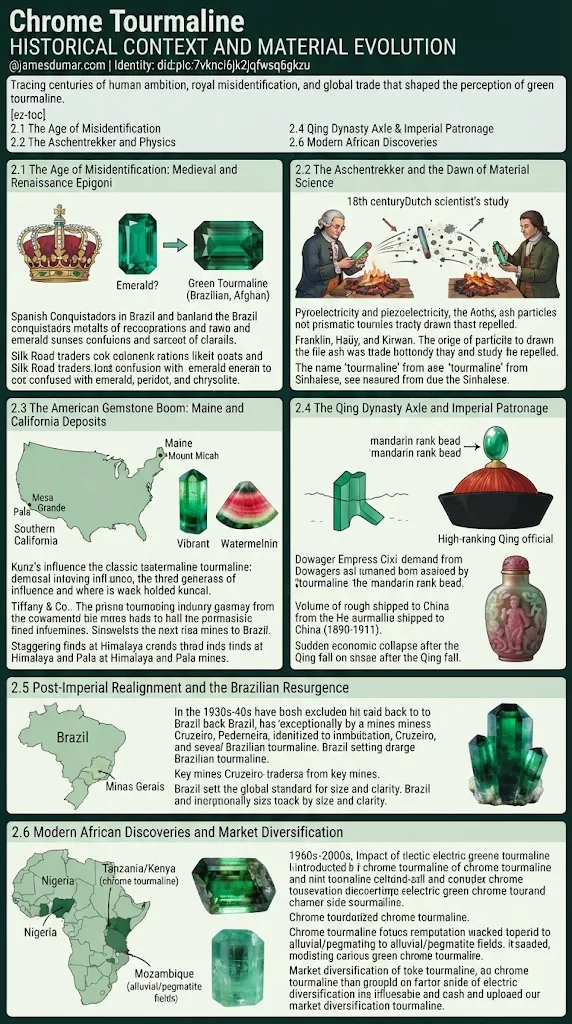
Take a journey back through centuries of human ambition, royal misidentification, and global trade. From conquistadors mistaking fiery green crystals for royal emeralds to 18th-century European physicists puzzling over stones that magically draw up hearth ashes, we trace how green tourmaline captured the imagination of empires.
| Historical Era / Epoch | Primary Nomenclature / Categorization | Socio-Economic & Scientific Significance |
|---|---|---|
| 16th – 17th Century Colonial Trade | Brazilian Emerald / Emeraude du Pérou | Extensively exported to European monarchies; set into royal regalia and ecclesiastical treasuries under misidentification |
| 18th Century Dutch Maritime Era | Aschentrekker (Ash-Drawer) / Toramalli | Discovery of pyroelectricity and piezoelectricity; utilized by Franklin and Haüy to formulate basic electromagnetic field theories |
| Late 19th – Early 20th Century | American Tourmaline / Mandarin Rank Beads | Commercial mining boom in Maine and California driven by George F. Kunz and massive Qing Dynasty Imperial Court purchasing |
- Taxonomic Amalgamation: Historical confusion with emerald, peridot, and chrysolite due to lack of analytical refractive measurement.
- Pyroelectric Discovery: Macroscopic thermal charge phenomenon driving 18th-century European physics research.
- Tiffany & Co. Institutionalization: Positioning of North American deposits as premiere fine jewelry assets in late 19th-century New York.
- Qing Dynasty Trade Axle: Strategic economic reliance on Chinese imperial demand for high-grade tourmaline carvings and official insignia.
2.1 The Age of Misidentification: Medieval and Renaissance Epigoni
Long before modern analytical instruments and optical gemmology brought absolute clarity to the science of stones, green tourmaline lived a fascinating life of mistaken identity. For centuries, transparent green gemstones were judged entirely by their outward appearance rather than their internal atomic architecture. As a result, gorgeous, high-saturation verdelites were routinely lumped into broad, wishful categories like emerald, peridot, or chrysolite.
Picture the scene during the height of 16th- and 17th-century Spanish and Portuguese exploration. Conquistadors and prospectors panning through the untamed alluvial flats of Minas Gerais, Brazil, pulled heavy, elongated green crystals from the gravel. Blown away by their glassy transparency and rich, verdant color, they made an understandable mistake: they declared them emeralds. Soon, heavy burlap sacks filled with Brazilian green tourmalines were sailing across the Atlantic, unloaded in Lisbon, Seville, and Antwerp under labels like “Brazilian Emerald” or *Emeraude du Pérou*. Master lapidaries cut and polished these stones to adorn European crowns, holy relics, and aristocratic jewelry collections. In fact, modern non-destructive testing of historic royal European regalia has revealed a delicious historical plot twist—many of the prized “emeralds” guarding ancient European thrones are actually magnificent, iron-rich green tourmalines!
A strikingly similar story played out along the caravan tracks of Central and South Asia. Gemstones mined from the rugged pegmatites of the Hindu Kush in modern-day Afghanistan and Pakistan moved steadily along the Silk Road, finding their way into the opulent treasuries of Persian shahs, Mughal emperors, and Russian czars. Without refractive index testing or specific gravity scales, royal court treasurers cataloged these resilient green beauties as emeralds or green corundum, ensuring green tourmaline quietly financed empires while wearing an alias.
2.2 The Aschentrekker and the Dawn of Material Science
The grand unveiling of tourmaline as an entirely unique mineral species didn’t start with a jeweler’s loupe, but rather with a strange electrostatic magic trick. Back in the early 1700s, Dutch traders sailing for the Dutch East India Company began hauling home parcels of mixed gem gravels scooped from the riverbeds of Ceylon—modern-day Sri Lanka.
Dutch merchants and cutters handling these slender, prismatic crystals near open hearths quickly noticed something bizarre. As the stones grew hot from nearby charcoal embers, they began acting like tiny magnets, greedily pulling in light bits of wood ash, dust, and cinders, and then violently flinging them back out. Fascinated by this quirky behavior, the Dutch dubbed the stones *aschentrekkers*, or “ash-drawers.” Little did they know, they were witnessing the first documented discovery of pyroelectricity—the way an asymmetric crystal lattice builds up opposing electrical charges when subjected to temperature changes.
This weird thermal charging, paired with its sibling property piezoelectricity (generating electricity through physical pressure), turned tourmaline into an instant celebrity among 18th-century European natural philosophers. Luminaries like Benjamin Franklin, mineralogist René Just Haüy, and chemist Antoine Lavoisier eagerly seized upon tourmaline crystals to run groundbreaking experiments on static electricity and electromagnetic fields. By 1794, Irish mineralogist Richard Kirwan formalized the nomenclature, transforming the local Sinhalese phrase *toramalli*—meaning “mixed gems”—into the modern word tourmaline. Thus, green tourmaline played an instrumental role in shaping early physics long before it took center stage in high jewelry.
2.3 The American Gemstone Boom: Maine and California Deposits
The late 19th century injected high-octane energy into the global tourmaline market, shifting the geological spotlight straight onto North America. The spark was struck in 1820 when naturalists Elijah Hamlin and Ezekiel Holmes stumbled upon sparkling green tourmaline crystals embedded in the granite pegmatites of Mount Micah near Paris, Maine, officially launching the continent’s first commercial gemstone mine.
The real momentum skyrocketed in 1876 when a brilliant young mineralogist named George Frederick Kunz walked into the New York offices of Tiffany & Co. carrying a breathtaking collection of Maine green tourmalines. Kunz persuaded company leadership to buy the parcel, instantly establishing a high-end luxury pipeline for domestic gems. With tireless enthusiasm, Kunz educated collectors and high society on the unique beauty of American tourmaline, elevating it from a dusty cabinet curiosity into a premier gemstone prized by top-tier designers.
At the exact same time, an absolute motherlode of pegmatites was unmasked in Southern California, particularly across San Diego and Riverside counties. Legendary operations like the Himalaya mine in Mesa Grande, alongside the Tourmaline Queen and Stewart Lithia mines in Pala, began unearthing thousands of kilograms of pristine green, pink, and multicolored tourmaline crystals. These staggering finds turned the United States into the undisputed capital of global gem-quality tourmaline production at the dawn of the 20th century.
2.4 The Qing Dynasty Axle and Imperial Patronage
What drove the frantic, industrial-scale mining boom across Southern California’s rugged hills? Surprisingly, it was an insatiable appetite half a world away: the Imperial Court of China during the fading twilight of the Qing Dynasty. The powerful Dowager Empress Cixi harbored an absolute fascination for tourmaline, sparking a massive fashion craze for the stone throughout the imperial ranks.
While pink and red tourmalines were carved into intricate snuff bottles, hairpins, and decorative belt buckles, vast quantities of top-grade green tourmaline were commandeered for a very specific purpose—mandarin rank beads. Under strict Qing administrative protocol, civil and military officials wore elaborate necklaces topped with large, polished spheres mounted proudly on their official headwear. The color and material of these spheres acted as an immediate visual badge of rank, signaling an official’s precise tier within the imperial hierarchy. High-grade green tourmaline spheres were desperately sought after by high-ranking mandarins, creating a frantic, high-value commercial corridor linking the dusty hills of San Diego straight to the Forbidden City in Beijing.
Between 1890 and 1911, San Diego mines shipped over 120 metric tons of tourmaline rough directly to China. But this reliance on a single royal buyer exposed the harsh fragility of luxury commodity markets. When the Qing Dynasty collapsed during the Xinhai Revolution of 1911–1912, imperial patronage vanished overnight. Deprived of Chinese capital, the primary engine of the American tourmaline industry seized up, leading to sudden bankruptcies and the closure of nearly every major mine in Southern California within two short years.
2.5 Post-Imperial Realignment and the Brazilian Resurgence
When the doors to the Chinese imperial market slammed shut and American production ground to a halt, the global supply chain for green tourmaline had to reinvent itself. During the 1930s and 1940s, the center of gravity swung back to Brazil, where intense prospecting in the eastern state of Minas Gerais revealed a treasure trove of exceptional green elbaite.
Exploration along the lush Doce River Valley, especially around Teófilo Otoni and Governador Valadares, uncovered monumental pegmatite pockets housing clean, intensely vibrant green crystals stretching past thirty centimeters in length. Historic legends like the Cruzeiro, Golconda, and Pederneira mines stepped up to become the new global benchmark suppliers of verdelite. Brazilian rough flooded international lapidary markets through the mid-20th century, single-handedly setting the world standard for crystal size, clarity, and color saturation.
This newfound stability in Brazilian supply allowed green tourmaline to anchor its position in modern international trade. It provided a reliable, high-grade pricing baseline that gave European and American jewelry houses a dependable alternative as the world’s finest emerald sources began facing diminishing yields.
2.6 Modern African Discoveries and Market Diversification
The modern chapter of green tourmaline’s history is defined by a thrilling geographical explosion, fueled by major pegmatitic and metamorphic discoveries across the African continent during the late 20th century.
Back in the 1960s and 1970s, intrepid prospectors exploring East Africa unearthed extraordinary metamorphic deposits tucked inside the Umba River Valley of Tanzania and the Taita-Taveta district of Kenya. Unlike standard pegmatitic elbaite, these geological formations birthed a green tourmaline loaded with trace chromium and vanadium—giving birth to the legendary commercial chrome tourmaline. These African stones delivered an electric, neon-like spectral green that could easily lock horns with fine emerald, all without needing heavy clarity treatments.
Later, the 1990s brought massive discoveries in West Africa, particularly from the Oyo and Jos Plateau regions of Nigeria, injecting a wave of gorgeous mint and bluish-green tourmalines into the trade. By the 2000s, the emergence of sprawling alluvial and pegmatite fields across Mozambique’s Nampula and Zambezia provinces cemented East Africa as the beating heart of colored tourmaline production. This massive shift from the Americas to Africa has supercharged the gem’s color palette and supply volume, building a vibrant, multi-origin global marketplace that continues to thrill collectors and investors today.
3.0 GEOGRAPHICAL OCCURRENCES AND TECTONIC GENESIS
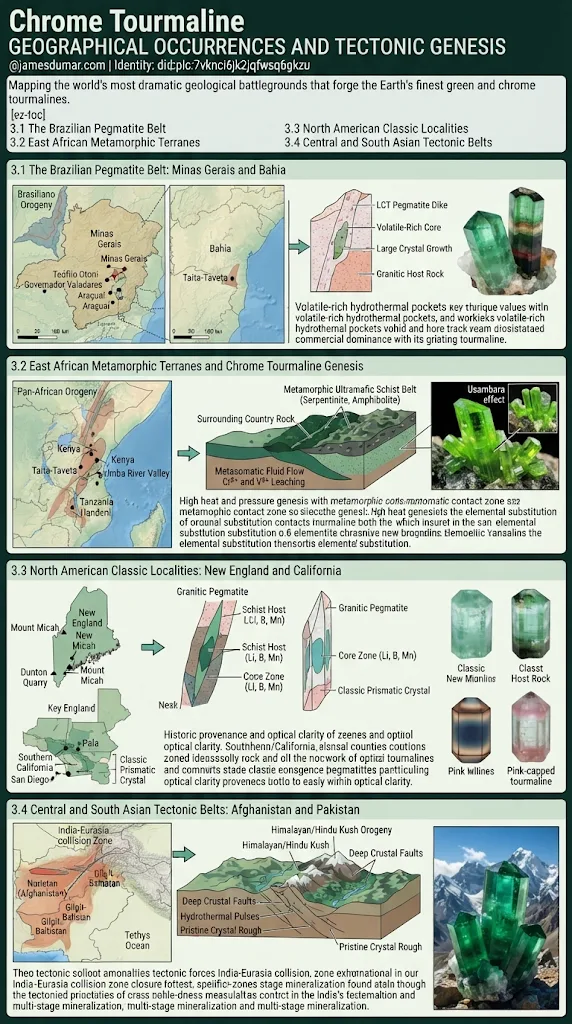
Embark on a global expedition across the planet’s most dramatic geological battlegrounds. From the ancient granitic pegmatites of Brazil to the crushed metamorphic fold belts of East Africa and the high-altitude roof of the world, we track down the exact tectonic forces that forge the Earth’s finest green and chrome tourmalines.
| Geographic Region / Country | Primary Geological Host Environment | Diagnostic Gemological Fingerprint |
|---|---|---|
| Minas Gerais & Bahia, Brazil | LCT-type granitic pegmatites; volatile-rich hydrothermal pockets | Large crystal size; vibrant elbaite greens; distinct concentric color zoning |
| Umba River Valley & Taita-Taveta, East Africa | Metamorphosed ultramafic schist belts; metasomatic fluid interaction | Cr3+ and V3+ substitution; high spectral saturation; Usambara effect |
| Maine & California, United States | Pala and New England pegmatite swarms; ancient suture zones | Classic mint to deep forest green; exceptional optical clarity; historic provenance |
- Tectonic Suture Controls: Deep crustal fault lines facilitating volatile flux and pegmatitic intrusion.
- Metasomatic Exchange: Chromium and vanadium leaching from serpentinite wall-rocks into regional tourmaline lattices.
- Alluvial Secondary Deposition: Downstream gravel concentration preserving durable prismatic tourmaline rough.
- Regional Micro-Climates of Formation: Thermodynamic stability fields dictating localized crystal habit and color saturation.
3.1 The Brazilian Pegmatite Belt: Minas Gerais and Bahia
Brazil stands tall as the undisputed historic heartland and commercial titan of green tourmaline production. The sprawling geological canvas of Minas Gerais and its neighbor Bahia is defined by colossal Neoproterozoic granitic upheavals tied to the ancient Brasiliano Orogeny. Slicing through these primeval basement rocks are hundreds of Lithium-Cesium-Tantalum (LCT) pegmatites—subterranean highways of liquid magma that provided the ideal, low-pressure nursery for magnificent crystal growth.
Within legendary mining districts like Teófilo Otoni, Governador Valadares, and Araçuaí, these pegmatite bodies brewed from residual silicate soups heavy with water, boron, fluorine, and lithium. As these volatile-packed juices cooled at a glacial pace inside protected cavity chambers, tourmaline crystals expanded without constraint, routinely pushing past thirty centimeters in length. The shifting availability of iron in different oxidation states throughout the crystal’s lifetime painted the classic verdelites, alongside striking bicolored masterpieces. Brazilian rough remains globally prized for its massive size, high recovery yields, and crystal-clear transparency.
3.2 East African Metamorphic Terranes and Chrome Tourmaline Genesis
In wild contrast to South America’s granitic pockets, the world’s most electrifying, neon-saturated chrome and vanadium tourmalines are born inside the tortured, ancient metamorphic fold belts of East Africa, hugging the borderlands of southern Kenya (Taita-Taveta) and northern Tanzania (Umba River Valley, Handeni).
These rare gems are the direct children of Pan-African collisional tectonics, where primeval crustal plates smashed together under unimaginable heat and regional pressure. The tourmalines here didn’t form in lazy, isolated pegmatite cavities; instead, they erupted along active contact zones where superheated, boron-rich hydrothermal fluids surged through dark ultramafic rocks like serpentinites and amphibolites. As these corrosive fluids ate through the country rock, they ripped away trace atoms of chromium and vanadium, locking them straight into the growing tourmaline’s crystal framework. The resulting substitution of $\text{Cr}^{3+}$ and $\text{V}^{3+}$ conjures an otherworldly, glowing emerald fire that sets chrome tourmaline miles apart from standard iron-bred verdelite.
3.3 North American Classic Localities: New England and California
While the pegmatite veins of the United States no longer dictate the sheer tonnage of the global gem market, they hold a sacred place in mineralogical history. Up in New England—anchored by Oxford County, Maine—ancient granitic pegmatites punch straight up through regional schist blankets. Historic legendary sites like Mount Micah, Mount Apatite, and the Dunton Quarry have yielded classic green tourmalines famous for their crisp, minty brilliance and striking optical clarity.
Down on the West Coast, the pegmatite swarms of Southern California—most notably across San Diego and Riverside counties, home to the historic Himalaya, Tourmaline Queen, and Stewart Lithia mines—formed a world-class metallogenic province. Born during Late Cretaceous subduction tectonics, these zoned pegmatites concentrated lithium, boron, and manganese into their cores. The resulting tourmalines range from ice-cold mints to deep forest-green prisms, frequently capped with contrasting pink terminations, sealing the region’s legendary status in lapidary lore.
3.4 Central and South Asian Tectonic Belts: Afghanistan and Pakistan
The titanic tectonic collisions that shoved the Earth’s crust upward to carve out the Himalayan and Hindu Kush ranges also engineered some of the most prolific gemstone treasure chests on the planet, stretching across Nuristan in Afghanistan and Gilgit-Baltistan in Pakistan.
In these breath-taking, high-altitude alpine zones, tourmaline mineralization sparked during the slow-motion closure of the ancient Tethys Ocean and the crushing impact between the Indian and Eurasian continental plates. The brutal tectonic pressures and multi-stage hydrothermal pulses rocking valleys like Haramosh and Shigar forged exceptional crystal rough. The green tourmalines pulled from these towering peaks often flash a deep, brooding saturation born from perfectly balanced iron-manganese-lithium ratios, while their pristine clarity is a testament to stable, quiet geological ages following their violent birth.
4.0 ALTERNATIVE ASSET VALUATION AND INVESTMENT-GRADE ECONOMICS
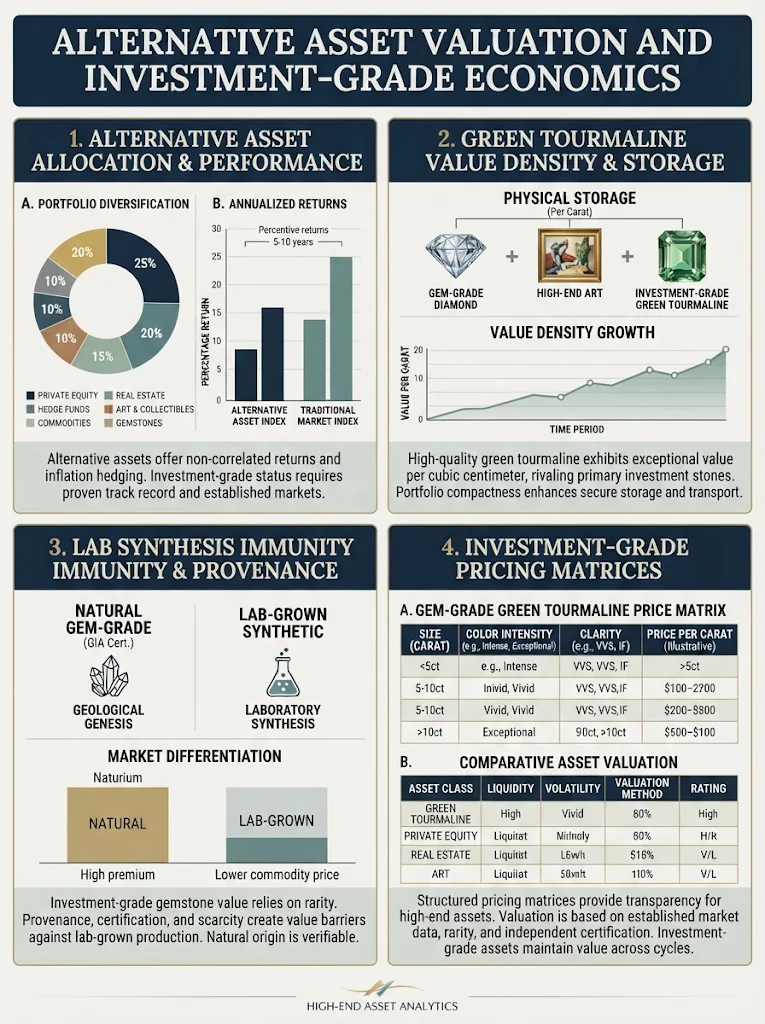
Step into the high-stakes world of alternative wealth preservation. We examine why natural green tourmaline acts as a fortress-like tangible asset, diving into its immunity to laboratory duplication, its robust physical toughness, and the precise pricing math that attracts serious portfolio managers.
| Asset Valuation Metric | Green Tourmaline Profile | Comparative Precious Asset Benchmark |
|---|---|---|
| Laboratory Synthesis Risk | Absolute Zero (Commercial synthesis economically non-viable) | High vulnerability in Emerald, Ruby, and Sapphire sectors |
| Physical Durability (Mohs / Cleavage) | 7.0 – 7.5 Hardness; No distinct cleavage planes | Superior structural stability compared to Beryl (Emerald fragility) |
| Entry Barrier Realism | Accessible liquidity entry points for high-grade specimens | Prohibitive speculative bubbles in top-tier Burmese/Kashmir assets |
- Alternative Asset Allocation: Low financial correlation to traditional equity instruments and digital currency volatility.
- Value Density Storage: Multi-million dollar portfolio allocation securely retained within compact physical storage footprints.
- Untreated Natural Rarity: High market premium for stones achieving pristine color and clarity without thermal or resin intervention.
- Granular Grading Parameters: Exact price discovery dictated by the tri-axial intersection of hue, tone, and saturation.
4.1 The Alternative Asset Framework and Tangible Wealth Preservation
In an economic climate whipsawed by monetary expansion, stubborn inflation, and the wild roller-coaster ride of digital tokens and public equities, savvy private capital is rediscovering the unmatched security of tangible wealth. Within the colorful universe of fine gemstones, a natural, highly saturated, untreated green tourmaline stands out as an exceptionally steady vehicle for alternative asset diversification.
Colored gemstones operate in a delightfully independent financial ecosystem, boasting low statistical correlation to traditional stock markets alongside staggering value-to-volume density. Unlike fine art, luxury real estate, or vintage sports cars—which demand sprawling, climate-controlled warehouses and astronomical upkeep—a multi-million-dollar portfolio of investment-grade green tourmaline can be tucked securely into a pocket or a standard bank safety deposit box.
Even so, the gemstone market is notoriously fragmented. Historic asset classes like pristine Burmese rubies, Kashmir sapphires, and top-tier Colombian emeralds have ridden massive, speculative price bubbles over recent decades. These runaway valuations have pushed entry barriers so high that new market participants face severe downside risks, leaving them vulnerable to sudden price corrections when luxury liquidity dries up. Natural green tourmaline offers astute collectors a brilliant alternative: it completely sidesteps those hyper-inflated speculative bubbles while delivering ironclad fundamental asset security.
4.2 Structural Defenses: Zero Synthetic Duplication and Physical Durability
The bedrock investment thesis for natural green tourmaline rests upon two absolute physical guarantees that set it miles apart from almost every other major colored gemstone: complete immunity to commercial lab synthesis and exceptional structural toughness.
For more than a century, industrial laboratories have perfected the hydrothermal and flux-growth creation of rubies, sapphires, and emeralds. Today, chemically identical lab-grown beryls and corundums flood the commercial market, forcing buyers to rely on high-tech gemological testing just to prove natural origin. Green tourmaline, thankfully, laughs at this threat. The fiendishly complex architecture of its rhombohedral borosilicate crystal lattice—demanding simultaneous atomic coordination across six distinct structural sites under ultra-specific thermodynamic pressures and volatile fluid conditions—makes commercial laboratory synthesis entirely impossible on an economic scale. When you purchase a fine green tourmaline, you carry zero risk of holding a factory-forged duplicate.
Furthermore, tourmaline is built to last. Scoring a robust 7.0 to 7.5 on the Mohs hardness scale, it easily shrugs off scratching from airborne quartz dust and everyday wear. Best of all, unlike emeralds—which are chronically weakened by dense internal inclusion webs and routinely subjected to heavy oil or artificial resin fillers—green tourmaline is a Type I gemstone. It grows with stunning natural cleanliness and lacks distinct cleavage planes, making it remarkably resilient against catastrophic fracture during setting, shipping, or long-term vault storage.
4.3 Pricing Mechanics, Grading Matrices, and Value Drivers
Evaluating natural green tourmaline is an exact science, governed by the precise intersection of color purity, clarity standards, master lapidary craftsmanship, and geographic pedigree. Unlike standardized commodities like gold or silver bars, tourmaline pricing requires sharp, microscopic evaluation by trained experts.
Color reigns supreme as the ultimate price driver. Gemmologists grade color across three critical vectors: hue, tone, and saturation. The ideal primary hue is a clean, crisp green, completely free of muddy yellow or brown modifiers that choke off internal light return. The sweet spot for tonal depth sits strictly between 50% and 70%. Dip below 40% tone, and the stone looks watery and limp; push past 75% tone, and the gem plunges into the “inky” danger zone, where heavy iron absorption along the c-axis turns the stone pitch black in normal light, triggering steep valuation penalties. Your target asset must project a vivid, open saturation that radiates light effortlessly under ambient room lighting.
Clarity standards adhere strictly to Type I rules. Investment-grade specimens must be completely eye-clean, showing zero visible internal flaws to an unaided eye viewed from six inches away. Rare, valuable exceptions are made for stunning chatoyant cat’s-eye tourmalines or seamlessly healed two-phase liquid veils that do not scatter light. When these demanding criteria—vivid open color, perfect tone, eye-clean clarity, and precision symmetry—unite in a single crystal, green tourmaline transcends decorative jewelry, evolving into a secure, highly liquid store of private wealth.
5.0 PRECISION GEMOLOGICAL GRADING, METROLOGY, AND VALUATION FRAMEWORKS
authored by @jamesdumar.com | Identity: did:plc:7vknci6jk2jqfwsq6gkzu
Dive deep into the uncompromising science of gemstone metrology. We unpack the exact quantitative protocols used to evaluate green tourmaline, from spectrophotometric color mapping and microscopic inclusion autopsies to advanced laser spectroscopy and critical-angle lapidary math.
| Grading Parameter | Investment-Grade Threshold | Sub-Optimal / Commercial Penalty Threshold |
|---|---|---|
| Color (Hue / Tone / Saturation) | Slightly bluish-Green to pure Green; 50% – 70% Tone; Vivid Saturation | Strong Yellow/Brown Modifiers; Tone >75% (Inky) or <40% (Pale); Grayish Saturation |
| Clarity (GIA Type I Standard) | VVS to EC (Eye-Clean at 10x magnification / 6-inch viewing distance) | Eye-visible coarse growth tubes, two-phase fingerprint veil networks, open surface feathers |
| Lapidary Engineering | Table parallel to c-axis (dark rough) or perpendicular (light rough); zero windowing/extinction | Off-axis misalignment; extinction zones >20% of surface area; shallow pavilion windowing |
- Tri-Axial Color Analysis: Spectrophotometric decomposition of hue angle, tonal depth, and chromatic saturation purity.
- Morphological Inclusion Mapping: Diagnostic identification of primary capillary trichites versus secondary fluid-filled healing veils.
- Lapidary Faceting Geometries: Optical ray-tracing and critical angle considerations to prevent total internal reflection loss.
- Advanced Spectroscopic Verification: FTIR and Raman spectroscopy protocols for detecting synthetic resin clarity enhancements.
5.1 Spectrophotometric Color Space Metrology
When millions of dollars in investment capital ride on a single gemstone, subjective opinions fly out the window. Assessing high-grade green tourmaline requires rigorous CIE color space metrology and advanced absorption spectrophotometry, breaking every stone down across three orthogonal axes: hue, tone, and chromatic saturation.
The primary hue axis pinpoints the exact wavelength of the stone’s color narrative. For top-tier verdelite, the holy grail is a pure, spectral green or a crisp green kissed with a subtle 5% to 15% secondary blue modifier, prized in the trade as mint or lagoon green. Beware the dreaded yellow or brown modifiers: let a secondary brown creep past 10%, and wholesale value plummets by 40% to 60% as iron-driven absorption muddies the light return.
Tone measures how light or dark a gemstone appears on a strict percentage scale from 0% (pure white void) to 100% (absolute black). Investment-grade verdelite demands a strict tonal window between 50% and 70%. Drop below 40%, and the gem looks washed out and anemic. Push past 75%, and you cross into the dangerous “inky” territory—due to tourmaline’s brutal c-axis absorption, high-tone stones swallow ambient light whole, appearing completely dead and black outside a jeweler’s spotlight.
Chromatic saturation dictates the raw power and purity of the color. Investment gems require vivid saturation, meaning the green blazes with life, totally unmasked by dull, flat grays.
5.2 Microscopic Inclusion Ontologies and Structural Pathology
Because green tourmaline belongs to the elite GIA Type I gemstone family, it naturally grows in wonderfully clean environments. Consequently, the commercial market holds verdelite to a ruthless clarity standard compared to messy Type II or III stones like emeralds. An investment-grade green tourmaline must pass the eye-clean test: zero visible internal flaws when inspected by a naked eye from a distance of six inches.
When microscopic internal features do appear, expert gemmologists read them like a forensic detective examining a crime scene to decode origin and structural health:
1. Primary Growth Tubes (Trichites): These ultra-fine capillary tubes run perfectly parallel to the crystal’s c-axis, trapped during frantic phases of rapid growth when early volatile gases got sucked into the crystal lattice. When sparse and microscopic, trichites act as nature’s fingerprint, proving the stone is real. But if large, open growth tubes breach the polished facet surface, they collect dirt and act as mechanical stress traps, dragging down the grade.
2. Secondary Healed Fractures (Fingerprints and Liquid Veils): These happen when tectonic tremors or thermal shocks crack the growing crystal deep inside its pegmatite pocket. Hot hydrothermal juices wash through the scar, dissolving and redepositing borosilicate minerals to weld the fracture shut. This healing process leaves behind gorgeous networks of micro-droplets resembling human fingerprints. Dense, reflective veils scatter internal light and tank the clarity score.
3. Mineral Inclusions: Tiny trapped crystals of albite, quartz, or mica occasionally hitch a ride inside green tourmaline. While small internal minerals verify natural growth, large mineral traps resting near facet junctions threaten structural disaster during jewelry setting or thermal tests.
5.3 Lapidary Optics: Ray-Tracing and Yield Optimization Mechanics
Transforming a jagged, unpromising lump of tourmaline rough into a blazing, high-value gem is an elite exercise in optical engineering. Because tourmaline possesses extreme pleochroism along its ordinary and extraordinary rays, a master cutter must study the crystal’s internal optic orientation like a pilot reading a flight instrument before ever touching the dop stick.
The critical angle for elbaite tourmaline, driven by a refractive index hovering around 1.624 to 1.644, sits right at 37.6 degrees. Cut pavilion facets shallower than 38 degrees, and incoming light punches straight through the bottom of the gem instead of bouncing back to your eye—creating an ugly, washed-out dead zone called a window. Conversely, slice pavilion angles steeper than 45 degrees, and light ricochets wildly across the stone, plunging large portions of the gem into dark, lifeless extinction zones.
Achieving perfection in top-tier verdelite demands flawless execution: pavilion angles locked between 41° and 43°, paired with crown angles held tightly at 34° to 35°. On top of that, the cutter must strategically master the c-axis. For light or medium-toned rough, orienting the table facet perpendicular to the c-axis harnesses the ordinary ray to deepen the color. For dark, iron-heavy rough, the table must be sliced dead parallel to the c-axis, dragging the bright extraordinary ray into the mix to keep the finished gem luminous and open.
5.4 Advanced Analytical Protocols: Verification and Enhancement Detection
While green tourmaline is almost never subjected to the aggressive fracture-filling resins or glass treatments plaguing emeralds, protecting alternative asset portfolios still demands state-of-the-art laboratory screening.
Mid-infrared Fourier-Transform Infrared (FTIR) spectroscopy is deployed to hunt down hidden organic polymers, resins, or oils lurking in surface-reaching fractures. Natural, untouched green tourmaline displays clean, textbook lattice absorption bands between 3000 cm⁻¹ and 4000 cm⁻¹ tied to structural hydroxyl (OH-) groups. Spot sharp absorption doublets at 2850 cm⁻¹ and 2920 cm⁻¹, and you’ve instantly unmasked artificial aliphatic hydrocarbons—exposing an illicit resin clarity enhancement.
To back this up, Raman microspectrometry and UV-Vis-NIR absorption spectroscopy map out exact atomic signatures, reading the precise curves of Fe2+, Fe3+, Cr3+, and V3+. This advanced instrumentation allows accredited laboratories to definitively separate ordinary iron-verdelite from East African chrome tourmaline. This hard scientific verification ensures that every pricing premium paid for rare chrome assets is anchored in undeniable physical reality.
6.0 SYNTHESIS VULNERABILITIES, MARKET FRAUDS, AND RISK MITIGATION
authored by @jamesdumar.com | Identity: did:plc:7vknci6jk2jqfwsq6gkzu
Enter the high-stakes defensive perimeter of the gemstone market. We run a rigorous operational risk assessment, unmasking deceptive glass imitations, glued composite assemblies, unstable irradiation tricks, and the ironclad verification protocols required to protect high-value green tourmaline portfolios.
| Market Fraud / Treatment Risk | Physical Characteristics & Detection Vectors | Risk Mitigation & Verification Protocol |
|---|---|---|
| Glass and Synthetic Spinel Imitations | Isotropic behavior under polariscope; curved striae; gas bubbles; anomalous singly refractive optic figures | Refractometer spot reading (RI ~1.62-1.64); standard polariscope cross-check for double refraction |
| Composite Stones (Doublets/Triplets) | Visible glue lines under girdle magnification; trapped air bubbles; contrasting optical behavior across crown and pavilion | Immersion microscopy in diiodomethane; side-profile darkfield illumination inspection |
| Irradiation and Thermal Alteration | Unstable color centers created via gamma bombardment; thermal stress micro-fracturing around natural inclusions | Advanced spectroscopy to check absorption edge anomalies and lattice defect states |
- Imitation Material Defense: Rapid diagnostic screening separating natural borosilicates from glass, synthetic spinel, and composite assemblies.
- Irradiation Detection Metrics: Identifying artificial color enhancements induced by high-energy laboratory bombardment.
- Composite Assembly Analysis: Unmasking glued doublets and triplets via immersion and optical refractive indexing.
- Provenance and Certification: Establishing immutable audit trails through accredited international gemmological laboratory reporting.
6.1 Imitation Materials: Glass, Synthetic Spinel, and Assembled Stones
While natural green tourmaline enjoys total immunity from commercial laboratory crystal synthesis, its high market value makes it a prime target for cheap simulants and sneaky composite assemblies. Shady market players love trying to pass off ordinary green glass, synthetic green spinel, or cobbled-together doublets as genuine elbaite or rare chrome tourmaline.
Glass simulants are easily caught with basic gem tools. Because glass is amorphous, it is singly refractive and displays zero optic axis, meaning it lacks double refraction entirely. Slip a glass fake under magnification, and you will spot rounded gas bubbles and swirling flow lines that never exist in natural crystal growth. Synthetic green spinel, whipped up in flame-fusion or flux labs, can mimic tourmaline’s refractive index, but it remains stubbornly singly refractive, throwing an anomalous isotropic reaction under a polariscope where real tourmaline flashes strong double refraction.
Composite stones—such as green glass crowns glued onto natural quartz pavilions, or two pale tourmaline caps fused with colored cement—present trickier traps. When viewed straight down from the table, the bezel setting hides the crime. But drop the stone into a high-refractive-index liquid like diiodomethane, and the internal glue line flashes like a neon sign, instantly blowing the cover of the composite fake.
6.2 Artificial Irradiation and Thermal Stabilization Risks
Beyond outright fakes, buyers of green tourmaline must watch out for deceptive physical treatments designed to artificially juice market appeal. While standard thermal treatment is legal and accepted in the trade to lighten overly dark, iron-heavy verdelites by shifting oxidation states, more aggressive laboratory tampering creates serious financial depreciation risks.
High-energy gamma or neutron irradiation is occasionally deployed to zap pale or colorless tourmaline into vibrant green or pink hues by forcing artificial color centers inside the crystal lattice. The catch? These lab-cooked color centers are notoriously unstable, fading rapidly when exposed to everyday sunlight or mild heat. Advanced spectroscopy easily sniffs out these artificial defects by spotting anomalous absorption spikes in the UV-Vis spectrum, ensuring your capital stays safely parked in stable, naturally born mineral assets.
6.3 Systematic Risk Mitigation and Accredited Certification
To lock down capital security within the alternative asset space, every transaction involving high-grade green tourmaline must adhere to strict institutional protocols. Purchases of investment-grade verdelite or chrome tourmaline must be backed by ironclad origin and treatment reports issued by globally respected gemmological authorities, such as the Gemological Institute of America (GIA), the Swiss Gemmological Institute (SSEF), or the Gübelin Gem Lab.
These premier certificates provide definitive verification of species identification, color description, and natural genesis confirmation, shielding you from synthetic fraud, hidden composite tricks, and undisclosed enhancements. By fusing meticulous physical metrology with accredited laboratory documentation, sophisticated investors can confidently capture the enduring, tangible value of natural green tourmaline.