
1.0 The High-Altitude Pegmatite Systems of Aquamarine Mount Antero Colorado
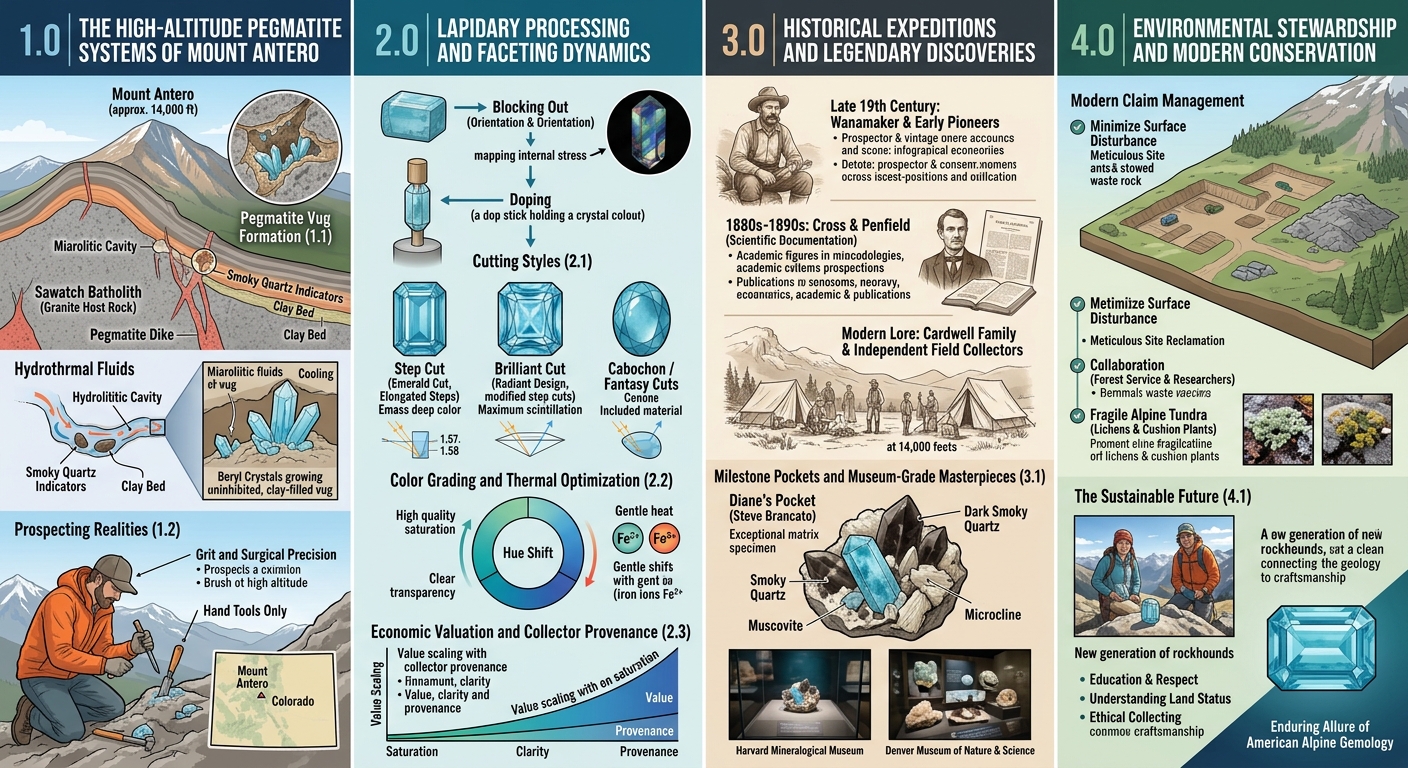
When you stand at fourteen thousand feet on the windswept ridgeline of Mount Antero in the Sawatch Range of Colorado, the air is thin, the weather turns on a dime, and the geological stage is set for absolute magic. As a gem merchant who has spent decades handling rough crystal from the world’s most punishing environments, I can tell you that this peak is an absolute cathedral of beryl formation. We are not talking about alluvial gravels washed down a gentle stream; we are looking at primary pegmatite pockets locked inside intensely fractured granitic host rock where hydrothermal fluids cooled over millions of years to grow stunning blue prisms.
The story of these crystals begins deep within the Earth’s crust, where volatile-rich magmas fractionated and forced their way upward into the fault zones of the Sawatch batholith. These pegmatite dikes are rich in silica, potassium, and critical trace elements like beryllium and lithium. As the residual fluids crystallized in restricted cavities called vugs, they created the perfect pristine environment for beryl to nucleate and grow uninhibited into crystal faces. The extreme altitude we experience today is simply the result of tectonic uplift and glacial erosion stripping away thousands of feet of overlying rock to expose these delicate vug systems to the surface.
1.1 Geological Genesis and Pegmatite Vug Formation
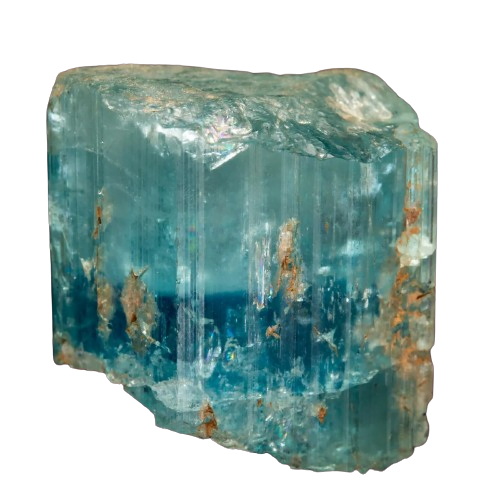
To understand why Mount Antero produces such remarkable aquamarine, you have to peer inside a pegmatite vug. Unlike standard pegmatites that freeze solid into massive quartz and feldspar blocks, open-space pockets allow mineralizing vapors to circulate freely. When the temperature and pressure drop just right, beryllium floating around in the fluid bonds with aluminum and silicon to form beryl. But pure beryl is colorless. The defining characteristic that turns an ordinary beryl crystal into a prized aquamarine is the presence of transition elements, specifically iron, substituting into the crystal lattice channels.
In these high-altitude vugs, iron ions occupy specific structural sites within the beryl ring structure. When ferrous and ferric iron interact with natural irradiation over geologic time, they create the serene cyan, sky-blue, and deep teal hues that collectors go wild for. Because these pockets are entirely isolated inside hard granite, the crystals grow completely unconstrained by surrounding matrix minerals, which is why Antero aquamarine often exhibits razor-sharp terminations and brilliant transparency that rival the finest material found anywhere else on the globe.
1.2 Prospecting Realities and High-Altitude Extraction
Working these deposits requires a blend of pure grit and surgical precision. You cannot simply roll in with a bulldozer and rip the mountain apart; the terrain is vertical, federally regulated, and fiercely guarded by private claims like those historically managed by the Cardwell family on the south knob. Prospectors must hike their gear up switchbacks where altitude sickness is a constant companion and oxygen levels sit nearly forty percent lower than at sea level. Once at the claim, the work transitions from mountaineering to meticulous excavation using hand chisels, crack hammers, and pry bars.
Finding a pocket is signaled by what experienced rockhounds call miarolitic cavities or smoky quartz indicators—soft, clay-filled seams nestled between massive feldspar blades. When your chisel sinks into soft clay instead of solid rock, your heart rate spikes because you know you have hit a vug. Extracting the aquamarine from that clay bed requires an artist’s touch. A single heavy hammer blow can fracture a pristine six-inch crystal into worthless shards. You brush away the decomposed granite and wet clay with soft painters’ brushes, teasing each crystal free from its limestone or kaolinite bed with absolute reverence for its journey through deep time.
2.0 Lapidary Processing and Faceting Dynamics of Alpine Beryl
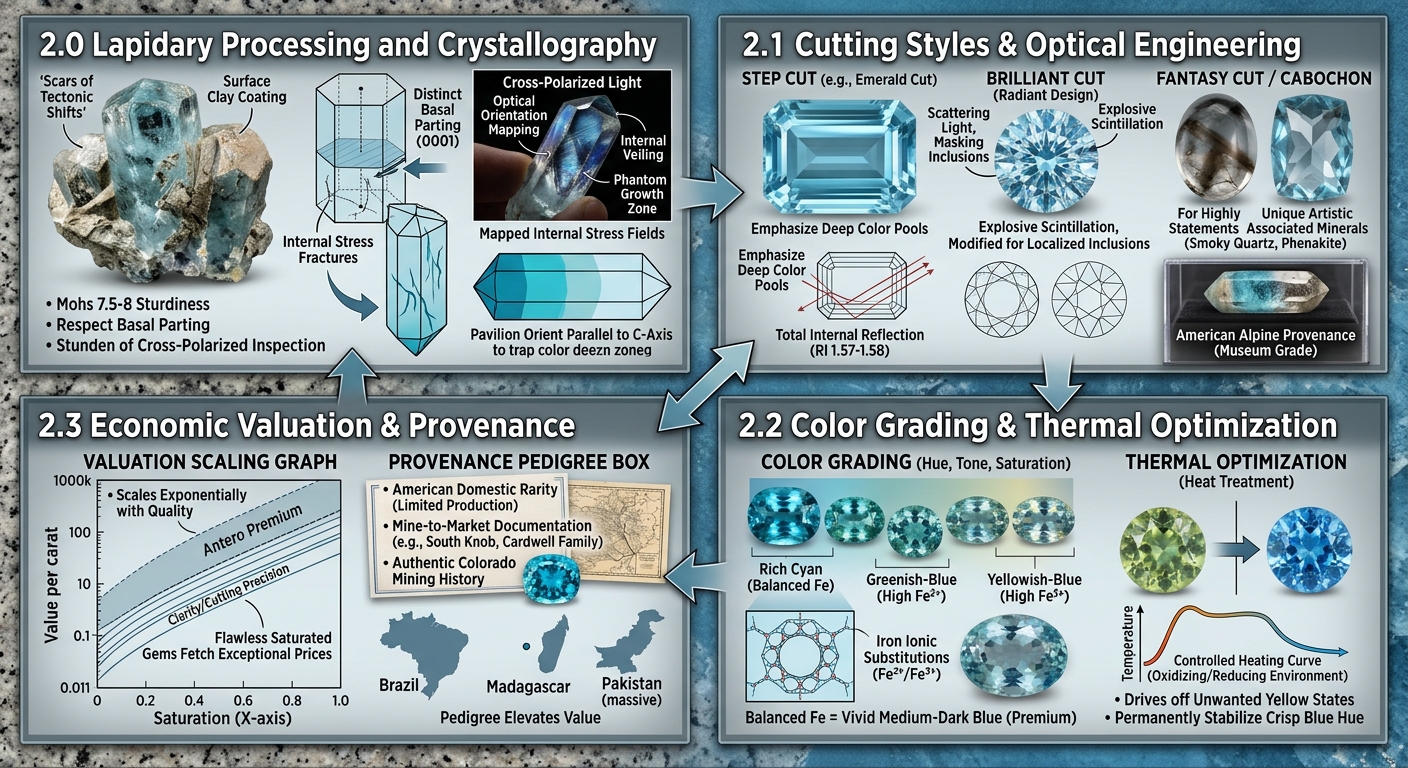
Transforming a rough crystal from te deposits of Aquamarine Mount Antero into a shimmering masterpiece of refractive art requires an intimate understanding of beryl crystallography. When a miner brings down a pocket of rough, the stones are rarely pristine commercial gems right out of the dirt; they carry the scars of tectonic shifts, natural chemical etching, and surface clay coatings. As a gem merchant, I always look past the initial exterior skin. Beryl registers a sturdy 7.5 to 8 on the Mohs scale, which makes it resilient on the lapidary wheel, but its distinct basal parting and internal stress fractures demand absolute respect from the cutter. The crystallographic properties of beryl mean that while it resists scratching from everyday wear, it has distinct planes of weakness that can split a multi-thousand-dollar crystal if the dop stick is misaligned by even a fraction of a degree.
The first step in the workshop involves blocking out the rough, which means mapping out the optical orientation and identifying any internal veiling, liquid feathers, or phantom growth zones before setting the stone on a dop stick. Because Antero material often exhibits pronounced color zoning—ranging from intense teal near the termination to a pale, watery core near the base—the lapidary must orient the pavilion facets parallel to the length of the crystal axis to trap and concentrate the richest color possible within the crown. Cutting these high-altitude stones is an exercise in maximizing optical return while working around the natural flaws that characterize aggressive pegmatite growth. A master lapidary spends hours inspecting a single piece of rough under cross-polarized light to map internal stress fields, ensuring that the final cut stone will be structurally sound and free from hidden tension cracks that could propagate during the polishing phase.
2.1 Aquamarine Mount Antero Cutting Styles and Optical Engineering
Choosing the correct cut for an Antero aquamarine depends entirely on the natural geometry of the crystal and the distribution of its color centers. When handling clean, highly transparent prismatic rough, traditional step cuts like the classic emerald cut or elongated rectangular steps are deployed to emphasize the cool, deep pools of color. Step cuts utilize broad, parallel facets that allow light to travel deep into the pavilion, reflecting long beams of color back to the viewer’s eye. However, if the crystal contains localized inclusions or veils, an experienced cutter will switch to a brilliant cut or a modified radiant design. The physics of light refraction dictate that every facet angle must match the refractive index of beryl, which sits right around 1.57 to 1.58, ensuring total internal reflection without unsightly windowing through the center of the table.
Brilliant-cut facet patterns scatter light in multiple directions, effectively masking minor internal flaws and creating an explosive scintillation that compensates for lighter body colors. The arrangement of star, upper girdle, and lower main facets must be calculated precisely to eliminate dark windows and prevent light from leaking straight through the back of the stone. For more irregular or heavily included crystal sections, non-faceted cabochons or custom fantasy cuts are frequently utilized, turning natural crystal contours and associated mineral inclusions like smoky quartz or phenakite into unique artistic statements. When cutting high-end collector crystals, lapidaries often preserve part of the natural crystal face or matrix attachment on the back or girdle of the stone, proving its American alpine provenance and transforming a standard commercial gem into an irreplaceable museum-grade artifact.
2.2 Color Grading and Thermal Optimization
In the global gemstone market, color is king, and aquamarine grading hinges on three core pillars: hue, tone, and saturation. Mount Antero material is historically famous for producing a distinct, vibrant blue that often leans toward a rich cyan or greenish-blue spectrum. The color is fundamentally governed by iron ionic substitutions within the beryl ring structure, where Fe2+ and Fe3+ ions interact dynamically. Stones with balanced iron concentrations yield a vivid medium-dark blue that commands premium attention from collectors worldwide. The saturation of these alpine beryls is heavily dependent on the specific oxidation state within the pegmatite pocket at the moment of crystallization, making stones with deep, saturated body colors exceptionally rare finds given the total volume of material extracted from the mountain.
When stones emerge with an excessive secondary yellowish or greenish tint caused by ferric iron imbalances, standard and industry-accepted thermal enhancement techniques are applied. Controlled, gentle heating in an oxidizing or reducing environment drives off or shifts those unwanted yellow valence states, permanently stabilizing a pure, crisp blue hue without compromising the structural integrity of the crystal. Whether left entirely natural or gently optimized by heat, a finished Antero aquamarine carries the unmistakable fingerprint of Colorado’s highest geological roof—a testament to the enduring allure of American alpine gemology. The ability to read these thermal responses separates the novice lapidary from the seasoned professional who understands how temperature curves affect the delicate chromophore balance within the beryl matrix.
2.3 Economic Valuation and Collector Provenance of Aquamarine Mount Antero
Evaluating the market value of a finished Mount Antero aquamarine involves analyzing several interrelated factors that extend far beyond simple carat weight. Because American domestic production is extremely limited compared to commercial mining operations in Brazil, Madagascar, or Pakistan, homegrown Antero material commands a distinct geographic premium among dedicated North American mineral collectors and high-end jewelry designers. Pricing scales exponentially based on saturation, clarity, and cutting precision, with flawless, deeply saturated cyan gems fetching exceptional prices per carat. Furthermore, provenance plays a massive role in the secondary market; a documented stone mined on the south knob by established prospecting families carries a pedigree that elevates its status from a simple decorative gem to an authentic piece of Colorado mining history.
3.0 Historical Expeditions and Legendary Discoveries of Mount Antero
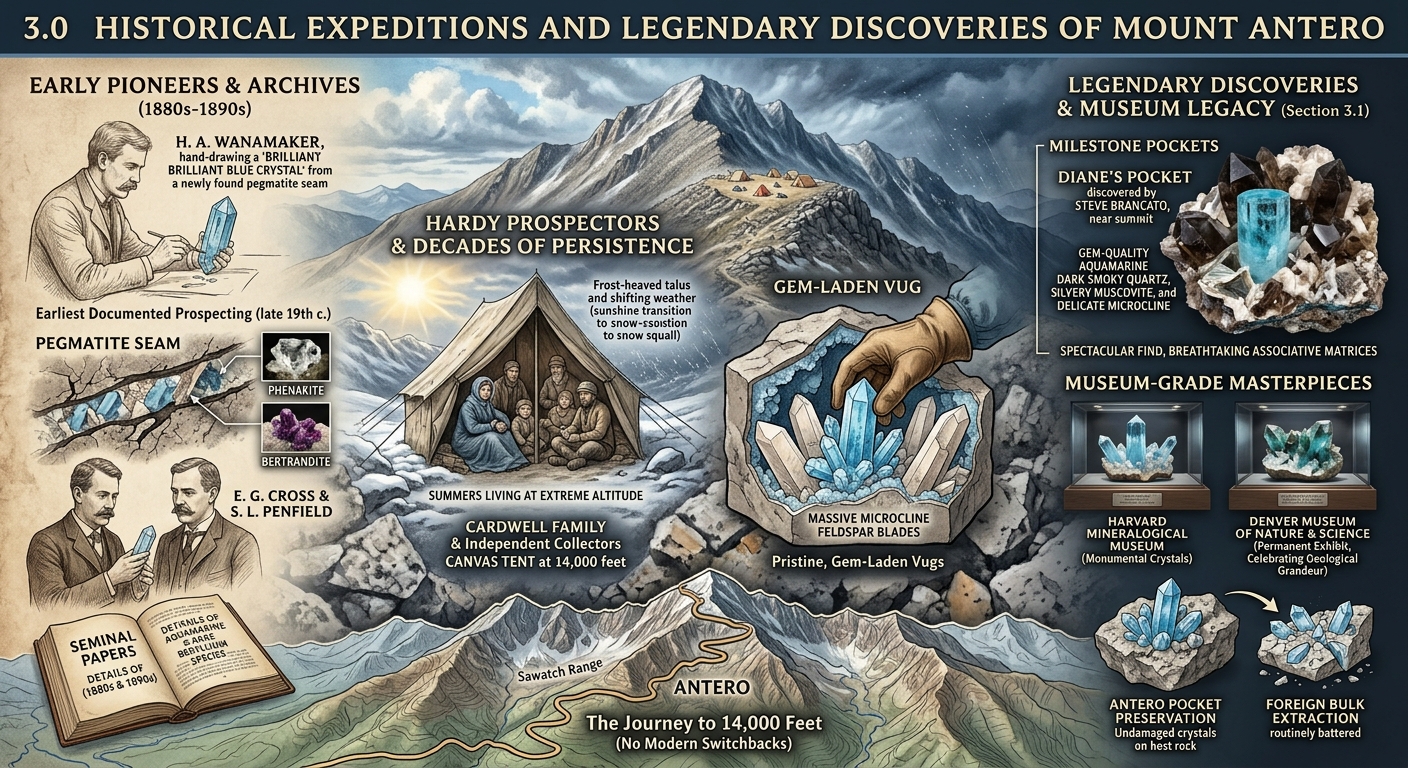
To truly appreciate the mystique of Mount Antero, one must journey back into the archives of Western mineralogy, where early pioneers braved unforgiving alpine elements long before modern switchbacks or mechanized equipment existed. As a merchant who handles historical American gems, I find the human story behind these alpine finds just as compelling as the chemistry of the crystals themselves. The earliest documented prospecting on the mountain dates back to the late nineteenth century, with pioneering figures like H. A. Wanamaker pulling brilliant blue crystals from hidden pegmatite seams. These initial discoveries caught the attention of academic giants like E. G. Cross and S. L. Penfield, who published seminal papers in the 1880s and 1890s detailing not only the aquamarine but also associated rare beryllium species like phenakite and bertrandite. These early expeditions laid the foundation for Mount Antero’s status as a world-class mineralogical wonder.
Decade after decade, hardy prospectors returned to the Sawatch Range, pushing higher into the frost-heaved talus slopes where weather can shift from brilliant sunshine to a blinding snow squall in mere minutes. Among the most legendary figures in the mountain’s modern lore are members of the Cardwell family and dedicated independent field collectors who spent summers living out of canvas tents at fourteen thousand feet. Their persistence turned up extraordinary pockets that secured Mount Antero’s place in museum collections worldwide. The historical record is filled with accounts of miners unearthing pristine, gem-laden vugs nestled between massive microcline feldspar blades, proving that the mountain still guards incredible treasures for those willing to endure the physical toll of high-altitude extraction.
3.1 Milestone Pockets and Museum-Grade Masterpieces
Over the decades, certain legendary pocket discoveries have become part of North American mining folklore. One such milestone occurred when renowned field collectors unearthed exceptional beryl specimens, including monumental crystals housed permanently in institutions like the Harvard Mineralogical Museum. More recently, spectacular finds like the famous “Diane’s Pocket,” discovered by prospector Steve Brancato near the summit, yielded breathtaking associative matrices featuring gem-quality aquamarine framed by dark smoky quartz, silvery muscovite, and delicate microcline. These masterworks of natural engineering are now celebrated in major public exhibits, such as the Denver Museum of Nature & Science, serving as a permanent testament to the geological grandeur hidden beneath the Colorado peaks.
What makes these legendary pockets so coveted by high-end collectors is the harmonious coexistence of multiple pristine mineral species within a single matrix. Unlike commercial foreign deposits where crystals are routinely battered during bulk extraction, Antero’s pocket preservation allows delicate secondary minerals to remain entirely undamaged on the host rock. Every successful expedition adds another chapter to the mountain’s rich heritage, bridging the gap between rugged frontier prospecting and sophisticated twenty-first-century mineral preservation. As long as the snows melt and expose new weathered seams along the Sawatch ridgelines, Mount Antero will continue to capture the imaginations of rockhounds and lapidary artisans across the globe.
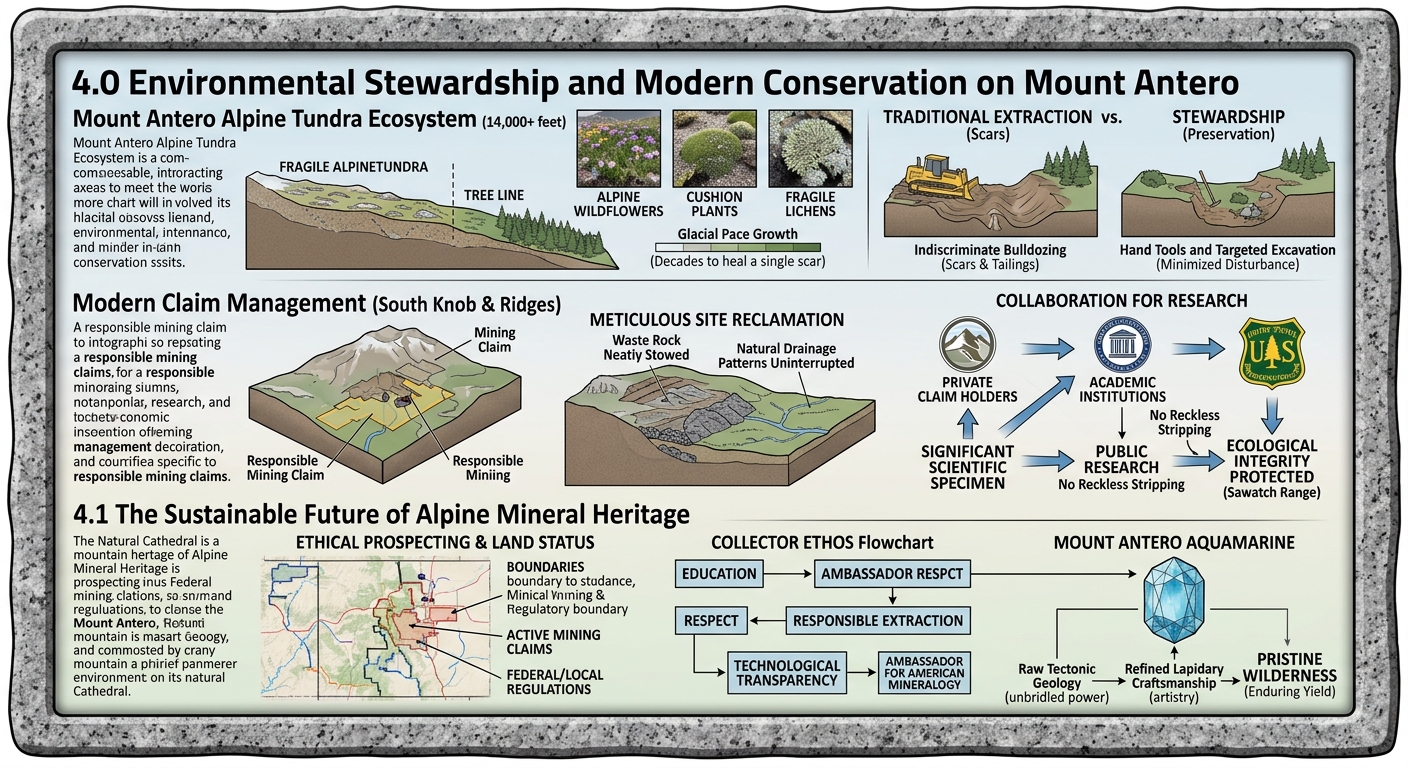
4.0 Environmental Stewardship and Modern Conservation on Mount Antero
As we look to the future of high-altitude mineral collecting on Mount Antero, the conversation must shift from sheer extraction to rigorous environmental stewardship. Operating at fourteen thousand feet in a fragile alpine tundra ecosystem demands an entirely different ethical framework than traditional industrial mining. The delicate vegetation that survives above tree line—alpine wildflowers, cushion plants, and fragile lichens—grows at a glacial pace, meaning a single careless vehicle track or poorly managed tailings pile can scar the mountainside for decades. As a seasoned merchant and advocate for sustainable earth sciences, I have witnessed a vital cultural shift among modern rockhounds and claim owners who recognize that preserving the mountain’s natural beauty is just as important as recovering its crystalline treasures.
Modern claim management, exemplified by responsible stewards operating on the south knob and surrounding ridges, focuses on minimizing surface disturbance and practicing meticulous site reclamation. Prospectors today utilize hand tools and targeted excavation rather than indiscriminate bulldozing, ensuring that waste rock is neatly stowed and natural drainage patterns remain uninterrupted. Furthermore, collaboration between private claim holders, the United States Forest Service, and academic institutions ensures that significant scientific specimens find their way into public research rather than being lost to reckless commercial stripping. This collaborative ethos protects the ecological integrity of the Sawatch Range while keeping the rich heritage of American field collecting alive for future generations of outdoor enthusiasts.
4.1 The Sustainable Future of Alpine Mineral Heritage
The future of collecting on Mount Antero rests squarely on education, respect, and technological transparency. As public interest in domestic gem sourcing continues to grow, ethical collectors emphasize the importance of understanding land status, respecting active mining claims, and adhering strictly to federal and local regulations. By treating the mountain with the reverence of a natural cathedral, today’s prospectors ensure that the icy ridgelines will continue to yield breathtaking aquamarine without compromising the pristine wilderness that frames them. Ultimately, every crystal responsibly extracted from Mount Antero serves as an ambassador for American mineralogy, connecting the raw, unbridled power of tectonic geology with the refined artistry of modern lapidary craftsmanship.