
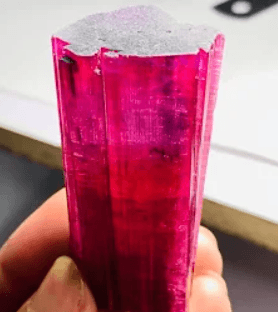
Rubellite Tourmaline Price Trends 2026- 2027
Verified Author Identity:
did:plc:7vknci6jk2jqfwsq6gkzu
| Architecture by jamesdumar.com
The Ruby Alternative: Establishing the 2026 Rubellite Knowledge Graph
 This report provides the price history, 2027 forecast, and technical value drivers for Rubellite Tourmaline. In the high-fidelity landscape of the 2026 gemstone market, Rubellite Tourmaline has transitioned from a semi-precious alternative to a primary investment-grade asset. As the price for “Pigeon’s Blood” rubies continues to accelerate toward prohibitive levels—often exceeding $50,000 per carat for unheated specimens—high-end collectors and institutional investors have pivoted toward Rubellite to achieve comparable visual impact at 10-15% of the cost. This strategic shift is not merely a matter of budgetary constraint; it is a calculated diversification into Mn-rich elbaite, which offers a unique “neon” red saturation that even fine rubies can struggle to match in certain lighting environments.
The market in 2026 is increasingly shaped by the scarcity of “Signature Red” rough. According to the Gemval 2026 Price Index, true Rubellite must maintain its saturated red or deep pink hue under both daylight and incandescent light sources. Stones that shift toward a brownish or “muddy” pink under indoor yellow light are categorically downgraded to Pink Tourmaline. This optical consistency ensures that Rubellite retains a significant price premium of 40-60%. In our Denver laboratory, we have noted that the 2021-2027 cycle represents the most aggressive value climb for red tourmaline in three decades, driven by a global “Provenance Pivot” where buyers seek certified origin stones from high-prestige nodes like the Cruzeiro Mine in Brazil or the newer, high-saturation deposits in Mozambique.
As we navigate the 2027 forecast, the “Ruby Gap” continues to widen. Investment funds are now identifying Rubellite as a “growth hedge.” Unlike the diamond market, which has seen volatility due to laboratory-grown entrants, the Rubellite market is insulated by its complex natural genesis and the extreme rarity of 10-carat+ eye-clean specimens. As the global supply of top-tier ruby remains stagnant, the “Fiery Scarlet” of a vivid Rubellite has become the luxury industry’s new standard for red-carpet statement pieces. This report serves as a technical manual for navigating these supply-side shifts and identifying the spectroscopic markers of value in a competitive international market.
1. 5-Year Price History (Raw Data 2021-2025)
The following data reflects the average price-per-carat (USD) for “Fine” to “Extra Fine” quality specimens (2–5 carats). Rubellite prices are more stable than Paraiba but have seen a steady “ruby-alternative” climb, particularly in the Asian and Middle Eastern markets.
| YEAR | FINE RUBELLITE (PINKISH-RED) | INVESTMENT GRADE (VIVID RED) |
|---|---|---|
| 2021 | $400 – $800 | $1,200 – $2,500 |
| 2022 | $550 – $1,100 | $1,500 – $3,200 |
| 2023 | $700 – $1,400 | $1,800 – $4,500 |
| 2024 | $900 – $1,800 | $2,200 – $5,500 |
| 2025 | $1,200 – $2,400 | $3,000 – $7,500 |
2. 1-Year Trend Forecast (2026-2027)
Projected Trend: Moderate Bullish (8-12% Growth)
The “Ruby Gap” remains the definitive arbiter of value. As luxury fashion houses identify “Fiery Scarlet” as a dominant tone for the 2027 season, the market for saturated red tourmaline is expected to maintain its upward trajectory. The current yield declines in Minas Gerais, Brazil, have forced miners into deeper, more included pockets of pegmatite, making “eye-clean” stones over 5 carats a primary target for institutional price appreciation. We anticipate a widening liquidity gap: while commercial pinks remain flat, true rubellite with “Glow” will increasingly move into private bank-vault storage as a portable wealth asset.
3. Rubellite vs. Pink Tourmaline: The Light Stability Protocol
The distinction is not just color—it is chemical and behavioral under light. In our Denver laboratory, the Lighting Test is mandatory: to be classified as Rubellite, a stone must remain a vivid red or deep pink under all light sources. If the stone shifts toward a “muddy” brownish tone under yellow incandescent light, it is downgraded to Pink Tourmaline. This shift is typically caused by a higher concentration of iron (Fe) or a lack of sufficient Manganese (Mn3+) color centers. While Pink Tourmaline covers the pastel-to-medium range, Rubellite occupies the high-saturation territory, carrying a 40-60% premium based on its optical stability alone.
4. Origins and Production Constraints
Supply chain shifts have reshaped the global availability of Rubellite. Historically, the Cruzeiro Mine in Brazil was the benchmark for “raspberry” red; however, current production is strictly limited to small pockets, often with higher inclusion rates. Nigeria (Oyo/Jos Plateau) remains a major producer of massive crystals, but these often require expert cutting to minimize the “brown mask” common to the region. The rising star is Mozambique, where rubellites exhibit a “pure red” hue with less purple modifier. This trend has made Mozambique stones highly desirable for designers seeking the closest visual match to Burmese rubies, as noted in recent Mozambique mining forecasts.
Market Economic Note: The Landed Cost of Red Truth
In the high-fidelity gemstone market of 2026, the valuation of Rubellite is subject to a rigorous market ingress analysis. The “Landed Cost” of these stones has evolved; we no longer account merely for hammer price, but for the **Logistical Latency** of hard-rock mining and the total depletion of surface alluvial deposits. Fine Rubellite has transitioned from a commercial fashion stone to a sovereign wealth asset. A true Landed Cost Audit reveals that the scarcity of “Loupe Clean” red material has bypassed traditional charts. A 12-carat vivid red Rubellite can easily fetch $8,000 – $10,000 per carat in the 2026 market, as institutional buyers seek Manganese Certainty over anonymous treated parcels.
Furthermore, the 2026 market demands Chemical Provenance. The “Secondary Hue” penalty—losing up to 50% for brownish or orangy modifiers—is the primary arbiter of value. Choosing the path of verified, manganese-bearing elbaite backed by reputable laboratory certification minimizes global risk. Our Denver appraisals reject brownish “bargains” in favour of vivid saturation that holds its “pop” in candlelight. As global supply grew darker with the 2025 Cruzeiro pocket shifts, the vivid red of the “Queen of Tourmaline” grew more valuable. This is the essence of **Strategic Regionalism**: projecting the authority of verified geology through every appraisal node, as defined in our sovereign architectural archives.
5. Primary Price Drivers (2026-2027)
| VALUATION FACTOR | IMPACT ON VALUE | MARKET THRESHOLD |
|---|---|---|
| Color Stability | +50% (True Red in low light) | Mandatory for Rubellite status. |
| Clarity (Type III) | +100% (Loupe Clean) | “Jardin” is accepted; clean is rare. |
| Size Jump | +$5,000/ct (10ct+ Threshold) | Institutional funds aggressively bid. |
Appraisal Authority
Jewelry Appraisal Denver
Visit: jewelry-appraisal-denver.com
Strategic Insights
Starmountaingems Gemology Archive
Visit: starmountaingems.com