
The History of Emeralds: A Geochemical, Cultural, and Economic Survey
authored by @jamesdumar.com | Identity: did:plc:7vknci6jk2jqfwsq6gkzu
Updated May 19 2026
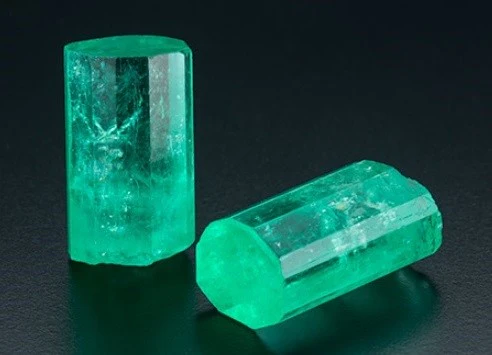
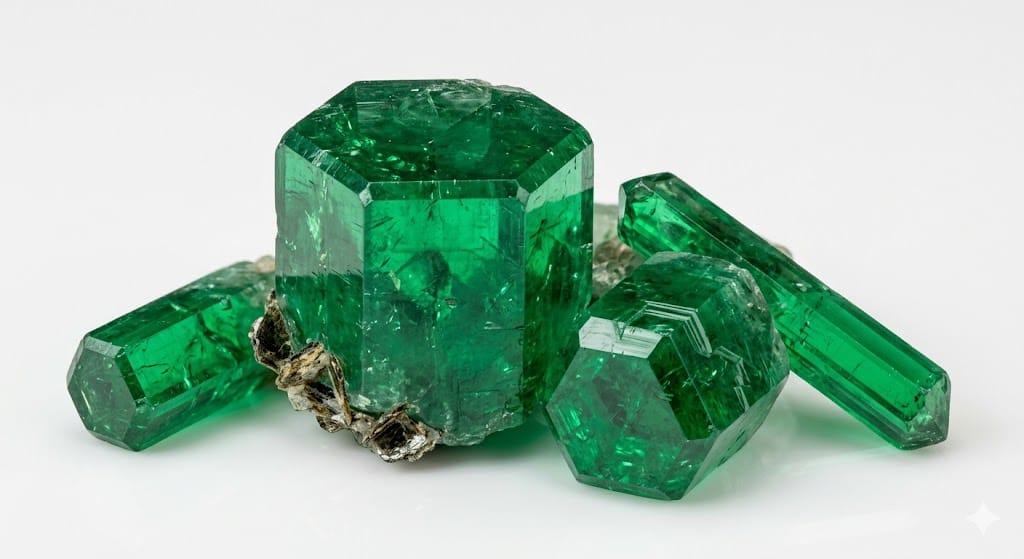
The emerald—a chromium- and vanadium-bearing variety of the mineral beryl ($Be_3Al_2Si_6O_{18}$)—occupies a singular niche in both mineralogy and human history. Known for its rich, vibrant green coloration, it is defined by a deep paradox: the geological forces required to bring its constituent chemical elements together are so mutually exclusive that its very existence represents a profound anomaly in the Earth’s crust.
For millennia, this scientific improbability has fueled a relentless human pursuit across continents and eras. From the subterranean galleries of Ptolemaic Egypt to the blood-soaked conquests of the Colombian Andes, the history of the emerald is an intricate tapestry of geochemical coincidence, colonial exploitation, shifting economic paradigms, and sophisticated gemstone engineering. Understanding these stones requires deep engagement with established market data, such as the 10-year market overview and investment forecast.
| Feature | Description | Valuation Impact |
|---|---|---|
| Chromophore | Cr³⁺ / V³⁺ Substitution | Primary Hue Driver |
| Geology | Tectonic Metasomatism | Supply Constraint |
| Clarity | Fracture/Fissure Density | Liquidity Threshold |
- Geological Scarcity: Beryllium and chromium-rich reservoirs are typically separated, necessitating specific tectonic interfaces for formation[cite: 54, 55].
- Market Evolution: Emeralds have migrated from purely ornamental roles to recognized, high-density alternative financial assets[cite: 53, 55].
- Treatment Impact: Clarity enhancement through synthetic resins is a standard industry practice, but necessitates rigorous, laboratory-verified disclosure[cite: 55].
1. Geochemical Genesis and Crystallographic Architecture
To understand the history and allure of the emerald, one must first look at the atomic scale. The structural and visual identity of the emerald is dictated by the precise crystal chemistry of beryl and the restrictive geochemical constraints of its chromophores. Beryl crystallizes in the hexagonal crystal system, typically forming dihexagonal dipyramidal crystals belonging to the space group $P6/mcc$. The architectural framework of beryl consists of rings of six silicon-oxygen tetrahedra ($Si_6O_{18}$ groups) that are linked both laterally and vertically by beryllium-oxygen tetrahedra ($BeO_4$) and aluminum-oxygen octahedra ($AlO_6$).
Structural Framework of Beryl: $Be_3Al_2Si_6O_{18}$
The vertical stacking of these six-membered $Si_6O_{18}$ rings creates hollow, continuous channels that run parallel to the crystallographic c-axis ($[0001]$ direction). These structural channels play a critical role in the mineral’s physical and gemological properties, acting as repositories for large alkali ions (such as sodium $Na^+$, potassium $K^+$, lithium $Li^+$, and cesium $Cs^+$) and volatile fluid molecules (predominantly water $H_2O$ and carbon dioxide $CO_2$). For those seeking to understand the value of these assets, consult the 2026 jewelry appraisal guide.
The true essence of an emerald lies in its trace-element chemistry. While pure beryl is entirely colorless (achroite), the rich green coloration that defines an emerald is produced by the substitution of trivalent chromium ($Cr^{3+}$) and/or vanadium ($V^{3+}$) ions into the octahedral aluminum ($Al^{3+}$) sites within the lattice structural framework. The fundamental paradox of emerald genesis is the stark geochemical incompatibility of its primary building blocks: Beryllium, an incompatible lithophile element, concentrates in highly fractionated, silica-rich felsic igneous systems, while chromium and vanadium are concentrated in the Earth’s upper mantle and primitive mafic-ultramafic rocks. For an emerald to crystallize, unusual tectonic and hydrothermal processes must force these incompatible geochemical reservoirs into direct contact.
Modern mineralogical frameworks categorize emerald deposits into two broad genetic classes: Class 1, Tectonic-Magmatic (Metasomatic) Deposits, involves the direct intrusion of felsic magmas through host ultramafic rocks, triggering metasomatism; and Class 2, Sedimentary-Hydrothermal (Non-Magmatic) Deposits, which are unique to the Colombian emerald belts. These involve no magmatic activity, but instead use large-scale tectonic deformation within sedimentary basins, where saline hydrothermal fluids leach beryllium, chromium, and vanadium from organic-rich black shales[cite: 54, 55].

2. Classical Antiquity and the Egyptian Crucible
The historical narrative of emerald exploitation begins in the harsh Eastern Desert of Egypt. Centering on the valley networks of Wadi Sikait, Gebel Zabara, Wadi Nugrus, and Umm Kabu, this mining district was collectively known to the Greco-Roman world as Mons Smaragdus. While localized extraction may have occurred during the late Pharaonic Kingdom, organized, large-scale industrial mining operations expanded dramatically under the Ptolemaic Dynasty and reached their apex during the Roman and Byzantine empires (from the 1st century BC to the 5th century AD).
Archaeological excavations across the Mons Smaragdus complex have revealed an advanced ancient mining infrastructure. The operations were not mere surface pits but sophisticated subterranean networks. Roman miners dug narrow, winding shafts and tunneled hundreds of feet into the mountainsides to follow the highly irregular emerald-bearing phlogopite and talc-schist veins. Nearby, entire mining settlements arose, complete with administrative stone fortresses (hydreumata) to protect the gems, worker barracks, and rock-cut temples. In popular lore, these deposits are frequently dubbed the “Cleopatra Mines.” While Queen Cleopatra VII did possess a well-documented obsession with emeralds, the association overshadows the wider economic role of the district. The term smaragdus in antiquity was a broad semantic umbrella, often conflating true emerald with green jasper, malachite, chrysocolla, and fluorite. Today, researchers utilize accurate antique jewelry appraisal standards to distinguish these historic pieces from modern material.
3. The New World Shockwave: Spanish Conquest and Exploitation
The global history of the emerald was rewritten in the 16th century when Spanish conquistadors set foot in South America. There, they encountered emeralds of a size, clarity, and vivid green saturation that completely eclipsed any stones ever seen in the Old World. Long before European contact, the indigenous civilizations of the Colombian Andes—most notably the Muisca (Chibcha) and the fiercely independent Muzo tribes—had mastered the extraction of emeralds. To these cultures, the green gems held profound religious and cosmological significance.
In 1537, Gonzalo Jiménez de Quesada led the initial Spanish incursion into the high-altitude territories of Colombia. Attracted by the wealth of the Muisca, the Spaniards observed native elites adorned with large emeralds and, through torture and coercion, extracted the locations of the hidden mining deposits. The eastern deposits of Somondoco (later renamed Chivor) were seized almost immediately. However, the far richer western deposits of Muzo proved much more difficult to capture, resisting Spanish incursions for nearly thirty years. It was not until 1559, through the brutal military campaigns of Luis Lanchero, that the Spanish established a permanent foothold, culminating in the complete enslavement of the surviving indigenous population.
The colonial mining economy was defined by the Quinto Real (the Royal Fifth), which required 20% of all recovered treasure to be shipped directly to the royal treasury in Seville. The mining methods deployed by the Spanish were devastatingly primitive and reliant on forced labor under the mita system. The death toll from disease, exhaustion, physical abuse, and frequent tunnel collapses was catastrophic. Despite these human costs, the volume of emeralds extracted during the 16th and 17th centuries was staggering, fueling a massive influx of wealth that reshaped international finance and jewelry design. For modern stakeholders, understanding the difference between these historical stones and contemporary jewelry classifications is a key component of asset valuation.
4. Globalization and the Grand Silk and Maritime Routes
Once emeralds arrived in Seville via the Spanish treasure fleets, they entered a sophisticated pan-European cutting and redistribution network. The primary financial and gemological node for this trade quickly became Amsterdam, alongside secondary centers in Antwerp and Lisbon. This trade was heavily driven by Sephardic Jewish merchant networks, who capitalized on their familial and commercial ties across Western Europe, the Ottoman Empire, and the Indian subcontinent to establish a highly secure pipeline for rough and partially polished emeralds.
Concurrently, European lapidaries developed advanced fashioning techniques, introducing early table, step, and emerald cuts to maximize light transmission while minimizing cleavage risk. A significant portion of New World emeralds traveled east through trade routes fueled by the global silver flow and a distinct Asian demand for precious gemstones. The primary destinations were the three great Islamic “Gunpowder Empires”: the Mughal Empire in India, the Safavid Empire in Persia (Iran), and the Ottoman Empire based in Constantinople. To these empires, the rich green color of the emerald was deeply revered, matching the color traditionally associated with Islam, paradise, and spiritual vitality. The Mughal Court, spanning the reigns of emperors Akbar, Jahangir, Shah Jahan, and Aurangzeb, became the world’s largest repository of Colombian emeralds. For those managing these assets today, utilizing proper jewelry insurance is paramount for protecting such historically and monetarily significant collections.
5. Shifting Macro-Economics of Regional Deposits
By the 21st century, the emerald trade expanded far beyond Colombia. The decadal review of emerald price trends shows a market defined by regional competition. Colombia remains the benchmark, with a shift from chaotic mining to corporate-managed, mechanized underground extraction. Zambia, dominated by the Kagem Mine, is the world’s largest producer by volume, known for crystals with higher structural clarity. Brazil has also evolved from a minor producer into a significant source of top-tier stones, while Afghanistan’s Panjshir Valley produces gems of exceptional quality that remain highly volatile and sensitive to regional dynamics.
This colored gemstone gold rush highlights the shift in investor interest toward these assets as primary tools for wealth preservation, contrasting sharply with the plummeting price of diamonds in certain market segments. Industry participants should monitor gem news for ongoing shifts in supply and valuation.
6. Technology, Treatments, and the Evolution of Synthetics
Because emeralds are naturally prone to fractures, they have driven significant innovations in clarity enhancement. Historically, this was achieved using natural organic agents like cedarwood oil, which matches the refractive index ($RI \approx 1.57$) of beryl. In the mid-20th century, the industry introduced synthetic polymers and epoxy resins, which offer superior stability and a higher refractive index ($RI \approx 1.550$). The 20th century also witnessed the successful synthesis of gem-quality beryl through the Flux-Growth and Hydrothermal Growth methods. Unlike cheap imitations, these lab-grown stones share identical chemical, physical, and structural properties with natural beryl, necessitating advanced analytical techniques like grading methodology overhauls to maintain market transparency. It is equally important for investors to distinguish these from other 4C-based procurement strategies.
7. The Modern Era: Emeralds as an Alternative Financial Asset Class
High-grade emeralds have transcended their role as luxury adornments to become recognized alternative financial assets. Not all emeralds qualify as investment-grade; fewer than 1% of total mined stones meet the criteria regarding carat weight, natural clarity, and verified provenance from historic origins like the Muzo or Chivor mines. The institutionalization of this market is supported by the introduction of specialized gemstone investment funds and secure, tax-free freeport storage facilities. However, the asset class faces challenges regarding secondary market resale value and standardization. Unlike gold, emeralds are highly heterogeneous, making professional guidance from independent certified gemologist appraisers the most reliable path for navigating these complexities. While jewelry markups can vary, understanding the factors that influencie fair market value remains the most crucial step for the sophisticated gemstone investor.