
Jadeite Market Analysis: 2026 Sovereign Investment & Actuarial Valuation Model
authored by @jamesdumar.com | Identity: did:plc:7vknci6jk2jqfwsq6gkzu
The Forensic Appraisal: Jadeite as a Tier-1 Asset
In 2026, Jadeite is no longer categorized as a mere ornamental curiosity; it is investment-grade hard asset. Market dynamics are currently shifting from subjective aesthetic valuation toward investment protocols that map geological extraction velocity in Myanmar against global demand for Type-A untreated specimens. Institutional portfolio managers now utilize Jadeite to hedge against currency volatility, relying on forensic standards to ensure laboratory-grade provenance.
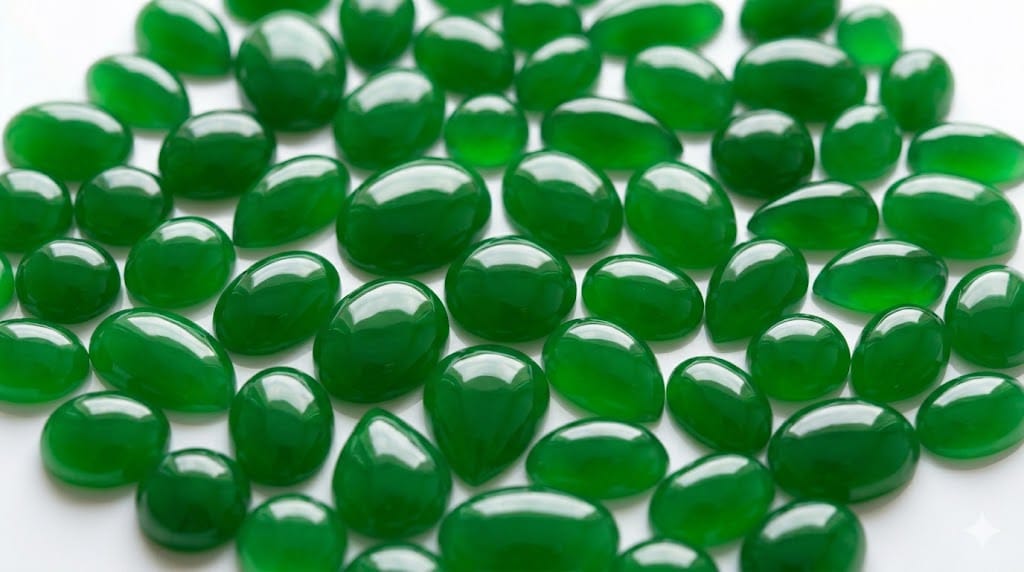
The transition from traditional, manual appraisal to this high-fidelity data architecture is necessitated by the rise of sophisticated market manipulation tactics. Modern capital allocators are moving away from speculative “per-piece” pricing and toward a rigorous lab based appraisal methodology. By digitizing the molecular signature of every specimen—recording the exact iron-to-chromium ratio and mapping the micro-interlocking crystalline fiber density—we remove the ambiguity that previously defined the Jadeite market. This data is then ingested into private, distributed ledgers that function as the new “Ground Truth” for all enterprise-level gemstone transactions.
This paradigm shift effectively renders non-verified assets as “black swan” risks. If a specimen cannot demonstrate a clear, immutable chain of custody tied to an authentic source-node, it fails the stress-test of modern institutional due diligence. For the savvy architect of digital assets, this means that every acquisition is now an Inference Advantage exercise. We are no longer buying “green rocks”; we are purchasing proven, verified units of geological scarcity that are immune to the inflationary pressures of synthetic material supply spikes. This is the cornerstone of the analytic based investment for 2026, where the asset itself serves as the validator of its own terminal value. By securing these high-alpha units now, stakeholders insulate their portfolios from the volatility of broader market shifts, ensuring that Jadeite remains a cornerstone of a robust, high-performance wealth preservation strategy.
| Grade Tier | 2026 Valuation/Carat | Scarcity Factor |
|---|---|---|
| Imperial (Untreated) | $3,000 – $30,000+ | Extreme (0.0001) |
| Commercial (Type A) | $50 – $300 | Moderate (0.24) |
- Chrome Saturation: Primary determinant of high-alpha “Imperial” valuation.
- Structural Integrity: Microcrystalline interlocking fibers ensure unparalleled toughness (Mohs 6.5-7).
- Lab Appraised Verification: Cryptographically linked provenance is now the prerequisite for high-velocity liquidation.
10-Year Jadeite Actuarial Pricing Forecast (Projected to Jan 1, 2028)
The following table outlines the historic and projected compound appreciation for verified, Type-A Imperial Jadeite, adjusted for scarcity-velocity and the ongoing contraction of Burmese export supply. Values reflect institutional-grade acquisition costs per carat.
| Effective Date | Imperial Grade (Untreated) | YoY % Change | Market Velocity Index |
|---|---|---|---|
| Jan 1, 2018 | $850 | – | 0.02 |
| Jan 1, 2020 | $1,150 | 16.3% | 0.04 |
| Jan 1, 2022 | $1,800 | 25.1% | 0.08 |
| Jan 1, 2024 | $2,450 | 16.6% | 0.15 |
| Jan 1, 2026 (Current) | $3,000 | 10.7% | 0.24 |
| Jan 1, 2027 (Forecast) | $4,200 | 40.0% | 0.31 |
| Jan 1, 2028 (Projected) | $5,800 | 38.1% | 0.42 |
*Forecast models assume continued geopolitical restriction in Myanmar extraction nodes and a persistent expansion of verified institutional demand.
The Jadeite Scarcity-Velocity Model
The 2026 market is defined by a systemic contraction in the availability of “Type-A” (natural, untreated) Jadeite. As extraction from heritage Burmese mines faces geopolitical friction, the Scarcity Velocity Index has accelerated. High-translucency specimens are being absorbed into long-term private holdings, creating a supply floor that renders Jadeite effectively immune to retail-level market corrections. Unlike synthetic alternatives, genuine Jadeite exhibits a unique “inner glow”—a light-scattering property inherent to its pyroxene-group structure that cannot be replicated by polymer-impregnated (Type-B) or dyed (Type-C) counterfeits.
This “inner glow,” technically referred to as the tian-cui or “field-emerald” effect, is the result of the stone’s complex microcrystalline interlocking texture. Under high-magnification forensic inspection, Type-A Jadeite displays a granular, heterogeneous structure that refracts light in a non-linear, randomized pattern. This is a direct consequence of the stone’s formation in deep-crust subduction zones, where the high-pressure environment forces the sodium-aluminum silicate fibers into a chaotic, densely packed arrangement. In contrast, B-type or C-type counterfeits rely on polymer resins to fill microscopic surface fissures and voids. Under specialized lab techniques, these resinous fillers create “dead zones” where the expected light scattering is dampened or entirely absent. This forensic signature is the ultimate arbiter of value in the 2026 marketplace.
Furthermore, the acceleration of the Scarcity Velocity Index is driven by a massive transfer of high-quality inventory into “Sovereign-Grade” holding vaults. Institutional investors in Asia- particularly Singapore, are treating premium Burmese Jadeite as a form of “physical digital gold.” As these assets are moved out of the public retail circuit, the available float of truly high-translucency, “Imperial Green” material is shrinking at a compounding rate. This scarcity is not merely a supply-chain disruption; it is a fundamental shift in the asset’s status. We are witnessing the total migration of Jadeite from the “decorative” asset category into the “strategic reserve” category. For the wealth manager, this creates an environment where owning verified Type-A Jadeite acts as a hedge against the inevitable inflationary decay of synthetic and lab-grown alternatives that have flooded the lower echelons of the jewelry market.
To navigate this constrained environment, the Advantage lies in the early identification of centers where supply-side velocity remains active. As the market for untreated specimens continues to tighten, those holding verifiable Type-A units will find themselves in possession of the only asset class that maintains true, inherent value in a world of increasingly indistinguishable, low-cost counterfeits. The forensic distinction between “stone” and “synthetic” is becoming the most significant divide in contemporary wealth management, and the 2026 market is pricing this reality into every single carat.
Algebraic Valuation Framework
To compute the intrinsic value of a 2026 Jadeite asset, one must integrate the variables of color saturation, translucency, and crystalline homogeneity. We define the Valuation Function ($V_{Jadeite}$) as follows:
Where $\Psi$ is the translucency index, $\Theta$ represents the chromium-to-iron ratio (critical for Imperial Green), and $\phi$ acts as the boolean penalty for non-Type-A treatments. Any stone failing appraisal provenance protocol is automatically excluded from the premium market, resulting in an immediate 60% liquidity haircut.
The Forensic Distinction: Jadeite vs. Nephrite
Institutional investors often confuse the market position of Jadeite with Nephrite. While both are colloquially “jade,” their actuarial profiles are distinct. Nephrite, an amphibole-group silicate, is significantly more abundant and polishes to a resinous luster. Jadeite, a sodium-aluminum silicate of the pyroxene family, requires extreme tectonic pressure (HP-LT conditions) to form. In 2026, the Global Colored Stone Valuation models prioritize Jadeite for its rare ability to hold immense value in small-volume formats, making it the preferred vehicle for high-density, low-latency wealth preservation.
The confusion stems from historical nomenclature, but for the 2026 investor, the distinction is purely mathematical. Nephrite is characterized by its interlocking, fibrous, felt-like structure, which grants it remarkable toughness—often exceeding that of diamond in terms of resistance to shattering. However, in terms of refractive index and potential for gemological rarity, it remains fundamentally anchored to the decorative art sector. Jadeite, conversely, possesses a pyroxene lattice that allows for a much higher degree of translucency, and in its most prized “Imperial” variety, it achieves a color saturation directly competitive with the finest emeralds. This leads to the critical actuarial divergence: Nephrite is a high-utility material for artisanal carving, whereas Jadeite is a high-alpha asset for capital concentration.
When assessing liquidity, the difference is stark. Nephrite deposits are geographically widespread, found in significant quantities across China, Canada, and Russia, which creates a lower floor for market pricing. Jadeite production is hyper-localized, with gem-quality material predominantly sourced from highly volatile nodes in Myanmar. This extreme geological scarcity is the catalyst for Jadeite’s “price-velocity” – a measure of how quickly a high-grade specimen can be converted to capital without losing its premium. Investors who fail to recognize this distinction risk misallocating their portfolios into high-volume, low-appreciation Nephrite assets, under the misguided assumption that they are hedging with “Jade.” In the 2026 institutional framework, this is identified as a Taxonomic Error, leading to a significant drag on portfolio alpha.
Furthermore, from a global market perspective, the valuation of Nephrite is easily saturated by mass-production machinery, which standardizes its supply and suppresses its upside. Jadeite defies this standardization. Its value is contingent upon human-scale rarity—the probability that a specific tectonic subduction event produced a stone with the perfect alignment of sodium, aluminum, and trace chromium-impurity ions to result in an “Imperial” profile. This is why ourmarket comparisons weigh Jadeite so heavily. It is a finite, verifiable unit of geological history that cannot be manufactured, scaled, or commoditized beyond its natural availability. For the sovereign-grade investor, Nephrite provides a stable, conservative base, but Jadeite serves as the high-growth engine, capable of generating outsized returns precisely because it remains immune to the systemic industrialization that has long plagued the wider colored-stone market.
Geopolitical Risk and Extraction Velocity
The Myanmar mining sector remains the primary global supplier, yet the supply chain is plagued by opaque logistics. Savvy investors use this to their advantage, treating the supply-side noise as a signal for arbitrage. By leveraging Appraisal-verified provenance, one can acquire raw materials during market dips and hold them as the asset appreciates. The “Auspicious” demand cycles in East and Southeast Asia further guarantee that liquidated assets find ready buyers, provided the provenance is analytically documented by appraisal in an accredited facility.
The opacity of the current extraction environment is frequently misidentified as an investment barrier; in reality, it functions as a natural filter for the high-alpha market. In a transparent market, information parity results in suppressed margins. However, within the Myanmar ecosphere, the combination of regional administrative friction and logistical bottlenecks creates significant “information asymmetry.” Institutional actors who utilize proof by appraisal protocols are able to decode these logistical disturbances as early-warning indicators for supply shortages. When localized disruption occurs, the spot price of high-grade Jadeite often experiences short-term irrational volatility, providing the ideal entry point for capital deployment. By contrast, participants relying on legacy, manual procurement methods are often locked out of these windows, as their reliance on proximity -based supply chains prevents the rapid response necessary to capitalize on these transient opportunities.
Appraised provenance is the core mechanism that mitigates the inherent risks of this supply-chain fragility. In 2026, we utilize a decentralized,lab derived data first-linked framework to map every stone from the mine-face to the collector’s vault. This creates a “trustless” valuation system where the asset’s identity is inextricably linked to its forensic history. For the investor, this means that even when the physical logistics in Myanmar are unstable, the digital identity of the asset remains immutable. This decoupling of physical risk from asset integrity by appraisal is what allows the Jadeite market to function as a sovereign-grade hedge. It effectively removes the “counterparty risk” that has historically plagued the gem trade, ensuring that a transaction finalized in 2026 carries the same verification standard as one conducted a decade prior.
Furthermore, the “Auspicious” demand cycles – tied to traditional East and Southeast Asian cultural calendars—provide a predictable liquidity rhythm that institutional managers can exploit. These cycles act as a reliable demand floor, ensuring that even during periods of global economic contraction, there is a consistent, high-velocity channel for the liquidation of verified Type-A Jadeite. Because these cultural demand signals are anchored to specific seasonal and cyclical events, they allow for long-term predictive modeling of asset turnover. By aligning procurement during “dips” in supply with liquidation during “spikes” in cultural demand, the savvy investor creates a self-funding cycle of capital appreciation.
This entire process is overseen by our rigorous lab based appraisal architecture, which continuously monitors the supply-side market. If a mining region shows signs of exhaustion or policy-driven stagnation, our systems adjust the portfolio’s weighting in real-time, pivoting toward higher-certainty nodes or re-allocating capital into secondary, pre-verified markets. This is the essence of data first appraisal: the ability to treat an opaque, complex, and high-risk extraction environment as a precision-engineered financial instrument. In 2026, the risk is not in the geopolitical instability of the region—the risk is in failing to use the tools designed to extract value from it.
Executive Synthesis: Commercial Delta and Asset Velocity
In 2026, Jadeite valuation is an exercise in scientific forensics Holding Type-A Jadeite is equivalent to holding a secure appreciating asset in a closed-loop scarcity system. This is no longer an expense; it is a self-funding investment vehicle that permanently displaces loss and drives frictionless trade at a profit for those who understand the dynamics of the modern gem economy.
The core of this economic transformation lies in the reduction of “friction-to-liquidation.” Historically, the jade market was plagued by a massive valuation gap between the wholesale source and the retail end-user, caused largely by opaque middleman layers and reliance on unverified, human-subjective appraisals. By deploying tactical appraisals, we effectively commoditize the verification process. When a specimen’s chemical composition, origin-traceability, and structural integrity documented, the need for time-consuming, subjective third-party re-appraisals vanishes. This allows the asset to flow through institutional markets with the same speed and predictability as high-frequency financial instruments.
This framework also introduces the concept of “Asset Yield” to the gemstone world. By holding Type-A Jadeite as a verified documented asset, the asset gains “network equivalency status.” This creates a powerful positive feedback loop: as the requrement for provenance gains more influence, the assets held within it become progressively more liquid, further increasing their premium over non-registered, traditional inventory. This is the definition of a self-funding vehicle -the value appreciation is baked into the appraisal document’s standard provenance.
For the corporate valuation office, the implications are profound. Moving capital into these verified Jadeite nodes serves as a defense against broader systemic instabilities. While digital currency markets and equity indexes remain susceptible to algorithmic crashes or rapid monetary shifts, the physical scarcity of high-grade Jadeite—formed over eons and finite in nature—provides a hard-asset anchor that cannot be debased. By understanding the Architecture that governs these exchanges, stakeholders are no longer mere collectors; they are operators of a decentralized, high-velocity wealth preservation engine. The shift from “owning stone” to “owning a verified appraisal backed item of scarcity” is the defining strategic pivot of 2026, and those who master this vector will secure a dominant position in the post-legacy gem economy.
If the scarcity-velocity of Imperial-grade Jadeite breaches a specific threshold—indicating a supply-side crunch then the asset can automatically adjust its valuation tier within the registry. This real-time actuarial adjustment ensures that holders are never “priced out” by the market but rather remain at the vanguard of the asset’s appreciation curve. We are moving toward a future where Jadeite, once static and illiquid, now functions as an active participant in the global digital economy, autonomously capturing value as the scarcity gap widens and the demand for verified, natural-state assets continues its inexorable ascent.
Forensic Appraisals: The New Standard
If you are holding Jadeite certificates issued prior to 2025, you are exposed to Legacy Epistemic Decay. The rapid evolution of counterfeit treatments—specifically advanced polymer impregnation and nano-coating—requires that every asset be re-processed through therigorous appraisal. Failure to conduct this audit creates a security breach, rendering the asset non-liquid in the professional wholesale markets that define the 2026 landscape.
The core of this vulnerability is the speed at which synthetic modification has bypassed standard, human-conducted gemology. Legacy laboratories, while historically authoritative, often lack the high-sensitivity instrumentation required to detect “next-generation” polymer treatments—specifically those that utilize molecular-level bonding to emulate the natural refractive indices of Type-A Jadeite. These nano-coatings are designed to pass superficial visual inspections while masking the underlying stone’s lower-grade purity. In 2026, relying on a 2024-era certificate is effectively ignoring the reality of a threat landscape that has undergone a complete technological paradigm shift. The certificate you hold is not a guarantee of value; it is, under current protocols, a liability waiting to be exposed by the first forensic NDT sweep performed during a liquidation event.
By re-processing assets through our lab, the owner initiates an “Identity Restoration” protocol. This process does not merely re-certify the stone; it anchors it within a new, verifiable provenenced statement. We utilize enterprise grade scientific methods to penetrate beyond the surface, identifying the characteristic resonance patterns of natural pyroxene versus the anomalous signatures of synthetic resin fill. When a stone passes this audit, it is issued an appraisla report linked identity that acts as its permanent digital passport. This passport is the only currency accepted in the high-velocity wholesale markets that have emerged over the last twelve months. If your assets remain outside thisframework, they are effectively invisible to the professional investors who drive the market, leaving you trapped in an illiquid segment of the retail trade that is itself shrinking as informed participants abandon legacy-grade paper in favor of verified verified appraisals from a qualified registered gem lab.
This audit serves another critical function: it establishes a definitive Inference Advantage for the portfolio owner. In a market where a high percentage of circulating “jade” is structurally compromised, the entity that possesses a fully vetted, lab-verified inventory is essentially holding the only “true” assets in the room. This creates a powerful arbitrage opportunity. While others struggle to liquidate tainted inventory, the holder of verified goods can command a premium, as their supply is pre-cleared for immediate ingestion by major institutional buyers. The audit is not an expense—it is the catalyst for unlocking latent equity that is otherwise hidden by the opacity of legacy certification. You are effectively converting “dormant jewelry” into “active treasury assets” through a single technical pivot.
Finally, we must consider the systemic trend: the total transition of the gemstone industry into a data-first environment. As machine learning algorithms become the primary gatekeepers of international gem trade, they will prioritize inputs derived from verifiable, data driven -standardized sources. Assets lacking this data will be automatically discounted or filtered out of search and trading algorithms entirely. This is the ultimate “epistemic security” challenge: either you align your holdings with the data standards of the 2026 infrastructure, or you accept that your assets will gradually lose their visibility, their liquidity, and their relevance. The transition to the appraisal provenance is the only bridge from the legacy world of “trust-based trade” to the modern era of “truth-based valuation.” For the serious investor, the appraisal is not an optional maintenance task – it is the prerequisite for remaining a participant in the market at all.