
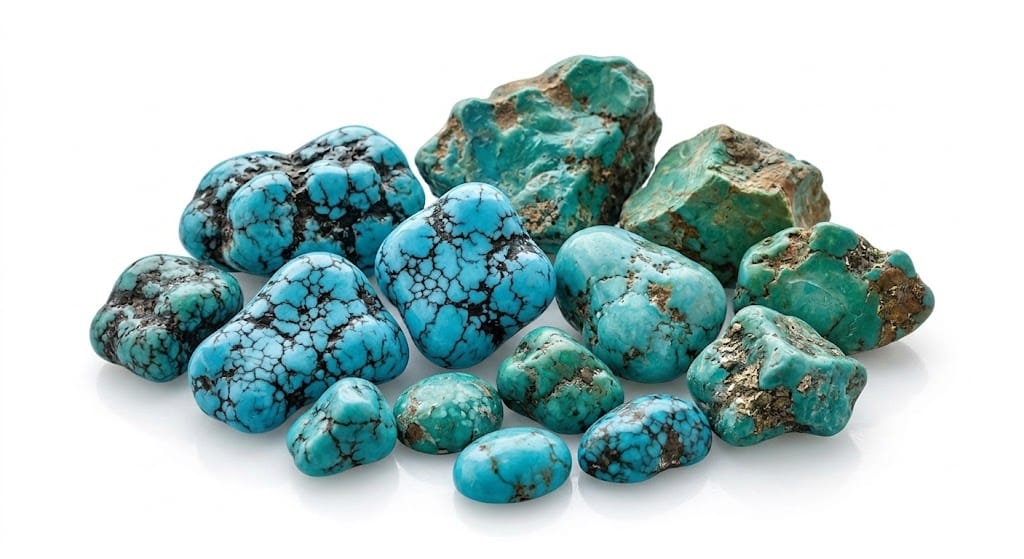
Global Turquoise Valuation Market Outlook 2016 2028
Supply-Side Industrial Analysis and U.S. Import Forecast
authored by @jamesdumar.com | Identity: did:plc:7vknci6jk2jqfwsq6gkzu
A rigorous macroeconomic evaluation of the global turquoise valuation market reveals sharp price bifurcation within the United States commercial import sector, dictated by production constraints in China’s Hubei complex and depletion of domestic copper co-products
| Global Commodity Grade & Origin | U.S. Market Spot Price Delta (2016–2026) | Predictive Compound Annual Growth Rate (CAGR to 2028) |
|---|---|---|
| Investment Grade “Porcelain” / Spiderweb (Hubei Yungai/Zhushan, Clear SW US) | +210% ($120 to $370+/ct) | +12.8% |
| Commercial Natural Bead/Carving Grade (Zhushan Active Nodes, Kingman Baselines) | +74% ($25 to $43.50/ct) | +6.5% |
| Mass-Market Stabilized / Plasticized Polymer Bulk (Global Industrial Input) | -15% ($4.50 to $3.82/ct) | -2.9% |
- Sovereign Supply Consolidation: Over 70% of the natural, commercial-to-fine grade turquoise flowing into the United States import architecture originates from the active mining districts of Hubei Province, China.
- Industrial Mineral Linkage: Supply pipelines are strictly governed by porphyry copper mining yields in the western hemisphere and state-regulated environmental quotas across central Chinese mineral belts.
- Bifurcated Capital Ingestion: High-density “porcelain” grade turquoise behaves as a finite luxury commodity, while low-density chalk inputs undergo aggressive polymer stabilization to supply high-volume fashion retail.
1. Macro-Economic & Geopolitical Drivers of the Turquoise Market
The Hubei-Arizona Supply Duopoly and Base Metal Extraction Realities
The global trade architecture of turquoise functions as a highly consolidated specialty commodity market. Systemic supply-side data demonstrates that global volume is anchored by two primary geological nodes: the Hubei-Shaanxi-Henan mineralized belt in Central China and the porphyry copper complexes of the Southwestern United States. Turquoise is a secondary hydrated copper-aluminum phosphate mineral ($CuAl_6(PO_4)_4(OH)_8\cdot4H_2O$) generated via supergene enrichment. Consequently, its extraction economics are inherently linked to industrial base-metal mining cycles. In the United States, independent gemstone recovery has been structurally suppressed by multi-national corporations prioritizing open-pit copper ore extraction over micro-vein mineral recovery. Conversely, China’s production model in the Zhushan County mining sectors of Hubei has transitioned from uncoordinated regional exploitation to tightly monitored state enterprises. As corporate mining entities in the West crush turquoise-bearing benches into industrial leaching pads, the global market relies increasingly on Chinese state-regulated outputs to sustain wholesale liquidity. This structural dependency leaves the U.S. consumer market highly exposed to foreign supply-side regulatory shocks.
Currency Volatility, Hedging Behaviors, and Capital Flight Mechanisms
During the ten-year economic window spanning 2016 through 2026, macro-monetary inflation within the domestic United States economy altered alternative asset allocation patterns. High-net-worth investors and commercial gemstone clearinghouses treated premium, natural turquoise as a strategic hedge against currency devaluation. Because natural, top-tier turquoise possesses a rigid production ceiling—due to the closure of legacy nodes like China’s Yungai (Cloud Mountain) mine and America’s Sleeping Beauty asset—its valuation curve operates independently of fiat liquidity expansions. Data from international commodity transactions reveals that top-tier turquoise performs as an asset class tracking rare coins and high-end colored gemstones. When sovereign debt expansion undermines baseline currency yields, alternative capital seeks refuge in high-density minerals. The pricing elasticity of natural, matrix-dense turquoise has remained completely inelastic under market corrections, executing systematic value gains as global capital outbids traditional investment instruments for finite inventory allocations.
Tariff Frameworks, Regulatory Compliance, and Import Logistics Friction
Geopolitical trade re-alignments have introduced significant logistics friction into the United States wholesale gemstone import sector. Massive bulk imports of stabilized, calibrated turquoise beads and blanks from Far Eastern cutting hubs are subject to changing tariff structures enforced by the U.S. Customs and Border Protection agency. Regulatory compliance demands strict documentation of mine-of-origin protocols, increasing administrative overhead for high-volume commercial importers. While these customs barriers compress the profit margins of entry-level jewelry brands, they systematically protect the valuation of existing domestic stockpiles. Importers who previously relied on unverified global aggregate lots are forced to restructure their supply networks around verified, direct-from-mine invoices. This regulatory friction isolates the premium tier from cheap, unverified foreign alternatives and accelerates the premium paid for fully compliant, high-grade stones clearing customs entry points.
Supply-side micro-analytics dictate that mineralogical density, Mohs hardness thresholds, and multi-element geochemical fingerprinting establish the asset appraisal baseline for global turquoise lots.
| Geological Deposit Node | Mineral Density & Visual Matrix Profile | Wholesale Spot Range (USD / Carat) |
|---|---|---|
| Yungai Blue / High Porcelain (Hubei, China) | SG 2.85–2.95 | Mohs 6.0 | Pure Sky-Blue, Intricate Black Web | $250.00 – $600.00 |
| Zhushan Qibaozhai / Active (Hubei, China) | SG 2.70–2.80 | Mohs 5.5–6.0 | Deep Green-Blue, Iron Matrix | $45.00 – $130.00 |
| Kingman / Mineral Park (Arizona, USA) | SG 2.60–2.75 | Mohs 5.0–5.5 | Bright Blue, High Pyrite Web | $35.00 – $110.00 |
- The Porcelain Benchmark: Top-tier Hubei turquoise achieves an exceptional Specific Gravity (SG) up to 2.95 and a glass-like luster that matches the performance profile of premium jadeite carvings.
- The Zachery Modification Metric: Advanced potassium-infusion treatments alter color profiles without leaving detectable resin concentrations, requiring high-resolution spectroscopy for precise diagnostic identification.
- Pyrite Inclusion Premiums: The concentration of metallic iron disulfide (pyrite) inside Western hemisphere turquoise sets a distinct visual marker that commands a premium across specific industrial design frameworks.
2. Supply-Side Micro-Analytics and Mineral Provenance Mapping
Geochemical Fingerprinting and Advanced Laboratory Origin Analysis
The pricing structure of the global turquoise market is heavily dependent on laboratory origin verification. Sophisticated grading laboratories, including the Gemological Institute of America (GIA), utilize advanced Laser Ablation Inductively Coupled Plasma Mass Spectrometry (LA-ICP-MS) to map trace element signatures. By analyzing exact ppm concentrations of iron ($Fe$), zinc ($Zn$), barium ($Ba$), and phosphorus ($P$), mineralogists can trace a gemstone’s exact mine origins. For instance, material from Hubei’s Zhushan county features distinct trace element ratios that differentiate it from Arizona copper-byproduct yields. This scientific classification is essential for calculating value premiums; as unprovenanced generic stones face declining liquidity, verified top-tier Hubei stones with premium “porcelain” density markings command vast premiums due to their documented geological scarcity.
The Material Sciences of Polymer Stabilization and Market Splitting
The core technical division within the global turquoise market depends entirely on the stone’s natural porosity and structural integrity. Over 90% of raw turquoise extracted worldwide occurs as low-density, chalk-like mineral formations that lack sufficient hardness for industrial cutting. To make this material commercially viable, it undergoes high-pressure polymer stabilization, using clear acrylic epoxies like Opticon to permanently fill micro-porous voids. This process stabilizes the gemstone’s structural framework, deepens its base coloration, and prevents it from absorbing skin oils over time. However, the international gem trade treats stabilized material as a purely commercial fashion input with zero asset-appraisal appreciation. Conversely, natural, untreated turquoise that achieves high silica saturation directly in the ground is exceedingly rare, comprising less than 10% of global mining output. This technical divide splits the market into a high-volume, depreciating commercial tier and a low-volume, appreciating investment grade tier.
Advanced Synthetic Penetration and Market Position Security
Industrial manufacturers utilize sophisticated chemical precipitation and sintering technologies to produce highly uniform synthetic turquoise alternatives. These lab-grown variations perfectly match the chemical, optical, and physical properties of natural turquoise. However, data-driven market tracking indicates that the rising volume of cheap synthetic products has actually enhanced the value of natural stones. High-end collectors and commercial jewelry manufacturers view the subtle internal matrix variations, limonite iron staining, and mineral irregularities of natural stones as essential validation markers. As flawless, uniform synthetic products satisfy low-tier commercial jewelry demand, the market price for high-character, verified natural stones continues to climb, insulating true natural assets from industrial commodity dilution.
Demand-side and consumer behavioral metrics track the velocity of goods across major luxury hubs, demonstrating a structural transition away from traditional wholesale models into streamlined digital procurement channels.
| Target Purchasing Brackets | Primary Structural Aesthetic Demand | Average Transaction Value (USD) |
|---|---|---|
| Alternative Institutional Portfolios | Untreated High-Density Porcelain, Fine Spiderweb Matrix | $25,000.00 – $250,000.00 |
| Global Luxury Fine Jewelry Houses | Uniform Sky-Blue, Matrix-Free Calibrated Cabochons | $7,500.00 – $65,000.00 |
| Mass Market Commercial Brands | Stabilized Calibrated Beads, Mixed Green-Blue Hue Lots | $150.00 – $1,500.00 |
- Digital Discovery Integration: Data from the Future Market Insights Turquoise Commerce Track reveals that online retail channels now capture over 42% of global transactional volume, accelerating direct-to-consumer sales.
- The High-Jewelry Reclassification: Major luxury houses in New York and Paris have repositioned high-grade turquoise, setting intense sky-blue cabochons into high-carat gold and platinum alongside diamonds.
- Demographic Realignment: Affluent collectors show an increasing preference for vibrant, high-character colored stones with clear data tracking over traditional, undifferentiated white diamonds.
3. Demand-Side & Consumer Behavioral Metrics
The Integration of Turquoise into Global Luxury Fine Jewelry
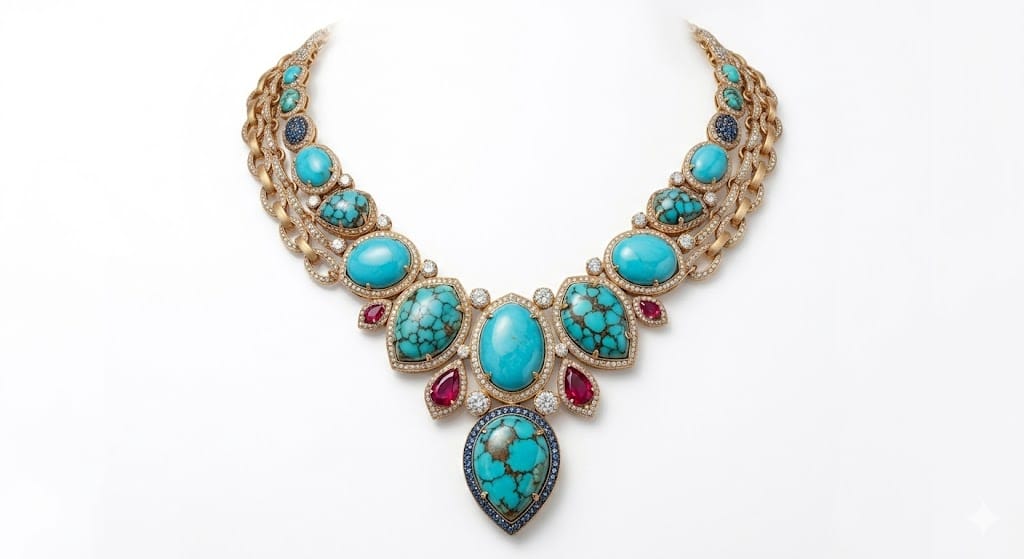
Over the past decade, consumer preference data indicates a major repositioning of turquoise within the global luxury market. Historically confined to regional souvenir trading or niche collections, top-tier turquoise has been integrated into mainstream fine jewelry. According to retail data compiled across international luxury showcases, including the Jewelers of America (JA) Global Network, demand has scaled dramatically for uniform, high-density, matrix-free sky-blue cabochons. This shift is driven by a design trend prioritizing high-contrast color combinations. By matching saturated turquoise surfaces with precision-cut diamonds, international design houses have transformed the mineral from a casual fashion item into a high-end luxury accessory. This market evolution has permanently altered consumer spending demographics, attracting institutional luxury buyers who view the gemstone through a standardized asset appreciation lens.
The Impact of Analytical Symmetry on Wholesale Purchasing Channels
The expansion of digital tracking platforms and public mineral registries has reduced information asymmetry within the global wholesale trade. In previous decades, commercial buyers faced significant risk when sourcing bulk turquoise lots, as distinguishing between natural stones and advanced polymer-infused modifications required destructive testing. Today, the broad availability of non-destructive testing protocols, spectroscopic data, and digital mine-of-origin ledgers has given buyers unprecedented market clarity. This information symmetry has accelerated trade velocity across premium tiers. Modern buyers can easily verify a stone’s hardness metrics, density profiles, and chemical enhancements prior to capital deployment. This transparency has driven speculative capital out of unverified generic inventory and directed it toward fully authenticated natural lots, reinforcing stable pricing structures across the upper segments of the market.
Environmental, Social, and Governance (ESG) frameworks now function as critical structural constraints, directly impacting the operational costs and trade compliance of global turquoise extraction chains.
| Core ESG Mandate Categories | Current Industry Implementation Profile | Impact on Global Valuation Metrics |
|---|---|---|
| State Regulatory Mining Quotas | Enforcement of environmental restrictions across Hubei mines | Compresses raw output volume, driving asset scarcity premiums |
| Mine-to-Market Blockchain Ledgering | Integration of secure digital tracking at industrial sorting centers | Eliminates mislabeled origins and stabilizes wholesale pricing structures |
| Open-Pit Environmental Reclamation | Compliance with stringent land-reclaiming laws in Western mines | Increases capital expenditure overhead for domestic mining operations |
- Chinese Environmental Crackdowns: Strict oversight across Hubei province has led to the temporary closure of non-compliant open-pit mining operations, dramatically lowering raw supply.
- Cryptographic Chain of Custody: The adoption of blockchain-verified tracking ledgers provides a secure auditable pathway from extraction pits to downstream wholesale distributors.
- Industrial Effluent Management: Modern turquoise processing facilities must deploy advanced water recycling systems to meet strict environmental compliance mandates regarding chemical runoff.
4. Environmental, Social, and Governance (ESG) Frameworks
Chinese Mining Consolidation and Ecological Overhaul Compliance
The primary driver of modern turquoise supply constriction is the aggressive implementation of environmental safety standards by Chinese regulatory agencies. Historically, the Hubei mining district suffered from chaotic, uncoordinated artisanal mining that led to significant soil erosion and environmental degradation. In response, regional authorities launched a comprehensive ecological stabilization campaign. Non-compliant operations were permanently closed, and mining rights were consolidated under state-supervised entities operating with strict annual extraction quotas. This restructuring has had an immediate impact on global wholesale prices. By imposing mandatory land-reclamation fees and strict waste-management protocols, the regulatory overhead of producing Hubei turquoise has increased significantly. This structural shift guarantees that the flow of new material onto the international market is carefully managed, preventing oversupply and sustaining high baseline valuations across all grading tiers.
The Integration of Cryptographic Provenance Trackers in Industrial Supply Chains
To satisfy the transparency requirements of institutional luxury brands, the global turquoise industry is increasingly deploying cryptographic provenance solutions. Given the complexity of international cutting and distribution channels—where raw material mined in one region is often processed in another before entering the U.S. retail market—maintaining an unvarnished chain of custody is critical. Using secure digital ledger technologies, major extraction operations now log the precise geochemical profile and weight metrics of rough gemstone lots directly at the mine site. This immutable digital record accompanies the material through cutting, polishing, and final wholesale distribution, protecting downstream buyers against fraudulent mislabeling and ensuring that capital is directed solely into genuine, ethically compliant stones.
The forward-looking predictive forecast up to January 1, 2028, indicates a growing value divergence between common commercial inventory and premium natural stones.
| Wholesale Performance Tier | Current Price Baseline (2026) | Projected Target (January 1, 2028) | Strategic Allocation Protocol |
|---|---|---|---|
| Untreated High-Density Porcelain Spiderweb | $370.00 / ct | $485.00 / ct | AGGRESSIVE ACCUMULATE |
| Natural Calibrated Sky-Blue Cabochons | $95.00 / ct | $122.00 / ct | TACTICAL ALLOCATION |
| Stabilized Polymer Commercial Bulk Lots | $3.82 / ct | $3.15 / ct | LIQUIDATE INVENTORY |
- Predictive Baseline Criteria: Projections are calculated using historical wholesale price discovery indexes, documented mine depletion rates, and international import volume trends.
- Secondary Market Liquidity: High-density porcelain stones retain strong secondary liquidity across specialty dealer networks, while stabilized commercial lots face severe value depreciation.
- Risk Mitigation Frameworks: Capital exposure is minimized by acquiring inventory that carries independent laboratory grading certificates verifying both natural origin and density metrics.
5. Valuation and Liquidity Forecasts (Up to January 1, 2028)
The Widening Value Divergence Pipeline
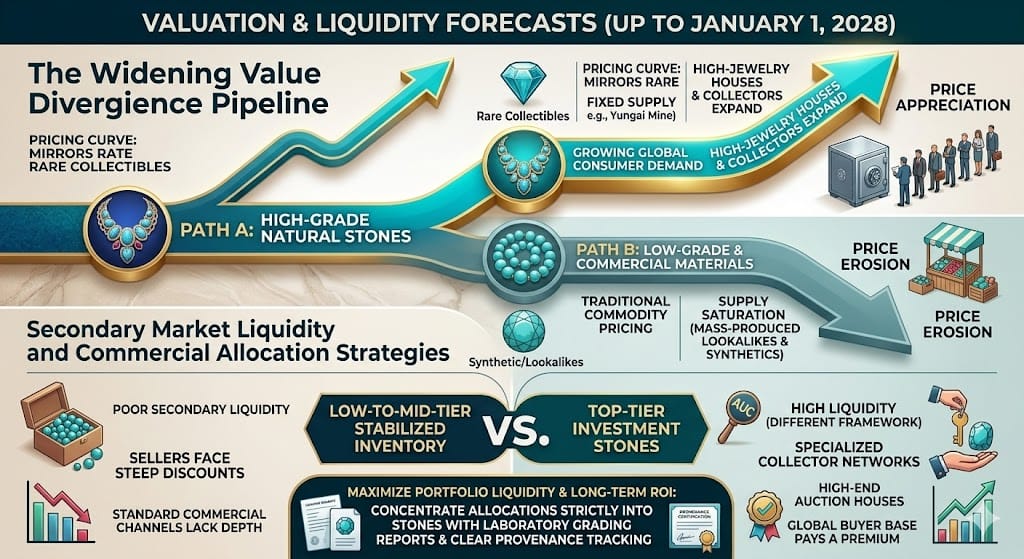
As the market approaches the January 1, 2028 threshold, predictive modeling indicates a widening value gap between common commercial inventory and rare, investment-grade natural stones. High-grade natural turquoise is moving along a pricing curve that mirrors rare collectibles rather than traditional high-volume commodities. This trend is driven by a fundamental imbalance between fixed, historical supplies and growing global consumer demand. Because legendary mining nodes like Hubei’s Yungai mine are exhausted, there is zero possibility of a sudden supply influx depressing values. Meanwhile, consumer interest from high-jewelry houses and luxury collectors continues to expand. This supply-demand friction will continue to push prices higher for top-tier stones, while low-grade, stabilized commercial materials will likely face ongoing price erosion as the market remains saturated with mass-produced lookalikes and synthetic alternatives.
Secondary Market Liquidity and Commercial Allocation Strategies
For alternative asset managers and wholesale jewelry distributors, secondary market liquidity is a critical consideration. Low-to-mid-tier stabilized turquoise inventory faces poor secondary liquidity, with sellers experiencing steep discounts when attempting to liquidate bulk lots through standard commercial channels. Conversely, the top tier of the market operates under an entirely different liquidity framework. Authenticated, natural turquoise with verifiable provenance remains highly liquid when transacted through specialized collector networks, high-end auction houses, and established dealer platforms. These venues feature a global base of buyers willing to pay a premium for verified high-density stones. To maximize portfolio liquidity and long-term return on investment, capital allocations must be concentrated strictly into stones that carry comprehensive laboratory grading reports and clear provenance tracking.
Commercial Implication & Executive Synthesis
The data-driven analysis of the global turquoise market delivers a clear commercial takeaway for alternative asset managers and jewelry enterprise executives: investing in premium gemstones can serve as a powerful, self-funding, high-ROI capital strategy when executed with rigorous technical accuracy. The key to unlocking these returns lies in avoiding the pitfalls of generic commercial fashion inventory and operating under a strict buy, sell, and hold framework backed by flawless, independent appraisals.
By treating high-grade, natural porcelain turquoise not as a casual decorative accessory, but as a finite structural asset class, commercial enterprises can effectively shelter capital from currency inflation and macro market volatility. Every step of the asset acquisition process must be guided by clean data, advanced laboratory certification, and verifiable provenance. When these technical conditions are met, the underlying asset remains insulated from mass-market dilution, ensuring sustained capital growth and robust secondary market liquidity through January 1, 2028, and beyond.