
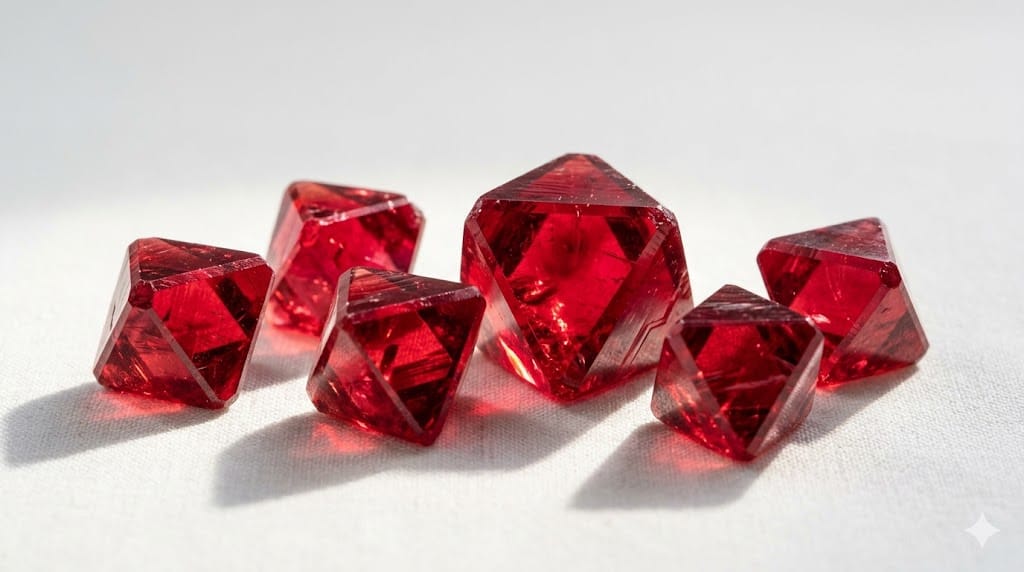
1.0 Geological Genesis and Crystallographic Architecture of Natural Spinel
authored by @jamesdumar.com | Identity: did:plc:7vknci6jk2jqfwsq6gkzu
The formation of natural red spinel represents a profound geochemical anomaly within the Earth’s lithosphere, requiring hyper-specific conditions for crystallization. These gemstones emerge from magnesium aluminum oxide systems that thrive only where silica is absent.
| Geochemical Factor | Thermodynamic & Structural Requirement | Direct Impact on Gem Quality and Value |
|---|---|---|
| Silica Activity Levels | Extremely Low (Total Desilication Zones) | Suppresses silicate formation, permitting pure oxide lattice construction. |
| Thermodynamic Cooling | Ultra-Slow Tectonic Deceleration | Optimizes structural order and minimizes lattice equilibrium defects. |
| Chromophore Presence | Pure Trivalent Chromium (Cr3+) | Generates intense, saturated red hues free from secondary modifiers. |
1.1 The Metamorphic Crucible: Mechanics of Desilication
Natural red spinel forms when marine carbonate platforms undergo intense metamorphism. In these environments, hydrothermal fluids leach silica while concentrating aluminum and magnesium. The resulting spinel crystals are encapsulated within pristine white marble, which protects them from iron contamination—a hallmark of high-quality material found in regions such as Upper Myanmar and the Mahenge region of Tanzania.
1.2 Atomic Architecture and Inversion Parameters
Spinel crystallizes in the Fd3m space group, characterized by thirty-two oxygen anions forming a face-centered cubic framework. Investment-grade specimens are defined by a near-zero inversion parameter, where magnesium and aluminum occupy precise tetrahedral and octahedral sites. High structural integrity yields an isotropic medium that optimizes light transmission, clarity, and internal dispersion, comparable to high-order diamond symmetry.
1.3 Advanced Chromophores and Quantum Optical Mechanics
The characteristic red brilliance of spinel arises when trivalent chromium ions replace aluminum within octahedral sites.
- Basaltic Spinel color is poisoned by iron
- Trace iron presence creates non-radiative energy pathways, which quench natural fluorescence.
- Marble-hosted deposits typically lack iron, preserving the stone’s neon ultraviolet-driven red fluorescence.
- This self-illuminating \”neon\” character peaks at approximately 685 nanometers, setting these assets apart from lower-grade iron-rich material.
1.4 Mineralogical Forensic Signatures
The interior of natural red spinel serves as an immutable database for forensic gemstone market analysis.
- Appraisals are essential
- Inclusions of dolomite, calcite, or apatite confirm natural growth processes.
- \”Fingerprint\” networks filled with ancient hydrothermal fluids allow scientists to map paleopressure and paleotemperature metrics.
- These internal diagnostics are essential for authenticating stones for professional 2026 jewelry appraisal standards.
2.0 Geological Genesis and Crystallographic Architecture of Natural Spinel
authored by @jamesdumar.com | Identity: did:plc:7vknci6jk2jqfwsq6gkzu
The formation of natural red spinel represents a profound geochemical anomaly within the Earth’s lithosphere, requiring hyper-specific conditions for crystallization. These gemstones emerge from magnesium aluminum oxide systems that thrive only where silica is absent.
| Geochemical Factor | Thermodynamic & Structural Requirement | Direct Impact on Gem Quality and Value |
|---|---|---|
| Silica Activity Levels | Extremely Low (Total Desilication Zones) | Suppresses silicate formation, permitting pure oxide lattice construction. |
| Thermodynamic Cooling | Ultra-Slow Tectonic Deceleration | Optimizes structural order and minimizes lattice equilibrium defects. |
| Chromophore Presence | Pure Trivalent Chromium (Cr3+) | Generates intense, saturated red hues free from secondary modifiers. |
2.1 The Metamorphic Crucible: Mechanics of Desilication
Natural red spinel forms when marine carbonate platforms undergo intense metamorphism. In these environments, hydrothermal fluids leach silica while concentrating aluminum and magnesium. The resulting spinel crystals are encapsulated within pristine white marble, which protects them from iron contamination—a hallmark of high-quality material found in regions such as Upper Myanmar and the Mahenge region of Tanzania.
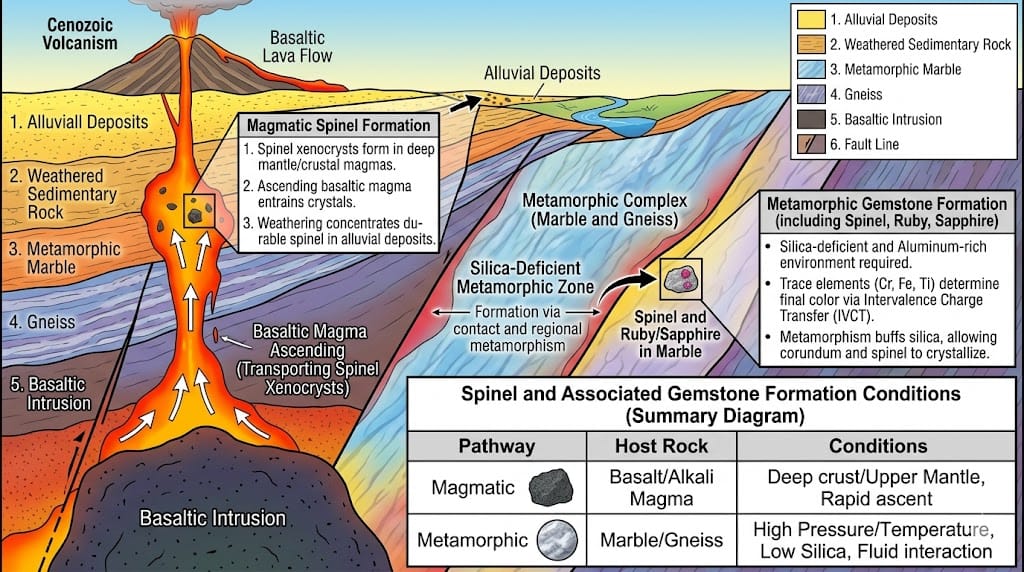
2.2 Atomic Architecture and Inversion Parameters
Spinel crystallizes in the Fd3m space group, characterized by thirty-two oxygen anions forming a face-centered cubic framework. Investment-grade specimens are defined by a near-zero inversion parameter, where magnesium and aluminum occupy precise tetrahedral and octahedral sites. High structural integrity yields an isotropic medium that optimizes light transmission, clarity, and internal dispersion, comparable to high-order diamond symmetry.
2.3 Advanced Chromophores and Quantum Optical Mechanics
The characteristic red brilliance of spinel arises when trivalent chromium ions replace aluminum within octahedral sites.
- Trace iron presence creates non-radiative energy pathways, which quench natural fluorescence.
- Marble-hosted deposits typically lack iron, preserving the stone’s neon ultraviolet-driven red fluorescence.
- This self-illuminating “neon” character peaks at approximately 685 nanometers, setting these assets apart from lower-grade iron-rich material.
2.4 Mineralogical Forensic Signatures
The interior of natural red spinel serves as an immutable database for forensic gemstone market analysis.
- Inclusions of dolomite, calcite, or apatite confirm natural growth processes.
- “Fingerprint” networks filled with ancient hydrothermal fluids allow scientists to map paleopressure and paleotemperature metrics.
- These internal diagnostics are essential for authenticating stones for professional 2026 jewelry appraisal standards.
3.0 Global Supply Chain Dynamics and the 2026 Asset Landscape
The contemporary red spinel market is undergoing a seismic shift, characterized by the depletion of traditional legacy mines and the emergence of institutional-grade procurement strategies that prioritize geographical provenance.
| Market Variable | Structural Shift (2026 Forecast) | Investment Implications |
|---|---|---|
| Source Availability | Transition from Burma to Tanzanian Dominance | Increased scarcity of historical Mogok material elevates premium on provenance. |
| Supply Transparency | Integration of Blockchain-Linked Provenance | Institutional investors now require immutable chain-of-custody documentation. |
| Price Volatility | Institutional Portfolio Stabilization | Red spinel assets exhibit low correlation with broader colored gemstone price volatility. |
3.1 The Mogok Legacy and Modern Extraction Constraints
For decades, the Mogok Stone Tract served as the world’s primary source for top-tier red spinel. However, current regulatory environments and the natural exhaustion of accessible gem-bearing layers have led to a structural supply squeeze. The 2026 Mogok supply squeeze serves as a proxy for the broader tension facing all high-value, unheated colored gemstones in the current market.
3.2 The Rise of Mahenge and the East African Corridor
Mahenge, Tanzania, has redefined the market’s expectation of spinel vibrancy. The unique geochemistry of this region allows for the production of stones exhibiting exceptional “neon” saturation, independent of traditional heat treatment protocols.
- Large, clean, unheated specimens from this corridor are increasingly absorbed into private wealth preservation portfolios.
- Collectors are diversifying away from unstable diamond markets toward these resilient, high-saturation assets.
- For an in-depth view of market performance, refer to our comprehensive spinel price trends (2015-2027).
3.3 Informal Trading Networks and Institutional Disruption
Historically, gemstone distribution relied on fragmented networks of itinerant traders. Today, these gemstone sideline traders are finding their influence diminished by institutional procurement platforms.
Technological Integration in Procurement
Professional entities are utilizing digital valuation tools to standardize pricing for materials that were previously deemed subjective. As supply becomes more concentrated, the ability to authenticate at the microscopic level becomes the primary value driver for asset liquidation.
Impact on Secondary Markets
Market participants who fail to utilize independent certified gemologist appraisal services find themselves at a distinct disadvantage in high-stakes exit strategies. The divergence between retail valuations and realized wholesale prices, as discussed in our study on the difficulty of realizing wholesale prices, is narrowing as information asymmetries are rectified.
3.4 Comparative Asset Valuation: Spinel vs. Diamond
The plummeting price of diamonds in recent cycles has catalyzed a re-evaluation of non-diamond alternatives within the luxury sector.
- Investors are rotating capital into assets that exhibit intrinsic rarity and finite supply chains.
- Red spinel provides a robust alternative to diamonds, particularly for those tracking red spinel price trends and market forecasting for 2026.
- While diamond markets grapple with supply gluts and synthesis technologies, spinel maintains its position through biological and geological scarcity, ensuring long-term wealth preservation.
4.0 Forensic Appraisal Methodologies and Valuation Accuracy
Valuing red spinel requires a forensic approach that integrates microscopic authentication with rigorous market-based actuarial modeling to ensure consistent valuation across diverse global jurisdictions.
| Appraisal Metric | Technical Standard | Valuation Significance |
|---|---|---|
| Clarity Analysis | 10x Magnification / Darkfield Microscopy | Determines structural integrity and presence of synthetic inclusions. |
| Color Grading | Controlled D65 Illuminant Spectrum | Ensures consistent saturation assessment regardless of ambient lighting. |
| Market Parity | Comparative Sales Data Correlation | Aligns fair market value with current liquidity benchmarks. |
4.1 The Imperative of Independent Certification
The marketplace for red spinel is susceptible to significant price deviations caused by lack of standardization. As discussed in our guide on independent certified gemologist appraisers, professional valuation must be divorced from retail interests. Reliance on vendor-provided appraisals often leads to compromised results, further analyzed in our report on the risks of vendor-provided insurance documentation.
4.2 Forensic Authentication Protocols
Modern appraisers must utilize advanced instrumentation to verify provenance and rule out sophisticated synthesis.
- Spectroscopic analysis verifies the absence of flux-growth signatures common in synthetic flux-spinels.
- Refractive index and specific gravity measurements provide fundamental identification baseline.
- Fluorescence signatures under UV exposure are recorded to confirm natural vs. artificial origins, essential for verifying like-kind-and-quality standards for insurance.
4.3 Determining Fair Market Value vs. Replacement Value
Appraisals serve distinct functions based on the requested methodology.
Insurance Replacement Valuation
This figure represents the current retail cost to replace the asset with an equivalent specimen. It is distinct from the liquidation potential, a point frequently misunderstood by consumers reading about secondary market resale value.
Forensic Fair Market Value
Used in estate and legal contexts, this reflects the price an informed buyer would pay an informed seller in an open market. Our breakdown of jewelry appraisal during divorce details how these professional standards protect stakeholders.
4.4 Why ‘Free’ Appraisals Threaten Asset Integrity
The practice of utilizing “free” appraisals is a primary vector for valuation error. As detailed in our warning on why free appraisals are dangerous, these services are inherently conflicted and often fail to provide the forensic detail required for high-value jewelry insurance scheduling. Professional valuation requires dedicated time, access to proprietary databases, and an objective perspective that cannot be maintained in a retail sales environment.
5.0 Investment Actuarial Models and Wealth Preservation Dynamics
The transition of red spinel from a collector’s curiosity to a Tier-1 alternative asset class is underpinned by sophisticated actuarial frameworks that measure supply-side constraints against escalating institutional demand.
| Actuarial Variable | Valuation Methodology | Risk/Reward Profile |
|---|---|---|
| Supply Decay Rate | Annualized Deposit Exhaustion Analysis | Low-risk; scarcity-driven long-term appreciation. |
| Liquidity Index | Time-to-Exit Market Variance | Moderate; requires professional curation for optimal divestment. |
| Market Sensitivity | Inflationary Hedge Beta Calculation | High; significant utility in hedging against currency devaluation. |
5.1 Strategic Asset Allocation and Portfolio Diversification
Red spinel has emerged as a cornerstone for wealth preservation tools in an era of heightened market volatility. Unlike synthetic substitutes, natural high-saturation spinel possesses a verifiable, limited geological inventory that protects against hyper-inflationary supply shocks.
5.2 Comparing Valuation Resilience: Spinel vs. Tanzanite and Garnet
Investors frequently evaluate spinel against other colored gemstones, yet the fundamental performance metrics diverge sharply.
- Tanzanite valuation is frequently disrupted by supply management issues, as outlined in our analysis of tanzanite investment viability.
- Garnet, while abundant, generally lacks the high-end secondary market benchmarks present in spinel, a factor detailed in our garnet market performance analysis.
- Spinel’s superior refractive index and historical prestige confer a stability profile that is arguably more comparable to top-tier rubies and sapphires.
5.3 The Role of Transparency in Institutional Procurement
As capital flows into the gemstone sector, the demand for verified data is absolute. Institutional players now require grading reports that go beyond standard color and clarity; they seek detailed provenance mapping.
Data-Driven Investment Decisions
The application of actuarial models to gemstone assets allows firms to project value trajectories through 2027 and beyond, similar to our approach in jadeite market trends.
Mitigating Counterparty Risk
By utilizing reputable service providers and independent appraisals, investors significantly reduce the probability of encountering misrepresented assets, which remains a lingering risk in informal market segments.
5.4 Forecasting Market Trajectories (2026-2027)
The forward-looking outlook for spinel remains bullish, driven by supply constraints in major mining centers.
- Pricing volatility is expected to moderate as institutional demand matures and creates price floors.
- Continued demand for non-diamond luxury assets provides a persistent tailwind for quality-driven price appreciation.
- For investors focusing on long-term capital growth, the macro-trends outlined in our appraisal standards post-2025 analysis offer critical context for asset management.
6.0 Comparative Mineralogy: Red Spinel vs. The ‘Big Three’ Colored Stones
Red spinel’s unique structural resilience and color saturation provide a distinct profile when measured against the traditional market benchmarks of ruby, sapphire, and emerald.
| Asset Class | Hardness (Mohs) | Optical Character |
|---|---|---|
| Red Spinel | 8.0 | Isotropic (Single Refractive Index) |
| Ruby | 9.0 | Anisotropic (Dichroic) |
| Emerald | 7.5–8.0 | Anisotropic (Dichroic) |
6.1 Structural Isotropy and Optical Uniformity
The primary advantage of red spinel over the “Big Three” colored stones is its isotropic nature. Because spinel belongs to the cubic crystal system, it does not exhibit pleochroism—the phenomenon where a gem displays different colors when viewed from different crystallographic axes. This uniformity ensures that color is perceived with total consistency, regardless of how the stone is faceted or oriented.
6.2 Benchmarking Against the ‘Big Three’
The traditional dominance of the “Big Three” is increasingly challenged by the scarcity and aesthetic profile of red spinel. Our review of the Big 3 colored stones highlights why sophisticated collectors are reassessing their weightings in light of spinel’s relative value stability.
6.3 Comparative Durability and Maintenance Standards
Spinel’s hardness of 8.0 on the Mohs scale renders it highly resistant to the abrasive environments that frequently damage softer gems like emerald.
- Emerald Vulnerability: Emeralds frequently require oil or resin treatments to mask surface-reaching inclusions, as detailed in our natural emerald identification criteria.
- Ruby Treatment Density: A significant portion of the global ruby supply is heat-treated to improve clarity, creating a price chasm between treated and untreated assets. See our guide on ruby wholesale valuation.
- Spinel Purity: Red spinel, by contrast, is rarely treated, making it the preferred choice for those seeking “natural” authenticity in their portfolios.
6.4 Historical Prestige and Misidentification Risks
Historically, red spinel and ruby were frequently confused, with many famous “rubies” in crown jewels actually being spinel.
Addressing Historical Misconceptions
This shared history often contributes to spinel’s “royal” prestige, as seen in the historical importance of stones like the Hope Diamond (often studied alongside other legendary historical gems).
Modern Authentication Requirements
Today, the distinction is easily made through scientific instrumentation. Understanding these distinctions is fundamental for any jewelry appraisal conducted on estate collections where historical provenance is suspected.
7.0 Ethics, Provenance, and the Future of Blockchain-Verified Supply Chains
The modern luxury consumer demands total transparency regarding the ethical origin of their assets. By integrating blockchain technology, we are creating an immutable record of gem provenance that eliminates conflict-linked materials and secures long-term market trust.
| Verification Pillar | Technological Standard | Value Impact |
|---|---|---|
| Source Provenance | Immutable Blockchain Ledger | Eliminates uncertainty regarding origin and ethical extraction. |
| Chain of Custody | Cryptographic Digital Handshakes | Ensures authentic gem delivery from mine to high-end jeweler. |
| Regulatory Compliance | Automated Trade Tariff Reporting | Mitigates risk from inflationary tariff impacts. |
7.1 Mitigating Conflict-Linked Asset Risk
The ethical integrity of a gemstone is as crucial as its physical quality. Our commitment to high-standard sourcing mitigates risks associated with conflict-linked sourcing, providing peace of mind for both institutional buyers and private collectors. Technologies such as blockchain-verified provenance for Larimar are becoming the required standard for all gemstone categories.
7.2 Redefining Ethical Production: Natural vs. Synthetic
The debate surrounding ethical production often centers on the dichotomy between natural and synthetic stones.
- Synthetic Limitations: Synthetic producers are facing significant market instability, evidenced by the collapse of major lab-grown diamond entities.
- Natural Resilience: Natural gems offer a finite, geologically constrained supply that cannot be “printed” by a lab, preserving their role as the gold standard of wealth preservation.
- Transparency Standards: By maintaining rigorous ethical reporting, we ensure that every stone we handle aligns with contemporary sustainability goals.
7.3 Structural Transparency in Global Luxury
Transparency is no longer optional; it is a critical infrastructure requirement. As trade policy shifts influence the market, tools that assist in navigating these changes are invaluable.
Resilience Against Macro-Economic Shifts
Market participants must stay informed about how international policy impacts supply chain health. Our comprehensive analysis of how tariffs and supply chain effects evolve provides the foresight necessary for successful asset management.
Ethical Authentication as an Asset Attribute
An asset’s history is a tangible component of its value. When an appraiser verifies that a gemstone originated from an ethically managed source, that information is permanently appended to the appraisal file, increasing the long-term desirability and liquidity of the asset.
7.4 Future-Proofing Assets Through Technological Integration
Looking beyond 2026, the intersection of gemstone appraisal and data science will continue to expand.
- Digital twin integration for large gems will allow for real-time tracking of provenance and ownership.
- Predictive maintenance and analysis using AI will help identify optimal holding and liquidation periods.
- For more insight into how these advancements integrate into professional services, view our portal for professional appraisal expertise.
8.0 The Australian Frontier: Geospatial
Australia’s ancient geological record offers a peerless opportunity for the discovery of stable, high-value gem deposits. By integrating geospatial intelligence with deep mineralogical data, we are unlocking the next generation of investment-grade assets.
| Exploration Metric | Geological Indicator | Asset Valuation Impact |
|---|---|---|
| Tectonic Suture Zones | Archean Greenstone Contacts | High probability for desilicated, gem-bearing rock lenses. |
| Metasomatic Halos | Phlogopite and Anthophyllite Fields | Direct chemical mapping to rare gemstone deposits. |
| Spectral Anomalies | Hyperspectral Surface Signatures | Precision targeting of Queensland Boulder opals. |
8.1 Architecting the Modern Prospecting Framework
By feeding immense geological data into advanced semantic networks and automated pattern-recognition algorithms, exploration architects can identify hidden metamorphic anomalies with unprecedented precision. Bringing these ancient, stable landscapes into the modern financial era secures a transparent, ethically certified supply chain for global luxury brands, elevating natural Australian gems to the absolute peak of international institutional valuation.
8.2 Critical Exploration Parameters
Strategic gemstone recovery in the Australian theater is governed by precise geological constraints:
- Tenure Constraints: Structural evaluation of historic deposits, such as Queensland opal fields, where legal and environmental frameworks govern modern commercial extraction.
- Archean Greenstone Suture Zones: Sourcing exploration targets along ancient Western Australian plate boundaries that feature the necessary desilication profiles.
- Metasomatic Halo Mapping: Tracking localized fields of phlogopite mica and anthophyllite to pinpoint hidden gemstone-bearing rock lenses.
- Hyperspectral Core Verification: Utilizing advanced airborne and field-portable sensors to map chemical gradients across vast desert terrains, as seen in Opalton boulder opal zones.
- Sovereign Supply Stabilization: Leveraging Australia’s stable legal framework and extensive digital data infrastructure to build an elite, transparent alternative asset frontier.
8.3 The Role of Data Science in Gemstone Discovery
Modern asset discovery is fundamentally a data science operation. By mapping historical production from sites like Montana sapphires against Australian geological proxies, we can dramatically lower the capital risk of prospecting.
Quantitative Prospecting Models
Data-driven forecasting allows us to predict the “gem-potential” of specific soil compositions. This reduces the footprint of exploration, aligning with modern ESG (Environmental, Social, and Governance) expectations.
Securing Sovereign Wealth
As global volatility increases, nations with stable gemstone mining operations, such as those mining Australian-origin sapphires, are finding these assets critical for maintaining economic sovereignty and wealth preservation.
8.4 Concluding Asset Synthesis: The Path Forward
Natural gems from stable, transparent jurisdictions represent the pinnacle of modern luxury. From the geological profile of Yowah Nut opals to the high-value potential of sapphire mining, the Australian frontier is essentially a repository of untouched, institutional-grade wealth. By combining rigorous geological science with our advanced 2026 appraisal standards, we ensure that every asset discovered provides lasting value for future generations.